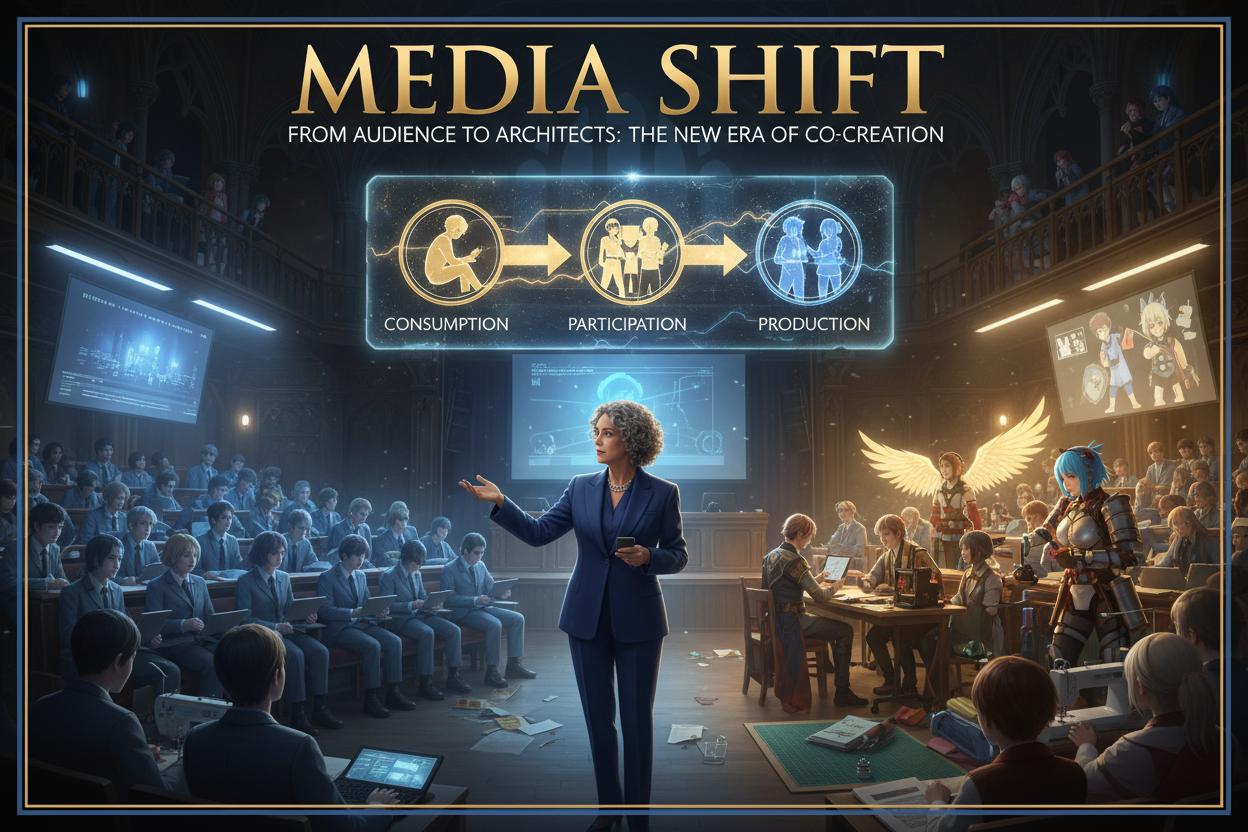
💡 Editorial Note: For decades, media theorists treated media consumption as a linear, top-down hierarchy. Audiences sat at the bottom of the pyramid as passive consumers, while centralized studio monopolies dictated narrative realities. Even early subcultural scholarship routinely reduced fan costuming to a derivative form of romanticized escapism or hyper-commercial fandom. In 2026, that passive paradigm has been completely dismantled. Driven by the evolution of Participatory Culture within global Media Studies, academic institutions have executed a structural reclassification. Cosplay has officially outgrown its definition as mere consumer fandom, transitioning into a recognized engine of Co-Creation. By transforming the passive act of consumption into active participation, and finally into high-fidelity material production, modern creators are operating as equal co-authors of global media properties.
1. The Theoretical Inversion: Consumption to Production
The classic communication model that separated the media producer from the media audience has formally collapsed. In 2026, contemporary media studies departments utilize Henry Jenkins’ foundational frameworks of Participatory Culture to analyze how fan text-shifting has evolved into a physical, highly industrialized craft.
[ Legacy Media Consumption Model ]
Studio Production ──> Broadcast Delivery ──> Passive Consumer Reception (Linear Path)

[ 2026 Participatory Co-Creation Loop ]
Original Studio Media Drop (Anime, K-Pop, Gaming IP)
       │
       ▼
Creative Reception & Critical Deconstruction
       │
       ▼
High-Agency Physical Production (Textile Engineering, 3D Asset Fabrication)
       │
       ▼
Distributed Cultural Output ──> Algorithm Interception ──> Co-Authoring the Living IP
Academics map this evolution across three distinct structural shifts:
-
The Consumption Phase: The subject acts as a traditional audience member, decoding the semiotic signs of an anime broadcast, a music video, or a cinematic masterpiece.
-
The Participation Phase: The subject joins decentralized digital networks, analyzing character design mechanics, discussing textile viability, and trading open-source pattern modifications across global subcultural platforms.
-
The Production Phase: The subject crosses the threshold into active authorship. By deploying complex engineering disciplines—such as multi-material composite fabrications and programmatic electronics—they manufacture real-world physical extensions of the virtual asset, forcing the industry to view them as active cultural producers.
2. The Co-Creation Dynamic: Re-Authoring the Media Franchise
When media studies analyze this transformation, they look directly at how fan-produced material assets retroactively reshape the official commercial trajectory of global intellectual properties.
⚙️ Textual Poaching and Material Actualization
Borrowing from modern cultural sociology, researchers study how creators engage in "textual poaching." They do not accept a corporate media product exactly as it is delivered. Instead, they strip away narrative layers, isolating specific aesthetic vectors to recreate, modify, and improve them in physical spaces. This act of physical actualization forces a 2D animated sketch or a highly stylized digital idol to conform to the real-world physics of textile weight, human ergonomics, and specular reflectivity, turning the creator into an active design collaborator.
⚙️ The Convergence of the Fandom Lifecycle
In 2026, the boundaries between professional media marketing and grassroots subcultural production have blurred entirely. Major animation houses and global talent agencies no longer control their brands in isolation. They actively rely on the high-fidelity output of independent fabricators to maintain their properties' cultural relevance between major broadcast seasons, transforming the traditional fan ecosystem into a multi-tiered system of decentralized co-creation.
📋 3. Case Studies: Deconstructing the 2026 Participatory Hubs
To examine how these abstract media theories operate across diverse global entertainment sectors, we reverse-engineer four prominent character models that define the current landscape of participatory media production.
1. Asuka Langley Soryu (Neon Genesis Evangelion) — The Deconstruction of the 02 Plugsuit
🧬 The Participatory Media Context
Within modern media scholarship, Asuka’s iconic 02 Plugsuit serves as a primary case study for analyzing transgenerational media durability through participatory modification. For three decades, her character architecture has migrated across classical cel animation, digital cinematic reboots, and high-fidelity video game collaborations.
🔧 The Production Blueprint
The construction of a modern 02 Plugsuit represents a highly advanced study in ergonomic high-polymer manipulation. Rather than relying on simple fabric choices, 2026 creators utilize a complex mix of four-way stretch high-gloss polyurethane vinyl panels and custom-molded EVA foam armor cores.
To achieve the precise, form-fitting geometric paneling required by Studio Khara’s visual identity, creators deploy advanced digital pattern drafting software, running multi-stage testing to align the seam matrices flawlessly with the human body's natural movement vectors. By translating a flat, impossible animated drawing into a high-specular, physically functional leather and polymer bodysuit, the creator co-authors the tangible reality of the franchise, ensuring the IP maintains a dominant visual presence on modern algorithmic feeds.
2. Shinobu Kocho (Demon Slayer: Kimetsu no Yaiba) — The Transition from 2D Assets to Textile Realism
🧬 The Participatory Media Context
Shinobu Kocho represents a masterclass in the physical localization of traditional-fantasy animation. Her character design bridges historical Japanese garment silhouettes with stylized, insect-inspired visual geometry, acting as an elite canvas for cross-border textile research.
🔧 The Production Blueprint
Shinobu’s signature butterfly-wing haori presents a severe engineering challenge that forces creators to move far past basic consumer assembly. The visual power of the garment relies on its absolute fluid motion and complex color gradient transitions.
Global creators achieve this by abandoning cheap mass-market printing in favor of custom sublimation fabric printing or traditional hand-painting on heavy silk georgette. The edges of the fabric are structurally reinforced with ultra-lightweight memory wire or custom horsehair braid roll-hems, ensuring that when the performer moves, the textile catches ambient air currents to replicate the exact fluid motion lines rendered by Ufotable's animation software. This transformation turns a flat animation frame into a high-fidelity piece of living textile art, redefining the technical boundaries of the original media property.
3. K-Pop Virtual Concept Idols — The Materialization of Synthetic Music Archetypes
🧬 The Participatory Media Context
Analyzed heavily by Global Music Media and Transmedia Studies tracks, the modern K-Pop concept idol (exemplified by high-concept, tech-infused virtual styling models) represents the materialization of hyper-mediated pop icons. These idols exist simultaneously as musical performers, digital avatars, and high-end fashion editorial statements.
🔧 The Production Blueprint
K-Pop concept garments demand a deep understanding of modern high-contrast luxury fashion semiotics. Creators must expertly merge asymmetrical streetwear tailoring with high-gloss reflective materials, multi-layered utility harness rigs, and integrated micro-electronics (such as customized LED strip accents reactive to audio frequencies).
The production process mimics the operations of elite haute couture fashion design houses—incorporating manual heavy-denim distressing, custom metal hardware casting, and precise material layering. When independent creators build these complex outfits to execute synchronized performance choreography on short-form video networks, they are not simply acting as music fans; they are operating as decentralized visual distribution hubs that elevate the digital idol into a palpable, real-world cultural phenomenon.
4. Sailor Moon (Sailor Moon Cosmos) — The Architectural Engineering of Classical Magical Silhouettes
🧬 The Participatory Media Context
Brought into research panels focusing on feminist media history and visual culture education, Sailor Moon represents the foundational cornerstone of magical-girl silhouette engineering. In the 2026 landscape, her classic look is continually re-interpreted through a modern, high-fashion lens.
🔧 The Production Blueprint
The deceptive simplicity of the classic sailor scout uniform requires immense structural engineering to translate successfully into physical reality. Creators must build absolute geometric symmetry: shaping the massive, perfectly circular back bows using internal high-density buckram or rigid PETG reinforcement plates to prevent sagging under intense convention floor lighting.
The iconic structured sailor collar and knife-pleated skirt demand rigorous heat-setting textile treatments to ensure the lines remain permanently crisp during movement. By replacing soft, unstructured costume fabrics with high-density, tailored architectures, the creator elevates a nostalgic media icon into a striking statement of contemporary structural fashion, demonstrating how grassroots participation systematically preserves and upgrades historical media legacies.
📊 4. Core Behavioral Matrix: Participatory Production Metrics
To map out how these diverse media properties are processed by creators within the modern participatory ecosystem, the following matrix connects each character node to its specific technical discipline, cultural transformation path, and network impact.
| Target Character Node | Original Media Origin | Primary Technical Material Discipline | Core Subcultural Action | Legacy Consumption Value | Modern Production Asset Realized | Global Network Distribution Vehicle |
| Asuka Asuka | Neon Genesis Evangelion | High-polymer 4-way stretch PU vinyl & molded EVA foam | Translating 2D sci-fi mecha aesthetics into high-specular ergonomic bodysuits | Passive viewership of television/film animation | High-fidelity materialization of structural anime technology | Short-form video platforms & high-resolution 3D asset loops |
| Shinobu Kocho | Demon Slayer (Kimetsu no Yaiba) | Customized sublimation silk printing & kinetic wire reinforcement | Engineering traditional historical textiles to match stylized animation flow | Consuming episodic studio broadcast streams | Living textile art that actualizes cartoon fluid dynamics | Global convention stages & high-macro photography feeds |
| K-Pop Concept Idol | Global Music Industry | Asymmetrical streetwear worsteds, utility rigging, & reactive LEDs | Merging haute couture tailoring lines with interactive, wearable electronics | Streaming audio tracks & viewing commercial music videos | Decentralized physical branding of synthetic digital performers | Viral dance trend choreography & social discovery recommendation streams |
| Sailor Moon | Sailor Moon Cosmos | High-density buckram stiffeners, resin casting, & permanent pleat setting | Formulating rigid geometric symmetries out of soft, flexible fabrics | Reading traditional manga & viewing classic media releases | Structural fashion design that archives historical pop-culture icons | Editorial style lookbooks & global pop-culture research panels |
5. The Structural Battleground: Corporate Capture vs. Participatory Autonomy
The systematic reclassification of cosplay into a high-agency co-creation engine has triggered an intense dialogue between contemporary media theorists and grassroots subcultural advocates.
┌─────────────────────────────────────────────────────────────────────────────────────────┐
| r/media_studies • Posted by u/Theory_Vanguard_2026 • 1 day ago                           |
| 🧠 The Co-Creation Illusion: Free Labor or Authentic Participatory Agency?              |
|                                                                                         |
| As academia rushes to celebrate cosplay as the ultimate form of "co-creation" in        |
| participatory culture, we need to ask a deeply uncomfortable question about political  |
| economy.                                                                                |
|                                                                                         |
| When a creator spends hundreds of dollars on materials and weeks of intense physical     |
| labor to build a flawless Shinobu haori or an Asuka plugsuit, who ultimately profits?   |
|                                                                                         |
| The studio gets free, hyper-viral marketing that keeps their IP alive on social media  |
| algorithms, while the creator absorbs all the financial and structural risks. Are we   |
| witnessing a triumph of fan agency, or the ultimate corporate capture of free labor?     |
|                                                                                         |
| 💬 1.9k Comments  |  Share  |  Save  |  Hide                                           |
+-----------------------------------------------------------------------------------------+
📉 The Exploitation Critique: The Outsourcing of Promotional Labor
Critical media economists argue that framing cosplay as "co-creation" obscures a sophisticated system of corporate exploitation. In this view, media conglomerates deliberately design visually striking characters to bait subcultures into performing unpaid marketing labor. When a creator manufactures a complex costume, documents the build-log online, and populates social media pipelines with high-engagement content, they are effectively absorbing the research, development, and advertising costs that multi-billion-dollar studios used to pay for internal promotional campaigns. Fandom, under this critique, has been successfully industrialized into an unpaid extension of corporate marketing machinery.
📉 The Empowerment Defense: The Reclamation of Cultural Ownership
Conversely, progressive participatory culture scholars argue that reducing this complex relationship to "free labor" completely ignores the genuine agency, social capital, and cultural authority wielded by modern creators. Within this framework, building a high-fidelity physical costume is an act of profound cultural reclamation. Creators are not passive tools of a studio; they are high-agency artists who use the shared language of global intellectual properties to build independent personal brands, command massive digital audiences, and capture real economic value through their own monetization networks. By mastering complex engineering and design disciplines, the community breaks down the historic monopoly of corporate media production, forcing studios to respect them as true co-owners of the living intellectual property.
6. ❓ Frequently Asked Questions (FAQ)
Q: How does the concept of "Participatory Culture" differ from traditional fandom?
A: Traditional fandom typically centers around the shared consumption and emotional adoration of a media text—such as organizing viewing clubs or collecting official commercial merchandise. Participatory Culture, however, requires an active leap from consumption to production. It demands low barriers to artistic expression, strong community support for creating original physical or digital assets, and a shared understanding that fan-produced creations carry a legitimate, independent voice that directly influences the broader media ecosystem.
Q: In what ways do global entertainment studios officially acknowledge this co-creation model?
A: In 2026, leading entertainment studios no longer issue aggressive cease-and-desist orders against high-fidelity fan fabrications. Instead, they actively integrate the community into their official transmedia launch strategies. Studios regularly release detailed digital design toolkits and character fabrication assets on the exact day of an anime or game announcement, intentionally providing the subculture with the technical blueprints needed to launch decentralized, real-world co-creation campaigns that synchronize perfectly with corporate media rollouts.
🎯 Conclusion: The Realignment of the Media Universe
The formal integration of costume play into the theoretical frameworks of participatory culture marks a permanent shift in how modern society defines artistic authorship and media production. The subculture has successfully shattered its historical classification as a passive consumer hobby, claiming its position as a high-agency, co-creative force within global entertainment networks.
By analyzing these complex construction methodologies through the lens of modern media studies, contemporary institutions are validating a profound truth about the digital age: the definitive reality of an intellectual property is no longer authored solely by the studio that holds the legal copyright; it is continuously co-shaped, engineered, and brought to life by the global community of creators in the physical world.
Whether engineered to withstand the rigorous performance demands of an Asuka Langley Soryu plugsuit, meticulously tailored to archive the fluid traditional dynamics of Shinobu Kocho, meticulously constructed to materialize the hyper-mediated aesthetics of modern K-Pop Idols, or structurally reinforced to lock down the iconic geometric balance of Sailor Moon—the master craftspeople of the global community are demonstrating that the future of media belongs to those who build it.

Leave a comment
This site is protected by hCaptcha and the hCaptcha Privacy Policy and Terms of Service apply.