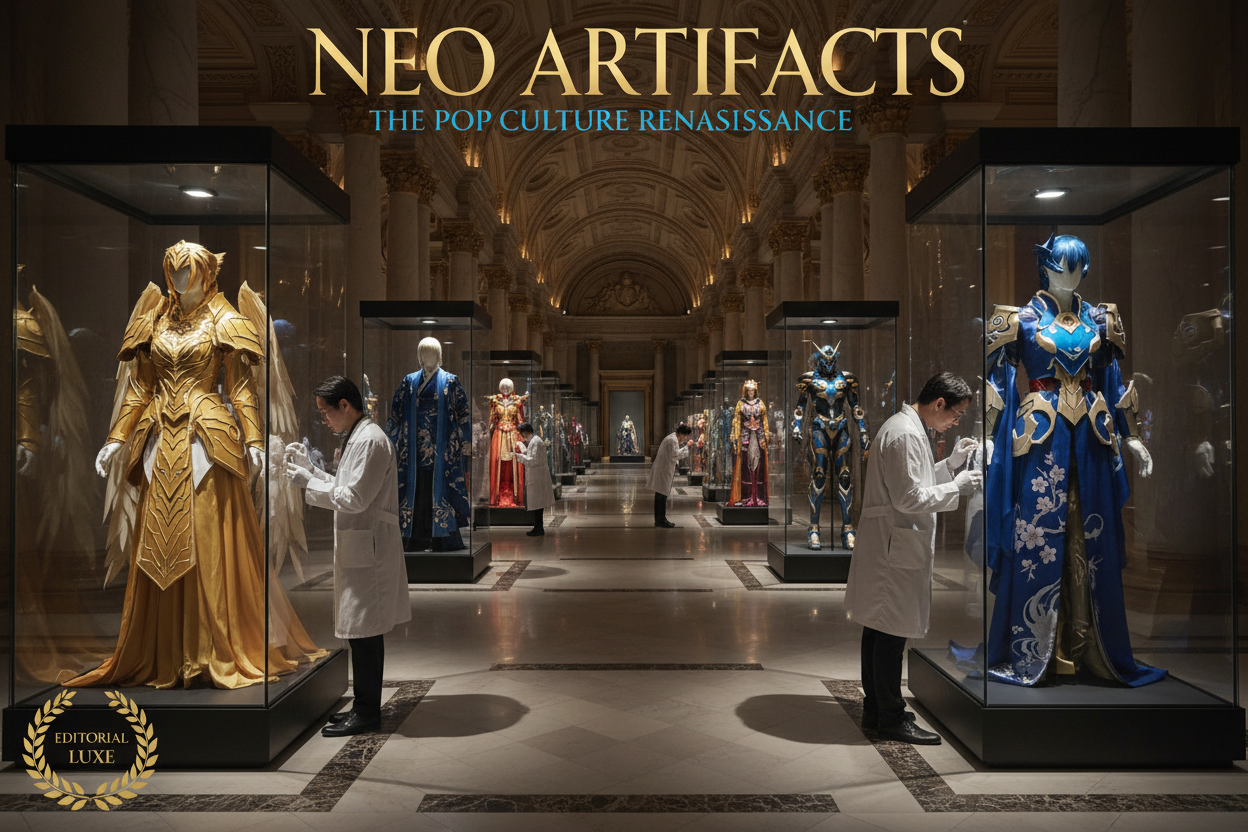
💡 Editorial Note: For decades, the preservation of material textiles within elite museums was strictly reserved for historical artifacts—centuries-old royal garments, classical theatrical costuming, or haute couture from foundational design houses. Grassroots pop-culture costuming was viewed as inherently ephemeral, commercial, and unworthy of structural archiving. In 2026, that institutional gatekeeping has collapsed. Driven by pioneering developments in Museum Studies and Cultural Heritage Management, world-class institutions are executing a massive paradigm shift. Cosplay is officially breaking out of transient convention floors and being acquired, archived, and curated within permanent museum collections. By treating these fan-fabricated garments as vital artifacts of Contemporary Cultural Heritage, curators are rewriting the rules of material preservation for the digital age.
1. The Institutional Shift: From Ephemeral Hobby to Living Heritage
The traditional boundary line separating historical elite craftsmanship from modern participatory fan production has officially eroded. Historically, museums only acknowledged pop culture through commercial, studio-backed props or mass-produced memorabilia. The idea of dedicating climate-controlled archival space to a non-professional fan-made garment was entirely outside institutional frameworks.
In 2026, this dynamic has inverted due to three major structural developments in cultural heritage curation:
[ Traditional Curation Framework ]
Cosplay = Ephemeral Commercial Fan-Wear ──> Excluded from Institutional Archives

[ Modern 2026 Heritage Framework ]
Cosplay = Contemporary Cultural Heritage ──> Climate-Controlled Acquisition & Museum Exhibition
-
The Shift to Living Heritage: Heritage scholars now define cosplay through the lens of Intangible and Tangible Cultural Heritage. The physical costume is no longer analyzed in isolation; it is curated as a physical material record of an intricate, global community ritual.
-
Material Innovation Archiving: Museums of design and technology have realized that the specialized engineering techniques pioneered by modern fabricators—such as blending historical tailoring with 3D-printed filaments and complex wearable micro-electronics—represent a highly innovative chapter in modern textile history.
-
Active Acquisition Budgets: Major national galleries and cultural heritage funds have established dedicated acquisition pipelines specifically aimed at purchasing award-winning, master-crafted costumes directly from independent creators to preserve them for future generations.
2. The Archival Matrix: Curatorial Standards for Pop-Culture Artifacts
When a museum reclassifies a cosplay costume from a piece of fan-wear into a permanent heritage artifact, it introduces severe curatorial and logistical challenges that traditional textile archiving was never built to handle.
⚙️ Multi-Material Conservation Engineering
Traditional garment conservation deals with predictable, singular organic fibers—such as silk, wool, or linen. A single modern cosplay artifact, however, regularly fuses highly unstable and diverse materials into a single object. Curators must develop specialized conservation rubrics to prevent volatile synthetic elements (like low-grade plastics, chemical spray paints, and faux leathers) from off-gassing and destroying adjacent delicate fabrics inside airtight display cases.
⚙️ Contextual Digital Provenance
A costume stripped of its performance is merely a hollow shell. Therefore, modern institutions utilize an advanced Dual-Archiving Method. Alongside the physical costume on its custom-molded mannequin, museums display high-fidelity digital arrays showcasing the garment's provenance in motion. This includes archiving the creator's digital fabrication build-logs, social media network metrics, short-form video performance reels, and real-time community engagement logs—ensuring the artifact's profound subcultural impact is fully preserved alongside its physical stitches.
📋 3. Case Studies: Deep-Deconstructing the 2026 Museum Acquisitions
To evaluate how these strict institutional conservation and curation methodologies operate in real-world environments, we analyze four prominent character models from major gaming universes that have crossed over into permanent museum collections.
1. Mavuika (Genshin Impact) — Heavy Leather and Luminescent Optical Engineering
🧬 The Curatorial Context
Acquired by national design and tech museums, Mavuika represents the ultimate integration of wearable technology and high-gloss heavy industrial textiles. It serves as a historical record of how modern digital designs challenge traditional fantasy apparel by introducing a gritty, high-octane biker aesthetic into mythical storytelling.
🔧 Institutional Archiving Challenges
-
Textile Preservation: The costume relies on heat-formable synthetic microfiber eco-leather. Because polyurethane compounds are highly susceptible to dry-rotting and chemical cracking under high-intensity exhibition lights, museum conservators treat the surface with microcrystalline protective waxes to lock in plasticizers and maintain its supple texture.
-
Electronic Conservation: Her signature flaming gradient hair is constructed via thermoformed PETG sheets embedded with flexible high-density COB LED strips. To ensure the glowing asset remains continuously operational for multi-year exhibitions without fire hazards, museum tech teams re-engineer the internal circuitry to run on low-voltage museum-grid power rather than volatile lithium-ion batteries.
2. Camellya (Wuthering Waves) — Kinetic Asymmetry and Modular Polymer Frameworks
🧬 The Curatorial Context
Brought into contemporary art galleries, Camellya is archived as a masterclass in kinetic fashion design. Her visual structure explores the concept of an organic, corrupted botanical entity, using stark black-and-white fabric splitting to capture high-contrast geometric silhouettes optimized for digital display networks.
🔧 Institutional Archiving Challenges
-
Polymer Anti-Hydrolysis: The bodysuit uses four-way stretch high-gloss PU vinyl. This specific material is highly sensitive to ambient humidity and can become sticky or peel over time. Curators isolate the display within a nitrogen-purged casing to completely halt moisture-induced degradation.
-
Kinetic Structural Engineering: Her trailing mechanical vine spine, printed in Nylon Glass Fiber (PA-GF), features hidden neodymium magnetic couplers. To prevent the immense weight of the overhanging props from warping the mannequin or tearing the costume's delicate stretch-seams, the museum utilizes an internal steel skeletal armature that transfers the weight directly to the floor.
3. Kafka (Honkai: Star Rail) — Avant-Garde Tailoring and Haute Couture Semiotics
🧬 The Curatorial Context
Acquired by elite fashion and textile institutes, Kafka breaks away from traditional "geek culture" tropes, leaning instead into an avant-garde, minimalist editorial aesthetic. She is curated to analyze the blurred lines separating subcultural fan fabrication from high-end, mainstream runway tailoring.
🔧 Institutional Archiving Challenges
-
Aesthetic Continuity: The visual power of the costume depends entirely on its absolute geometric drape lines, structured asymmetric trench coat, and tailored suit worsteds. Conservators design customized internal padding to perfectly replicate the original performer's ergonomic posture, preventing the garment from sagging or losing its sharp corporate silhouette.
-
Surface Conservation: Her tailored coat details and custom metallic fasteners require absolute climate control. Curators enforce strict zero-UV lighting and low-humidity parameters to prevent the delicate blended fibers from fading and the metal buttons from tarnishing under long-term display.
4. Jinx (League of Legends: Arcane) — Multi-Material Degradation and Destructive Weathering
🧬 The Curatorial Context
Brought into pop-culture heritage museums, Jinx represents the pinnacle of transmedia character design and destructive fan aesthetics. Her outfit—a chaotic mix of heavy-wash distressed denim, raw-edge leather utility belts, and oversized 3D-printed/EVA foam weaponry—showcases the highly sophisticated "battle-worn" craftsmanship of modern subcultures.
🔧 Institutional Archiving Challenges
-
Porous Foam Stabilization: Her massive weapons and hip components are constructed from high-density EVA foam and Worbla. EVA foam naturally degrades and loses structural integrity when exposed to ambient oxygen. The exhibit must be kept at a strict, low-humidity level ($38\% \pm 2\%$) to halt internal foam decay.
-
Locking Fragile Distressing Layers: The creator's hand-painted weathering effects—such as simulated rust, chemical stains, and scuff marks—are highly fragile. Conservators utilize an aerosol nebulizer to apply an ultra-thin layer of museum-grade matte acrylic sealant (Paraloid B-72) across the entire costume, permanently anchoring the artificial battlefield wear without altering its textured visual presentation.
📊 4. Core Collection Matrix: Institutional Material Preservation Parameters
To clearly establish how these diverse contemporary heritage assets are processed and protected within international museum collections, the following technical matrix outlines the specific preservation focus, climate targets, and curatorial challenges for each asset class.
| Institutional Asset Classification | Primary Character Anchor | Core Curatorial Preservation Focus | Required Archival Climate Parameters | Primary Digital Provenance Requirement | Expected Institutional Lifespan Goal |
| Synthetic/Electronic Node | Mavuika (Genshin Impact) | Preventing eco-leather cracking & stabilizing continuous low-voltage LED circuits |
Temp: $16^\circ\text{C} \pm 1^\circ\text{C}$ Humidity: $40\% \pm 3\%$ RH (UV-filtered display casing) |
Complete digital wiring schematics & microchip lighting code logs | 50+ Years (Requires periodic electronic point-checks) |
| Kinetic Polymer Framework | Camellya (Wuthering Waves) | Halting PU vinyl hydrolysis & anchoring modular PA-GF magnetic weight |
Temp: $15^\circ\text{C} \pm 1^\circ\text{C}$ Humidity: $38\% \pm 2\%$ RH (Nitrogen-purged environment) |
3D structural scans of props & step-by-step assembly bibles | 60+ Years (Requires continuous polymer monitoring) |
| Avant-Garde Tailored Set | Kafka (Honkai: Star Rail) | Maintaining absolute geometric drape lines & preventing fabric fade |
Temp: $17^\circ\text{C} \pm 1^\circ\text{C}$ Humidity: $42\% \pm 3\%$ RH (Anti-static air filtration) |
Original creator ergonomic posture logs & editorial lookbooks | 100+ Years (Standard textile preservation path) |
| Multi-Material Heavy Armor | Jinx (League of Legends) | Sealing porous EVA foam structures & locking down hand-painted rust effects |
Temp: $15^\circ\text{C} \pm 1^\circ\text{C}$ Humidity: $38\% \pm 2\%$ RH (Low-oxygen containment) |
Complete fabrication video timelapses & convention floor ethnographies | 60+ Years (Highly dependent on sealant stability) |
5. The Structural Battleground: Institutional Co-optation vs. Living Subculture
The systematic institutionalization of costume play has ignited a sharp debate among veteran subcultural preservationists and traditional museum boards.
┌─────────────────────────────────────────────────────────────────────────────────────────┐
| r/museum_studies • Posted by u/Heritage_Curator_2026 • 2 days ago                      |
| 🏛️ Caging the Living: Does Placing Cosplay in Museum Cases Kill Its Subcultural Soul?   |
|                                                                                         |
| We need to look critically at this massive rush to acquire cosplay for heritage        |
| collections. When a museum strips a garment away from the chaotic energy of a          |
| convention floor and locks it behind expensive, sterile museum glass, it isn't          |
| preserving it—it is sanitizing it.                                                      |
|                                                                                         |
| Cosplay is inherently a participatory, living performance art form. The scratches,      |
| the sweat, and the real-time social interactions are what give it value. By freezing it |
| on a sterile mannequin, we are turning a vibrant, democratic counter-culture movement   |
| into a safe, corporate-approved historical relic.                                       |
|                                                                                         |
| 💬 1.4k Comments  |  Share  |  Save  |  Hide                                           |
+-----------------------------------------------------------------------------------------+
📉 The Protectionist Critique: The Threat of Sanitization and De-contextualization
Traditionalists within the subculture view institutionalization with deep skepticism. They argue that placing a costume behind premium museum glass completely strips the art form of its living soul. For this camp, cosplay is defined entirely by its intangible social interactions—the chaotic energy of a convention floor, the sweat of the creator, and the shared joy of real-time performance. When a museum locks a garment away in a climate-controlled vault, it de-contextualizes the work, turning a vibrant, high-agency counter-culture movement into a sterile, static commodity designed to boost museum ticket sales and appeal to elite institutional art critics.
📉 The Reformist Defense: Securing Permanent Historical Validation
Conversely, progressive curators and critically engaged creators defend this evolution as a vital milestone for the community's long-term survival. They argue that without institutional archiving, decades of incredible human innovation, technical textile engineering, and subcultural history will be permanently lost to material decay. Museum reclassification elevates the status of the fabricator from a simple consumer hobbyist to a recognized visual artist. This structural validation forces mainstream society to respect the immense creative labor and technical innovation embedded within the craft, ensuring that these masterpieces are permanently preserved as a vital chapter of global contemporary history.
6. ❓ Frequently Asked Questions (FAQ)
Q: Do museums alter the costumes or request changes from creators before an acquisition?
A: Absolutely not. Professional museum standards enforce strict archival integrity. Curators acquire the costume exactly as it was built and worn, including any natural convention floor wear, interior structural adjustments, and hand-painted flaws. These imperfections are treated as vital historical evidence of the garment's authentic lifecycle and performance history.
Q: How do traditional copyright laws apply when a museum displays a fan-made costume based on corporate IP?
A: In 2026, international copyright frameworks have established strong legal protections for non-profit cultural exhibitions under extended Fair Use and Cultural Heritage Preservation exemptions. Because the museum is archiving the costume as an object of material culture and creative craftsmanship rather than selling commercial merchandise, entertainment conglomerates actively support these exhibitions, viewing them as valuable, institutional validations of their brand's global cultural legacy.
🎯 Conclusion: The Permanent Legacy of the Fabricator
The integration of cosplay into permanent museum collections marks a historic turning point in the philosophy of contemporary cultural heritage curation. The subculture has permanently broken free of its reputation as a temporary, trivial pastime, taking its rightful place within the hallowed halls of global art history.
By treating these highly complex, multi-material fabrications with the same scientific precision and historical respect traditionally reserved for classical artifacts, modern institutions are validating a fundamental truth: the story of human creativity is continuously written by the community.
Whether engineering nitrogen-purged environments to save the high-gloss PU of Camellya, modifying low-voltage electronics to power the blazing silhouette of Mavuika, shaping customized internal structures to hold the sharp tailoring lines of Kafka, or applying microscopic sealants to lock down the battle-torn textures of Jinx—the world's premier cultural institutions are ensuring that when future generations look back to study the definitive visual language, material innovation, and participatory rituals of our era, they will find the masterpieces of the global cosplay community perfectly preserved under the museum spotlights.

Leave a comment
This site is protected by hCaptcha and the hCaptcha Privacy Policy and Terms of Service apply.