If you've ever searched "what is peace bonding" before your first convention, you're in very good company. It's one of the most consistently asked questions in cosplay forums — threads on Cosplay.com and Quora asking "what does peace bonding actually mean" get revisited year after year, often from first-time con-goers who assumed a foam sword wouldn't need any paperwork at all.
The confusion is understandable. Prop weapon rules vary from convention to convention, they're rarely explained clearly on event websites, and the consequences of getting it wrong — having a prop confiscated at the door, or worse, missing your contest slot because you're stuck in a weapons-check line — can wreck a weekend you spent months building toward. These rules also didn't appear out of nowhere. Convention weapon policies tightened significantly after real incidents involving replica weapons, including a fatal police shooting of a man carrying a replica sword and a shooting at a Florida zombie-themed convention, both of which pushed organizers nationwide to formalize what had previously been loose, inconsistent guidelines.
This guide walks through what peace bonding actually is, why the rules exist, and how to prepare specific types of props — with real examples pulled from some of the most commonly cosplayed weapon-heavy characters right now.
What Is Peace Bonding, Actually?
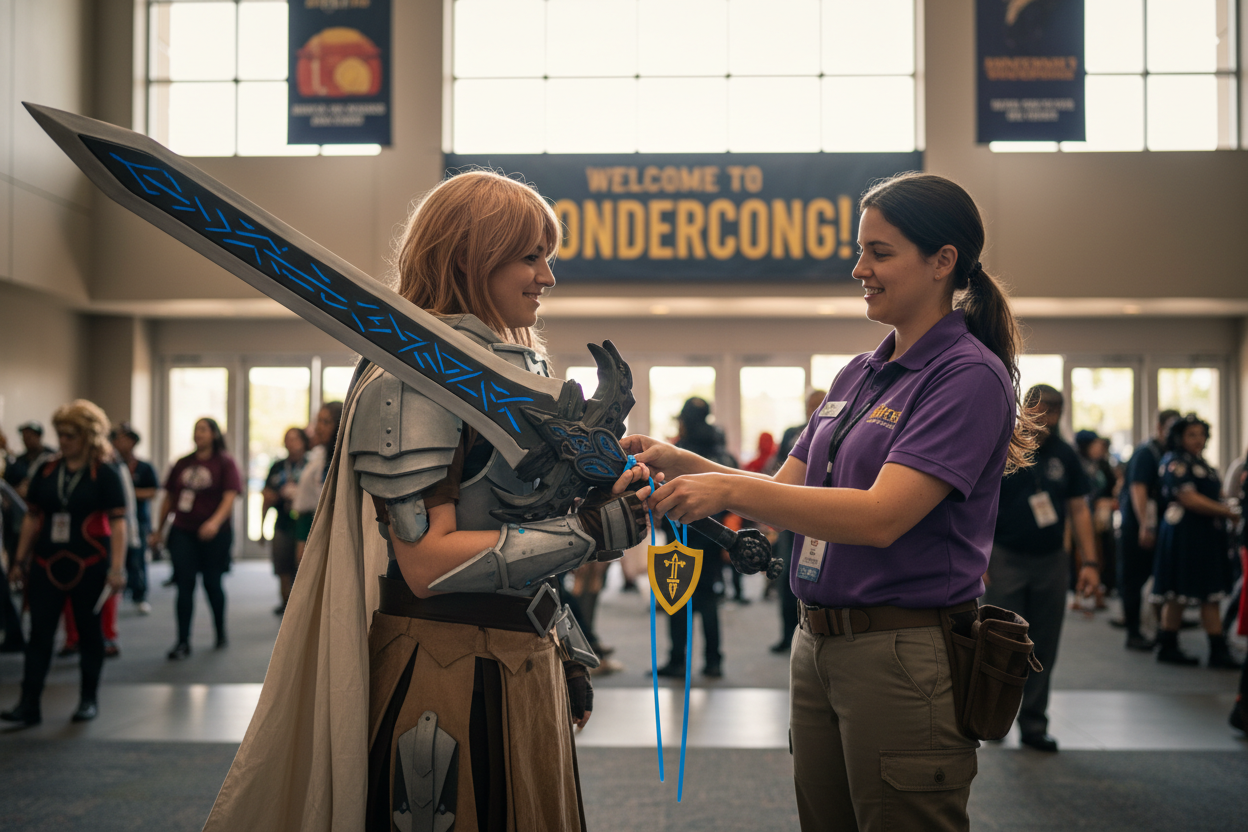
Peace bonding is the practice of securing a prop weapon so it cannot be drawn, fired, or removed from its sheath or housing while you're walking the convention floor. In most cases, this means convention staff (usually at a dedicated weapons check station near registration) will tie, tape, or zip-tie your weapon in place and attach a small tag or colored band showing that it's been inspected and approved.
It's not about confiscating your prop — it's about creating a visible, tamper-evident signal that says "this weapon has been checked and cannot be used." That's why even completely harmless foam or resin props often still need to go through the process: the rule isn't really evaluating danger on a prop-by-prop basis, it's applying a consistent standard so staff and attendees don't have to guess which weapons are safe and which aren't.
Why the Rules Got Stricter
For most of cosplay's early convention history, weapon policies were informal — a con might simply ask attendees not to brandish props aggressively. That changed over the past decade as a handful of serious incidents made national news: a replica samurai sword led to a fatal police shooting after a bystander mistook it for a real weapon, and a shooting at a Florida convention (unrelated to prop weapons themselves) accelerated a broader push toward formal security screening at fan events. Around the same time, several major UK and US conventions began confiscating realistic prop firearms at the door entirely, regardless of orange safety tips or peace bonding.
The result is that today's rules are less about any individual cosplayer's intentions and more about managing risk at scale, across venues that can have tens of thousands of attendees moving through crowded halls, public transit, and hotel lobbies. Rules also vary by venue, not just by convention — a hotel-based con and a convention-center-based con can have completely different weapon policies even in the same city, because the venue itself sets baseline security requirements the event has to follow.
Why Rules Vary So Much From One Event to the Next
This is the part that trips up even experienced cosplayers, because it isn't really the convention making the call — it's the venue underneath it. A convention center is typically a public or quasi-public facility with its own security staff, insurance requirements, and sometimes local law enforcement embedded on-site. A hotel-based con, by contrast, is operating inside a private business that's balancing convention needs against normal paying guests who aren't part of the fandom at all — which tends to make hotel venues considerably more conservative about anything resembling a weapon in a hallway or elevator.
| Venue Type | Typical Weapon Policy | Why |
|---|---|---|
| Large convention center (e.g., major regional/national cons) | Moderate — peace bonding required, realistic firearms often banned outright | Professional security staff, formal weapons-check stations, higher attendee volume requires consistent enforcement |
| Hotel-based convention | Stricter, sometimes case-by-case | Shared space with non-attendee guests; hotel liability and staff (not con staff) often make the final call |
| Small local/regional con | Variable — sometimes looser enforcement, sometimes stricter due to limited staff | Fewer dedicated security resources means rules may be enforced inconsistently or, alternatively, banned outright to avoid the issue entirely |
| Outdoor or public meetup (non-ticketed) | Often governed by local/state law, not convention policy at all | No convention authority applies; open-carry and replica weapon laws vary significantly by state and city |
That last row matters more than people expect. Once you step outside a ticketed convention space — a public photoshoot in a park, a meetup at a plaza — peace bonding isn't a convention rule anymore, it's a legal question governed by your state's laws on replica and concealed weapons. Several states treat realistic replica firearms and edged weapons differently in public spaces than convention centers do internally, which is exactly why "it was fine at the con" isn't a reliable guide once you're photographing outside the venue.
The Realism Paradox
Here's the tension that doesn't get talked about enough: the same craftsmanship that wins cosplay contests is often exactly what triggers the most weapons-check scrutiny. Contest judges reward screen-accurate detailing, correct proportions, and realistic finishes — the same qualities that make security staff take a second, closer look. A deliberately stylized or toy-like prop can sail through a weapons check in seconds; a beautifully weathered, metal-finished replica of the same weapon might mean a longer conversation at the check station, even though it's objectively less structurally dangerous than a rigid, unpainted foam blank.
This isn't a contradiction convention organizers are unaware of — it's just an unavoidable tradeoff. A prop that's convincing enough to impress a judge is, by definition, convincing enough to read as a real weapon to someone unfamiliar with cosplay. If you're building toward both contest craftsmanship and a smooth check-in experience, the practical takeaway is to plan for the extra scrutiny rather than be surprised by it — budget more time at weapons check specifically because your build is good, not despite it.
The Practical Guide: What to Expect by Prop Type
The table below summarizes what's covered in detail further down — use it as a quick reference, then jump to the relevant section for specifics.
| Prop Category | Peace Bonding Required? | Common Pitfall | Extra Consideration |
|---|---|---|---|
| Bladed weapons (swords, katanas, daggers) | Almost always | Screen-accurate finishes draw more scrutiny, regardless of material | Working release mechanisms need to be demonstrated as non-functional |
| Polearms / long-handled weapons | Almost always | Length restrictions, not appearance, are the main issue | May need to be carried disassembled or sheathed outside photo areas |
| Oversized weapons | Almost always, plus size/weight review | Bottlenecks at doors, elevators, escalators | Some cons require separate "large prop" registration |
| Bows / ranged weapons | Usually, if string is functional-looking | Draw-and-release motion reads as more threatening than a static blade | String is typically secured even if nothing can be fired |
| Soft / novelty props | Rarely, or fast-tracked | Assuming every prop needs the same process | Still worth confirming — "obviously safe" is a judgment call, not a guarantee |
Bladed Weapons (Swords, Katanas, Daggers)
This is the most common category cosplayers run into, and it's also where the "why is my convincing foam katana getting extra scrutiny" confusion usually comes from. The more screen-accurate and metallic-looking your blade is, the more likely it is to get a closer look — even if it's made entirely of resin or hardened foam.
Example: Demon Slayer's Nichirin Swords (Tanjiro, Zenitsu) These are near-universally recognized, extremely screen-accurate blade designs, which means staff will almost always flag them for peace bonding regardless of material. Expect your sword to be tied into its sheath, with a visible tag or band applied at the hilt or guard. If your build includes a working release mechanism (even a cosmetic one), be ready to demonstrate that it doesn't actually allow the blade to slide free.
Example: League of Legends' Yasuo (Katana) Game-inspired weapon designs sometimes get a slightly different level of scrutiny than screen-accurate anime blades, since they're visually stylized rather than a 1:1 replica of a real sword. That said, don't assume a "fantasy" design skips the check — if it reads as a functional blade shape from a few feet away, it'll still go through peace bonding.
Polearms and Long-Handled Weapons
Long weapons introduce a different problem: crowd safety in tight hallways, not just "could this be mistaken for real." Many conventions cap the total length of carried props or require them to be sheathed/covered while indoors.
Example: Genshin Impact's Raiden Shogun (Naginata/Polearm) This is a great example of a prop that's rarely dangerous-looking but still gets flagged — the length is the issue, not the appearance. Check your specific convention's maximum prop length before you build; some venues cap weapon props at 6 feet, others are stricter. If your polearm exceeds the limit, you may be asked to carry it disassembled or wrapped except during designated photo areas.
Oversized Weapons
Example: Wuthering Waves' Calcharo (Broadsword) Large-format weapons like this face two separate checks: the standard peace-bonding process, and sometimes a size/weight restriction tied to crowd safety in packed hallways or elevators. It's worth checking whether your convention has a separate "large prop" registration process — some do, specifically because oversized weapons and armor pieces create bottlenecks at doorways and escalators.
Bows and Ranged Weapons
Working or semi-working bows (even ones that can't actually fire anything) tend to get treated cautiously, since draw-and-release motion reads as more overtly weapon-like to onlookers than a static blade does. If your prop bow has a functional-looking string, expect it to be secured so the string can't be drawn back, even if there's nothing to actually fire.
"Soft" and Novelty Props
Not everything needs the same scrutiny — comedic, clearly non-threatening props (foam mallets, oversized novelty items, or joke weapons) are usually waved through quickly or exempted entirely at many conventions. If you're building a character known for a lighthearted signature prop rather than a bladed weapon, you'll generally have a much faster check-in experience, though it's still worth confirming your specific convention's policy rather than assuming.
Your Pre-Convention Weapon Prop Checklist
1. Read the specific convention's weapon policy before you build. Don't assume last year's con had the same rules, or that a "similar" convention in another city follows the same standard. Policies genuinely vary by venue and by event.
2. Check for length and material restrictions. Some cons ban metal entirely, even for peace-bonded props; others allow it with restrictions. Know this before you invest hours into a metal-finish build.
3. Build in a way that makes peace bonding easy. If your prop has a sheath, make sure it's functional enough that staff can actually tie it closed. If it doesn't have a natural "secured" position, think through how staff will realistically bond it before convention day.
4. Budget extra time for weapons check. Lines at the prop check station can be long, especially early on the first day of a con. Arrive earlier than you think you need to if you're bringing a weapon prop.
5. Keep your bonding tag or band visible. Once your prop is checked, don't remove or hide the tag — it's your proof that the weapon has been cleared, and losing it can mean a repeat trip to the check station.
6. Expect re-checks at re-entry. If you leave the venue and come back, some conventions will re-verify your peace bonding rather than assuming it's still valid.
Frequently Asked Questions
Does peace bonding damage my prop? Generally no — staff typically use tape, zip ties, or string that can be removed without harming the prop. That said, avoid delicate paint finishes or fragile trim near the areas most likely to be bonded (hilts, sheath openings, string mechanisms).
Do foam props really need to be peace bonded? Often yes, especially if the design closely resembles a real weapon. The rule is usually applied based on how the prop looks, not just what it's made of.
What happens if my prop doesn't pass inspection? Depending on the convention, you may be asked to leave it at a bag/prop check for the day, modify it on the spot (if possible), or in stricter cases, not bring it into the venue at all. This is exactly why checking the policy in advance matters — a same-day surprise is much harder to solve than a design decision made weeks earlier.
Are toy or replica guns ever allowed? Some conventions allow them with orange safety tips and peace bonding; a growing number ban realistic-looking prop firearms entirely, regardless of modifications. This is one of the most convention-specific rules out there, so verify directly rather than assuming.
Do I need to peace bond a prop I'm only using for photos, not walking around with? Most conventions still require it if the prop will be visible or carried through public convention space, even briefly. Designated photo areas sometimes have separate rules — check with your specific event.
Is peace bonding the same at every convention? No. This is the single biggest source of confusion in cosplay forums, and it's a completely reasonable one — a policy that worked perfectly at one convention can be stricter or more lenient at the next.
Final Thoughts
Prop weapon rules can feel like an annoying extra step when you're excited to finally wear a build you've spent weeks on, but they exist because conventions have had to learn — sometimes the hard way — how to keep tens of thousands of people safe in a shared space. The realism paradox is worth sitting with here too: the more convincing your craftsmanship, the more that same skill will get flagged at the door, and that's not a flaw in the system so much as the unavoidable cost of building something good. The friction is largely avoidable with a little planning: check your specific convention's policy before you build, design your prop with peace bonding in mind, and budget the extra time at check-in — especially if your build is good enough to turn heads for the right reasons. Do that, and the process becomes a two-minute formality standing between you and a great convention day, not a last-minute scramble.


Leave a comment
This site is protected by hCaptcha and the hCaptcha Privacy Policy and Terms of Service apply.