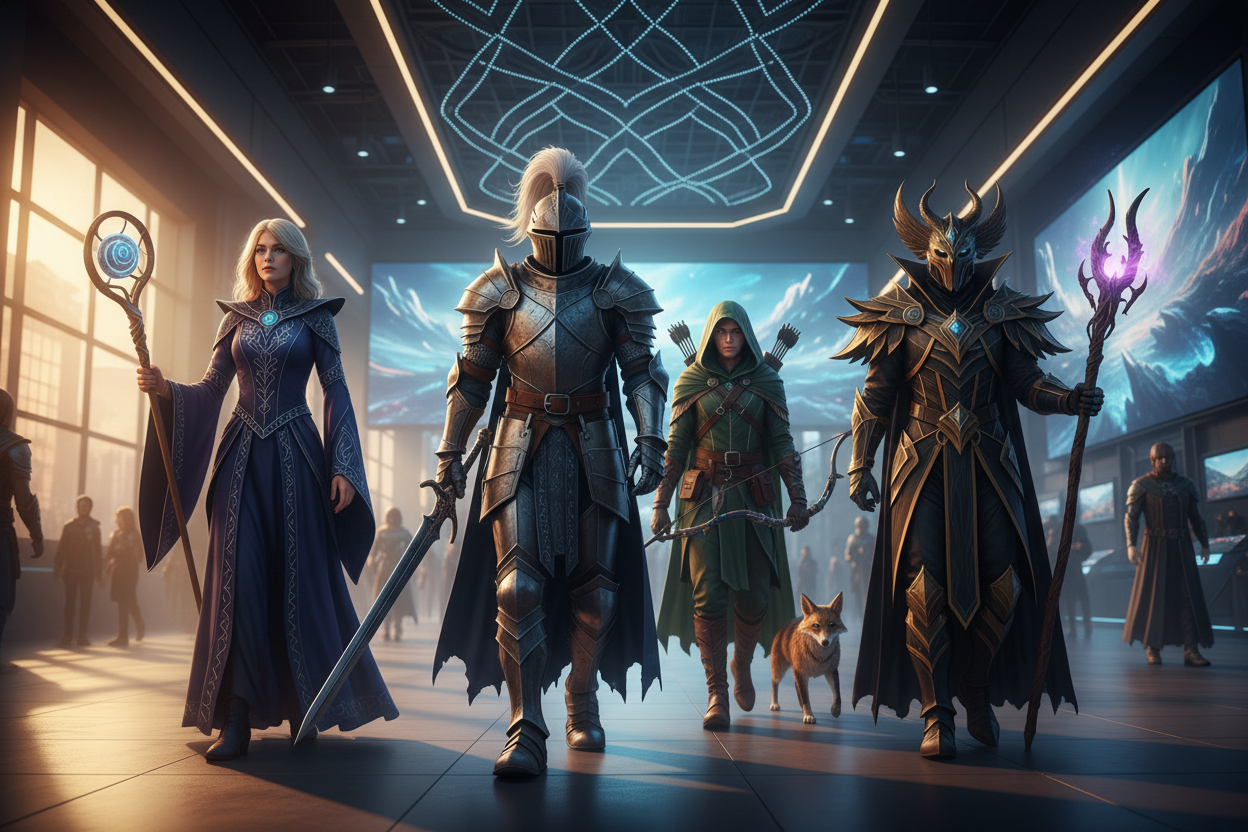
Ask a cosplayer in 2022 what they were building for the next convention, and the answer was almost always an anime or game character — someone with a name, a canon outfit, and a wiki page you could screenshot for reference. Ask that same question in 2026, and you're increasingly likely to hear something different: a fantasy knight loosely inspired by three different games, a witch design built around a feeling rather than a specific character, an original armor concept that borrows silhouettes from Baldur's Gate 3 without replicating any single companion exactly.
This shift has a name in industry trend coverage this year — broadly grouped under "fantasy cosplay" — and it's become one of the more interesting threads running through 2026 convention season. It's not a rejection of anime cosplay, which remains enormous. It's something running alongside it: a growing appetite for high-fantasy aesthetics, magical-world worldbuilding, and character concepts that don't require a specific IP to justify the build.
What "Fantasy Cosplay" Actually Means Here
It helps to separate two things that get lumped together. There's fantasy as a genre — the literary and visual tradition of knights, witches, dragons, and invented worlds that runs from classic fantasy fiction through modern fantasy art. And there's fantasy cosplay specifically, which pulls from that broader tradition rather than from one licensed character sheet.
In practice, this shows up as three overlapping approaches:
- Fantasy-genre characters from existing IP — cosplaying a knight, witch, or mage from a game or show built explicitly in the fantasy tradition (Baldur's Gate 3, Witch Hat Atelier, Final Fantasy)
- "Archetype" builds — costumes built around a fantasy role (a paladin, a court mage, a forest ranger) without being a 1:1 replica of any single named character
- Fully original fantasy design — a costume that's entirely the cosplayer's own invention, using fantasy visual language but representing no existing character at all
The throughline across all three is that recognizability shifts from "do you know this exact character" to "does this feel like it belongs in a fantasy world." That's a meaningfully different design goal than screen-accurate anime cosplay, and it changes what actually gets rewarded.
Anime-Accurate vs. Fantasy/Original Cosplay: What Actually Changes
| Anime/Game-Accurate Cosplay | Fantasy / Original Design Cosplay | |
|---|---|---|
| Primary goal | Match a specific reference as closely as possible | Evoke a mood, archetype, or world — reference is a starting point, not a target |
| Judging emphasis | Accuracy to source material, construction precision | Originality, cohesion, storytelling, craftsmanship |
| Recognition method | Instant — viewers identify the character by sight | Contextual — viewers respond to the feeling even without knowing the "answer" |
| Reference flexibility | Low — deviating from canon can read as "wrong" | High — mixing influences is expected and often celebrated |
| Typical risk | Getting a detail "wrong" relative to canon | Being unclear or generic without a strong enough concept |
| Where it shines | Group cosplays, character recognition at photo ops, contest categories with strict accuracy criteria | Original design contests, portfolio/photography-driven content, standing out in a sea of identical popular-character cosplays |
This table gets at something real: fantasy cosplay isn't "easier" than accurate cosplay, it's a different skill set. You lose the safety net of a reference sheet telling you exactly what's correct, and you gain the freedom — and pressure — of having to make every design decision yourself.
Why This Is Happening Now
A few forces are converging at the same time, and it's worth naming them plainly rather than treating this as a mysterious aesthetic mood shift.
Saturation of a small pool of "must-cosplay" characters. When a handful of characters from the biggest current anime or game dominate every con floor, differentiation becomes valuable. An original or loosely-referenced fantasy build guarantees you won't be the fifth version of the same character in a photo line.
Contest culture increasingly rewards originality. This connects directly to a conversation we've covered before on this blog — the debate around handmade-percentage rules at contests like Dream Con. As craftsmanship requirements tighten, original design categories give cosplayers a way to be judged on construction and concept rather than accuracy to a source they didn't create, which sidesteps a lot of the "is this handmade enough" tension entirely.
A genuinely strong crop of fantasy source material landed at the same time. Witch Hat Atelier's April 2026 anime adaptation gave the "high-fantasy witch" aesthetic a fresh, visually distinct reference point after nearly a decade as a manga-only property. Baldur's Gate 3 cosplay has stayed remarkably durable years after the game's release, in part because its character designs already blend multiple fantasy archetypes rather than locking into one aesthetic. And long-running franchises like Final Fantasy continue to supply decades of fantasy character designs that never fully cycle out of relevance.
Games with fantasy-adjacent worldbuilding are pulling double duty. Genshin Impact sits in an interesting middle position here — it's technically anime-styled, but its regional aesthetics (particularly Fatui and Liyue-inspired designs) lean heavily on classic fantasy visual language: ornate armor, mythic color palettes, archetypal silhouettes. That's part of why Genshin cosplay has crossed over so easily into fantasy-focused spaces that wouldn't necessarily embrace a slice-of-life anime character the same way.
Franchise Comparison: Where Each Source Fits the Fantasy Wave
| Franchise | Genre Roots | Design Philosophy | Why It Fits the Fantasy Trend |
|---|---|---|---|
| Baldur's Gate 3 | Tabletop RPG / high fantasy | Grounded, lived-in fantasy realism — armor that looks functional, not decorative | Character designs already blend archetypes (rogue, cleric, warlock), making them easy to reference loosely rather than copy exactly |
| Witch Hat Atelier | Fantasy manga/anime | Elegant, rune-based magic aesthetic; pointed hats, flowing robes, muted palettes | 2026 anime adaptation gave the "cottagecore witch" aesthetic new visual specificity right as the trend was accelerating |
| Final Fantasy | JRPG / high fantasy | Decades of varied fantasy design language, from armored knights to elemental mages | Enormous back catalog means cosplayers can pull references spanning 30+ years without repeating anyone else's build |
| Genshin Impact | Anime-styled open-world RPG | Ornate, mythologically-inspired regional armor and robes | Straddles anime and fantasy cosplay communities, making it a natural entry point for cosplayers moving between both spaces |
The Real Tradeoff: Freedom vs. a Blank Page
The deeper thing worth understanding about this trend isn't the aesthetic — it's the shift in what's actually hard about the build. Anime-accurate cosplay has a well-defined finish line: does it match the reference. Fantasy and original cosplay replaces that finish line with a much harder question: is this design actually good, on its own terms, without a canon character validating it.
That's a real creative risk, and it's part of why this trend tends to attract more experienced cosplayers rather than first-timers. Building "a knight" instead of "this specific knight from this specific game" means every proportion, every color choice, and every material decision is a judgment call rather than a reference lookup. It's more demanding creatively, even when it's not more demanding technically.
The upside is that it rewards exactly the kind of craftsmanship-first thinking that's become more valued across the hobby recently — the same instinct behind handmade-percentage contest rules, behind "archetype" color-based cosplay, and behind judges increasingly asking cosplayers to explain their build process. Fantasy and original design cosplay is, in a sense, where several of these trends converge: it's harder to fake, harder to buy wholesale off a rack, and it puts craftsmanship and concept ahead of brand recognition.
Getting Started: A Practical Path Into Fantasy Cosplay
If this trend appeals to you but you're used to reference-driven builds, the easiest entry point isn't a fully original design — it's the middle category: archetype builds loosely inspired by an existing fantasy source.
- Start with a franchise you already love that has strong fantasy design roots. Genshin Impact's Liyue and Fatui character designs are a natural bridge if you're used to anime-accurate builds but want to experiment with a more mythic, ornate aesthetic without leaving familiar territory entirely.
- Pick a role, not just a character. Ask what archetype draws you in — a battle-worn knight, a court mage, a forest wanderer — before locking onto one specific reference image.
- Let materials guide the mood. Fantasy cosplay leans harder on texture and finish than pure silhouette accuracy. Weathering, layered fabrics, and mixed materials do a lot of the storytelling work that a screen-accurate print pattern would otherwise handle.
- Expect more decisions, not more hours. Original and archetype-based builds aren't necessarily longer projects than accurate cosplay — they just require more upfront design decisions before you start cutting fabric.
Frequently Asked Questions
Is fantasy cosplay replacing anime cosplay? No — it's running alongside it. Anime and game-accurate cosplay remains the largest share of convention cosplay by far; fantasy and original design cosplay is a growing adjacent category, not a takeover.
Do contests have separate categories for original fantasy designs? Many do, especially larger conventions with dedicated "original design" or "artisan" categories that judge concept and craftsmanship rather than accuracy to a specific character.
Is Genshin Impact considered fantasy cosplay or anime cosplay? Both, depending on the character and community context. Its anime-inspired art style keeps it firmly part of anime cosplay culture, while its ornate, mythologically-grounded regional designs (particularly Liyue and Fatui characters) give it strong crossover appeal with fantasy-focused cosplayers.
Do I need to be an advanced cosplayer to try an archetype or original build? Not necessarily, but it does require more upfront creative decision-making than reference-based cosplay. Starting with an archetype loosely inspired by an existing fantasy character — rather than a fully original design — is a gentler entry point.
Why did Witch Hat Atelier specifically become a big reference point in 2026? Its anime adaptation premiered in April 2026 after years as a manga-only property, giving its distinctive rune-magic, pointed-hat aesthetic fresh visual momentum right as broader interest in fantasy and witch-adjacent cosplay was already climbing.
Final Thoughts
The rise of fantasy cosplay isn't really about abandoning anime characters — it's about the hobby maturing in a direction where recognizability isn't the only thing being rewarded. Whether you're building a screen-accurate Genshin Impact regional design or an entirely original knight with no source material at all, the underlying shift is the same: craftsmanship, concept, and mood are earning a bigger seat at the table next to pure character accuracy. If you've been considering stepping outside your usual reference-driven builds, this is a genuinely good moment to try it — the community, the contest categories, and the source material have all caught up to meet you there.

Leave a comment
This site is protected by hCaptcha and the hCaptcha Privacy Policy and Terms of Service apply.