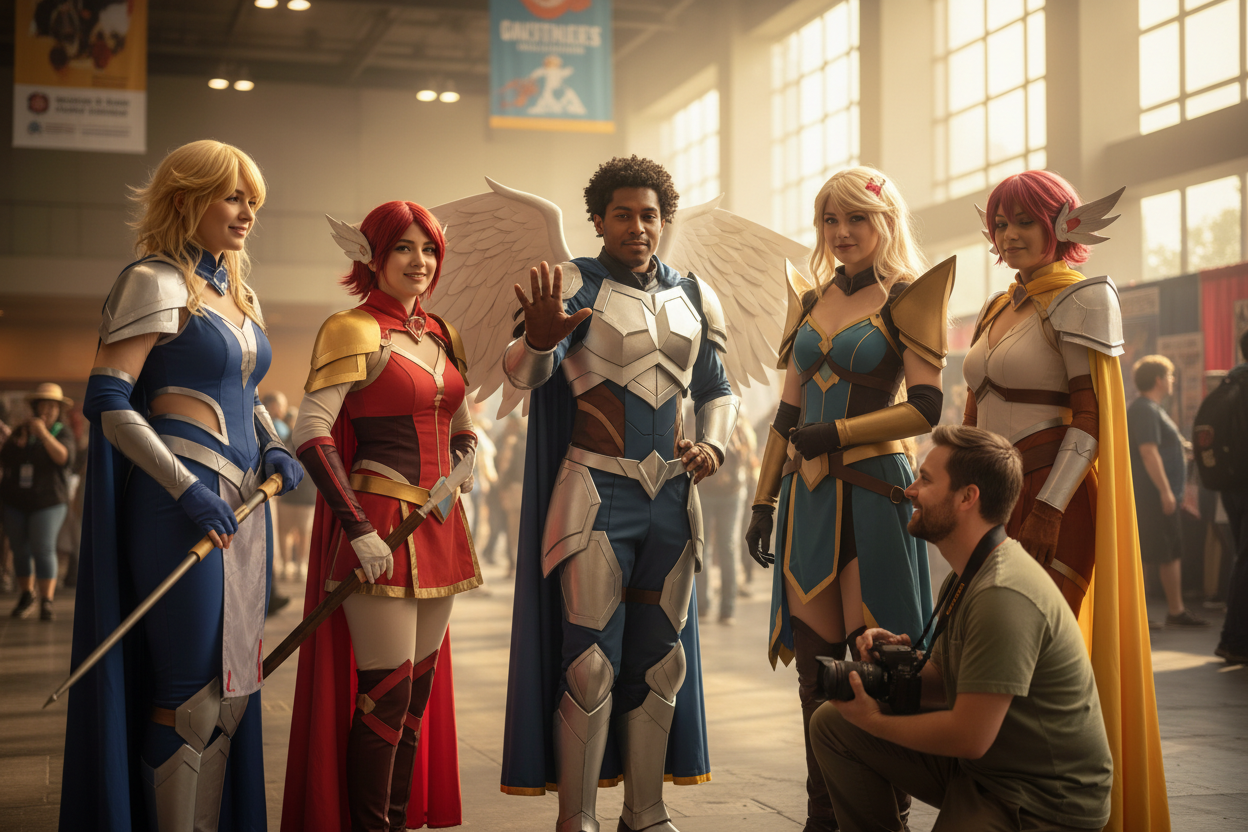
If you follow cosplay community conversations closely, you've likely seen this phrase resurface again this year: "cosplay is not consent." It's not a new idea — the phrase has circulated at conventions since around 2012 — but it came roaring back into the spotlight in April 2026, when three very different events (DreamHack, MegaCon, and the Arnold Sports Festival) overlapped at the same venue in Birmingham, England. Cosplayers there reported being filmed without permission, having their photos and videos interrupted, and fielding invasive questions from attendees who treated the weekend more like content-farming than a shared fan space.
The incident wasn't an isolated flare-up. It reopened a conversation the cosplay community has been having, in one form or another, for over a decade. As a store that lives and breathes this hobby, we think it's worth walking through where this conversation actually stands in 2026 — not just to repeat a slogan, but to lay out practical, actionable etiquette for photographers, fans, and cosplayers alike.
Where "Cosplay Is Not Consent" Actually Came From
The phrase started appearing on convention signage and badges around 2012–2015, as organizers like New York Comic Con and Emerald City Comic Con began responding publicly to a wave of harassment reports. A widely circulated survey from Bitch Media at San Diego Comic-Con found that a meaningful share of attendees reported unwanted sexual comments, and a smaller but still significant share reported being groped or worse. Those numbers, applied to a convention with well over 100,000 attendees, translate into thousands of people affected in a single weekend.
The core message was simple: wearing a costume — even a revealing one, even one based on a character known for being flirtatious — is not an invitation to touch, film, or harass someone. It's a message aimed at correcting a specific and recurring misunderstanding: that a costume somehow transfers consent from the person wearing it.
Why the Slogan Alone Isn't Enough
Here's where the more recent, more nuanced part of this conversation comes in. Advocacy groups like the Cosplayer Survivor Support Network have spent the past several years pushing back — not against the sentiment, but against treating a four-word phrase as a substitute for an actual policy. Their argument is straightforward: "cosplay is not consent" only addresses harassment aimed at cosplayers specifically. It doesn't cover harassment based on someone's race, body type, gender identity, or any other characteristic, and it can unintentionally suggest that harassment is only a "cosplay problem" rather than a broader convention culture problem.
Their recommendation, echoed by several convention organizers now, is that harassment policy needs to be explicit, visible, and universal — covering everyone at a venue, not just people in costume, and spelling out specific unacceptable behaviors (unauthorized photography, physical contact, stalking, disruptive filming) rather than relying on a single catchphrase to do all the work.
The April 2026 Birmingham incident is a useful case study here. The reported behavior wasn't limited to sexualized harassment — it included people disrupting planned photo shoots, filming cosplayers without asking, and pushing uncomfortable questions on camera for content. None of that requires malicious intent to still make a convention feel unsafe or exhausting, which is exactly the kind of behavior a vague slogan struggles to address on its own.
A Practical Etiquette Guide for Photographers and Fans
If you're attending a con and want to photograph or interact with cosplayers respectfully, the community's expectations in 2026 are fairly consistent across events:
Always ask before photographing. This applies even if the person is standing still, posing for someone else, or clearly dressed for photos. "Can I get a picture?" takes two seconds and makes a real difference.
Don't touch a cosplayer's costume, wig, or props without permission. This includes seemingly harmless contact — adjusting a piece that looks "out of place," touching fabric to ask about the material, or picking up a prop to look at it closely. Ask first, every time.
Wait for a natural break. If a cosplayer is mid-conversation, eating, fixing their costume, or already posing for someone else, that's not the moment to jump in — even for a "quick" photo.
Keep questions about the character and craft, not the person. Asking about a costume's construction, the character's backstory, or how long a build took is welcome. Comments about someone's body, or questions clearly meant to provoke a reaction for content, are not.
If you're filming for social content, say so upfront. Several of the complaints from the Birmingham incident specifically involved people filming reaction-style content without disclosing it. A simple "I'm filming for a video, is that okay?" resolves this immediately.
A Practical Guide for Cosplayers: Setting Boundaries With Confidence
Boundary-setting is a skill, and it's one a lot of cosplayers — especially newer ones — don't get much practice with before their first convention. A few things that consistently help:
Use the buddy system. Attending with even one other person changes the dynamic significantly. It gives you someone to hand your phone to for photos, someone to flag down staff with, and someone to simply stand next to when a conversation starts to feel off.
Decide your boundaries before you're in the moment. It's much easier to say "no photos right now" or "please don't touch the wig" if you've already decided in advance that you're allowed to say it. Waiting until you're uncomfortable to figure out your own rules makes it harder to enforce them.
A clear "no" doesn't need justification. You don't owe anyone an explanation for declining a photo, ending an interaction, or asking someone to step back. "No thank you" is a complete sentence.
Know your convention's reporting process before you need it. Most major U.S. conventions now list harassment reporting information directly on badges or in the program guide. Knowing where security or a designated safe point is located before the con starts means you're not searching for it while already stressed.
Comfort matters more than people expect. A costume you can move in, sit down in, and adjust easily is also a costume that's easier to defend boundaries in. Fumbling with a costume that's difficult to manage — tight seams, awkward layering, hard-to-remove pieces — makes it harder to react quickly or step away from an uncomfortable situation. It's a small, practical reason why fit and wearability are worth prioritizing alongside screen accuracy when you're choosing a build.
What Conventions Are Doing Differently in 2026
The Birmingham incident pushed several UK and U.S. event organizers to revisit their published policies again this year. The pattern among the more effective ones is consistent: harassment policy is treated as a venue-wide code of conduct rather than a cosplay-specific rule, it's printed on badges and posted throughout the venue (not just buried on a website), and it names specific behaviors — unauthorized filming, physical contact, stalking — instead of relying on a single slogan to cover everything.
If you're choosing which conventions to attend, it's worth checking whether an event publishes a detailed, specific harassment policy versus a vague one. It's a reasonably good signal for how seriously an event takes attendee safety in practice, not just in messaging.
Frequently Asked Questions
Does "cosplay is not consent" mean I can't take any photos at a convention? No — it means you should ask first. The vast majority of cosplayers are happy to be photographed when asked directly; the issue is being filmed or photographed without any acknowledgment or permission.
What should I do if I witness harassment at a convention? Most major conventions have on-site security or designated safety staff you can flag down directly. If you're unsure where to go, convention program guides and badges typically list a reporting contact or text line.
Is it ever okay to touch a cosplayer's costume to ask about how it was made? It's fine to ask about it — just ask before touching. Most cosplayers are glad to talk about their build process; they just want to be the one to hand over a prop or hold up a piece of fabric rather than have it grabbed.
Why do advocacy groups say "cosplay is not consent" isn't a real policy? Because it's a slogan, not a set of enforceable rules. Groups like the Cosplayer Survivor Support Network argue conventions need explicit, written policies that name specific unacceptable behaviors and apply to all attendees — not just a phrase printed on a badge.
Does this only apply to sexualized harassment? No. The 2026 Birmingham incident, for example, involved disruptive filming and invasive questioning that wasn't necessarily sexual in nature but still made cosplayers feel unsafe and unwelcome. Convention etiquette applies to any behavior that disregards someone's comfort or consent, regardless of the character they're portraying.
What's the single most useful habit for convention-goers to build? Asking before you photograph, touch, or film — every time, regardless of the costume, the character, or how public the setting feels. It's a small habit that resolves the overwhelming majority of these situations before they start.
Final Thoughts
"Cosplay is not consent" isn't wrong — it just isn't the whole conversation anymore. The more useful version of this idea in 2026 is specific, practical, and shared by everyone at a convention, not just the people in costume: ask before you photograph, ask before you touch, and treat "no" as a complete answer. If you're building or choosing a costume for your next convention, it's worth remembering that comfort and wearability aren't just about enjoying your day — they make it easier to move confidently, adjust your costume without help, and step away from a situation the moment it doesn't feel right. That's as much a part of a great convention experience as the build itself.

Leave a comment
This site is protected by hCaptcha and the hCaptcha Privacy Policy and Terms of Service apply.