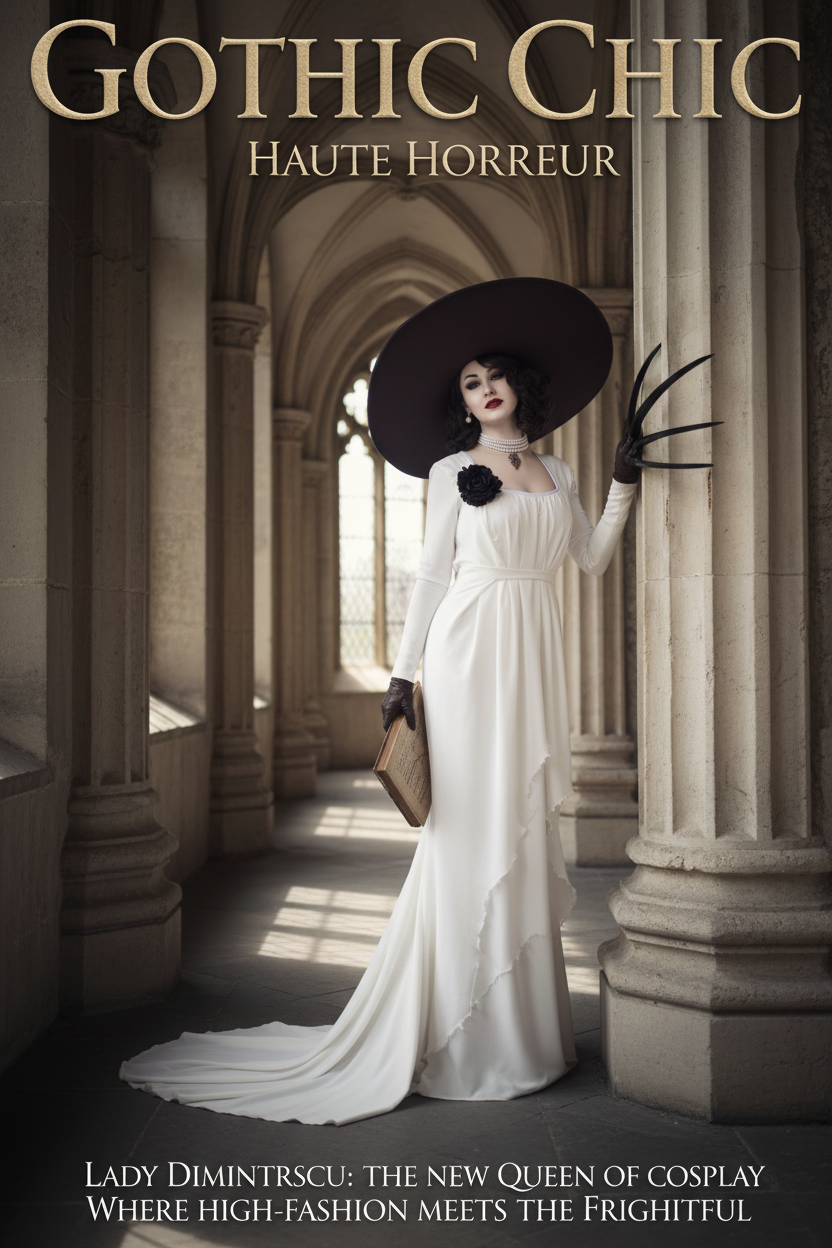
TL;DR: Resident Evil 8 cosplay — especially anything built around Lady Dimitrescu — keeps showing up on convention "best cosplay" lists because it sits in a genre almost nothing else occupies: gothic horror executed through genuine high-fashion construction, not torn fabric and fake blood. Building a convincing look from this cast means treating it like couture with a horror edit — precise 1930s-inspired tailoring, weathered but intentional fabric treatment, and oversized proportions engineered to actually be wearable, not just photographed from a flattering angle.
Why Resident Evil 8 Keeps Showing Up on Convention "Best Cosplay" Lists
Resident Evil Village cosplay has held a consistent spot at the top of convention galleries for years now, and the reasons go well beyond "she's tall and striking."
The design deliberately avoided typical horror-genre visual clichés. According to the game's own art direction, (cite index="33-1">the team behind Lady Dimitrescu specifically wanted to steer away from conventional gothic horror imagery, instead pulling reference from 1930s-era fashion trends</cite>, with (cite index="33-1">the family's clothing finely embroidered with floral patterns tied to the Dimitrescu family crest</cite>. That's a meaningfully different design brief than most horror-game villains get, and it's exactly why this character reads as "elegant" as much as "frightening" — the costume is doing real fashion work, not just horror-genre signaling.
The scale of the character created a genuine, ongoing cosplay challenge. Lady Dimitrescu's canonical height — (cite index="33-1">2.9 meters, or 9 feet 6 inches, including her hat and heels</cite> — turned her into one of the most talked-about proportion challenges in modern cosplay. That challenge has produced some of the most memorable attempts in the hobby's recent history, including (cite index="27-1">a 6'9" Olympic athlete and world-record-holding model recreating the look</cite>, and it's part of why this character specifically keeps generating fresh cosplay content years after the game's release — the height challenge alone gives cosplayers a reason to keep attempting new interpretations.
It occupies a distinct niche within horror cosplay overall. Where a lot of horror-genre cosplay leans into damage, decay, or mechanical broken-doll aesthetics, this cast represents the opposite pole — elegant, controlled, high-fashion horror. That gives gothic horror cosplay builders working in this specific style a lane almost nobody else is competing in at conventions, which is a meaningful part of why these builds stand out so consistently in "best of" galleries.
Key Elements: Gothic Glamour Meets Horror Construction
Fabric Treatment: Elegant, Not Torn
Unlike a lot of horror cosplay, this cast's damage is subtle rather than dramatic — age and wear rather than violence. A practical costume-building guide for the character notes that (cite index="29-1">the dress's off-white fabric should read as weathered by time rather than freshly torn, achievable through tea-dyeing or subtle airbrushed tan and brown tones</cite>. This restraint is the core technical skill this build teaches: convincing age and wear without tipping into generic "ripped horror costume" territory.
Getting the Silhouette's Proportions Right
The full gown silhouette, wide-brimmed hat, and gloves are all doing real recognition work, and small deviations from the reference matter more here than they would for a looser character design. One detailed costume breakdown notes that (cite index="29-1">the in-game neckline sits higher than most cosplay interpretations use, and can be adjusted by cutting a lower neckline and finishing the raw edge with stitching</cite> — a reminder that even widely-referenced builds benefit from checking your specific silhouette choices against actual game reference rather than against other cosplayers' interpretations.
Handling Height and Scale Without Stilts
This is the single most-discussed technical challenge tied to this character specifically. Costume guides consistently advise against literal stilts to chase the character's dramatic height, recommending instead that builders (cite index="31-1">focus on capturing her overall styling and presence rather than attempting to physically match her exact in-game scale</cite>. For cosplayers who do want to lean into the height illusion, camera angle and staged photography do more reliable work than any wearable height-extension device, which tends to compromise both safety and mobility.
Skin Effects and Character-Specific Detail
A ghostly, slightly undead skin tone is a key finishing detail, and it doesn't require elaborate prosthetic work — (cite index="31-1">body paint or a basic face-painting kit can recreate the sharp lines and pale, vampiric quality</cite> the character calls for. Elongated claw-style nails are another signature detail worth prioritizing, since they show up repeatedly in fan recognition of the character even in brief glimpses.
Oversized Props: Building for Wearability, Not Just Photos
The character's dramatically wide-brimmed hat is one of the most construction-intensive pieces of this build, and it's worth engineering with actual wearability in mind — proper weight distribution and secure attachment to a wig cap or headband base matter more here than they would for a smaller accessory, since a hat this size puts real strain on attachment points over a full day of wear.
Common Mistakes and Things to Watch Out For
Chasing literal height accuracy with stilts or platform devices. As covered above, this consistently ranks as the most commonly advised-against approach — it compromises safety and mobility for a height effect better achieved through photography and posing than physical elevation.
Treating the fabric damage like standard horror-costume distressing. Ripping or shredding fabric the way you might for a more conventional horror character undercuts this cast's specific "elegant decay" aesthetic. Weathering through dyeing and subtle airbrushing reads far more accurately than physical tearing.
Underestimating the hat's structural demands. A wide-brimmed piece this large needs genuine engineering — proper internal support and secure, evenly distributed attachment — or it becomes uncomfortable and unstable well before a full con day is over.
Skipping the specific silhouette research. Because this character has been cosplayed so many times, it's easy to reference other cosplayers' interpretations instead of the original game art, which can compound small inaccuracies (like neckline height) across successive builds. Going back to primary game reference avoids inheriting someone else's creative liberties as if they were canon.
Overlooking the family's supporting characters. The Dimitrescu daughters and other Village cast members offer the same gothic-glamour design language at a more construction-manageable scale, making them a strong option for cosplayers drawn to this aesthetic but not ready to tackle the flagship character's full scope.
Summary and Further Reading
Resident Evil 8's gothic-glamour cast earns its recurring spot on convention "best cosplay" lists through a genuinely distinct design brief — 1930s-inspired high fashion filtered through horror, rather than typical genre shorthand. Building a convincing version means prioritizing elegant weathering over torn fabric, referencing actual game proportions rather than other cosplayers' interpretations, solving the height challenge through styling and photography rather than literal elevation, and engineering oversized pieces like the signature hat for genuine all-day wearability.
Related reading you might find useful next:
- Our full guide to gothic cosplay reimagining, for the broader techniques behind this aesthetic applied to any character
- A guide to building and wearing oversized cosplay props comfortably across a full convention day
- A guide to full-body skin effects and makeup techniques for non-standard character proportions

コメントを書く
このサイトはhCaptchaによって保護されており、hCaptchaプライバシーポリシーおよび利用規約が適用されます。