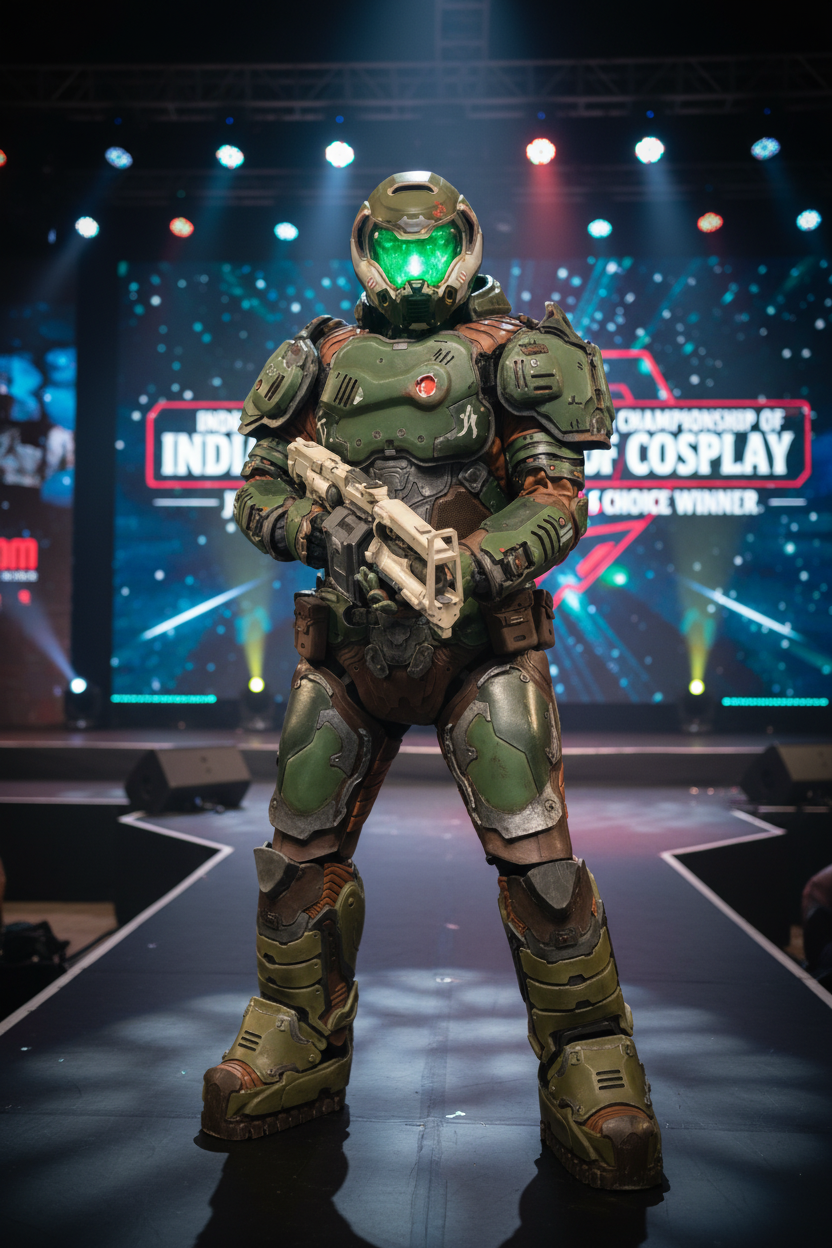
TL;DR: Doomguy cosplay just got a real-world proof of concept for the "hybrid construction" approach — at the Indian Championship of Cosplay, (cite index="22-1">Mumbai-based cosplayer Akshay Churi, known as The Red Comet, won the jury's choice award for his Doom Eternal Doomguy build, which combined EVA foam, wood, PVC, upholstery foam, 3D printing, and LED lighting into one cohesive costume</cite>. The build reportedly took (cite index="22-1">years to complete</cite>, and it's a strong illustration of exactly where competition-level Doom Slayer cosplay is heading: not one dominant technique, but several traditional and digital methods layered together with intention.
Why This Build Matters: The Logic Behind Hybrid Heavy Armor Construction
Understanding why this specific approach won a jury's choice award — rather than just looking impressive in photos — says something useful about where Doom Eternal cosplay and heavy armor construction generally are heading.
No single material does everything a design like Doomguy actually needs. Heavy sci-fi armor demands different properties in different places: rigid structural support in load-bearing areas, lightweight material anywhere that needs to move with the body, and fine surface detail in the areas judges and cameras will scrutinize closely. Foam alone tends to sacrifice sharp detail for comfort; rigid materials alone tend to sacrifice wearability for accuracy. A build that deliberately assigns each material to the job it's actually best at — foam for the bulk and comfort, wood or PVC for structural rigidity where it's needed, 3D printing for precise repeated or intricate detail — produces a more convincing result than committing to any single technique across the whole costume.
Digital fabrication is closing a detail gap traditional methods struggle with. Doomguy's armor design includes exactly the kind of small, precise, repeated detailing — panel lines, mechanical-looking hardware, symmetrical trim — that's genuinely difficult to replicate consistently by hand across a full suit of armor. This is precisely the application covered in our broader look at 3D printing's rise in cosplay construction: using digital fabrication for the fine, repeatable detail work while keeping traditional materials for the larger structural elements. A jury-level award for a build using exactly this hybrid approach is strong real-world validation that this isn't a theoretical trend — it's what's actually winning at competition level right now.
Multi-year builds reward layered technique over rushed single-method construction. A build undertaken over multiple years has the luxury of testing, refining, and combining approaches rather than committing to one technique out of time pressure. This is worth internalizing even if your own timeline is shorter: the underlying principle — using the right material and method for each specific part of the build, rather than forcing one technique to do everything — scales down to shorter timelines too, even if the final result is necessarily less elaborate.
Key Elements: Building Heavy Armor Cosplay That Actually Works
Foam for Bulk, Comfort, and the Base Structure
EVA foam remains the right starting point for the majority of a heavy armor build's volume — chest plate, shoulder guards, and other large panels benefit from foam's light weight and comfortable wear across a full con day, something rigid materials struggle to match without becoming genuinely exhausting to wear for hours.
Wood and PVC for Structural Rigidity Where It Counts
Certain elements of a heavy armor design need genuine structural rigidity that foam alone can't provide — load-bearing joints, mounting points for larger attached pieces, or any section that needs to hold a precise shape under its own weight rather than flexing. Wood and PVC serve this role well specifically because they're rigid without the weight penalty of metal, making them a practical middle ground between foam's flexibility and metal's strength.
3D Printing for Precision Detail
This is where 3D printed cosplay accessories earn their place in a build like this — small mechanical details, panel hardware, and any repeated or symmetrical elements that would take enormous hand-fabrication time to achieve consistently. Printing these pieces once and reproducing them as many times as the design calls for gets you precision and consistency traditional carving struggles to match, especially across a full suit of matching armor pieces.
LED Integration for Screen-Accurate Glow Effects
Doomguy's design includes glowing accent details that are core to his visual identity, not an optional add-on. Integrating LED elements properly — with battery placement planned for comfort and accessibility, not just tucked in wherever there's space — is what separates a build that reads as screen-accurate from one that's missing a defining visual element entirely.
Balancing All-Day Wearability With Screen Accuracy
The real technical achievement in a build like this isn't any single material choice — it's making the whole assembly genuinely wearable across a full competition or convention day. This means weight distribution across the whole body rather than concentrating bulk in any one area, secure but comfortable attachment points between armor sections, and enough mobility to actually walk, pose, and perform on a stage rather than standing rigidly still.
Common Mistakes and Things to Watch Out For
Committing to a single material out of habit rather than matching material to function. The strongest hybrid builds deliberately choose each material for what it does best in that specific location. Defaulting to all-foam or all-print construction because it's familiar, rather than because it's the right call for each specific part, tends to produce a less convincing and less comfortable result.
Underestimating how much post-processing 3D-printed pieces need. Printed detail elements still require sanding, priming, and painting to blend seamlessly with the rest of a mixed-material build — treating a printed piece as finished straight off the printer is a common way hybrid builds end up with visibly mismatched textures between sections.
Overloading weight in one area of the armor. Heavy armor construction can easily become uncomfortable if bulk and weight aren't distributed thoughtfully across the shoulders, torso, and legs. A build that looks accurate standing still but causes real fatigue within an hour undercuts the whole point of a multi-day competition or convention appearance.
Treating LED integration as a late add-on rather than planning it from the start. Retrofitting lighting into an already-finished armor piece is far harder than planning battery placement, wiring routes, and access points during initial construction. Build LED integration into your design from the beginning rather than trying to add it after the fact.
Rushing a build that genuinely needs the extended timeline this technique rewards. Hybrid construction at this level of quality benefits enormously from iteration time — testing a technique, refining it, and moving to the next section. Compressing a build like this into a tight deadline usually means cutting corners on exactly the layered detail work that makes hybrid construction worth doing in the first place.
Summary and Further Reading
This award-winning Doomguy costume is a genuinely useful real-world case study in hybrid cosplay construction — foam for comfortable bulk, wood and PVC for structural rigidity, 3D printing for precise repeated detail, and LED integration for screen-accurate glow effects, all combined with wearability treated as seriously as visual accuracy. Whether or not you're building at competition level, the underlying principle scales down to any heavy armor project: match your material and method to what each specific part of the build actually needs, rather than defaulting to a single technique across the whole costume.
Related reading you might find useful next:
- Our full roundup of how 3D printing is becoming standard in cosplay construction, for more detail on where digital fabrication fits into a hybrid workflow
- A guide to building lightweight, con-day-comfortable armor without sacrificing screen accuracy
- A guide to integrating LED effects into cosplay props and armor from the earliest planning stages


コメントを書く
このサイトはhCaptchaによって保護されており、hCaptchaプライバシーポリシーおよび利用規約が適用されます。