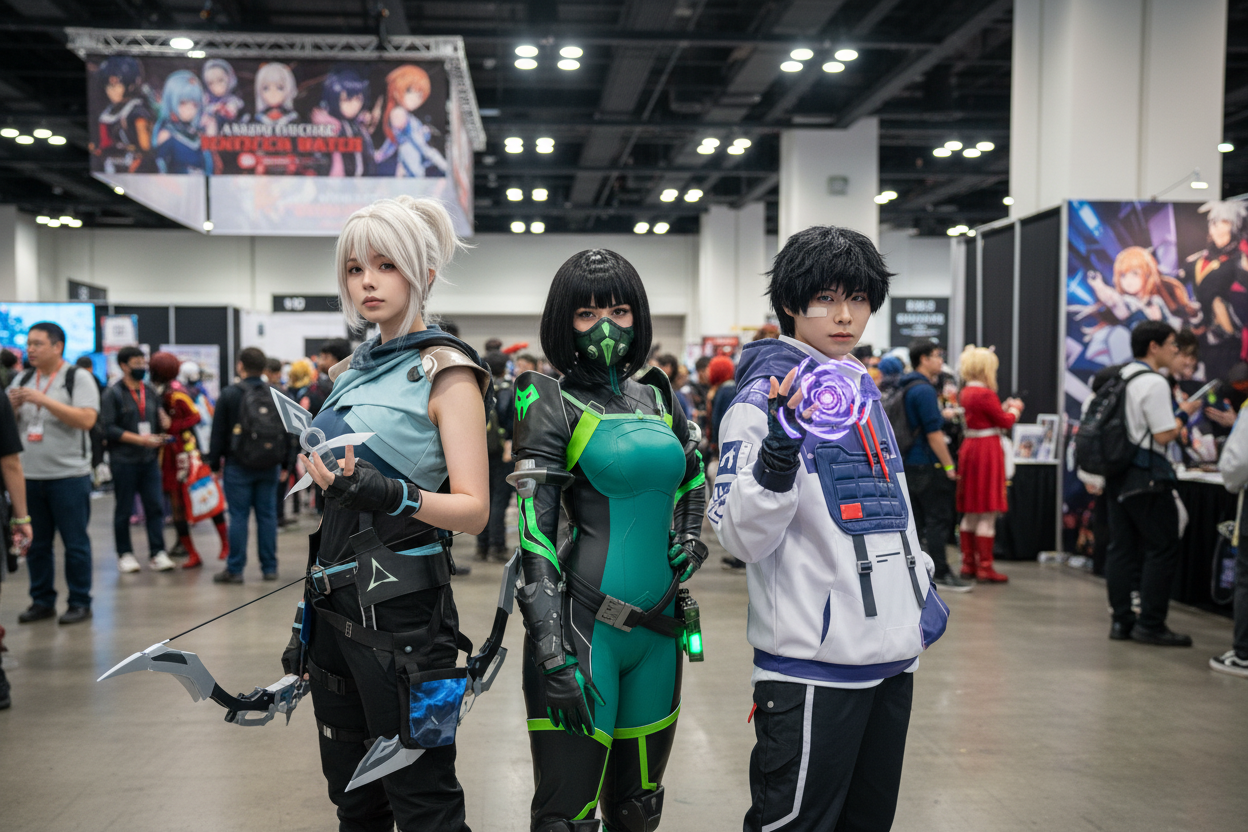
Realistic tactical cosplay — full body armor, radio headsets, and convincingly-detailed prop firearms inspired by Valorant agents like Sova, Viper, or Iso — has become a genuinely popular niche as tactical shooters have surged in mainstream popularity. It's also produced a real, recurring problem: photos and videos of cosplayers wearing realistic tactical gear in subway stations, city streets, and other public spaces outside convention grounds have repeatedly triggered 911 calls and police or SWAT responses, since realistic tactical gear reads very differently to a stranger — or a dispatcher — than it does to someone who recognizes the game reference. Here are the three questions people actually need answered before building or wearing this kind of costume outside a convention hall.
Question 1: Is it actually legal to wear realistic tactical gear and carry prop weapons in public spaces?
Direct answer: It depends heavily on your specific city and state — some jurisdictions ban realistic replica firearms outright regardless of markings, while most others require a visible orange safety tip at minimum, and tactical vests themselves aren't typically illegal but can still trigger a police response independent of their legal status.
This is a genuinely fragmented legal landscape, and it's worth understanding the actual range rather than assuming one rule applies everywhere. In the United States, federal guidance has long required toy and replica guns to carry a visible blaze-orange marking, but enforcement and additional restrictions happen almost entirely at the state and local level. Some cities have gone considerably further: Chicago's municipal code bans possessing, transferring, or even displaying any replica air gun, BB gun, or imitation firearm within city limits regardless of orange markings, and neighboring Cook County has a similar ban carrying fines up to $750.
Most relevantly for this exact debate, the village of Rosemont, Illinois — home to a major convention center that regularly hosts anime and gaming events — passed a specific local ordinance in June 2025 restricting the public display of imitation weapons on village property, directly prompted by complaints during conventions held there. That's about as close to a direct, real-world precedent for this exact controversy as it gets: a municipality watching this specific problem play out repeatedly and responding with a targeted law. The core lesson here is that "orange tip = automatically fine everywhere" is a myth — some places restrict or ban realistic replicas regardless of markings, and it's genuinely worth checking your specific city and county's rules before planning any outdoor tactical-cosplay photoshoot, not just assuming convention norms travel with you, especially when carrying prop weapons.
Question 2: Why does tactical FPS-style cosplay specifically trigger more public safety concern than other realistic costumes?
Direct answer: Because a tactical vest, headset, and prop firearm together closely replicate the exact visual profile law enforcement is trained to treat as an active threat indicator, and the contextual cues that make this obviously a costume inside a convention completely disappear in an ordinary public space.
Context does an enormous amount of quiet work in how a costume gets perceived, and it's worth being honest about how much of that work disappears the moment you step outside a convention's walls. Inside a convention hall, a person in tactical gear is one of hundreds of costumed attendees, inside a venue everyone present already knows is a con, often after their props have already been checked and tagged (or "peace bonded" by convention staff or security at the entrance specifically to confirm everything is a genuine non-functional prop. All of that context signals "this is costume" instantly and automatically to everyone around them, including venue security.
A subway platform, a city sidewalk, or a shopping district has none of that built-in context. A stranger — or a 911 dispatcher relying entirely on secondhand description — has no way to distinguish a highly detailed prop from genuine tactical equipment and a real firearm, and law enforcement response protocols for a reported armed individual are, appropriately, built around treating that report seriously until it's confirmed otherwise. This isn't a case of "the public is too sensitive" — it's a predictable consequence of removing a costume from the one environment specifically designed to communicate, at a glance, that what everyone is looking at is fictional.
Question 3: What can tactical-style cosplayers actually do to enjoy this genre without provoking a dangerous public response?
There's a real, practical path to building and wearing this kind of costume without creating the exact situation this debate keeps circling back to, and it draws directly from how experienced prop-makers and convention safety policies already handle this.
-
Keep prop weapons and full tactical gear on convention grounds specifically, changing into and out of costume inside the venue rather than arriving or leaving in full gear through public transit or city streets — this is standard, widely recommended practice for any weapon-adjacent costume, not just tactical builds, precisely because it keeps the "this is clearly a con" context intact for the entire time you're wearing it.
-
Transport any prop weapon in a bag, not carried or worn visibly, when you're not actively inside convention space — most convention weapon policies already require props to be checked and tagged at entry specifically because loose transport of a highly realistic prop through unrelated public areas is exactly the scenario that generates false alarms.
-
If you're planning a dedicated outdoor photoshoot with tactical gear or prop weapons — a common request for this specific aesthetic — treat it the way experienced prop communities recommend for any realistic replica: choose a private or permitted location rather than an open public space, and consider notifying local police in advance that a costumed photoshoot involving prop weapons will be taking place at a specific time and location. This sounds like overkill until you consider it from the other direction — a heads-up call takes a few minutes and completely prevents the scenario where a passerby's 911 call escalates into an emergency response for something that was never a real threat.
-
Keep your orange safety tip clearly visible whenever possible, even if you plan to briefly remove it for a specific close-up shot — treating it as a removable, quickly-reattachable piece rather than leaving it off for the full shoot minimizes the window where the prop reads as unmarked. And it's worth choosing prop weapons and gear designed with cosplay accuracy in mind rather than genuine military or law-enforcement surplus tactical equipment — a prop clearly built and finished as a costume piece is meaningfully easier for both the public and, if it comes to it, responding officers to correctly identify as non-functional than gear that's realistic down to genuine tactical-grade materials.
Summary and Further Reading
Tactical Valorant cosplay is a genuinely impressive, detail-driven craft, and none of this is a reason to avoid building an Iso, Sova, or Viper look — it's a reason to be deliberate about where and how you wear the finished result. The core issue isn't the costume category itself; it's that the contextual cues making tactical gear obviously fictional exist almost entirely inside convention walls, and carrying that same gear into an ordinary public space strips that context away completely, with real, documented legal and safety consequences on the other side.
Keep your gear on convention grounds, transport props discreetly, and plan any outdoor shoot with the same care experienced prop-makers already apply to realistic replica weapons generally. For more on this broader topic, check out our earlier guide on the legal gray areas around cosplay and IP, and our breakdown of convention prop and weapon policies, including peace bonding, before your next event.



Laisser un commentaire
Ce site est protégé par hCaptcha, et la Politique de confidentialité et les Conditions de service de hCaptcha s’appliquent.