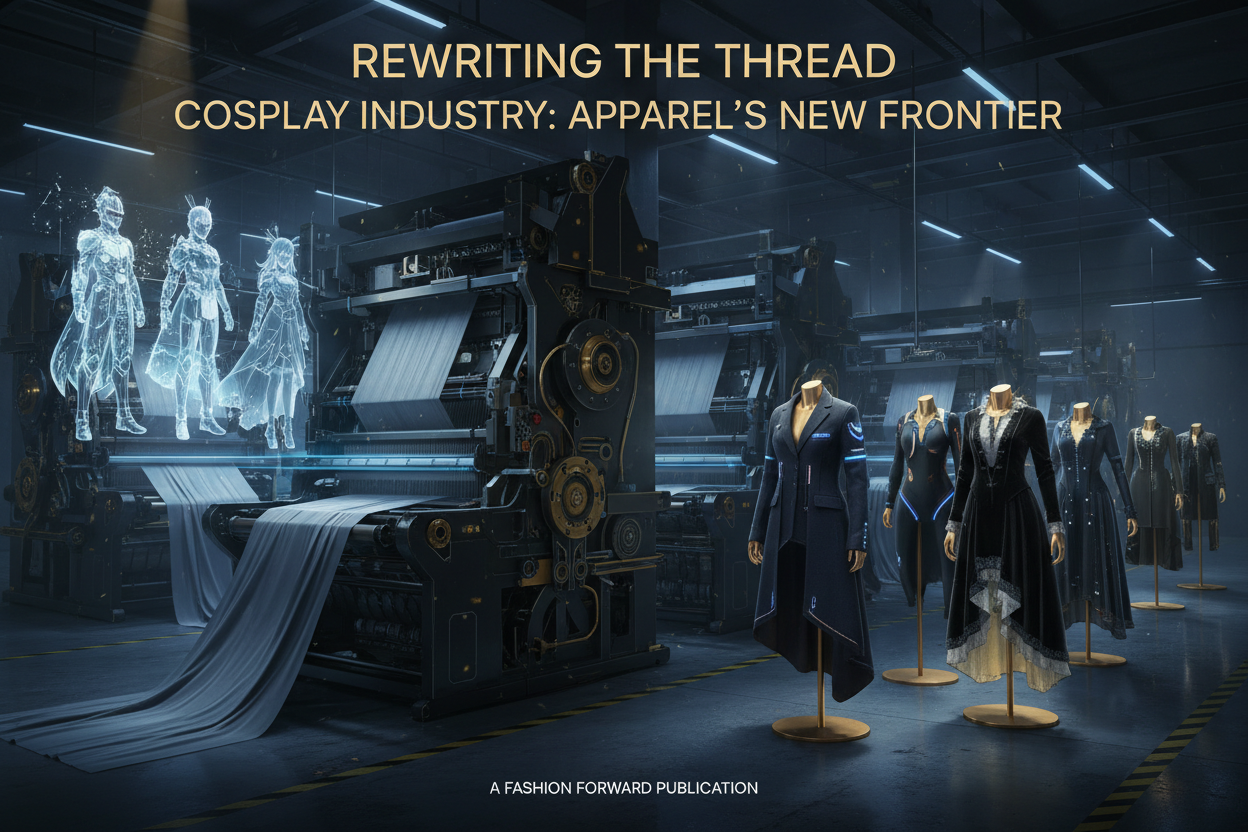
💡 Systemic Briefing: For decades, the global apparel industry operated on a linear top-down hierarchy: haute couture runways set the visual vocabulary, which was then systematically diluted by fast-fashion giants into mass-market basics. In 2026, this legacy pipeline has fractured. The unprecedented globalization of ACG (Anime, Comic, Games) subcultures, coupled with the rapid evolution of flexible manufacturing, has unlocked a bottom-up structural paradigm shift: Fashion Diffusion via Subcultural Inversion. Cosplay fashion—once dismissed as theatrical, over-engineered costume replication—has broken out of its niche boundary to become a primary design input for mainstream commercial apparel. Fast-fashion conglomerates are actively stripping the visual syntax of gaming and anime character archetypes, commercializing exaggerated silhouettes, modular techwear accessories, and soft armor aesthetics for daily consumer wear. Subculture is no longer borrowing from fashion; mainstream apparel manufacturing is being forced to adapt to the geometry of the virtual world.
1. The Industrial Shift: From Theatrical Niche to Agile Input
The traditional apparel supply chain was built on structural compromise. Mass production optimized for high-volume, low-complexity patterns—favoring predictable T-shirts, regular-fit trousers, and standard outerwear grids. Exaggerated structural seams, asymmetrical paneling, and high-contrast multi-fabric bonding were avoided due to excessive labor costs and high factory rejection rates.
[ Legacy Apparel Design Pipeline ]
Haute Couture Runways ──> Trend Agency Dilution ──> Factory Optimization ──> Standardized Homogeneous Basics

[ 2026 Subcultural Diffusion Pipeline ]
ACG Virtual Silhouette ──> Advanced Cosplay Prototyping ──> Agile Supply Chains ──> Avant-Garde High-Street Wear
                                                               (3D Knit / Laser Mesh / Bonded Armor)
By 2026, two massive structural forces collapsed these manufacturing barriers. First, the widespread adoption of 3D digital prototyping (CLO 3D / Browzwear) allowed factories to simulate hyper-complex ACG patterns instantly, eliminating months of manual pattern corrections. Second, the rise of flexible, small-batch manufacturing setups enabled commercial apparel lines to economically produce runs of highly complex garments.
Mainstream brands have realized that the advanced prototyping work has already been completed by the premium cosplay apparel industry. Cosplay designers spent years figuring out how to translate gravity-defying digital character sketches into wearable, structurally sound human garments. Mainstream manufacturing is now leveraging this R&D, scaling it down into commercially viable, avant-garde high-street products.
📋 2. Case Studies: Character Silhouette Deconstruction and Mass Production Interfacing
To understand how subcultural visual syntax directly reshapes commercial garment production, we must examine specific character archetypes, deconstructing their signature design lines into scaled industrial workflows.
1. Furina (Genshin Impact) — Neo-Classical Asymmetry and Commercial Suit Deconstruction
🧬 Subcultural Design Vocabulary
Furina’s visual framework is anchored in historical French court attire, heavily subverted by a modern fantasy silhouette. Her defining characteristics include a highly structured, double-breasted corset bodice, aggressive high-waisted side-slit cutouts, and an asymmetrical back coat configuration that flows into dramatic, layered swallowtail pleats.
┌────────────────────────────────────────────────────────────────────────┐
│  [FACTORY PATTERN BREAKDOWN: ASYMMETRICAL CORSET BLAZER JACKET]        │
│                                                                        │
│   ├─── [REINFORCED COLLAR STRAP] ─────────────────────────┐            │
│   │    Tech: Micro-fused Interlining / Zero Wrinkle Mesh  │            │
│   │                                                       │            │
│   ├─── [INTERNAL BODICE MESH] ────────────────────────┐   │            │
│   │    Material: 420g High-Density Ponte Knit         │   │            │
│   │    Feature: Invisible Under-bust Panel            │   │            │
│   │                                                   │   │            │
│   │              [ASYMMETRICAL BACK PANEL]            │   │            │
│   │             ┌────────────────────────────┐        │   │            │
│   │             │   Laser-Cut Swallowtail    │        │   │            │
│   └────────────►│   Raw-Edge Ultrasonic Bond │◄───────┴───┘            │
│                 │   No Hem Bulk / Zero Fray  │                         │
│                 └────────────────────────────┘                         │
└────────────────────────────────────────────────────────────────────────┘
🔧 Commercial Mass-Market Scaling
To bring this look to high-street retail without triggering luxury tailoring costs, commercial pattern makers combine the corset and blazer into a single unified piece. Production lines swap out historical steel boning for 420g high-density Ponte de Roma knit fabric mixed with fused internal stabilizers.
The dramatic swallowtail pleats are achieved using automated laser-cutting machines that simultaneously seal the fabric edge via ultrasonic bonding, completely removing the manual labor required for delicate double-needle hems. The result is an asymmetrical, structured high-street blazer that preserves the dramatic, theatrical posture of the original character design while remaining fully machine-washable and comfortable for daily corporate wear.
2. Lucy (Cyberpunk: Edgerunners) — Tactical Body Contouring and High-Frequency Material Bonding
🧬 Subcultural Design Vocabulary
Lucy’s visual identity represents an aggressive, futurist take on minimalist techwear. Her costume layout centers on a stark, ultra-high-neck white bodysuit characterized by severe geometric waist cutouts, exposed structural hip lines, and contrast-bonded technical seam tracks that break up the monochrome palette.
🔧 Commercial Mass-Market Scaling
Mainstream athleisure and streetwear brands have capitalized on this high-velocity silhouette by migrating high-end athletic compression technology directly into casual fashion lines. Factories utilize seamless circular-knit machines to create a single, continuous nylon-spandex base, eliminating the internal seam irritation common to hyper-fitted garments.
The high-contrast geometric side cutouts are reinforced using high-frequency thermal bonding tape instead of traditional elastic thread seams. This manufacturing shift guarantees that the garment maintains its severe, skin-tight silhouette without puckering, shifting the visual language of sci-fi netrunners directly into mainstream festival and high-street clubwear.
3. 2B (NieR:Automata) — High-Street Gothic Luxury and Mass-Market Keyhole Engineering
🧬 Subcultural Design Vocabulary
2B’s visual profile is an iconic masterclass in haute-gothic elegance. Her silhouette relies on a heavy, high-collared black dress featuring a deep, structurally stabilized keyhole chest cutout, dramatic organza-lined puff sleeves, and a high-slit skirt detailed with complex scalloped embroidery borders.
🔧 Commercial Mass-Market Scaling
Historically, heavy velvet and deep chest cutouts were notorious for losing their structural integrity over long consumer wear-cycles, causing the fabric to sag or gap. 2026 apparel plants solve this by deploying synthetic poly-velvet blends featuring multi-directional structural warp-stretch, which retain rich, pitch-black light absorption while shedding 40% of the weight of natural silk velvet.
The keyhole chest cutout is engineered with an internal, non-slip silicone gripper lining and a hidden, die-cut flexible TPU support matrix sewn inside the bodice facing. This structural upgrade allows commercial brands to mass-produce her distinct, plunging gothic neckline without requiring specialized bespoke fitting or internal adhesive taping from the consumer.
4. Jiyan (Wuthering Waves) — Lightweight Armor Embossing and Tactical Mandarin Interfacing
🧬 Subcultural Design Vocabulary
Jiyan’s aesthetic is built on (Avant-Garde Tactical Techwear), fusing classical East Asian military motifs with post-apocalyptic utility. His outerwear architecture is defined by an off-center, high-density Mandarin collar, asymmetrical shoulder coverage reminiscent of traditional segmented scale armor, and flowing, technical utility straps secured by industrial hardware.
🔧 Commercial Mass-Market Scaling
To translate his rigid, heavy battlefield plates into wearable urban outerwear, mainstream manufacturers discard heavy plastics and metals in favor of 3D thermal foam embossing (Sonic Press Molding) applied directly to water-resistant ripstop nylon shell fabrics.
The appearance of interlocking scale armor plates is stamped into the fabric under high-temperature pneumatic presses, creating a deep, structural dimension that weighs almost nothing and maintains the jacket's natural breathability. The traditional side placket is modernized via dual-track waterproof matte zippers, bringing the complex visual weight of ancient military armor into urban down jackets and windbreakers.
📊 3. Supply Chain Integration Matrix: Costume Complexity vs. Commercial Output
The following manufacturing matrix outlines the exact processing steps used to translate complex, avant-garde subcultural character aesthetics into efficient, scalable mass-market retail apparel.
| Character Reference Node | Core Subcultural Pattern Feature | Mainstream Material Migration | Industrial Production Technology | Scaled Commercial Product Outcome |
|
Furina (Genshin Impact) |
Asymmetrical swallowtail coats & double-breasted corset bodices. | 420g High-Density Ponte Knit & fused stabilizing interlinings. | Automated laser-cutting paired with ultrasonic edge-bonding. | Deconstructed, machine-washable high-street blazers with dramatic draped hems. |
|
Lucy (Cyberpunk: Edgerunners) |
Ultra-high-neck bodysuits featuring geometric hip cutouts. | High-performance Nylon-Spandex elastomeric blends. | Seamless circular-knitting & high-frequency thermal seam tape. | Skin-tight, zero-friction techwear bodysuits and athletic athleisure wear. |
|
2B (NieR:Automata) |
Deep-plunging chest window cutouts & heavy gothic puff sleeves. | Light-weight synthetic poly-velvet with multi-directional warp stretch. | Die-cut internal TPU support matrices & integrated silicone grippers. | Premium night-wear and high-street gothic dresses with structural necklines. |
|
Jiyan (Wuthering Waves) |
Segmented tactical scale armor & asymmetrical Mandarin collars. | Matte, DWR-coated ripstop nylon shell textiles. | 3D pneumatic thermal foam embossing (Sonic Press Molding). | Ultra-lightweight urban utility down jackets with integrated armor contours. |
4. The Cultural Driver: The Normalization of the Character Silhouette
The systemic migration of cosplay design into mainstream manufacturing is driven by a profound psychological shift in consumer behavior: the normalization of the "Character Silhouette."
For past generations, daily dressing was governed by a desire to blend into a uniform professional or social environment. Apparel was simple, desaturated, and structurally unassuming. In contrast, Gen Z and Alpha consumers—raised in hyper-visual digital ecosystems where identities are expressed through customizable game avatars—view clothing as a literal extension of personal lore and digital performance.
┌─────────────────────────────────────────────────────────────────────────────────────────┐
| r/fashion_trends • Posted by u/Pattern_Disruptor_2026 • 5 days ago                      |
| 🧵 Why is every winter jacket suddenly shaped like a video game boss armor?            |
|                                                                                         |
| Has anyone else noticed that high-street brands have completely abandoned normal        |
| silhouettes? I went to check out winter collections yesterday, and half the jackets      |
| have these intense, 3D embossed shoulder structures and asymmetric high collars that     |
| look straight out of Wuthering Waves or an urban techwear title.                       |
|                                                                                         |
| The wild part is that it doesn't look like cheap costume gear at all. The fabrics are   |
| premium matte ripstop and bonded knits. It feels like the apparel industry finally     |
| realized that some of us want our daily wardrobe to have a distinct, structured look    |
| without having to commit to full convention cosplay. I'm totally here for it.          |
|                                                                                         |
| 💬 2.1k Comments  |  Share  |  Save  |  Hide                                           |
+------------------------------------------------─────────────────────────────────────────┘
Consumers no longer want to wear plain basic t-shirts and uninspired jackets; they demand garments that convey a distinct narrative presence. They want the high-set, protective collar of a wandering swordsman, the sharp, authoritative lines of a dystopian corporate executive, or the technical utility of a sci-fi hacker.
By stripping away the literal, non-functional elements of a costume (such as oversized props or unwearable wing structures) while preserving its core geometric silhouettes, mainstream clothing brands give consumers the ability to project an intentional, stylized persona in their daily lives. The boundary between costume and fashion has been permanently erased; every sidewalk is treated as a runway, and every garment serves as a functional character skin.
5. ❓ Frequently Asked Questions (FAQ)
Q: Do mainstream fast-fashion brands face copyright or intellectual property infringement issues when copying cosplay and game designs?
A: Legally, clothing designs are classified as "useful articles" under international copyright law, meaning core garment cuts, seam lines, and silhouettes cannot be copyrighted. Mainstream brands systematically bypass IP infringement by stripping away trademarked logos, specific faction patches, and exact character crests, isolating only the underlying structural geometry (e.g., an asymmetrical blazer lapel or a specific technical pocket layout), which is perfectly legal to manufacture.
Q: Are these complex, cosplay-inspired garments harder to clean and maintain than traditional fast-fashion basics?
A: While original handmade cosplay gear often requires delicate dry-cleaning due to fragile prop paints and hot-glue assembly, mainstream commercialized adaptations are specifically engineered for mass-market durability. By replacing delicate craft materials with industrial-grade alternatives—such as substituting genuine leather armor plates with washable 3D foam-embossed ripstop nylon—manufacturers ensure these garments withstand standard residential washing machine and tumble-dryer cycles.
Q: How does the incorporation of asymmetrical and armored patterns impact factory production speeds and retail pricing?
A: Initially, asymmetrical patterns increased cutting room waste by up to 15%. However, the implementation of AI-driven marker making in 2026 minimizes material waste by automatically packing irregular geometric pattern pieces together across the fabric bolt like a digital puzzle. While assembly line sewing times are roughly 20-30% longer than a basic hoodie, advanced automated bonding techniques keep the final retail price within standard premium high-street ranges ($80 - $150 USD).
🎯 Conclusion: The Virtual Blueprint of Modern Fashion
The profound transition of cosplay fashion from a subcultural performance into a core design input for mainstream manufacturing marks a milestone in modern textile history. It proves that the creative center of gravity in the apparel world has definitively shifted away from the insular design studios of Milan and Paris toward the vibrant, collaborative, and unconstrained universes of global ACG media.
As flexible manufacturing pipelines continue to advance, the gap between the garments we see on digital screens and the clothes we hang in our physical closets will collapse entirely. Mainstream clothing production has embraced the wild, expressive freedom of subculture, ensuring that the wardrobes of tomorrow will be built from the boundless blueprints of our collective imagination.

Dejar un comentario
Este sitio está protegido por hCaptcha y se aplican la Política de privacidad de hCaptcha y los Términos del servicio.