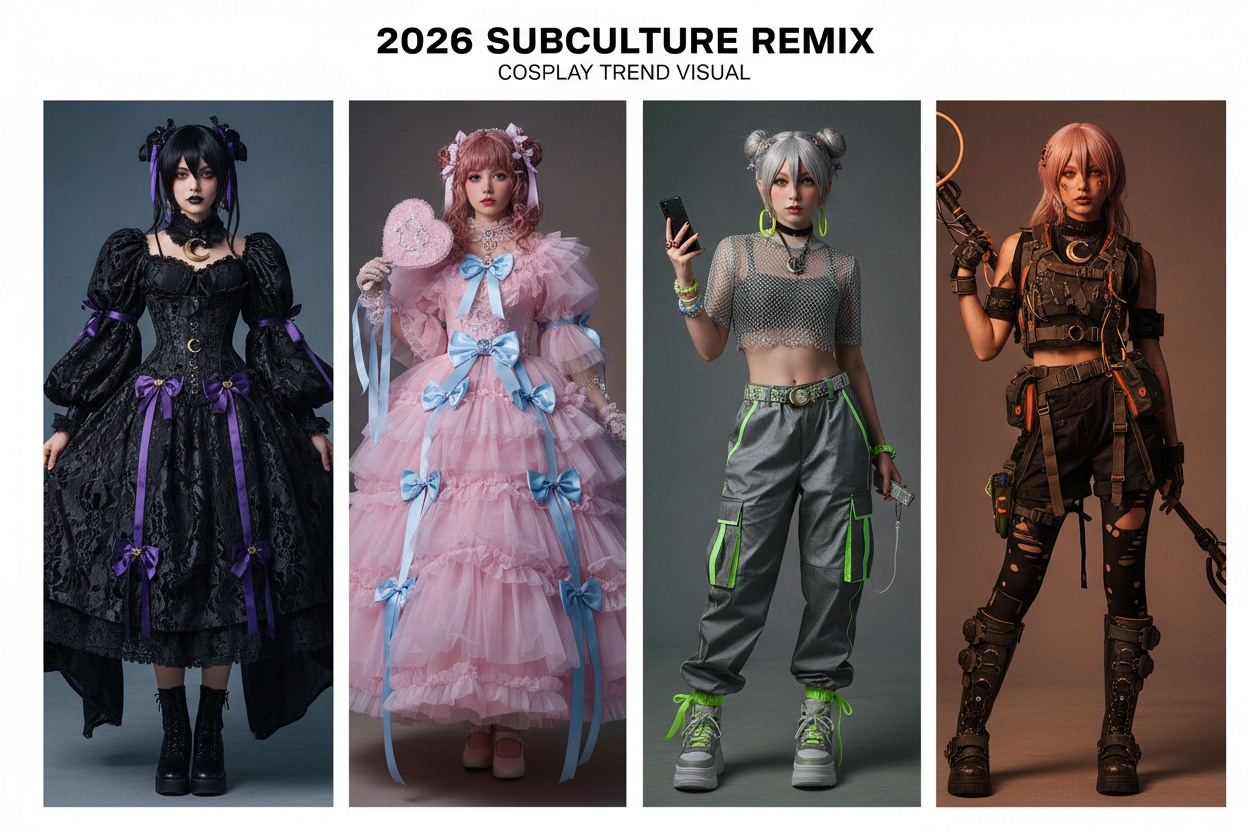
Instagram's cosplay feed has moved past straight screen-accuracy as the only goal. Fashion coverage tracking 2026's broader style shift describes it as a genuine subculture revival — Gen Z isn't reviving goth, Y2K, or cyberpunk aesthetics out of pure nostalgia, but remixing pieces from each into something reinterpreted and personal, prioritizing attitude over accuracy.
That same energy has fully landed in cosplay: instead of asking "how do I recreate this character exactly," creators are asking "what would this character look like styled through a goth, coquette, Y2K, or cyberpunk-wasteland lens" — a gothic-couture Nezuko, a ballet-coquette Hatsune Miku, a mesh-and-metallic Y2K reinterpretation of a magical girl. This guide walks through exactly how to build one of these remixed looks in a weekend, whichever subculture lens you want to shoot through.
What you'll need:
-
Clear reference images of your character's original design, plus a small mood board of your chosen subculture (Goth, Coquette, Y2K, or Cyberpunk-Wasteland)
-
Base garment pieces matched to your subculture (see Step Two for specifics per style)
-
A limited color palette — 2 to 3 colors maximum, chosen deliberately rather than defaulting to your character's full original palette
-
Subculture-appropriate accessories (detailed below)
-
Basic makeup kit and, if needed, a wig in a color that supports your remix rather than the character's original hair color
-
A simple lighting setup for photos — a single light source and a plain backdrop work well (see our editorial cosplay photography guide for a full setup)
Step One: Identify Your Character's "Anchor Traits"
Before touching any fabric or makeup, spend time deciding what has to survive the remix for people to still recognize the character. This is the step most first attempts skip, and it's the single biggest factor in whether a subculture remix reads as a clever reinterpretation or just an unrelated outfit that happens to share a name.
Look at your character's official art and pick two or three non-negotiable anchor traits — usually some combination of a signature color (Nezuko's pink-and-green kimono palette, Miku's teal), a defining silhouette element (a specific collar shape, a signature accessory like Nezuko's bamboo muzzle, Miku's twin-tail hair shape), and one instantly recognizable prop or hair detail. Everything else — fabric choice, garment style, overall silhouette, era — is fair game to reinterpret freely. Write these two or three anchors down before you move on; they'll be your checkpoint throughout the rest of the build to make sure the remix doesn't drift so far that the character disappears entirely.
Step Two: Translate the Look Through Your Chosen Subculture
This is where the actual remix happens, and the approach differs meaningfully depending on which aesthetic you're working in.
-
Goth: Lean into black or near-black fabric as your dominant base, built from structured, dramatic materials — corsetry, lace overlays, and leather or faux-leather accents in place of your character's original softer fabrics. Creating a cohesive Goth Costume means keeping one or two of your character's signature colors as small, deliberate accents rather than dominant tones — a thin ribbon, trim, or eye makeup color in the character's original palette keeps the anchor recognizable against an otherwise monochrome build. Silhouette-wise, goth remixes tend to favor structured, dramatic shapes — higher collars, longer hemlines, deliberate volume through layered skirts or draped fabric — over the character's original proportions.

-
Coquette: Build around soft, romantic materials — tulle, ribbon, lace in pale or pastel tones, ballet-inspired silhouettes like fitted bodices and full or layered skirts. For a complete Coquette Costume, bows are close to mandatory in this aesthetic and work well as a place to reintroduce your character's signature color in a controlled, feminine way. Where goth pushes toward drama and structure, coquette pushes toward softness and delicacy — think a character reimagined as if she stepped out of a ballet studio rather than her original setting.

-
Y2K: This is the aesthetic with the most internal variety — current style guides break Y2K down into sub-niches like Cyber-Y2K, Coquette-Y2K, and Mall Goth, so it's worth picking one specific lane rather than mixing all of them at once. When styling a Y2K Spicy Girl Style costume, the universal rules across sub-niches are a low-rise silhouette, and at least one of three key materials: distressed or flame-printed denim, metallic fabric, or mesh. For a cosplay remix specifically, metallic and mesh tend to translate a character's original design most legibly — a metallic bodice or mesh overlay can echo a character's original color and shape while still reading as unmistakably Y2K. Keep accessories chunky and deliberate — statement belts, layered jewelry, and platform footwear are all core to selling the era.

-
Cyberpunk-Wasteland: It's worth noting that 2026 cosplay trend coverage has flagged a specific shift within this aesthetic: the "shiny plastic," clean-chrome cyberpunk look that dominated a couple of years ago is giving way to a grittier, more weathered interpretation — think worn utility layers, distressed textures, and a sense of survival rather than sleek sci-fi polish. For an authentic Cyber-wasteland style costume, build your base from utility-style layering — harnesses, asymmetric straps, tactical pockets — in muted, desaturated tones, then introduce your character's signature color through weathering or staining rather than a clean block of solid color, which keeps the look feeling lived-in instead of costume-shiny. Faux leather, canvas, and matte technical fabrics all outperform anything glossy or reflective for this specific 2026 take on the aesthetic.

Step Three: Style Hair, Makeup, and Photography to Match
Your hair and makeup choices need to commit to the subculture as fully as your garment does, or the remix will read as a mismatched outfit rather than a cohesive reinterpretation.
-
For goth, favor dramatic, defined eye makeup and deep-toned lips, with hair styled sleek and structured or teased for volume depending on your reference mood board.
-
For coquette, soft, doll-like makeup — flushed cheeks, glossy lips, delicate lashes — paired with soft curls or half-up styling reinforces the romantic tone.
-
For Y2K, bold, graphic eyeliner or glitter accents and voluminous, era-accurate hairstyling (think claw clips, butterfly clips, or chunky highlights) sell the decade specifically rather than a generic "retro" look.
-
For cyberpunk-wasteland, matte, slightly weathered-looking makeup — smudged liner, muted tones, small scar or grime detailing — supports the gritty 2026 take on the aesthetic far better than anything glossy or clean.
When it comes to photographing the finished look, treat it as an editorial shoot rather than a standard con photo — a single, controlled light source (see our full editorial lighting walkthrough for the exact setup), a plain or thematically appropriate backdrop, and a mix of full-length shots with tight macro close-ups on fabric texture, jewelry, and makeup detail will do far more to sell the "high-fashion remix" feeling than a flatly-lit, straight-on photo ever could. Color grading in editing should reinforce your subculture choice — cooler, higher-contrast tones for goth and cyberpunk-wasteland, warmer and softer tones for coquette, and saturated, slightly harsh contrast for Y2K.
Common Troubleshooting and Mistakes to Avoid
-
The remix is unrecognizable as the original character. This almost always means one of your anchor traits from Step One got lost along the way. Go back and check — is your signature color present anywhere, even as a small accent? Is the defining silhouette or prop detail still there in some form? Reintroducing just one clear anchor is often enough to pull the whole look back into recognizable territory without sacrificing the subculture reinterpretation.
-
The look feels like it's mixing multiple subcultures at once and reads as confused rather than intentional. Pick one aesthetic lens and commit fully — a Y2K mesh top paired with goth corsetry and coquette ribbons all at once usually undercuts all three rather than creating something new. If you genuinely want to blend two aesthetics, choose one as your dominant 80% and let the second show up only in a single accent (one accessory, one color, one texture) rather than splitting the look evenly.
-
Cheap or clearly synthetic fabric breaks the "high-fashion" illusion. This category of cosplay leans hard on the material actually reading as quality on camera — a stiff, shiny polyester will undercut a goth or coquette look far more than it would a standard costume, since the entire visual language depends on fabric drape and texture looking intentional and elevated.
-
The color palette feels scattered rather than cohesive. Going back to a strict 2-3 color limit, decided before you start building, prevents this — it's tempting to include every color from your character's original design, but a tightly controlled palette is what makes a remix photograph as "editorial" rather than "costume."
-
Makeup doesn't match either the character or the subculture convincingly. This usually means the makeup choice was made independently of the rest of the planning. Treat your makeup palette as part of Step One's anchor-trait exercise — decide early which of your character's makeup details (eye shape, lip color, specific markings) need to carry through, and build your subculture-appropriate makeup style around preserving those rather than adding them as an afterthought.
Next Steps
Once you've built and photographed your first subculture remix, the format is highly repeatable — the same three-step process (identify anchors, translate through your chosen aesthetic, style and shoot to match) works for essentially any character and any subculture pairing, which makes this a great ongoing content series rather than a one-off project.
From here, experiment with applying a second subculture lens to the same character to see how differently the anchor traits can be reinterpreted, and consider building a small capsule wardrobe of subculture-specific pieces (lace and leather for a Goth Costume, mesh and metallics for a Y2K Spicy Girl Style costume that can be mixed and matched across multiple future remixes.
If you're ready to start building, check out our guides on sourcing goth-appropriate lace and leather fabric, Coquette Costume ribbon and bow accessories, Y2K mesh and metallic pieces, and weathering techniques for a convincing Cyber-wasteland style costume finish.

Dejar un comentario
Este sitio está protegido por hCaptcha y se aplican la Política de privacidad de hCaptcha y los Términos del servicio.