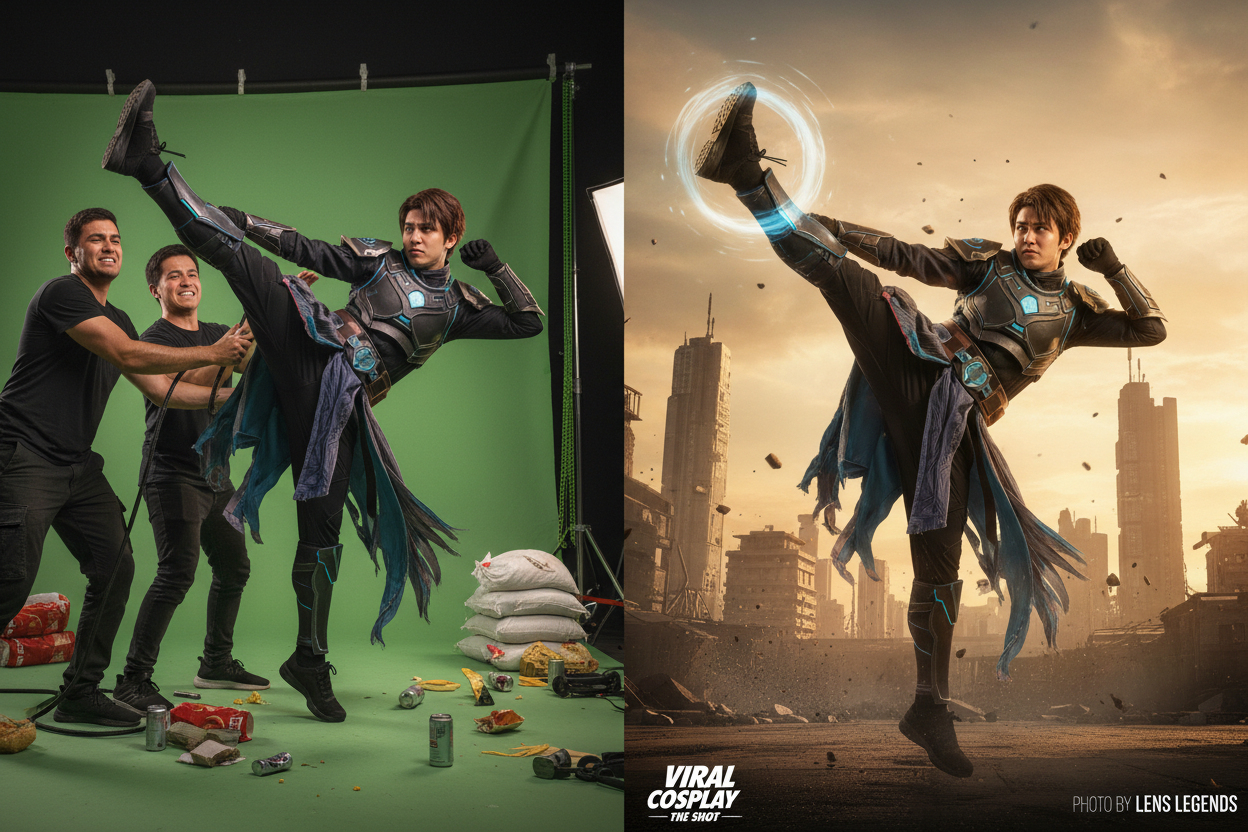
Some of the most-shared cosplay content on X right now isn't the final photo at all — it's the behind-the-scenes clip showing exactly what it took to get there. A cosplayer nailing Bayonetta's gravity-defying kick, a Final Fantasy character mid-air with a sword sweeping through a full arc, or Zenless Zone Zero's exaggeratedly arched, hyper-stylized combat poses — paired with a follow-up clip of three photographers gripping a belt, a wall-mounted harness, or someone genuinely hanging upside down to sell the angle.
The contrast is what makes it viral: the absurd, often hilarious effort required behind a single frame of effortless-looking dynamism. This roundup covers the tools and techniques cosplayers actually use to pull these shots off — selected based on how accessible they are for a small team (not a professional stunt crew), how well they hold up for genuinely extreme, gravity-defying poses rather than standard action shots, and, importantly, how safely they let you push the pose without real injury risk.
Quick Comparison
| Tool / Technique | Best For | Price | Core Highlight |
| Spotter Belt-Pull Technique | Quick, low-gear extreme lean/kick poses | Free (needs 1–2 helpers) | Simplest option, works almost anywhere |
| Clear Fishing Line / Suspension Wire | Suspending props or limbs briefly | $10–$25 | Invisible in final photos when lit correctly |
| Climbing-Style Safety Harness | Inverted or wall-hanging shots | $30–$90 | Genuine safety rating, reusable across shoots |
| Articulated Posing Mannequin | Planning pose mechanics beforehand | $15–$45 | Lets you test a pose before risking it live |
| Apple Boxes / Weighted Step Stools | Elevation and leverage without rigging | $20–$60 | Sturdy, reusable, doubles as general photo gear |
| Multi-Shot Photo Compositing | Achieving "impossible" poses safely | Free–$20/month | No physical risk at all — built entirely in editing |
| Mobility & Flexibility Training | Extending genuine range of motion | Free–low cost | Improves real capability over time, not just for one shoot |
1. Spotter Belt-Pull Technique
-
Core highlight: This is the technique behind most of the viral "three people holding my belt" BTS clips — one or two spotters physically supporting a cosplayer's weight from just outside the camera frame, allowing an extreme lean, kick, or off-balance pose that would be unsafe to hold unsupported.
-
Pros: Costs nothing beyond trusted friends willing to help, works in almost any location without special equipment, and is fast to set up and adjust between shots.
-
Cons: Requires spotters strong and attentive enough to actually bear real weight safely, and it only works for poses where a belt, waistband, or costume structure can bear the pull without damaging the costume.
-
Best for: Cosplayers working with a small, hands-on team who want to nail an extreme lean or kick pose without investing in dedicated rigging gear.
2. Clear Fishing Line or Suspension Wire
-
Core highlight: Thin, clear fishing line or specialized suspension wire can hold a prop, cape, or even a limb in an unnatural, mid-motion position — and when lit and angled correctly, it's essentially invisible in the final photo or easily removed in a quick editing pass.
-
Pros: Very inexpensive, extremely versatile for suspending capes, weapons, or hair in a "frozen mid-swing" look, and widely used across professional photography, not just cosplay.
-
Cons: Not rated for supporting a person's full body weight — this is a prop and limb tool, not a substitute for a real harness, and it takes practice to angle and light so it disappears in the shot.
-
Best for: Selling motion in a prop, cape, or weapon rather than the cosplayer's whole body — a common finishing touch layered on top of other techniques on this list.
3. Climbing-Style Safety Harness
-
Core highlight: For genuinely inverted shots — hanging upside down, "wall-crawling" angles, or anything where a cosplayer's full body weight needs real support — a proper climbing or rigging-rated harness is the only technique on this list built and tested specifically to bear that weight safely.
-
Pros: Actual safety certification behind the equipment, reusable across many future shoots, and it opens up pose options (true inversion, extended holds) that spotters alone can't safely achieve.
-
Cons: Requires some knowledge of how to rig an anchor point safely (a sturdy beam, wall mount, or rigging point — not an improvised setup), and it's a bigger upfront cost and learning curve than the other options here.
-
Best for: Cosplayers planning a genuinely inverted or suspended shot who are willing to invest in real safety equipment and, ideally, get guidance from someone experienced in rigging before attempting it solo.
4. Articulated Posing Mannequin
-
Core highlight: A small, fully articulated posing figure (the kind used by illustrators and photographers) lets you physically test whether an extreme pose is even anatomically achievable before you try to hold it yourself, saving a lot of trial-and-error — and potential strain — on shoot day.
-
Pros: Cheap, reusable for planning any future pose, and genuinely useful for figuring out camera angle and prop placement in advance rather than improvising on location.
-
Cons: It's a planning tool, not a shooting tool — it doesn't solve the actual physical challenge of holding the pose yourself.
-
Best for: Cosplayers who want to reduce shoot-day guesswork, especially for genuinely unusual poses pulled from a specific game screenshot or key art panel.
5. Apple Boxes and Weighted Step Stools
-
Core highlight: Borrowed directly from film and studio photography, sturdy, low-profile apple boxes and weighted stools give a cosplayer a stable, elevated surface to push off from, lean against, or partially stand on — supporting an exaggerated angle without any rigging at all.
-
Pros: Extremely sturdy and reusable for general photography use beyond just extreme poses, no rigging knowledge required, and safe to use solo without a spotter for many pose types.
-
Cons: Limited to poses where a stable surface just out of frame can realistically support part of the pose — it won't help with a true mid-air or fully inverted shot.
-
Best for: Cosplayers who want a low-cost, reusable piece of general shoot equipment that also happens to help with dynamic angles, without committing to specialized rigging gear.
6. Multi-Shot Photo Compositing
-
Core highlight: Rather than physically achieving an "impossible" pose at all, some of the most technically ambitious action shots are actually built from multiple separate, fully safe photos — a stable standing shot, a separately captured cape or hair "in motion," a jump captured at its peak — combined afterward in editing software into a single dynamic-looking frame.
-
Pros: Zero physical risk, since nothing dangerous is actually being held or attempted, and it can achieve angles that would be genuinely unsafe or physically impossible to hold live.
-
Cons: Requires real editing skill to blend elements convincingly, and purist audiences on X sometimes specifically want to see the "how'd they actually do that" BTS proof that comes from a live rig, not a composite.
-
Best for: Cosplayers with photo editing experience who want to hit truly extreme, physically impossible angles without any real safety risk at all.
7. Mobility and Flexibility Training
-
Core highlight: Unlike every other item on this list, this is a long-term investment rather than a shoot-day tool — regular stretching and mobility work genuinely extends how far a cosplayer can safely push a pose without a spotter, wire, or harness at all.
-
Pros: Improves your real physical capability over time, reduces injury risk across every technique on this list, and it's essentially free if you're following general mobility guidance rather than paying for specialized coaching.
-
Cons: It's a gradual process, not a quick fix for an upcoming shoot — this won't help you hit an extreme pose for a con happening next weekend.
-
Best for: Cosplayers who do a lot of dynamic, action-pose-heavy photography and want to build up genuine flexibility and control over time rather than relying entirely on external support each time.
How to Choose the Right Approach for You
Start with how extreme the actual pose is.
-
For a dramatic lean, kick, or off-balance angle, the spotter belt-pull technique is usually enough on its own and costs nothing beyond a helper or two.
-
For anything involving genuine inversion or full suspended body weight — the kind of shot that would seriously hurt someone if a spotter's grip slipped — don't cut corners: invest in a real, rated harness and, if you're new to rigging, get guidance from someone experienced before attempting it, or lean on photo compositing to achieve the same visual result without physical risk at all.
-
If you're shooting solo without a team of helpers, apple boxes and stable elevated props will get you further than you'd expect, and pairing them with a posing mannequin for pre-planning helps you work out the angle before you're actually holding the position under time pressure.
Whatever combination you land on, safety should come before the shot — a viral photo isn't worth a genuine injury, and honestly, a lot of the funniest, most-shared BTS content is precisely the moment where the "effortless" pose is revealed to have taken three people and a fair amount of visible strain to pull off.
Summary
The most gravity-defying cosplay action shots almost never happen by accident or through sheer physical talent alone — they're the result of a specific technique (or combination of techniques) chosen to match how extreme the pose actually is, with safety built in rather than left to chance.
Whether you're recreating a Bayonetta-style kick, a Final Fantasy mid-air sword arc, or Zenless Zone Zero's exaggerated combat perspective, matching your rigging method to the real physical demand of the pose — and never skipping a proper harness for genuinely inverted shots — is what separates a viral "how did they do that" post from a shoot-day injury.

Dejar un comentario
Este sitio está protegido por hCaptcha y se aplican la Política de privacidad de hCaptcha y los Términos del servicio.