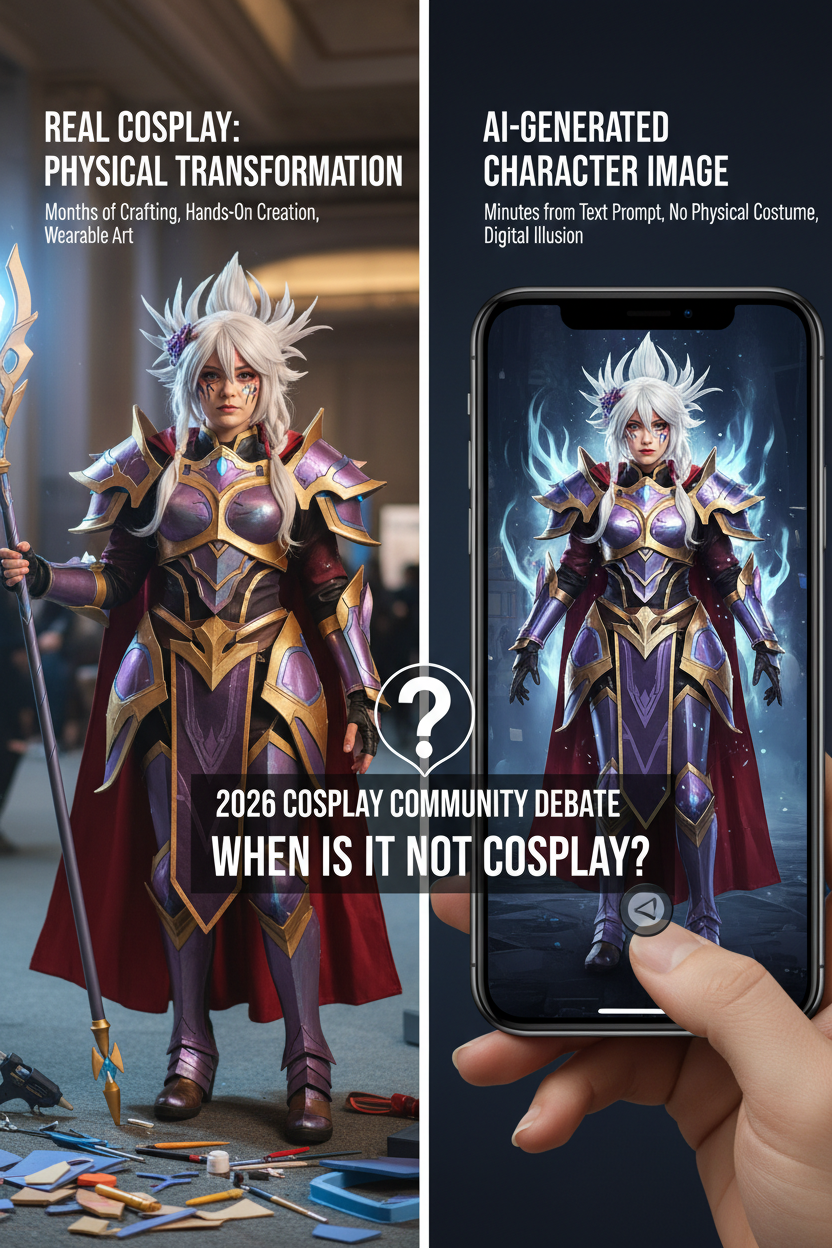
Introduction: Why “AI Cosplay” Has Become a Real Cosplay Culture Debate
Cosplay has always involved interpretation.
A person can buy a costume.
They can sew one from scratch.
They can modify existing clothing.
They can create armor from foam.
They can use makeup to transform their appearance.
They can even create an intentionally low-budget version of a character.
The community has historically been remarkably flexible about what counts as cosplay.
But generative AI introduces a fundamentally different question:
What happens when the person does not actually wear the costume at all?
That question is at the heart of the growing AI cosplay debate.
Throughout 2026, Reddit communities have increasingly discussed AI-generated images presented as cosplay. In one July discussion, users debated whether an image was AI-generated and criticized the growing number of AI cosplay accounts. Another discussion in the Genshin Impact community attracted hundreds of upvotes around accusations of “AI cosplay fakes.”
The controversy is not simply about whether AI images look good.
It is about something much deeper:
What exactly is cosplay?
Is cosplay defined by the final image?
Or by the physical act of becoming a character?
And if AI can generate an image of someone appearing to wear a perfect costume, where does cosplay end and AI-generated character art begin?
There are at least six important ways to look at this question.
1. The Traditional Definition: Does Cosplay Need to Be Physical?
The Traditionalist Position
The strongest argument against AI cosplay begins with the word itself.
“Cosplay” combines:
Costume + Play
The traditional activity involves physically dressing as a character and performing, posing, photographing, or otherwise embodying that character.
From this perspective, a completely AI-generated image does not contain the essential physical act.
A person may have generated an image of themselves as a character.
But they did not necessarily:
- Wear the costume
- Apply the makeup
- Style the wig
- Build the props
- Pose in the outfit
- Attend a convention
- Perform as the character
That distinction matters to many traditional cosplayers.
One Reddit discussion explicitly framed the issue around the idea that cosplay is fundamentally physical and wearable, arguing that an AI-generated image does not involve the same activity.
This leads to a simple definition:
Cosplay is something you do. AI-generated cosplay is something you generate.
From this perspective, calling both things “cosplay” creates unnecessary confusion.
2. The Creative Evolution Argument: Isn't AI Just Another Tool?
The Pro-AI Position
The opposite side makes a very different argument.
Cosplay has never required every element to be handmade.
Cosplayers already use:
- Purchased wigs
- Store-bought costumes
- 3D printers
- Digital design software
- Photoshop
- Professional photography
- LED electronics
- Laser cutters
- Sewing machines
- Commissioned props
So why should AI automatically be excluded?
Supporters of AI and cosplay may argue that generative AI is simply another creative technology.
Someone could use AI to:
- Visualize a costume
- Explore character concepts
- Design color combinations
- Create a fantasy environment
- Transform a photograph
- Develop a humanized character
- Experiment with alternate costume designs
Under this interpretation, AI does not necessarily replace cosplay.
It can become part of the creative workflow.
And this is where the debate becomes more complicated.
Because there is a huge difference between:
Using AI to help design a cosplay
and
Generating an image that completely replaces the physical cosplay.
Those two activities should not automatically be treated as identical.
3. The Real Divide: AI-Assisted Cosplay vs. AI-Generated Cosplay
This may be the most important distinction in the entire discussion.
Not everything described as AI generated cosplay actually involves the same process.
Consider these examples:
| Type | What Happens | Community Reaction |
|---|---|---|
| Physical cosplay | Person wears a real costume | Generally accepted |
| AI-assisted design | AI helps brainstorm costume ideas | More likely to be accepted |
| AI photo editing | Real cosplay receives AI effects | More complicated |
| AI background replacement | Real cosplayer remains physical | Often viewed differently |
| AI-enhanced cosplay | Real photo substantially modified | Debated |
| AI-generated character image | AI creates the entire appearance | Highly controversial |
| Fully synthetic cosplay | No physical cosplay exists | Most controversial |
This distinction is essential for real cosplay vs AI cosplay discussions.
Imagine a real cosplayer takes a photograph wearing a handmade costume and uses AI to replace the background with a fantasy castle.
The person still wore the costume.
The physical cosplay still existed.
Now compare that with uploading a selfie and asking an AI model:
“Turn me into this character wearing their complete costume.”
The result may look almost identical.
But the underlying creative process is completely different.
That is why the argument is not really about whether AI was used.
It is about how much of the cosplay actually existed before AI generated the image.
4. Craftsmanship: Why Cosplayers Feel AI Threatens Their Work
The Craftsmanship Argument
The strongest emotional reaction surrounding the AI generated cosplay controversy comes from craftsmanship.
Cosplay can involve enormous amounts of labor.
A costume might require:
- Pattern making
- Sewing
- Foam crafting
- Painting
- Wig styling
- Prop building
- 3D printing
- Jewelry making
- Makeup
- Testing
- Repairs
Some cosplayers spend weeks or months creating one costume.
Others build entire careers around those skills.
That makes the comparison with AI particularly sensitive.
Imagine two images appearing side by side.
The first comes from someone who spent 200 hours creating armor, sewing clothing, styling a wig, applying makeup, and photographing the finished costume.
The second was generated from a prompt in a few minutes.
If both are presented simply as:
“My cosplay”
the person who created the physical costume may understandably feel that the labor behind their work has been erased.
This concern appears repeatedly in 2026 community discussions. In one Reddit discussion about AI cosplay, users contrasted AI-generated images with low-budget real cosplayers who create costumes using ordinary materials and still manage to capture the character effectively.
That comparison reveals an important cultural value:
Effort itself has meaning in cosplay.
The finished image is only part of the experience.
The process matters too.
5. Authenticity: Why Are People Starting to Ask “Is This AI?”
This is where the debate becomes particularly interesting.
AI cosplay is not only creating new content.
It is also changing how people look at real cosplay.
In 2026, Reddit users have increasingly discussed whether apparently real cosplay photographs might actually be AI-generated. A CosplayHelp post from July 2026 involved a real cosplayer asking for help after being accused of using AI. The discussion received dozens of votes and comments.
Another CosplayHelp discussion focused specifically on how to identify AI-generated cosplay, with users pointing to unnatural details, overly smooth lighting, strange clothing construction, backgrounds, and other visual inconsistencies.
This creates a new problem:
AI does not just create fake cosplay. It can make people suspicious of real cosplay.
That is potentially more damaging to community trust than the existence of AI images alone.
A genuine cosplayer may post an unusually polished photograph.
Someone comments:
“AI?”
Another person replies:
“Definitely AI.”
The original creator then has to prove that they actually made and wore the costume.
That is a strange new burden for a community built around physical creativity.
6. AI Cosplay Ethics: Where Should the Community Draw the Line?
The Ethical Question
The biggest issue may not be:
“Is AI cosplay real cosplay?”
It may instead be:
“What should creators disclose when AI is involved?”
Transparency could provide a middle ground.
For example, creators could distinguish between:
Real cosplay
A physical costume was worn.
AI-assisted cosplay
AI was used for editing, effects, or design.
AI-generated cosplay
The final character appearance was substantially generated by AI.
This would not force everyone to agree about whether AI cosplay is “real.”
It would simply make the creative process clearer.
That matters because audiences currently cannot always tell.
The Contest Question: What Do Cosplay Competitions Think?
This is where the debate moves beyond social media.
Cosplay competitions have to make an actual decision.
If a contest judges:
- Costume construction
- Craftsmanship
- Performance
- Creativity
- Character accuracy
then completely AI-generated entries create an obvious problem.
There is no physical costume for judges to inspect.
There may be no craftsmanship to evaluate.
And there may be no performer physically wearing the costume.
As a result, some 2026 competitions have already taken explicit positions.
Youmacon 2026
Youmacon's cosplay rules state that generative AI is strictly prohibited in contest entries. The prohibition extends beyond final images and includes AI-generated build books, performance assets, character art, 3D-print files, patterns, and other materials.
San Japan 2026
San Japan's cosplay competition rules are even more explicit.
They prohibit generative AI in any aspect of an entry, including AI designs, build books, references, music, visual assets, and AI-generated voices. The rules state that violating the policy can result in removal from the contest and a two-year ban.
Tracon 2026
Tracon's Aurora Cosplay Tournament requires costumes to be substantially made by the competing group and explicitly states that generative AI is not permitted for pattern making or other aspects of the work.
This reveals something important.
The cosplay community does not necessarily need to reach a universal philosophical answer.
Competitions can establish their own definitions.
For a craftsmanship contest:
Physical creation may be a requirement.
For an online creative-image competition:
The rules may be completely different.
Context matters.
So, Is AI Cosplay Actually “Real” Cosplay?
There is no universally accepted answer.
But a useful framework is to separate the categories.
| Type of Creation | Should It Be Called Cosplay? | Why |
|---|---|---|
| Handmade physical cosplay | Yes | Physical costume and performance exist |
| Purchased physical cosplay | Generally yes | Person still physically wears the character |
| Low-budget cosplay | Yes | Creativity does not require expensive materials |
| AI-assisted costume design | Depends on context | AI supports rather than replaces cosplay |
| AI photo editing of real cosplay | Usually closer to cosplay | Physical cosplay still exists |
| AI-enhanced real cosplay | Debatable | Depends on how much AI changes the result |
| Fully AI-generated character image | Highly controversial | No physical costume may exist |
| AI-generated image presented as a real cosplay photo | Most problematic | Can mislead viewers about the creative process |
This is why the question “is AI cosplay real cosplay?” is more complicated than a simple yes-or-no answer.
The word “cosplay” is being used to describe several fundamentally different creative processes.
Real Cosplay vs. AI Cosplay: What Are People Actually Comparing?
The comparison becomes clearer if we separate output from process.
Output-Based View
From this perspective:
“If the final image looks like a person cosplaying a character, it is cosplay.”
The technology used to create the image is secondary.
Process-Based View
From this perspective:
“If nobody actually wore the costume, it is not cosplay.”
The physical transformation is essential.
Community-Based View
There is also a third perspective:
“The community gets to decide what the word means.”
This may ultimately be the most realistic answer.
Different communities can establish different standards.
A meme page may welcome AI character images.
A cosplay subreddit may prohibit them.
A convention photography group may require real costumes.
A cosplay craftsmanship competition may ban generative AI entirely.
None of these rules necessarily have to apply everywhere.
Why Low-Budget Cosplay Is an Important Comparison
One of the strangest aspects of the current debate is that low budget cosplay provides an excellent counterexample to the argument that cosplay is primarily about visual quality.
Low-budget cosplayers have been creatively recreating characters with:
- Household objects
- Cheap clothing
- Makeup
- Cardboard
- Paper
- Thrift-store finds
- Improvised props
The result may not look professionally manufactured.
But the creativity is still visible.
This is important because cosplay has historically valued interpretation over perfection.
Someone does not need a $2,000 costume to participate.
They simply need to create a version of the character.
That is why some community members react strongly when AI-generated images are presented as equivalent to physical cosplay.
The concern is not necessarily:
“AI looks too good.”
It is:
“The process that made the image is completely different.”
What About AI-Assisted Cosplay Design?
This is where the conversation becomes less black and white.
Suppose you want to create an original armor piece.
You use AI to brainstorm:
- Silhouette
- Color combinations
- Decorative elements
- Material ideas
Then you actually build the armor yourself.
Is that cosplay?
Most people would probably say yes.
The AI was a design tool.
The physical costume still exists.
Now imagine using AI to create a 3D-printable model, printing it, modifying it, painting it, and incorporating it into the costume.
The conversation becomes more complicated.
Some competitions may allow certain digital tools while explicitly banning generative AI.
Others may allow AI-assisted design but require disclosure.
This is why cosplay rules are likely to become more specific over time.
What Should Cosplayers Do If They Use AI?
The simplest recommendation is:
Be transparent.
If AI significantly contributed to the final image, say so.
For example:
“Physical cosplay photographed by me; AI used for background effects.”
or:
“AI-assisted concept design; final costume handmade.”
or:
“AI-generated character interpretation — no physical costume.”
This gives the audience enough information to understand what they are seeing.
It also prevents the most damaging scenario:
A completely AI-generated image being presented as a real cosplay photograph.
Transparency does not force everyone to like the work.
But it creates a clearer creative boundary.
What Does the Future of AI and Cosplay Look Like?
The most likely future is not that AI completely replaces cosplay.
Instead, we are likely to see several parallel forms.
Physical Cosplay
The traditional community continues creating and wearing costumes.
AI-Assisted Cosplay
Creators use AI as part of planning, design, editing, or post-production.
AI Character Art
Creators generate fictional representations of themselves or characters without physically cosplaying.
Hybrid Cosplay
A real costume is combined with AI-generated environments, effects, animation, or transformations.
The problem is that social media often compresses all four into one label:
“Cosplay.”
That is where confusion begins.
How Should You Think About AI Cosplay in 2026?
Instead of asking only:
“Is AI cosplay real cosplay?”
ask four separate questions:
1. Was there a physical costume?
If yes, there is a traditional cosplay component.
2. How much did AI contribute?
Was it a background effect or the entire costume?
3. Was the use of AI disclosed?
Transparency matters.
4. What is the context?
A social-media post, cosplay contest, photography community, and fan-art community may have completely different standards.
This framework is much more useful than simply declaring:
“AI cosplay is fake.”
or:
“AI is just another tool.”
Both statements are too broad.
How to Choose Between AI-Assisted and Traditional Cosplay
If your goal is craftsmanship, prioritize physical construction.
If your goal is character exploration, AI can potentially help with early concept development.
If your goal is social-media experimentation, hybrid approaches may be interesting.
If your goal is cosplay competition, always read the specific contest rules before using generative AI.
And if your goal is to participate in cosplay culture itself, actually making and wearing the costume remains the most direct way to participate.
For readers who want the physical experience, shop real handmade cosplay essentials and build from there—whether that means starting with a complete costume, adding a wig, experimenting with makeup, or modifying an existing outfit.
The point is not that every cosplayer must spend hundreds of dollars or learn to sew.
It is that physical participation remains one of the things that makes cosplay distinct from character artwork.
FAQ
Is AI cosplay real cosplay?
There is no universal definition. Traditional cosplay generally involves physically wearing or creating a costume, while fully AI-generated images may be better described as AI-generated character art. Different communities and competitions can establish their own definitions.
What is AI cosplay?
AI cosplay generally refers to images or videos created or substantially modified with generative AI to depict a person as a fictional character, sometimes without the person physically wearing the character's costume.
Is AI-generated cosplay fake?
Not necessarily in every context. AI-generated character art can be a legitimate form of digital creative expression. The controversy usually begins when AI-generated images are presented as though they document a real physical cosplay.
What is the difference between AI cosplay and AI-assisted cosplay?
AI-assisted cosplay involves using AI as part of a broader cosplay process, such as concept development or editing, while AI-generated cosplay can mean that AI creates most or all of the final character appearance.
Can AI be used in cosplay competitions?
It depends entirely on the competition. Some 2026 competitions explicitly prohibit generative AI. Youmacon, San Japan, and Tracon are examples of events with restrictions against generative AI in their cosplay competitions.
Why are cosplayers angry about AI cosplay?
Many concerns center on craftsmanship, authenticity, economic competition, misleading presentation, and the possibility that AI-generated images could overshadow people who spend significant time and money creating physical costumes.
Is using AI to edit a cosplay photo the same as generating a cosplay?
Not necessarily. If a real cosplayer wore the costume and AI was only used for a background or visual effect, the physical cosplay still exists. A fully generated character image is a fundamentally different process.
Conclusion: Maybe the Real Question Isn't “Is AI Cosplay Real?”
The 2026 AI cosplay debate is unlikely to disappear.
And perhaps that is because it is not really an argument about technology.
It is an argument about identity.
Cosplay is simultaneously:
- A craft
- A performance
- A fandom activity
- A form of fashion
- A creative hobby
- A social experience
- A form of self-expression
Generative AI challenges each of those definitions in a different way.
For traditionalists, cosplay means physically becoming the character.
For digital creators, AI may simply be another medium for exploring character identity.
For competition organizers, the answer can be determined through rules.
And for the broader community, the biggest issue may simply be transparency.
The most reasonable distinction may therefore be:
AI can create an image of cosplay without necessarily creating the physical act of cosplay.
That does not mean AI-generated character art has no creative value.
It means we should be precise about what we are looking at.
A person who spends months sewing, crafting, styling, painting, and wearing a costume has created something different from someone who types a prompt into an image generator.
Both can be creative.
But they are not necessarily the same activity.
And that distinction may become increasingly important as AI-generated images become harder to recognize.
The future of cosplay probably will not be AI vs. humans.
It will be a much messier ecosystem where:
Physical Cosplay + Digital Editing + AI-Assisted Design + AI Character Art
all exist side by side.
The real challenge for the cosplay community will be deciding what labels, rules, and cultural boundaries make sense for each one.
And that conversation has only just begun.

コメントを書く
このサイトはhCaptchaによって保護されており、hCaptchaプライバシーポリシーおよび利用規約が適用されます。