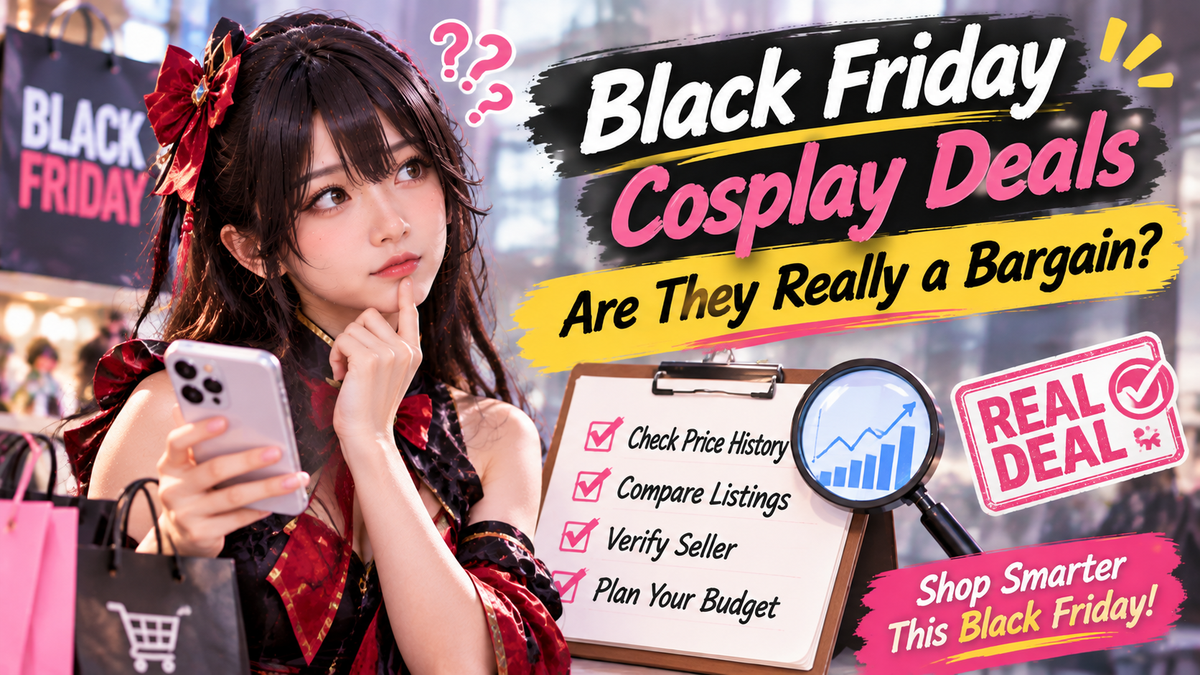
Introduction
Black Friday has become one of the biggest shopping events of the year, but not every advertised discount represents meaningful savings. For cosplay shoppers, the question is particularly important. A costume, wig, pair of boots, or set of character accessories may be purchased for a specific convention, photoshoot, or event, leaving little room to correct a bad purchase after the deadline.
Consumer skepticism is also becoming more visible. In Drive Research's October 2026 survey, 64% of Black Friday shoppers believed retailers raise prices before the event to make discounts appear more attractive, while 72% said deals were not as good as they used to be. A separate 2026 Boston Consulting Group study found that only 54% of surveyed consumers trusted advertised Black Friday prices to be genuinely lower than usual.
These findings do not mean every Black Friday promotion is misleading. They show why shoppers increasingly need evidence rather than relying on a large discount percentage.
For cosplay buyers, that evidence should cover three things: the product's actual price history, the quality and reliability of the seller, and whether the item can arrive in time for its intended use.
Question 1: Are Black Friday Cosplay Deals Really Cheaper Than Regular Prices?
Direct Answer: A Black Friday discount is only meaningful when the current price is lower than the product's recent selling price or a credible historical low. A large percentage reduction alone cannot prove that a costume or wig is a genuine bargain.
Why the advertised discount can be misleading
Retailers often present promotions by comparing a sale price with a previous or reference price. For example, a listing might show a costume reduced from $120 to $72, advertising a 40% discount.
However, the comparison does not tell you whether the costume was regularly selling for $120. If its ordinary selling price was already around $75, the advertised reduction may create a much stronger impression of savings than the actual price difference justifies.
This is the difference between an advertised discount and a verified price reduction.
The issue is recognized in consumer-protection guidance. In the United States, the Federal Trade Commission's Guides Against Deceptive Pricing explain that a former price used in a comparison should be a genuine price at which the product was openly offered for a reasonably substantial period. An artificially inflated former price created to make a later discount look larger can constitute deceptive bargain advertising.
The European Commission has also investigated online discount practices. In a March 2026 report covering 314 online traders, authorities found that approximately 30% referenced discounts incorrectly. Under the EU's price-reduction rules, the reference price generally needs to be the lowest price applied during the preceding 30 days.
These rules are useful examples of how regulators approach price transparency, although the exact legal requirements differ by market.
What price-tracking research tells us
A 2025 analysis published by Visualping monitored more than 1,500 retail products during the period leading up to Black Friday and Cyber Monday. It reported that approximately one-third of the tracked products were more expensive during the sale period than at their lowest observed price earlier in the season.
The study also found that the products classified as misleading deals were, on average, 37% above their lowest observed prices.
This is a useful warning, but it needs to be interpreted carefully. The research covered a selected group of products and retailers over a limited monitoring period. It does not establish that one-third of all Black Friday products, or one-third of cosplay products, are misleadingly discounted.
The practical lesson is narrower and more useful: the Black Friday label does not establish that a product is at its lowest price.
How to check price history for cosplay gear
Before purchasing a cosplay item, compare the current price with the price history of the same product.
A practical process looks like this:
-
Record the product and its exact version. Make sure you are comparing the same costume design, size, wig length, color, and included accessories. Similar-looking listings may contain different items.
-
Check the price over time. Look for a 30-day or longer price history where available. A longer period is more useful for identifying seasonal changes.
-
Compare the current price with ordinary selling prices. Do not rely exclusively on the crossed-out price or the advertised percentage.
-
Check the total checkout cost. Include shipping, taxes, import charges where applicable, and any required customization fees.
-
Set a target price. Decide what the item is worth to you before the countdown timer or promotional banner creates urgency.
For Amazon-listed products, tools such as Keepa and CamelCamelCamel provide price history charts and price-drop alerts. Amazon also offers price-history information on supported product pages.
One important limitation: these tools primarily track Amazon listings. They do not automatically provide historical pricing for every independent cosplay store or Shopify product page.
For an independent store, you may need to monitor the product page manually, save dated screenshots, or use a website-monitoring tool that records changes to the listing.
Question 2: How Can You Spot Fake Black Friday Costume Discounts?
Direct Answer: Look beyond the advertised percentage. Compare the current price with previous prices, check whether the product and included items are identical, and calculate the complete delivered cost. Unusually large discounts are a reason to investigate, not automatic proof of a bargain.
Check the product before comparing the price
Cosplay products are not always straightforward to compare. Two listings may use similar character names or promotional images while offering different materials, construction details, or included components.
For example, one costume listing may include the main outfit, gloves, and decorative accessories, while another sells only the clothing pieces. A lower price does not necessarily mean better value if the second listing requires several additional purchases.
Before treating two prices as comparable, check:
-
Character design and costume version
-
Fabric and construction details
-
Included clothing pieces
-
Wig, shoes, and accessory availability
-
Size chart and customization options
-
Shipping cost and estimated delivery date
This matters especially when searching for a black friday cosplay price history comparison. Historical prices are useful only when they refer to the same product or a genuinely comparable version.
Use a simple real-savings calculation
You can calculate the difference between the advertised discount and the discount against a more realistic reference price.
Consider this illustrative example:
| Price information | Amount |
|---|---|
| Advertised original price | $120 |
| Current Black Friday price | $72 |
| Recent ordinary selling price | $80 |
| Advertised discount | 40% |
| Discount against recent ordinary price | 10% |
The advertised reduction is 40% because the seller compares $72 with $120.
However, if the product was normally selling for around $80, the actual reduction against that recent price is only 10%.
The formula is:
Verified reduction = (Recent reference price − Current price) ÷ Recent reference price × 100
Using the example:
($80 − $72) ÷ $80 × 100 = 10%
This calculation does not determine whether a seller has broken any law. It simply gives shoppers a more realistic way to evaluate the value of a promotion.
Which tools can help track cosplay wig price drops?
The right tool depends on where the product is sold.
-
Keepa: Useful for tracking supported Amazon listings, viewing historical price charts, and setting price-drop alerts.
-
CamelCamelCamel: Another Amazon-focused tracker that provides price history and notifications when a product reaches a selected price.
-
Amazon's built-in price history: A convenient option for checking supported Amazon products without relying on a separate extension.
-
Website monitoring tools: Useful for independent store product pages when you want to record changes to a listed price over time.
For shoppers looking for verified cheap cosplay wig Black Friday deals, the most important step is to compare the exact wig rather than comparing only by character name or hairstyle.
A long twin-tail wig, for example, may differ substantially in fiber quality, length, density, color, and styling work. A lower price for a shorter or less complete version should not be interpreted as a better deal.
The same comparison principle applies to complete costumes. Check the included pieces, material information, sizing, and construction before deciding whether a discount represents good value.
Question 3: How Do You Check Cosplay Store Reliability Before Buying?
Direct Answer: Check whether the store provides clear product information, realistic shipping estimates, accessible customer support, transparent return policies, and credible customer feedback. For convention-bound purchases, delivery reliability and stock confirmation can matter as much as the price itself.
Why a low price is not the only buying consideration
A costume that arrives after a convention is not a successful bargain, even if the discount was substantial.
Cosplay purchases can involve more timing constraints than ordinary clothing purchases. Some shoppers need a complete outfit for a specific event, while others need time to alter a costume, style a wig, or replace missing accessories.
A store's reliability should therefore be evaluated through the entire purchasing process, not just the product page.
A 2023 study published in Heliyon, examining trust and customer loyalty in online shopping, identifies factors such as perceived security, accurate product information, and on-time delivery as relevant elements of the online retail experience.
The research is not specifically about cosplay retailers, but its findings provide a useful framework for evaluating online shopping reliability.
A practical cosplay store reliability check
Before placing an order, review these five areas.
1. Product information
A reliable product listing should explain what is included and provide useful details about materials, sizing, colors, and product variations.
Be cautious when a listing uses vague descriptions or images that do not clearly correspond to the selected version.
2. Shipping and event deadlines
Check the estimated processing time as well as the shipping time. These are not necessarily the same.
A product that ships in three to five business days may still require additional processing time before dispatch. Custom-made or made-to-order items may have different schedules.
If you need an outfit for a convention, contact the store before ordering if the delivery estimate is unclear.
3. Stock and customization confirmation
Do not assume that a product is available simply because its page is visible.
For customized costumes, confirm whether the selected size, color, and requested alterations can actually be fulfilled. If a seller needs to replace an unavailable item, you should understand the process and expected timing before paying.
4. Customer reviews
Look for feedback that describes actual purchasing experiences.
Useful reviews often discuss:
-
Whether the received product matched the listing
-
Fabric and construction quality
-
Wig appearance and styling
-
Packaging and shipping speed
-
Customer service when a problem occurred
-
How the seller handled refunds or replacements
Do not judge a store from one unusually positive or negative review. Look for repeated patterns across multiple independent customer experiences.
5. Return and refund policies
Read the policy before checkout, particularly for customized or made-to-order products.
Check whether returns are accepted, whether customization affects eligibility, who pays return shipping, and how damaged or incorrect items are handled.
A clearly written policy is more useful than a vague promise that the store offers excellent customer service.
Why accessories and complete outfit planning matter
A cosplay outfit is often made up of several separate purchases. A discounted main costume may still require a wig, shoes, gloves, jewelry, or other finishing pieces.
That means the total cost of the finished look can be very different from the price shown in a promotional banner.
Create a simple checklist before buying:
| Item | What to verify |
|---|---|
| Main costume | Design, size, included pieces |
| Wig | Color, length, fiber, styling |
| Shoes | Size, design, comfort |
| Accessories | Included or sold separately |
| Shipping | Processing time and delivery estimate |
| Final cost | Product price plus additional charges |
Planning the entire outfit also reduces the risk of buying a discounted item only to discover that the remaining components are unavailable or too expensive.
Conclusion: A Real Cosplay Deal Needs More Than a Discount Banner
Black Friday remains a useful opportunity to purchase cosplay costumes, wigs, and accessories, but a large discount percentage should never be the only reason to buy.
The growing skepticism around promotional pricing reflects a broader change in consumer behavior: shoppers increasingly want to understand what they are paying, whether the product is genuinely cheaper, and whether the seller can deliver what was promised.
For cosplay shoppers, three habits make a meaningful difference:
-
Check the product's price history instead of trusting the advertised discount.
-
Compare identical products and calculate the full cost of the finished outfit.
-
Evaluate store reliability, delivery estimates, customer feedback, and return policies before checkout.
A genuine deal is not simply the lowest number on a sale banner. It is a product that offers reasonable value, matches the description, comes from a seller you can evaluate, and arrives when you need it.
This Black Friday, compare the evidence before you buy. Your next convention outfit should be worth more than the discount printed beside it.



コメントを書く
このサイトはhCaptchaによって保護されており、hCaptchaプライバシーポリシーおよび利用規約が適用されます。