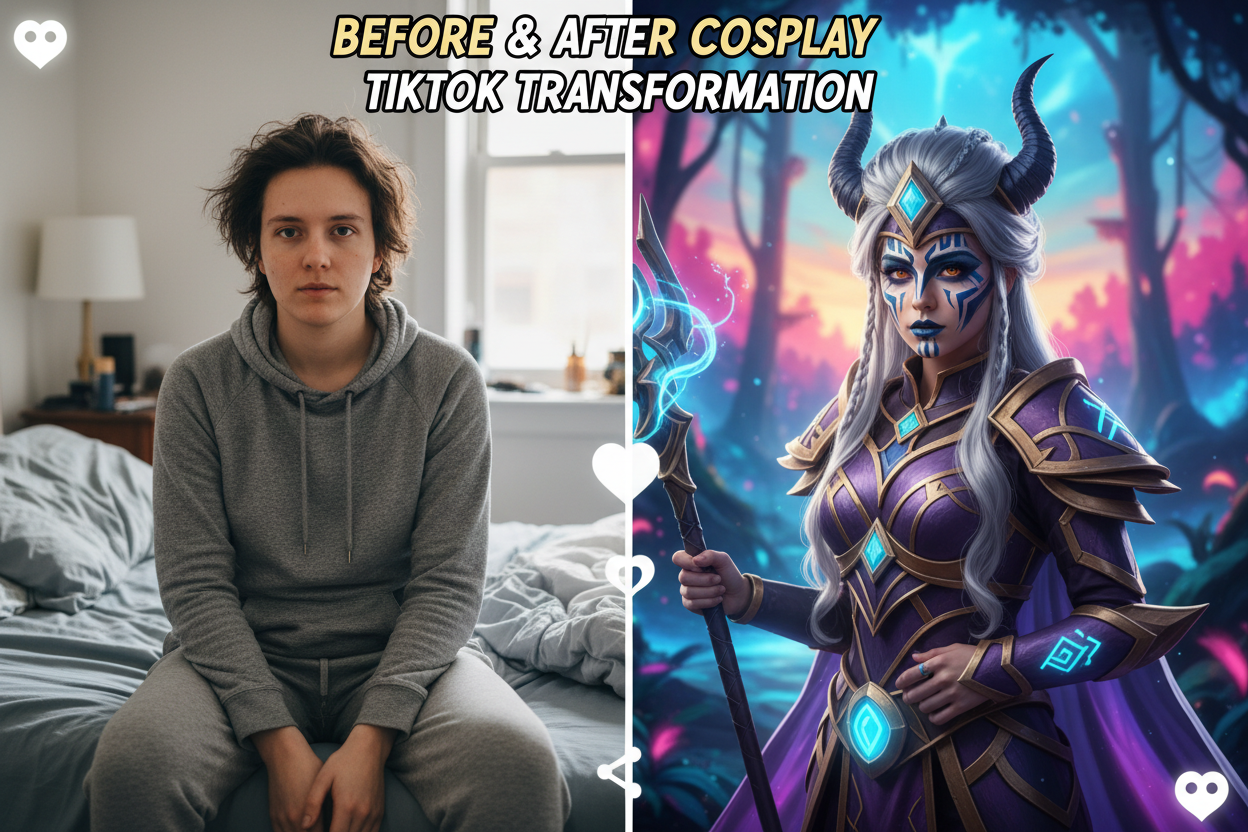
TL;DR: Two cosplay transition formats are dominating TikTok right now. The 2016 Nostalgia Reset cuts from a bare face to heavy 2016-era makeup (thick liner, cut crease, dramatic contour) set to throwback pop or anime music, riding a broader "2026 is the new 2016" nostalgia wave. The Color Palette Archetype trend skips named characters entirely and builds a look around one dominant color story — think mint cyber-witch or ice-blue winter fae — because a single, high-contrast palette reads instantly on a small screen and drives up watch-through rate. Both work because they're built for the algorithm first, character accuracy second.
Why These Two Trends Are Winning the Algorithm Right Now
TikTok's recommendation system rewards two things above almost everything else: how many people watch a video all the way through, and how quickly it hooks someone in the first second or two. Cosplay transitions are structurally built for exactly that. A "before" shot (bare face, plain clothes) creates a question the viewer wants answered — what does this become? — and the beat-synced cut to the "after" look pays that question off in under a second. That's the entire mechanical reason transition-style content consistently outperforms straightforward getting-ready or tutorial content: it's a hook-and-payoff structure compressed into a single clip, and it works whether someone watches once or rewatches to catch the cut frame-by-frame.
The 2016 Nostalgia Reset adds a second layer on top of that mechanic: shared cultural memory. 2016 has become a specific, widely recognized reference point on TikTok — heavy contour, boxy brows, cut creases, and the YouTube-tutorial-era "more is better" approach to makeup that a huge number of viewers either wore themselves or watched their favorite creators demonstrate a decade ago. Nostalgia content performs well generally, but it performs exceptionally well when the reference point is specific enough that people instantly recognize it and want to comment "I remember this" or tag a friend who wore the same look. Pairing that makeup era with music from the same window — old anime openings, early-2010s pop hits — reinforces the time-stamp even before the transition cut happens, which is why so many of these videos hold attention through the setup shot alone.
The Color Palette Archetype trend works on a different but related principle: visual clarity at a glance. Most people scroll TikTok with sound off or with a split-second attention span before deciding whether to keep watching. A cosplay built around a single, saturated color story — all mint, all ice-blue, all blood-red — reads as a cohesive "vibe" almost instantly, even to someone unfamiliar with the source character or with no character reference at all. That's a meaningful shift from traditional cosplay content, which has historically depended on the viewer recognizing a specific character to appreciate the craftsmanship. An archetype built around color doesn't need that recognition — it just needs to look striking enough in the first frame that someone stops scrolling, which is exactly what the algorithm is optimizing to detect and reward.
Key Elements and Where to Use Them
For the 2016 Nostalgia Reset: the "before" shot should be as plain and undone as possible — bare face, hair not styled, ideally in a mundane setting like a bedroom or bathroom, since the flatness of the starting point makes the transformation land harder. The "after" look needs specific, recognizable era markers rather than generic "dramatic makeup": a sharply overlined, ultra-matte lip in deep red or nude, boxy geometric brows, heavy cut-crease eyeshadow blending into dramatic contour mapping, and glitter or shimmer used deliberately rather than sparingly. Wig and costume choices from this era tend to favor big voluminous curls or sleek straight styles with heavy side-swept bangs. This format works especially well for anime and game characters who were popular around 2015–2017, since pairing an era-accurate makeup style with a character from that same window doubles down on the nostalgia hook instead of splitting it across two different reference points.
For the Color Palette Archetype trend: start by picking one dominant hue and committing to it across every visible element — wig, contacts, eyeshadow, and costume fabric should all sit in the same narrow color family, with at most one accent tone for contrast. Popular archetypes right now include icy blues and silvers for "winter fae" or frost-witch looks, deep mint and seafoam for "cyber witch" or sci-fi sorceress concepts, and blood reds or near-black for villain-glam archetypes. Because this format isn't tied to a specific character, it's a strong fit for original character (OC) cosplay and fantasy mashups, and it pairs well with small wearable lighting elements — LED wig strands, fiber-optic accents, UV-reactive makeup — since a light-up detail in a matching color amplifies the palette instead of competing with it. This is also the format where photo and video lighting matters the most: a strong single-color palette can wash out or look muddy under warm indoor lighting, so cool white or color-matched lighting setups tend to perform noticeably better on camera.
Common Mistakes to Avoid
The most common failure with the 2016 Nostalgia Reset is going "dramatic" without going specific — a heavy smoky eye alone doesn't read as 2016 the way a cut crease with boxy brows and an overlined matte lip does, and viewers who lived through that era will notice the difference immediately in the comments. A second common issue is music mismatch: pairing 2016-era makeup with current pop music, or vice versa, undercuts the nostalgia hook entirely, since the whole format depends on sight and sound reinforcing the same time period together. It's also worth using TikTok's commercial sound library or officially cleared audio where possible, since transition videos that get flagged for audio rights issues can get muted or throttled in distribution, which defeats the purpose of a format built entirely around the sound-to-visual cut.
For the Color Palette Archetype trend, the most frequent mistake is diluting the palette with too many colors "just in case" — adding a second or third contrasting hue to make the look feel more complete usually backfires, since the entire appeal of this format is instant visual clarity, and a busier palette takes longer to read on screen. Another common issue is treating this as purely a makeup or wig challenge while neglecting fabric: a cyber-witch archetype built with plain cotton or basic polyester in the right color still won't have the sheen, texture, or movement that makes the look feel intentional rather than accidental. Finally, cosplayers sometimes underestimate lighting's impact on saturated color palettes specifically — a look that appears vivid and cohesive in person can appear flat or color-shifted on camera without deliberate white balance and lighting choices, which is worth testing before committing to a full shoot.
Summary and Further Reading
Both trends are ultimately about designing for how people actually watch short-form video — a sharp before/after contrast and a color story that reads in half a second — rather than optimizing for character accuracy alone. If you're planning your next transition video, it's worth treating your makeup era, your color palette, and your wardrobe as one coordinated decision rather than three separate ones.
For more on building a cohesive look, check out our guides on choosing the right colored wig for a single-palette archetype, styling era-accurate cut-crease makeup at home, and adding wearable LED accents to an existing costume without a full rebuild.

コメントを書く
このサイトはhCaptchaによって保護されており、hCaptchaプライバシーポリシーおよび利用規約が適用されます。