💡 Systemic Briefing:
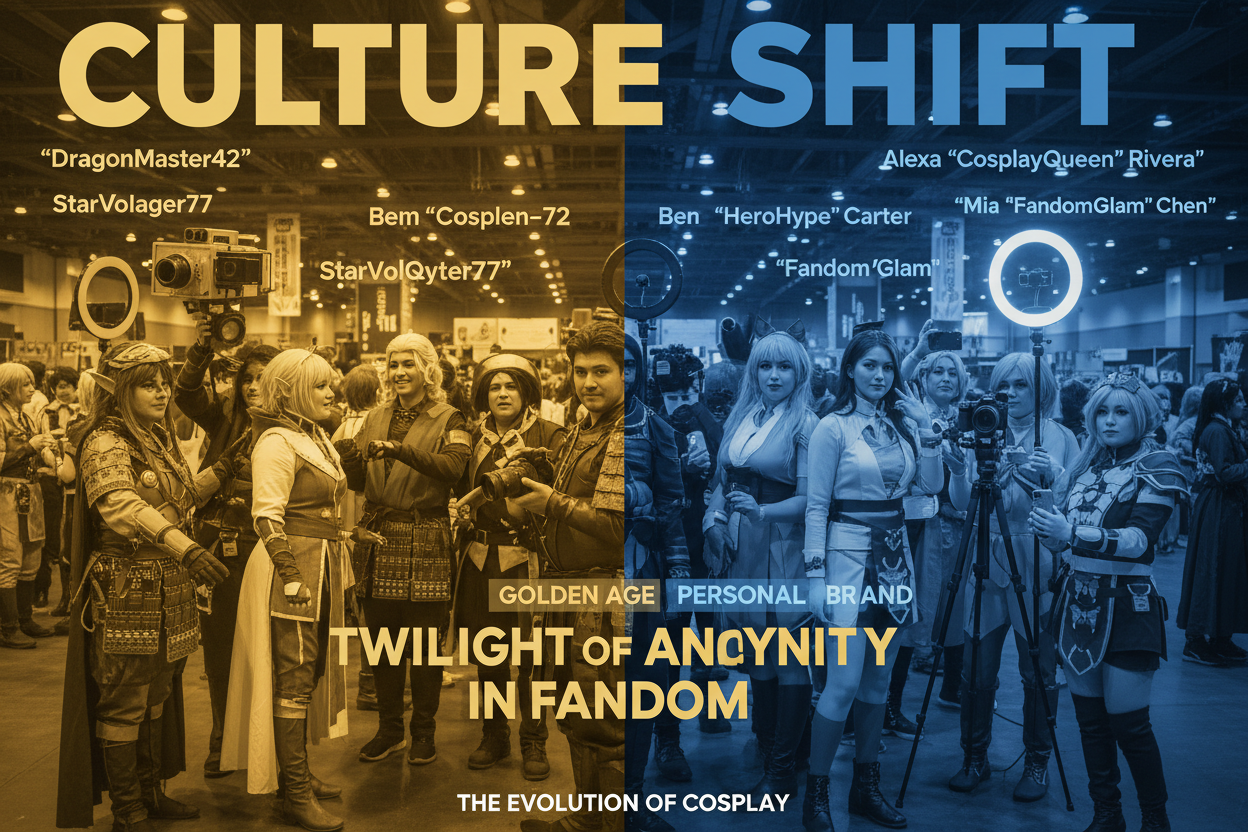
A profound ideological shift has quietly reached a tipping point within the global ACG subculture. For decades, cosplay operated as an anonymous sanctuary where a participant's real-world identity was entirely secondary to the character they portrayed. Fandom spaces were built around forum usernames, community nicknames, and a shared hobby identity. Today, however, that paradigm is collapsing. Driven by the monetization mechanics of modern internet culture and online identity algorithms, the subculture has transitioned into an era dominated by the real-name creator and the personal brand. Across Reddit cosplay communities, Tumblr fandom discussions, and veteran convention panels, a bittersweet debate is raging: Have we traded a pure, character-first utopia for a hyper-commercialized world where the person matters more than the character?
1. Core Character IP Analyses: The Evolution of Identity
To understand how the decay of anonymity impacts the subculture, we must analyze three iconic properties that span different eras of digital community building.
🎭 Hatsune Miku cosplay costume (Vocaloid)
-
The Vintage Era: Born in the golden age of decentralized, anonymous internet culture, the classic Hatsune Miku cosplay costume—with its signature turquoise twin-tails and futuristic school uniform—originally served as a blank canvas. Early cosplayers interacted using obscure forum usernames or localized community nicknames. On the convention floor, the individual behind the mask was irrelevant; the collective joy came from seeing the digital diva brought to life. The character was always greater than the person.
-
The 2026 Friction: On Reddit r/vocaloid and retro fandom spaces, veterans are noting a stark change. The Hatsune Miku cosplay costume is frequently used as a high-visibility tool for content creators to drive traffic to their personal brand platforms. Discussions center on how the iconic outfit has transformed from a symbol of communal (doujin) passion into a recognizable aesthetic template designed to boost real-name creator metrics within short-form video algorithms.
🎭 Raiden Shogun / Furina cosplay costume (Genshin Impact)

-
The Modern Era: As a product of modern, highly commercialized fan culture, Genshin Impact represents the absolute peak of the creator-first landscape. The Raiden Shogun cosplay costume and Furina cosplay costume are masterpiece designs engineered for massive visual impact.
-
The 2026 Friction: Unlike vintage properties, these outfits are heavily utilized within a highly optimized, cross-platform media matrix. On TikTok and modern cosplay circles, performers do not seek to disappear into the character. Instead, they use the immense built-in search volume of a Furina cosplay costume to anchor their own real-world modeling personas and consumer brands. Fandom observers on Tumblr point out that the performance is no longer about embodying the Archon's lore; it is about utilizing the character's clout to build an individual aesthetic business, placing the person firmly above the character.
🎭 Tifa Lockhart / Cloud Strife cosplay costume (Final Fantasy VII)

-
The Trans-Generational Era: Spanning nearly three decades, Final Fantasy VII carries the heavy nostalgic weight of old-school gaming forums alongside modern cinematic remakes. The Tifa Lockhart cosplay costume and Cloud Strife cosplay costume are sacred designs for veteran gamers who spent years cultivating a pure hobby identity around these figures.
-
The 2026 Friction: This franchise is the center of intense generational conflict on platforms like ResetEra and Tumblr. Traditionalists complain that old-school, anonymous craftsmanship circles—where people spent months silently building buster swords in obscurity—are being overshadowed by professional, real-name creators who churn out highly optimized variants of Tifa Lockhart to maintain algorithm consistency. It highlights a painful community split: Older fans view the monetization of these characters as a loss of a sacred, anonymous sanctuary, while younger creators defend it as the legitimate professionalization of a modern visual art form.
⚖️ 2. The Structural Shift: Character Over Person vs. Person Over Character
The decline of anonymity has fundamentally rewritten the social contract of attending a convention.
[ OLD-SCHOOL PARADIGM ]
Forum Anonymity ──► Absolute Character Immersion ──► "Look, there is Tifa!" (Community-Centric)

[ MODERN PARADIGM ]
Real-Name Branding ──► Character as a Visual Filter ──► "Look, there is Creator X!" (Influencer-Centric)
In the traditional era, walking through a convention was an immersive experience in shared fiction. You spoke to a cosplayer as the character, completely unaware of their real-world job, name, or social status. In 2026, that boundary has dissolved. Attendees frequently queue not to appreciate a specific garment's construction, but to meet a specific internet personality who happens to be wearing that garment. The costume has shifted from being the final goal of expression to a powerful marketing funnel for a personal brand.
📈 3. The Algorithmic Impact on Independent Creation
This cultural evolution is directly driven by the mechanics of modern online identity platforms. Image and video algorithms favor consistent faces, real identities, and continuous personal branding over rotating fictional characters. When an independent cosplayer remains completely anonymous, hiding behind a mask or a changing rotation of heavy character makeup, algorithms struggle to categorize and reward their content. To survive in the digital economy of 2026, creators are forced to step out from behind the veil of the character, leading directly to the decline of the traditional, anonymous hobby identity.
📊 4. The Supply Chain Registry: Manufacturing for the Personal Brand Era
As anonymity declines and cosplay becomes an extension of professional lifestyle modeling, the structural requirements for manufacturing costumes have radically shifted. Independent studios and e-commerce platforms must cater to creators who demand high-performance, photogenic clothing that serves a premium personal brand:
| Target Character Node | The Branding Reinterpretation | Traditional Design Flaw | 2026 Supply Chain Standard | E-Commerce Strategy Shift |
|
Hatsune Miku (Vocaloid) |
Transitioning from communal同人 representation to high-visibility personal branding. | Low-grade fabrics look flimsy under professional ring lights and studio setups. | High-density Neoprene and matte anti-glare synthetics that hold clean lines during high-definition street photography. | Focus on specialized, fashion-forward alternative variants that make a creator stand out in algorithm feeds. |
|
Raiden Shogun / Furina (Genshin Impact) |
Utilizing massive canon search traffic to build a real-name influencer portfolio. | Complicated, slow-to-wear armor plates that limit movement during long videography sessions. | Lightweight, screen-accurate composite metals and integrated magnetic fastening systems for fast assembly. | Optimize designs for mobility, enabling creators to perform complex choreography for short-form video formats. |
|
Tifa Lockhart / Cloud (Final Fantasy VII) |
Bridging the gap between nostalgic hobby identity and premium commercial art. | Stiff, un-breathable faux leather that creases permanently after a single event appearance. | Ultra-supple, four-way stretch breathable polyurethane leathers paired with custom-cast alloy belt buckles. | Market costumes as premium, luxury garments rather than disposable party props to appeal to elite creators. |
❓ 5. Frequently Asked Questions (FAQ)
-
Q: Does the decline of anonymity mean that the core passion for cosplay is dying out?
-
A: Not at all. The passion has simply changed its structure. While the old-school, anonymous forum culture is shrinking, it is being replaced by a highly professionalized form of visual art where creators have real agency, financial independence, and direct ownership over their work. It is an evolution from an insular hobby into a recognized global creative industry.
-
-
Q: How can independent, non-commercial cosplayers still enjoy the subculture without building a personal brand?
-
A: Localized convention communities and private meetup groups remain incredibly resilient sanctuaries for hobbyists. Many fans intentionally choose to separate their casual, everyday internet presence from their real-life convention experiences, creating close-knit offline spaces where character immersion and anonymous fun still thrive without the pressure of metrics.
-
-
Q: How should e-commerce apparel brands adjust their marketing to appeal to this new era of real-name creators?
-
A: Brands need to move away from marketing costumes solely to "fans of the character." Instead, they should frame their premium apparel lines as professional tools that empower a creator to produce flawless, high-engagement content. Highlighting fabric durability under studio lights, fast assembly, and high-definition photography readiness will naturally capture the modern, brand-conscious buyer.
-
🎯 Conclusion: The Balance Between Sanctuary and Stage
The ongoing debate surrounding the decline of anonymous cosplay culture is not a sign of the subculture's decay, but a reflection of its incredible maturity. While it is natural to feel nostalgic for the quiet days of obscure forum user names and pure character-first isolation, the rise of the real-name creator has brought unprecedented visibility, respect, and artistic innovation to the medium. Cosplay in 2026 continues to be a magnificent engine for imagination—whether it is used as a private sanctuary to escape the real world or a global stage to build a creative empire.

コメントを書く
このサイトはhCaptchaによって保護されており、hCaptchaプライバシーポリシーおよび利用規約が適用されます。