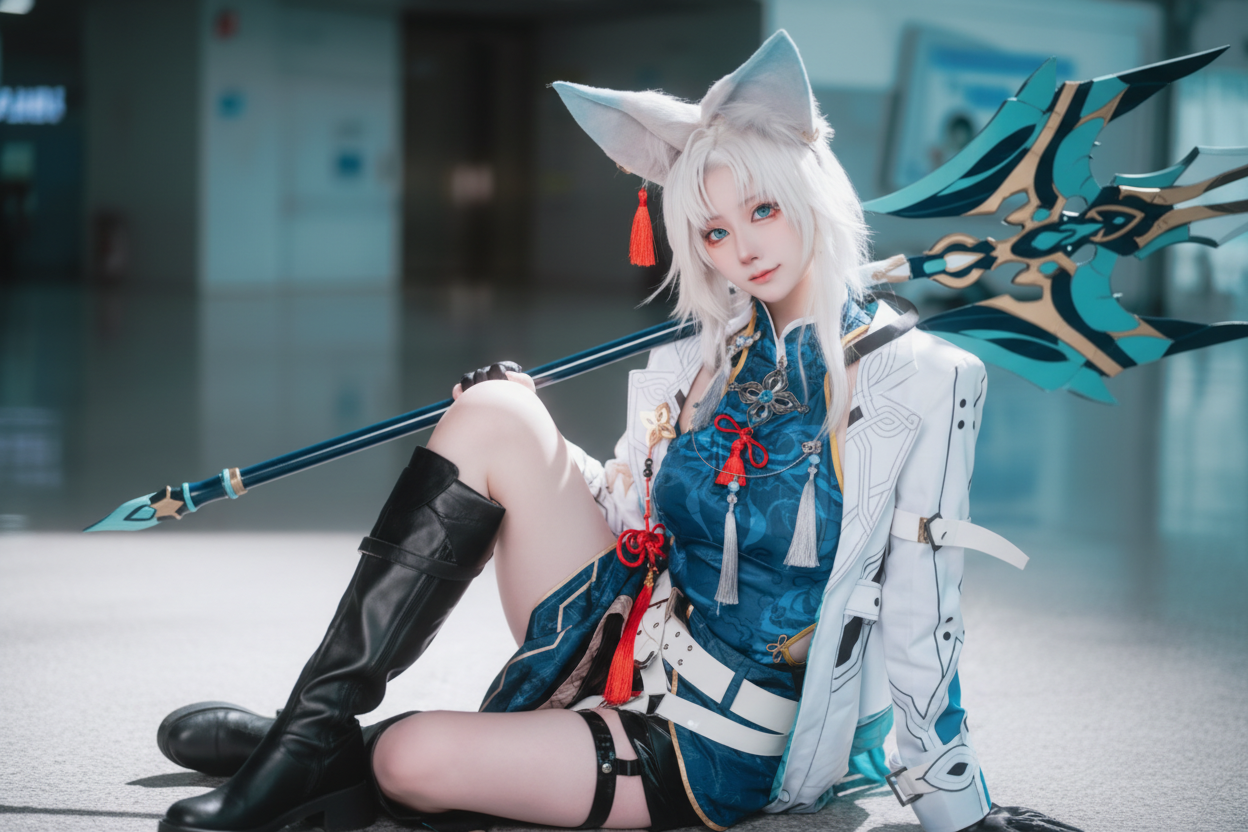
When HoYoverse officially unveiled the character artwork for Xianzhou Yaoqing’s General Feixiao and her trusted advisor Jiaoqiu in Honkai: Star Rail, commercial cosplay factories listed pre-orders for mass-produced outfits in under 48 hours.
This hyper-accelerated release cycle ignited a massive viral debate across Reddit (r/cosplay) and X (formerly Twitter). Traditional handmade artisans accused fast-fashion factories of ruining garment craftsmanship and destroying independent tailoring, while budget-conscious casual fans defended mass production as a vital victory for accessibility and inclusion.
Below are the 5 core questions that break down this clash between commercial automation and traditional artisan craftsmanship.
Question 1: How can commercial factories release a Honkai: Star Rail Feixiao costume within 24 to 48 hours of an official reveal?
Direct Answer: Commercial factories utilize modular pattern templates, digital sublimation printing, and automated pattern-cutting software to immediately translate 2D artwork into 3D garments. By opening instant pre-orders based on digital renders before physical prototyping finishes, factories secure upfront capital and streamline rapid factory line production.
+-----------------------------------------------------------------------+
|                 24-48 HOUR FAST-FASHION WORKFLOW                       |
|                                                                       |
|  [Official Artwork Reveal] ---> [AI/Vector Pattern Extraction]        |
|                                                |                      |
|  [Sublimation Fabric Printing] <----------------+                      |
|                 |                                                     |
|  [Digital Render Pre-Order] ---> [Batch Factory Assembly & Shipping]  |
+-----------------------------------------------------------------------+
Background & Operational Logic
Modern commercial cosplay brands (such as Uwowo, DokiDoki, and Miccostumes) operate on a hyper-agile manufacturing model similar to fast-fashion retail giants. The moment official drip marketing for a character like Feixiao or Jiaoqiu drops online, digital pattern makers analyze the 2D illustration using vector software.
Instead of hand-drafting physical patterns or sourcing specialized embroidered brocades, factory designers map complex garment details—such as Feixiao’s military trims, fur collar linings, and coat emblem gradients—directly onto flat polyester digital templates.
These designs are applied via high-speed sublimation printing, cut with laser tools, and rendered digitally for instantaneous pre-order listings. By collecting pre-orders before physical garments are stitched, factories eliminate inventory risk and optimize batch assembly lines in real time.
Question 2: Why do traditional artisans claim fast-fashion factory releases are destroying cosplay craftsmanship?
Direct Answer: Traditional tailors argue that ultra-cheap mass production commodifies cosplay into disposable fast fashion, undercutting skilled artisans who invest hundreds of hours perfecting tailored silhouettes and premium materials. They warn this devaluation drives independent custom tailors out of business and degrades overall costume quality standards.
              TRADITIONAL ARTISAN vs. FAST-FASHION FACTORY

 +----------------------------------+  +----------------------------------+
 |       TRADITIONAL ARTISAN        |  |       FAST-FASHION FACTORY       |
 +----------------------------------+  +----------------------------------+
 | • Bespoke anatomical drafting    |  | • Standardized Asian size blocks |
 | • High-grade brocade/silk/leather|  | • 100% synthetic polyester blends|
 | • 40 to 100+ hours of hand labor |  | • Automated 2D flat printing     |
 | • Built for longevity & mobility |  | • Single-season disposable wear  |
 +----------------------------------+  +----------------------------------+
Background & Community Backlash
In prominent Reddit discussions on r/cosplay, independent tailors and prop makers expressed frustration over how rapid commercialization distorts consumer perception. Creating an authentic, screen-accurate Feixiao coat requires bespoke pattern drafting to accommodate real-world human proportions, structural shoulder padding to support heavy military coats, and physical applique layering for metallic trims.
When mass-production factories flood online marketplaces with $60 to $90 printed polyester suits within days, consumers develop unrealistic price expectations. Independent artisans spending 40 to 100 hours crafting a single coat cannot compete with factory-line prices.
Tailors warn that this shift turns a craft once centered on skill-building, sewing techniques, and material selection into a fast-food culture driven by immediate gratification, single-use photo shoots, and landfill-bound synthetic garments.
Question 3: How do casual players and budget buyers defend purchasing mass-produced Honkai: Star Rail costumes?
Direct Answer: Budget cosplayers defend mass-produced outfits as an essential tool for accessibility, allowing fans without sewing skills, high disposable income, or hundreds of spare hours to participate in conventions. They reject handmade exclusivity, emphasizing that fan celebration should not be restricted by steep financial barriers.
Background & Accessibility Arguments
On X and TikTok, casual gamers pushed back forcefully against accusations of "ruining the hobby." For many fans, ordering a pre-made Honkai: Star Rail Cosplay Outfit is the only feasible way to participate in convention culture.
       BARRIERS TO ENTRY: BESPOKE vs. MASS PRODUCTION

 Custom Artisan Commission   [ $$$$$ ]  $600 – $1,500+ | 8–12 Weeks Wait
 Mass-Produced Pre-Order     [ $ ]      $70 – $120     | 2–3 Weeks Delivery
Supporters of factory production emphasize several practical realities:
-
Financial Inclusivity: A bespoke, hand-tailored Feixiao coat commission can easily exceed $800 to $1,500, placing it far out of reach for students, young adults, or casual convention attendees.
-
Time Constraints: Drafting patterns, fitting mockups, and hand-stitching complex garments requires hundreds of hours that working professionals and students do not have.
-
Skill Barriers: Cosplay is ultimately a form of character fandom and social celebration; forcing every fan to become a master seamstress creates unnecessary gatekeeping.
Casual fans argue that commercial production democratizes the hobby, letting anyone dress up as their favorite General without incurring crippling debt or sacrificing weeks of free time.
Question 4: What are the critical quality and fitting differences between 24-hour factory outfits and custom tailor builds?
Direct Answer: Factory outfits rely on standardized Asian sizing, non-breathable synthetic polyester, and flat printed graphics instead of physical embroidery, resulting in stiff fits and lower durability. Custom tailor builds offer precise anatomical fitting, authentic textured fabrics, structural boning, and durable long-term construction.
Deep-Dive Feature Comparison
| Evaluation Metric | 24-Hour Factory Outfit (Mass Produced) | Custom Tailor Build (Handmade Artisan) |
| Material Composition | Standard 100% thin polyester, synthetic lining, printed vinyl | Textured jacquard, cotton-silk brocade, real leather accents |
| Trims & Embellishments | Flat 2D sublimation printed patterns on fabric | Physical 3D metallic embroidery, raised trims, metal filigree |
| Fit & Silhouette | Standardized fixed sizing (often runs small/rigid at shoulders) | Custom tailored to individual body measurements & proportions |
| Mobility & Breathability | Limited stretch, heat-retaining synthetic layers | Breathable linings, targeted stretch panels, articulated joints |
| Durability & Reusability | Delicate seams; prone to peeling/fraying after 1–2 washes | Reinforced stress points; built for multi-year convention wear |
Feixiao’s character design features a sharp, structured military silhouette paired with fluid teal coat tails and fur-accented shoulders. Mass-produced versions often use flat printed graphics to simulate gold embroidery and lightweight faux-fur collars that lack volume.
In contrast, an artisan build uses physical boning inside the coat waist, heavy faux-fur weight-balanced across the collarbone, and structured shoulder epaulettes that maintain their crisp shape even when moving through crowded convention halls.
Question 5: How can cosplayers strike a balance between budget-friendly factory buys and supporting independent artisans?
Direct Answer: Cosplayers can balance cost and craftsmanship by adopting a hybrid strategy: purchasing a budget mass-produced base garment for basic layers, then upgrading high-visibility focal points—such as Feixiao’s shoulder armor, weapon props, or wig styling—by commissioning independent artisans or modifying the outfit themselves.
                    THE HYBRID UPGRADE METHOD

    +-------------------------------------------------------+
    | BASE GARMENT (Factory Buy: $70)                       |
    | Inner shirt, basic trousers, base coat structure       |
    +-------------------------------------------------------+
                                |
                                v
    +-------------------------------------------------------+
    | ARTISAN UPGRADES (Independent Commissions / DIY)      |
    | • Hand-styled ventilated wig                         |
    | • 3D-printed & weathered Feixiao gunblade prop       |
    | • Real faux-fur collar & metal epaulette swap        |
    +-------------------------------------------------------+
Practical Hybrid Workflow
-
Buy the Base, Craft the Highlights: Purchase a low-cost, mass-produced inner layer and coat base from a reputable brand to handle the bulk sewing work efficiently.
-
Upgrade Key Focal Points: Replace flat, printed factory accessories with high-quality components. Commission an independent prop maker for Feixiao's Weapon Props or hire a specialized wig stylist for her distinctive ponytail and fox ears.
-
Tailor for Personal Fit: Take the mass-produced garment to a local seamstress or alter it at home. Taking in the waist seam, adding shoulder pads, and reinforcing buttons instantly elevates a cheap factory costume into a tailored piece.
-
Support Open-Source Designers: If you own a 3D printer, purchase 3D print models directly from independent digital sculptors on platforms like Etsy or Cults3D rather than downloading pirated files.
Summary & Related Further Reading
The debate surrounding Feixiao’s 24-hour fast-fashion cosplay release highlights a fundamental evolution in fan culture. While hyper-fast commercial manufacturing provides unprecedented accessibility for budget-conscious players, it also places immense pressure on traditional tailoring traditions.
Ultimately, mass-produced accessibility and bespoke artisan craftsmanship do not have to be mutually exclusive—combining budget base garments with specialized handmade upgrades offers a sustainable path forward for the entire cosplay community.
Related Further Reading & Resources
-
Explore our detailed guide on Cosplay Armor Construction: EVA Foam vs 3D Printing to learn how to craft custom weapon props for Honkai: Star Rail characters.
-
Check out our comprehensive breakdown of Convention Dress Codes & Prop Safety Rules before bringing large weapons to your next event.

コメントを書く
このサイトはhCaptchaによって保護されており、hCaptchaプライバシーポリシーおよび利用規約が適用されます。