Introduction
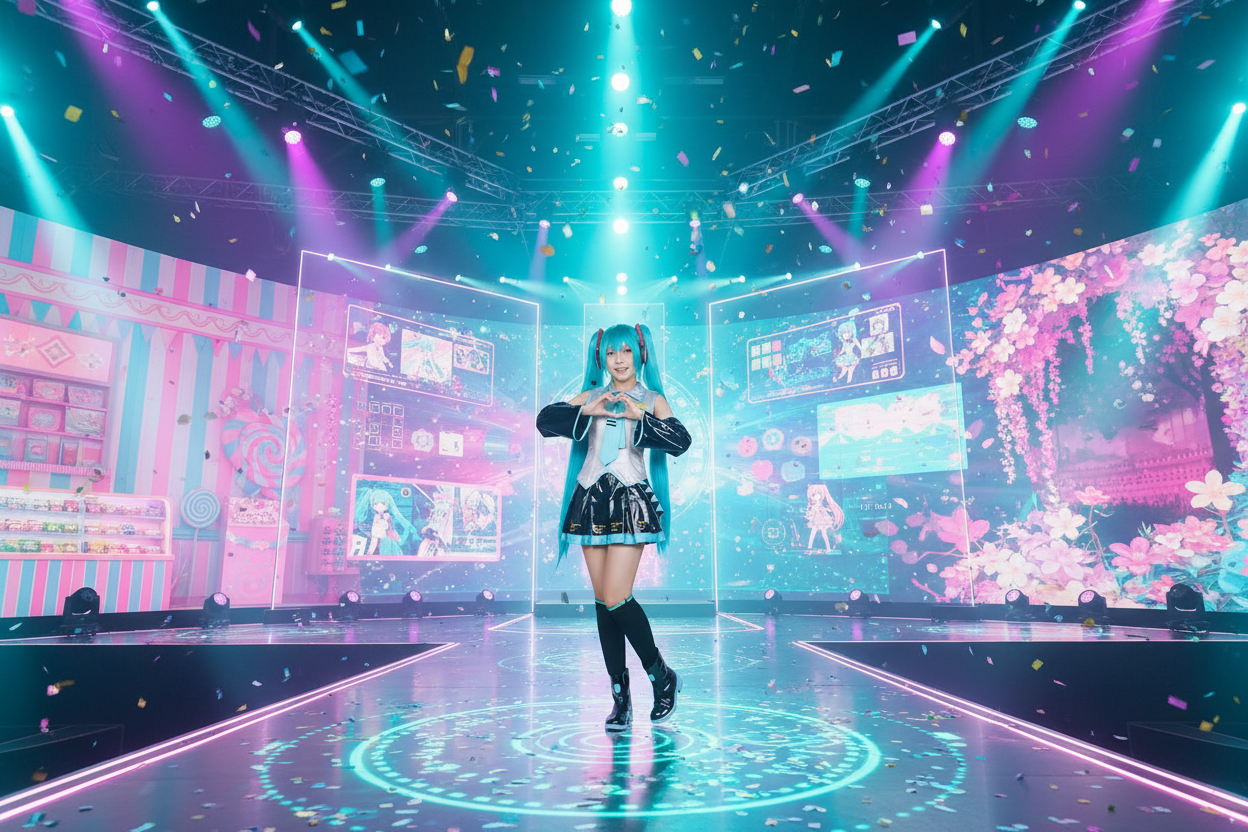
Most characters who debuted in 2007 have long since faded from convention floors — but Hatsune Miku cosplay is arguably more visible now than it's ever been. This spring, Miku Expo 2026 wrapped its North American tour with 100,000 attendees across 15 cities, nearly two decades after her original release, and the crowd wasn't just longtime fans reliving nostalgia — it included teenagers who discovered her through a mobile rhythm game, not a 2007 software box. In this guide, we'll break down exactly why Miku keeps pulling in new generations of cosplayers, and what that means for choosing your own anime cosplay costume .
A Character Who Was Never Meant to Age
Hatsune Miku launched on August 31, 2007, as vocal synthesis software from Crypton Future Media — technically a product, not a character in the traditional sense. Crypton's official backstory freezes her at 16 years old permanently, which sounds like a small detail but turns out to be foundational to everything that followed. Unlike a manga or anime protagonist who ages (or at least exists) within a finished story, Miku has no canon narrative to outgrow. She's a persistent, ageless vessel — which is exactly why she can be reinvented endlessly without ever feeling like she's "moved on" from a version fans grew up with.
Why Miku's Ever-Changing Design Makes Every Miku Costume Different
Here's the detail that separates Miku cosplay from almost every other long-running character: there is no single official "Miku costume." Crypton has released dozens of official redesigns over the years — concert-specific outfits, Magical Mirai's annual costume reveal, crossover collaboration looks — and none of them override the others as more "canon" than the last. Miku's 2026 Miku Expo North America tour alone was built around a "candy shop" visual theme, with pastel, confection-inspired costuming that looked nothing like her original teal-and-grey base design.
That constant costume rotation means Miku cosplay functions less like recreating one fixed character and more like choosing which era of Miku you want to represent — the original 2007 look, a specific Magical Mirai year, a tour-specific outfit, or a fan-reimagined design entirely. Few characters offer that much legitimate creative range while still being instantly recognizable by the twin-tails and signature voice-synth aesthetic alone.
| Era | Design Signature | What Drove It |
| 2007 (Debut) | Teal twin-tails, grey/black sleeveless top, detached sleeves | Original 2007 base design sold as a vocal synth product |
| 2011 (Mainstream breakout) | Same base design, broader visibility | Toyota Corolla US ad campaign, Lady Gaga tour opener slot |
| Magical Mirai (annual, ongoing) | New illustrator-designed outfit released each year | Crypton's annual concert series, a different artist reimagines Miku every summer |
| 2020 (Project SEKAI generation) | Stylized, game-native redesigns per in-game "unit" | Project SEKAI game-native costumes introduced Miku to a significantly younger fanbase |
| 2026 (Miku Expo "Candy Shop") | Pastel, confection-themed tour costume | North America tour, 15-city run, 100,000 attendees |
How Fan Art and the Piapro License Turned Miku Into a Multi-Generational Icon
Miku's staying power isn't just about official redesigns — it's structural. When fan-made songs and animations exploded within weeks of her 2007 release, Crypton made an unusual choice for the time: instead of restricting use of her likeness, they introduced the Piapro license, a framework explicitly permitting fans to create and share non-commercial derivative work featuring Miku. That single decision is arguably the reason Miku cosplay culture is as deep as it is today — by 2026, the fan ecosystem around her has grown to include more than 100,000 officially recognized fan-produced songs, alongside countless fan-designed costume variations that never came from Crypton at all.
This is a meaningfully different foundation than most cosplay-heavy franchises operate on. Cosplaying a strictly copyrighted anime character usually means working from a fixed reference the studio controls entirely. Cosplaying Miku means drawing from an enormous, decentralized library of fan-created designs that are, by design, just as "legitimate" as anything Crypton releases officially — which is part of why Miku cosplay rarely looks repetitive at conventions, even among people building the "same" character.
From Project SEKAI to Miku Expo: How Virtual Idol Culture Keeps Recruiting New Fans
The clearest evidence that Miku cosplay is genuinely cross-generational, rather than just long-running, is where her newest fans are actually coming from. Project SEKAI: Colorful Stage!, a mobile rhythm game released in 2020, introduced Miku and the wider Vocaloid cast to a significantly younger audience through stylized, game-specific character designs and storylines — many of whom had no prior exposure to her 2007-era origins at all. That generational on-ramp shows up directly in convention crowds: Miku Expo 2026's 100,000-attendee North American run drew a visibly wide age range, spanning fans who remember her Toyota Corolla commercial debut in the American mainstream alongside teenagers who found her through a phone game less than six years ago.
Miku's continued presence in unexpected mainstream spaces reinforces this further — everything from Magic: The Gathering crossover cards to Japanese school textbooks now referencing her as a cultural touchpoint. Each new entry point recruits cosplayers who weren't previously part of the fandom, and because there's no single "correct" Miku design to gatekeep behind, new fans can jump straight into building a costume without needing two decades of context first.
Building Your Own Miku Costume: What to Consider
Because Miku cosplay covers so much creative range, your first real decision isn't fabric or fit — it's which era or version of Miku you're building toward. A few practical considerations once you've chosen:
Wig styling carries more weight than usual. Miku's twin-tails are arguably more instantly recognizable than any single outfit variation, which means wig quality and styling accuracy matter even if you're building a less common costume era. If you want to see our full step-by-step breakdown on detangling and managing extra-long fibers, check out our Miku wig styling guide
Fabric choice should match the specific era's silhouette. The original 2007 design relies on structured panels and clean lines, while tour-specific or Magical Mirai looks often use flowing or pastel-toned fabrics that call for a completely different construction approach — check your reference art closely before choosing materials.
Check the size chart against the specific costume style, not just your usual size — structured designs (like the original look) and looser, flowing tour costumes fit very differently even at the "same" labeled size.
Stitching and seam quality matter most on structured designs, where clean panel lines are a major part of the costume's recognizability, similar to how precision seaming matters on other tightly-designed anime costumes. To ensure your build stands up to packed convention halls, look for reinforce-stitched options that show real product photography of the interior seams rather than basic digital renders.
Frequently Asked Questions
Is there an "official" Miku costume I should cosplay if I'm new to the character?
The original 2007 teal-and-grey design remains the most universally recognized starting point, but there's no wrong answer — Magical Mirai, Project SEKAI, and tour-specific designs are all considered equally legitimate depending on which version of Miku you connect with most.
Why does Miku get a new costume so often compared to other characters?
Because she was designed from the start as an evolving, non-canon character without a fixed storyline, Crypton and fan creators alike are free to reinterpret her regularly — through annual Magical Mirai reveals, tour-specific looks, and independent fan designs, all without contradicting an established narrative.
Do younger fans discovering Miku through games like Project SEKAI cosplay differently than longtime fans?
Often yes — newer fans frequently gravitate toward game-specific unit designs rather than the original 2007 look, which is part of why Miku cosplay at conventions now spans a noticeably wider range of costume styles than it did a decade ago.
What made Miku's fan culture different from other virtual idols or vocal synth characters?
Crypton's Piapro license, introduced shortly after her 2007 debut, explicitly allowed non-commercial fan-created content featuring Miku — a decision that fueled an unusually large, decentralized ecosystem of fan art, music, and costume design that most licensed characters never develop.
Is Miku cosplay more expensive than typical anime cosplay because of the wig and accessories?
Not inherently — costs vary by which era or costume style you choose, though structured designs with detailed panel work or long, styled wigs (particularly for tour-specific looks) can require more investment in styling time and maintenance than simpler costume variations.
Conclusion
Choosing a high-quality Hatsune Miku cosplay costume starts with understanding something most character-based cosplay doesn't require: deciding which era of an intentionally ever-changing character you want to represent. Nearly 20 years after her 2007 debut, Miku's combination of a permanently youthful, non-canon design, an open fan-creation culture built around the Piapro license, and a steady stream of new entry points like Project SEKAI and Miku Expo have made her one of the rare cosplay subjects that genuinely spans generations rather than fading with them. If you're ready to build your own Hatsune Miku cosplay costume, check our sizing and wig styling guide below before you order.

コメントを書く
このサイトはhCaptchaによって保護されており、hCaptchaプライバシーポリシーおよび利用規約が適用されます。