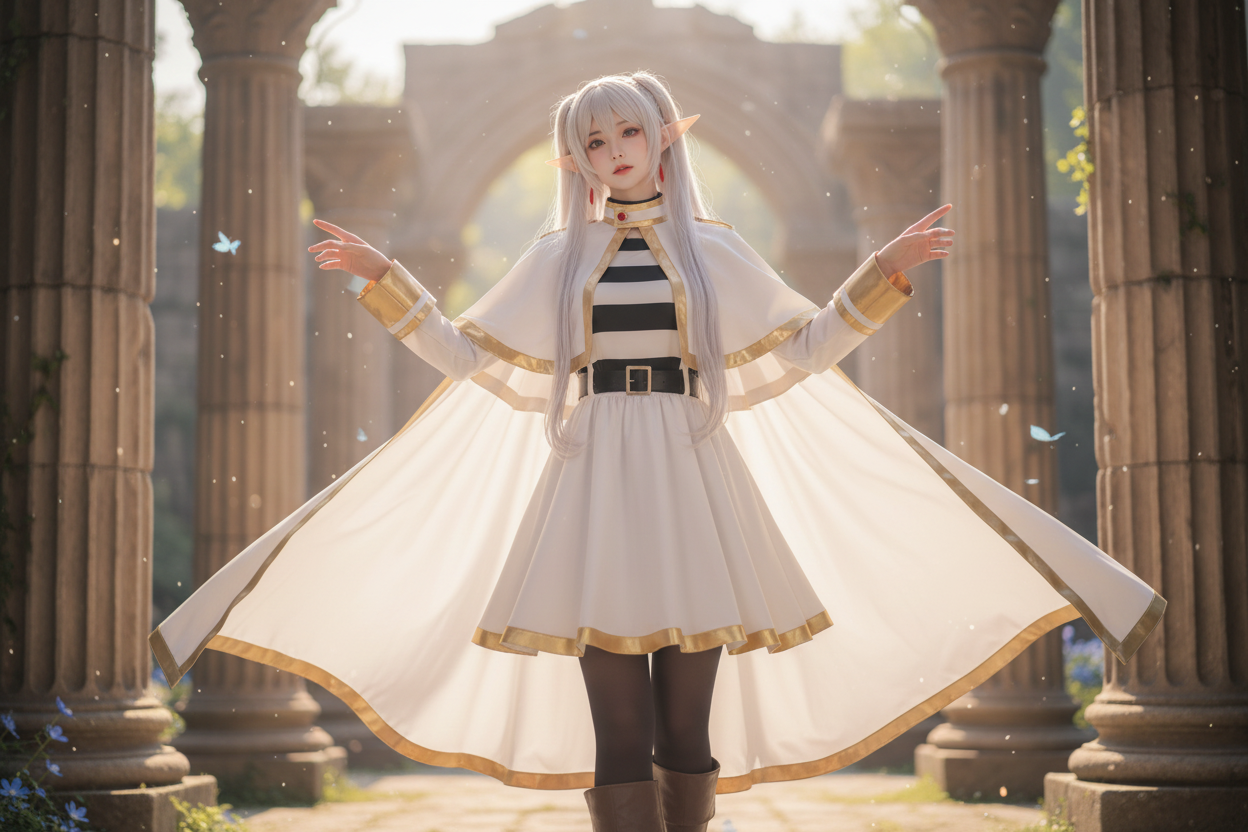
In the high-fantasy aesthetic of Frieren, the Mage’s silhouette is characterized by a specific, gravity-defying weight. Unlike standard fantasy costumes that rely on thin, flowy fabrics, Frieren’s attire commands space through volume and structure. For the creator, the most common pitfall is the "deflated" look—where the skirt and sleeves lose their intentional shape, turning a masterfully designed costume into a flat, limp layer of fabric.
Capturing the essence of a thousand-year-old mage requires an understanding of internal structural engineering. To project authority and timelessness, the garment must possess inherent volume, independent of the wearer's movement. This level of consistency can only be achieved through professional-grade structural support systems, which utilize hidden boning and tiered-weighting to maintain the iconic Mage silhouette under any lighting condition.
🧭 The Structural Audit: Engineering Standards for Volume
When building or sourcing your Frieren ensemble, evaluate your gear against these three "Engineering-Grade" standards for silhouette control:
1. The Cantilever Effect (Sleeve & Hem Volume)
Frieren’s aesthetic relies on the dramatic arc of her sleeves and the heavy sweep of her hem. If these are made from single-layer fabric, they will inevitably collapse against the body.
-
The Technical Target: Multi-layer interfacing (fused stabilizer) within the cuffs and hem, creating a "memory" in the fabric that resists folding.
-
Why it Matters: A structured sleeve provides a consistent geometric shape that translates perfectly into high-speed action photography, where you need clear lines to define the character’s presence.
2. Tiered Weight Distribution (Skirt Dynamics)
The skirt must appear heavy but retain enough "bounce" to suggest movement.
-
The Technical Target: An internal, hidden corset-anchored petticoat system with hem-weighting strips.
-
Why it Matters: Hem-weighting ensures the skirt drops in a clean, vertical line rather than bunching up when the wearer stops moving. This creates a "weighted" look that signals high-production quality to the viewer.
3. Tension Anchor Points (Shoulder & Torso Geometry)
The connection between the tunic and the outer garment must be seamless.
-
The Technical Target: Internal "gravity anchors"—concealed straps that distribute the weight of the garment across the wearer's shoulders rather than letting it sag at the waist.
-
Why it Matters: Without proper tension distribution, the entire garment will shift as you pose, resulting in asymmetrical creases that ruin the "perfect" look required for editorial portraiture.
🛠️ The Structural Performance Audit
| Structural Component | Amateur Construction | Professional Engineering |
| Sleeve Arc | Natural Fall (Sagging) | Interfaced Cantilever (Fixed Curve) |
| Skirt Support | Standard Petticoat | Integrated Corset-Anchor Tiering |
| Weighting | None (Floaty/Light) | Hem-Weighted Strips (Vertical Drop) |
[Technical Expert Note]: When fitting your garment, ensure the tension anchors are adjusted while you are in your "signature pose." If the costume is adjusted while standing perfectly straight, it will inevitably pinch or restrict your movement when you shift into a dynamic, magical-casting stance.
💡 Practical Application: The "Silhouette Sculpting" Studio Setup
To highlight the structural integrity of the garment, you must utilize High-Contrast Depth Mapping:
-
The "Outline" Light (Rim): Use a high-intensity, narrow-beam spot light placed directly behind the subject, aiming toward the camera’s edge. This "cuts" the silhouette from the background and highlights the crisp edges of your sleeves and hem.
-
The "Texture" Fill: Place a large, soft-box light low to the ground, off-center. This fills the shadows created by the structural pleats, revealing the quality of the fabric construction without destroying the contrast.
-
The "Movement" Capture: Use a high-shutter speed (1/500s or higher) to freeze the motion of the skirt. Because the structural engineering holds the shape, the fabric won't look "limp" even when captured mid-stride.
❓ Developer's FAQ
Q: Does internal structural engineering make the costume heavy or uncomfortable?
A: Properly engineered support uses tension distribution, meaning the weight is spread across your torso rather than hanging from a single point. It is significantly more comfortable for long shoots than a heavy, poorly-balanced dress.
Q: Can I add structural support to a costume I already own?
A: You can retrofit hem-weighting strips and use stiff interfacing (fusible) in cuffs, but fully integrated corset-anchored tiering is best built into the base construction.
Q: How do I store a garment with this much internal structure?
A: Always hang by the internal tension anchors, never by the outer fabric. Use wide-shouldered hangers to prevent the sleeve arcs from deforming over time.
🏁 The Final Frame
A silhouette is a promise—it tells the viewer exactly who the character is before they even see the face. Frieren’s authority comes from her stillness and her weight. By mastering the structural foundation of your ensemble, you move past the realm of "dressing up" and enter the realm of architectural costume design. Respect the geometry, control the tension, and let the silhouette tell the story of the mage.

コメントを書く
このサイトはhCaptchaによって保護されており、hCaptchaプライバシーポリシーおよび利用規約が適用されます。