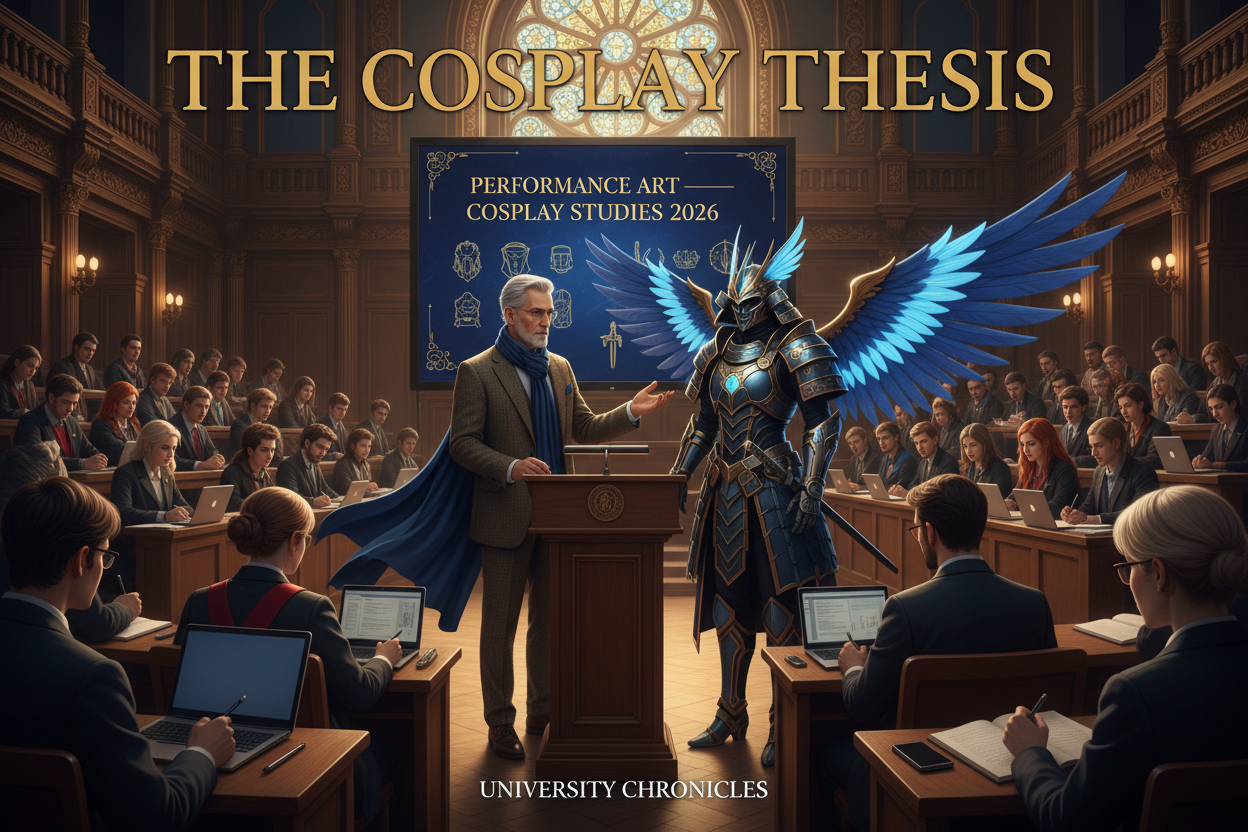
💡 Editorial Note: For decades, mainstream academic and cultural institutions viewed cosplay through a patronizing, highly reductionist lens. It was routinely dismissed as a derivative, hyper-commercialized hobby or a form of juvenile escapism. In 2026, that historical bias has collapsed. Driven by a major wave of global cultural studies research and the rapid expansion of contemporary media scholarship, premier universities have begun executing a massive systemic shift. Cosplay is officially breaking out of its subcultural sandbox and being incorporated directly into formal curricula as a recognized branch of Performance Art. By treating costume design, character embodiment, and subcultural rituals as rigorous objects of critical analysis, academic institutions are fundamentally redefining what it means to perform identity in a hyper-mediated world.
1. The Institutional Shift: From Fan Subculture to Academic Discipline
The traditional boundary line separating institutional "high art" from grassroots fan production has officially eroded. Historically, if an academic department examined costuming, it did so strictly through the historical lens of classical theater design or textile anthropology. The idea of analyzing an individual wearing a self-made garment representing an animated or gaming character was largely met with institutional skepticism.
In 2026, this dynamic has inverted due to three major structural developments:
[ Traditional Academic View ]
Cosplay = Derivative Fan Consumerism ──> Excluded from Fine Arts Funding

[ Modern 2026 Institutional Framework ]
Cosplay = High-Agency Performance Art ──> Peer-Reviewed Journals & Specialized University Curricula
-
Explosive Growth in Peer-Reviewed Literature: Specialized journals focusing on visual culture and performative studies have experienced a major surge in peer-reviewed submissions dedicated exclusively to the semiotics, sociology, and technical engineering of costume play.
-
Curriculum Integration: Department chairs in Cultural Studies, Performance Studies, and Visual Arts are actively redesigning syllabi to include cosplay as a mandatory module under modern performance theories.
-
Institutional Research Funding: Graduate students and critically engaged practitioners are successfully securing academic grants to explore how costume creation intersects with modern concepts of identity exploration, community building, and material culture.
2. Theoretical Frameworks: Deconstructing the Costumed Body
When universities classify cosplay as performance art, they look far past the aesthetic surface. Academic analysis treats the costumed individual as a complex site of cultural production and negotiation.
⚙️ Participatory Culture and Prosumerism
Rooted heavily in modern media scholarship, academics utilize the framework of Participatory Culture to evaluate how cosplayers operate simultaneously as cultural consumers and producers. They do not merely consume media passively; they actively co-author the physical reality of a character, translating a flat 2D vector or a digital 3D model into a tangible, material presence.
⚙️ Identity Negotiation and Performativity
Drawing from foundational sociological performance theories, researchers analyze the "dual persona" constructed during an exhibition. The physical act of altering the body through structural modification, advanced makeup techniques, and tailored textiles serves as a deep exploration of self-presentation. Scholars explore how shifting between an ordinary everyday identity and a hyper-stylized character allows individuals to test social boundaries, experiment with gender expression, and build psychological resilience within safe, collaborative subcultural spaces.
📊 3. The Academic Matrix: How Institutions Analyze the Craft
To fully understand how this subculture is systematically cataloged by modern universities, the following comparative matrix maps out the primary research pathways, linking academic departments to their specific analytical focuses and core theoretical frameworks.
| Academic Department | Specialized Research Framework | Core Object of Institutional Analysis | Key Theoretical Foundation | Primary Methodology Employed |
| Performance Studies | Performative Embodiment & Method Representation | The live execution of character cadences, dramatic dialogue, and physical stage presence during conventions. | Gender Performativity & Theatrical Materiality | Participatory Ethnography & Real-Time Performance Auditing |
| Visual Culture & Art Education | Critical Pedagogy & Applied Craftsmanship | The integration of costume fabric engineering and fabrication techniques into formal art school curricula. | Visual Culture Art Education (VCAE) | Curricular Design Testing & Practice-Based Case Studies |
| Sociology & Anthropology | Identity Negotiation & Subcultural Socialization | How the construction of a "dual persona" alters real-world self-monitoring, community cohesion, and social capital. | Goffman’s Self-Presentation & Face-Negotiation Theory | Interpretative Phenomenological Analysis (IPA) & Quantitative Surveys |
| Media & Global Studies | Transnational Cultural Hybridization | The localization of global intellectual properties and the blending of traditional regional textiles with modern character designs. | Jenkins' Participatory Culture & Cultural Hegemony | Cross-Border Content Analysis & Comparative Media Metrics |
📋 4. Case Studies: The Core IPs Driving University Curricula
To demonstrate how these abstract academic frameworks are applied in actual university lecture halls, we analyze four global intellectual properties that serve as the primary case studies in modern syllabus designs.
1. Hatsune Miku — The Study of Decentralized Virtual Performance
The Academic Context
Within Media and Global Studies departments, Hatsune Miku is analyzed as a masterclass in the crowdsourced evolution of a synthetic icon. Because she possesses no single, rigid canonical narrative, her identity is entirely defined by her global community of fans.
The Research Focus
University seminars use Miku to examine the total breakdown of the traditional boundary between the creator and the consumer. When a student cosplays as Hatsune Miku, they are executing a physical performance of a completely decentralized digital asset.
Scholars analyze how the physical costume bridges the gap between software-based music production (Vocaloid) and real-world physical spaces, transforming the performer into a physical extension of a global, digital collective consciousness.
2. Furina (Genshin Impact) — The Study of Layered Theatricality and Deception
The Academic Context
Performance Studies tracks heavily favor Furina due to her intricate in-game narrative, which centers entirely on the psychological toll of forced, lifelong public performance and institutional roleplay.
The Research Focus
Graduate-level papers utilize Furina to explore advanced concepts of meta-theatricality—specifically, "the actor playing an actor." Academics audit how a cosplayer navigates multiple distinct performance layers simultaneously:
-
Layer 1: The creator's natural everyday self.
-
Layer 2: The theatrical, high-flair public facade of the character.
-
Layer 3: The underlying vulnerability of the character's true narrative identity.
This complex psychological hierarchy makes Furina an elite subject for studying emotional regulation, method acting, and the maintenance of public face under intense scrutiny.
3. Kafka (Honkai: Star Rail) — The Study of Fashion Semiotics and Mature Subversion
The Academic Context
Visual Arts and Fashion Design departments utilize Kafka to deconstruct the semiotics of mature subcultural costuming and its intersection with contemporary luxury fashion silhouettes.
The Research Focus
Rather than analyzing over-exaggerated or comical fantasy gear, research panels focus on Kafka’s highly structured, asymmetrical tailoring and tailored trench coat architecture. Scholars analyze how her design uses subtle, high-contrast visual cues to project authority, control, and subversive elegance.
Students are challenged to unpack how the precision engineering of such garments can manipulate a viewer's psychological perception, demonstrating how subcultural costume design directly mirrors the principles of high-end haute couture fashion.
4. Jinx (League of Legends) — The Study of Hyper-Expressive Chaos and Transmedia Appeal
The Academic Context
Sociology and Transmedia Studies tracks look closely at Jinx to investigate the cross-media globalization of an anti-hero archetype and its viral resonance within modern youth culture.
The Research Focus
Jinx serves as an essential case study for analyzing the transmedia migration of a character from an online competitive video game into an Emmy-winning animated series (Arcane), and finally into a real-world physical performance art asset.
Researchers analyze how her hyper-expressive, chaotic visual language gives cosplayers a safe, legitimate outlet to perform intense emotional states, subvert standard behavioral norms, and critique traditional representations of female stability in mainstream global media.
5. The Pedagogical Debate: Academic Validation vs. Counter-Culture Roots
The systematic institutionalization of costume play has ignited a sharp debate among veteran subcultural historians and modern academic reformers.
┌─────────────────────────────────────────────────────────────────────────────────────────┐
| r/academic_culture • Posted by u/Subcultural_Scholar_2026 • 3 days ago                  |
| 🎓 Institutional Traps: Are Universities Commercializing and Sanitizing Cosplay Art?    |
|                                                                                         |
| While it is exciting to see my master's thesis on transmedia embodiment validated by    |
| a formal academic board, I am growing deeply concerned about the institutionalization   |
| of the cosplay subculture.                                                              |
|                                                                                         |
| When a university department codifies cosplay into a structured syllabus, it imposes   |
| rigid, Western-centric analytical frameworks onto a practice that was born from raw,   |
| decentralized fan passion.                                                              |
|                                                                                         |
| Are we actually elevating the craft, or are we just helping universities monetize and    |
| sanitize a counter-culture movement to boost their cultural studies enrollment?       |
|                                                                                         |
| 💬 1.2k Comments  |  Share  |  Save  |  Hide                                           |
+-----------------------------------------------------------------------------------------+
📉 The Protectionist Critique: The Threat of Academic Sanitization
Critics of this institutional trend argue that forcing a raw, organic fan practice into rigid academic structures risks stripping the movement of its subcultural vitality. When university boards establish standardized grading rubrics, explicit theoretical criteria, and formal performance metrics for costume play, they introduce an artificial hierarchy. This institutionalization can alienate grassroots hobbyists who lack formal training in performance theory or art history, turning a highly inclusive, decentralized space into an elitist academic discipline focused more on conceptual jargon than the joyful spirit of community creation.
📉 The Reformist Defense: The Necessity of Structural Validation
Conversely, progressive educators and critically engaged practitioners emphasize that formal academic recognition is vital to secure the long-term cultural and economic viability of the craft. Without institutional classification as a legitimate performance art form, creators are continually denied access to high-value fine arts grants, museum exhibition spaces, and formal public research funding. Academic validation elevates the public status of the fabricator from a simple consumer hobbyist to a recognized visual artist, forcing mainstream society to respect, protect, and properly value the immense creative labor and technical innovation embedded within the subculture.
6. ❓ Frequently Asked Questions (FAQ)
Q: Can a student pursue a dedicated degree specializing entirely in cosplay performance art?
A: While very few institutions offer a major explicitly titled "Cosplay Studies," students can easily construct a fully accredited academic focus by pairing a major in Performance Studies or Visual Culture Art Education with a dedicated thesis project centered on costume fabrication and identity performativity. This pathway allows them to use university design labs and research grants to fund their creative portfolios.
Q: How do academic institutions evaluate the technical precision of a costume versus the live performance aspect?
A: In contemporary university curricula, grading matrices are meticulously balanced. The physical costume is evaluated through the lens of material culture and visual arts education, checking for structural engineering skill, textile selection, and creative problem-solving. Simultaneously, the performative presentation is audited through performance studies frameworks, analyzing how effectively the creator embodies the character's physiological movements, vocal delivery, and psychological core during an exhibition.
🎯 Conclusion: The Intellectual Awakening of the Craft
The integration of cosplay into formal university curricula marks a historical milestone in the evolution of contemporary art history. The practice has permanently outgrown its classification as a simple consumer pastime, claiming its rightful place as a sophisticated, high-agency discipline within the global landscape of contemporary performance art.
By analyzing these complex creative processes through rigorous theoretical lenses, modern universities are validating what millions of global creators have known for decades: the costumed body is a powerful medium for artistic innovation, cultural negotiation, and deep self-exploration.
Whether auditing the decentralized digital performance mechanics behind Hatsune Miku, unpacking the layered psychological deceptions of Furina, dissecting the fashion semiotics of Kafka, or analyzing the transmedia youth resonance of Jinx—academic institutions are demonstrating an undeniable reality: when modern society seeks to understand the future of identity performance, art education, and participatory media, the classroom must look directly to the master craftspeople of the global cosplay community.


コメントを書く
このサイトはhCaptchaによって保護されており、hCaptchaプライバシーポリシーおよび利用規約が適用されます。