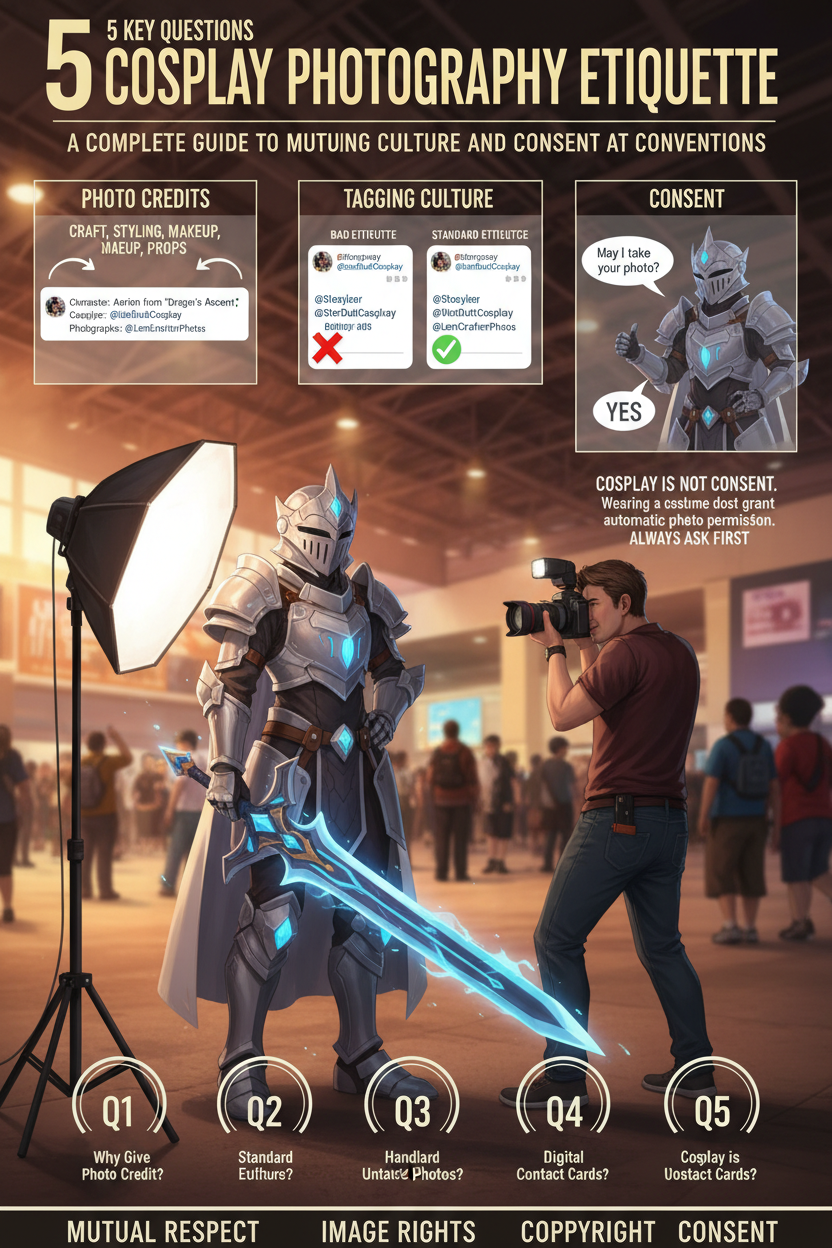
Debates across TikTok under #cosplayphotographer highlight a growing friction at conventions: hall photos posted without tagging the maker or photographer, raw unflattering shots uploaded without permission, and candid photography taken without clear consent.
Establishing a healthy convention social contract relies on cosplay photography etiquette—a set of practices built on mutual respect, personal image rights, artistic copyright, and explicit consent.
Table of Contents
-
Question 1: Why is giving proper photo credit essential for both cosplayers and photographers?
-
Question 2: What is the standard tagging etiquette for posting convention photos?
-
Question 3: How should you handle unauthorized cosplay photos and polite takedown requests?
-
Question 4: What are the best practices for using digital contact cards at events?
-
Question 5: What does "Cosplay Is Not Consent" mean for hall photography?
Question 1: Why is giving proper photo credit essential for both cosplayers and photographers?
Direct Answer: How to credit cosplay photographers and tagging makers properly ensures creators receive professional attribution for their work. Proper photo crediting protects intellectual property, drives portfolio discovery, and builds lasting creative relationships between builders, models, and photographers.
                    [ DUAL-CREATOR ATTRIBUTION PIPELINE ]
                                       │
     ┌─────────────────────────────────┼─────────────────────────────────┐
     ▼                                 ▼                                 ▼
1. Craft & Tailoring               2. Lighting & Capture              3. Public Attribution
- Hair, makeup, & prop build       - Camera work, editing, & framing  - Clear dual tags on post
- Credit: @Cosplayer               - Credit: @Photographer            - Fair exposure for both
Background & Mutual Respect
A convention photo represents a collaboration between two artists: the cosplayer who crafted or styled the suit and the photographer who composed, lit, and edited the shot. When someone posts a photo dump without credits, both artists lose discovery opportunities within the community.
Question 2: What is the standard tagging etiquette for posting convention photos?
Direct Answer: Following cosplay photo tagging etiquette requires listing all collaborators clearly in the top lines of your caption using standardized handles ("Cosplayer: @... / Photo: @..."), rather than hiding tags at the bottom of a hashtag block.
                  [ CAPTION STRUCTURE COMPARISON ]
                                   │
 ┌─────────────────────────────────┴─────────────────────────────────┐
 ▼                                                                   ▼
Standard Etiquette Format                            Poor Tagging Practices
- Character: [Name] from [Series]                   - No tags anywhere in caption
- Cosplayer: @handle                                - Handles hidden inside 30 hashtags
- Photographer: @handle                             - Cropping out photographer watermarks
- Retoucher: @handle (if applicable)                - Tagging handles only on image overlay
Best Practices for Tagging
-
Visible Handles: Place collaborator handles directly in the post description so viewers can immediately click through to both profiles.
-
Respect Watermarks: Never crop out, blur, or filter over a photographer's signature watermark without prior permission.
Question 3: How should you handle unauthorized cosplay photos and polite takedown requests?
Direct Answer: Address unauthorized cosplay photos by sending a polite direct message citing image rights or lack of consent. Most creators will take down or edit posts promptly when contacted respectfully.
                   [ POLITELY REQUESTING A TAKEDOWN ]
                                   │
 ┌─────────────────────────────────┴─────────────────────────────────┐
 ▼                                                                   ▼
1. Private Direct Message                           2. Escalation (If Refused)
- "Hi! I noticed you posted a photo of me..."       - Report post via platform tools for privacy
- State reason clearly (unflattering/no permission) - Submit a formal copyright / image rights form
- Maintain polite, firm tone                        - Block persistent boundary-violating accounts
Dealing with Unapproved Uploads
If an unedited or unflattering candid photo appears online without your approval, reach out privately first. Use clear, non-confrontational phrasing: "Hi! Thanks for capturing my cosplay at [Con Name]. I wasn't able to review this shot beforehand and prefer it not remain public. Could you please untag or remove it?"
Question 4: What are the best practices for using digital contact cards at events?
Direct Answer: Utilizing cosplay photography contact cards involves using quick-scan QR codes linked to a digital landing page (like Linktree or a digital NFC card) containing your social handles, preferred contact method, and photo usage guidelines.
                  [ DIGITAL CONTACT CARD WORKFLOW ]
                                   │
 ┌─────────────────────────────────┼─────────────────────────────────┐
 ▼                                 ▼                                 ▼
1. Physical QR / NFC Badge        2. Quick On-Site Scan             3. Organized Follow-Up
- Wearable badge or phone card    - Takes 3 seconds in line         - Clear photo-sharing link
- Contains handles & guidelines   - No lost paper cards             - Easy tagging reference
Streamlining Convention Networking
Handing out paper business cards often leads to lost contact info in crowded bags. Digital cards speed up networking on the convention floor:
-
Wearable QR Badges: Print a clear QR code on the back of your convention badge or phone case.
-
Standardized Folders: Photographers can share a view-only Cloud folder link where cosplayers can retrieve high-res files after the event.
Question 5: What does "Cosplay Is Not Consent" mean for hall photography?
Direct Answer: Cosplay photography consent at conventions establishes that wearing a costume does not grant automatic permission for photos, videos, or physical contact. Photographers must ask before shooting and receive explicit verbal or non-verbal confirmation.
Key Rules of Convention Consent
-
Always Ask First: Simple etiquette dictates asking, "May I take your photo?" before raising your camera.
-
Respect Resting Creators: Never photograph cosplayers while they are eating, sitting in designated break areas, repairing props, or adjusting costumes.
-
Touch-Free Posing: Never touch a cosplayer's body or props without explicit permission, even when adjusting a pose or fixing a stray fabric layer.
Summary & Related Culture Resources
Healthy convention photography thrives on mutual respect. By crediting collaborators clearly, respecting privacy boundaries, using digital contact cards, and practicing explicit consent, both cosplayers and photographers contribute to a supportive, creative community.
Related Community & Culture Resources:
-
Cosplay Culture & Community Insights: Explore deep dives on convention safety, community ethics, and creator support.

コメントを書く
このサイトはhCaptchaによって保護されており、hCaptchaプライバシーポリシーおよび利用規約が適用されます。