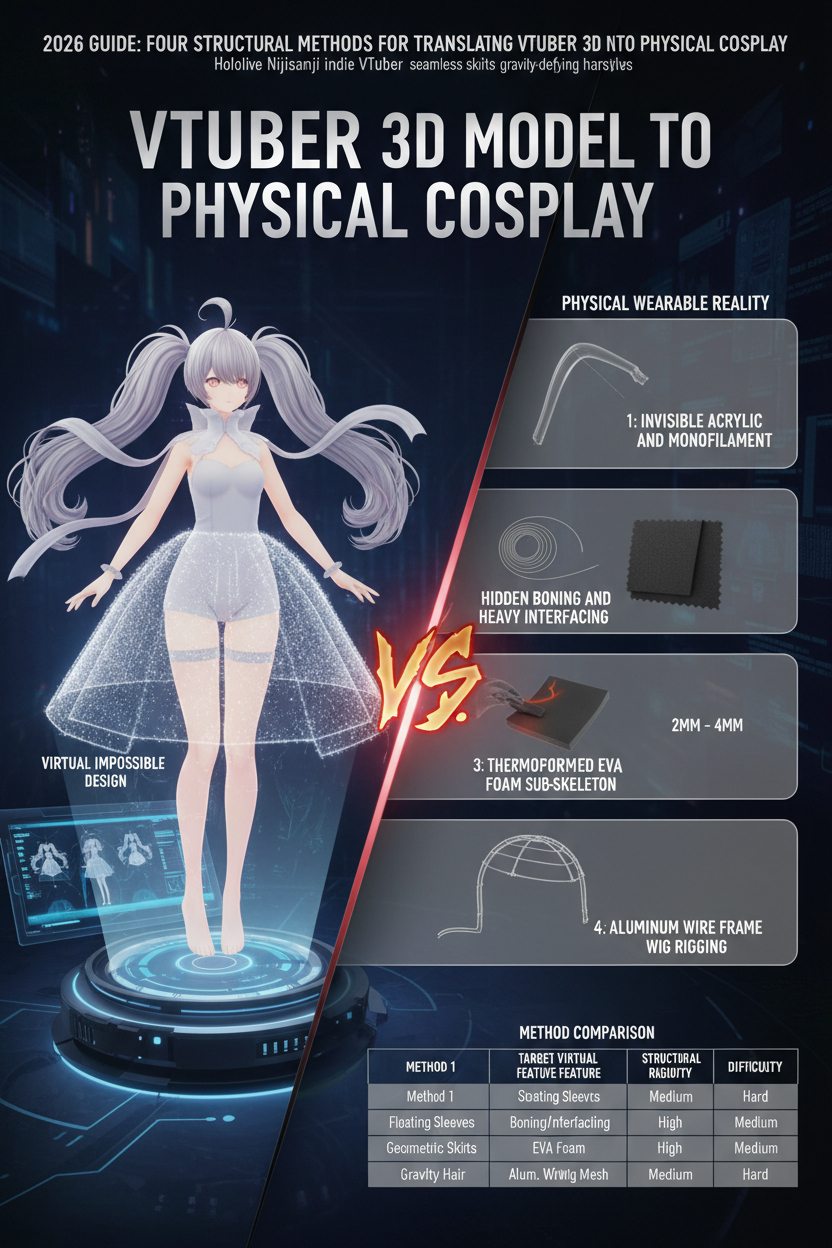
On platforms like TikTok under #vtubercosplay, creators showcase the challenging process of bringing Hololive, Nijisanji, and indie VTuber avatars into physical reality. Virtual character artists design 3D models using digital shaders and clipping-free physics, resulting in floating sleeves, seamless multi-layered skirts, and gravity-defying hairstyles that ignore real-world gravity.
Translating a virtual model into a real-world garment requires moving beyond traditional flat pattern-making. This guide breaks down the four most effective structural methods used by master tailors to make "physically impossible" VTuber outfits wearable, durable, and convention-ready.
Quick Structural Comparison
| Method | Target Virtual Feature | Core Material | Structural Rigidity | Construction Difficulty |
| 1. Invisible Acrylic & Monofilament | Floating ribbons, detached shoulder pads, hovering hair ornaments | Clear PETG/Acrylic sheets, fluorocarbon wire | Medium | Moderate |
| 2. Hidden Boning & Structural Interfacing | Gravity-defying flared collars, rigid tailcoats, architectural lapels | Spiral steel boning, extra-heavy woven canvas | High | Advanced |
| 3. Thermoformed EVA Foam Sub-Skeletons | Seamless 3D hip skirts, geometric flared hems, rigid chest plates | 2mm–4mm high-density EVA foam, Worbla | Very High | Advanced |
| 4. Aluminum Wire Frame Wig Rigging | Anti-gravity hair spikes, massive twin tails, floating ahoge strands | 8-gauge aluminum craft wire, expanding foam core | High | Expert |
1. Invisible Acrylic & Monofilament Rigging — Floating Ribbons & Detached Ornaments
Virtual garment designs frequently feature elements that hover adjacent to the body without visible attachment points. Traditional sewing cannot keep a ribbon suspended in mid-air or hold a shoulder crest away from the torso without drooping.
                    [ INVISIBLE ACRYLIC MOUNTING LOGIC ]
                                     │
 ┌───────────────────────────────────┼───────────────────────────────────┐
 ▼                                   ▼                                   ▼
[Base Garment Anchor]               [Clear PETG Support Arm]            [Floating Detail]
Hidden internal fabric bracket      Heat-bent transparent plastic strap   Stitched or riveted floating ribbon
Core Features
-
Uses clear PETG plastic strips or high-tensile monofilament (fluorocarbon line) anchored to a concealed inner harness.
-
Translucent materials refract light, creating the optical illusion of detached, floating accessories during motion.
Pros & Cons
-
Pros: Achieves true "floating" visuals; extremely lightweight; hidden from standard camera angles.
-
Cons: Prone to surface scratching over long convention days; requires precise heat-bending to prevent snapped brackets.
Ideal For
Creators learning how to make floating cosplay details such as unattached hip ribbons, floating sleeves, or suspended head halo props.
2. Hidden Boning & Heavy Interfacing — Anti-Gravity Collars & Layered Tailcoats
3D models often feature crisp, razor-sharp lapels and exaggerated standing collars that never sag, regardless of movement. Standard fabric weight causes these oversized elements to collapse under their own mass.
                  [ STRUCTURAL INTERFACING STACK ]
                                  │
 ┌────────────────────────────────┼────────────────────────────────┐
 ▼                                ▼                                ▼
[Outer Fashion Fabric]          [Internal Canvas Core]           [Spiral Steel Boning]
Satin, velvet, or uniform cloth  Heavy fusible woven interfacing   Cased channels sewn into structural seams
Core Features
-
Combines extra-heavyweight fusible canvas interfacing with spiral steel boning channels enclosed inside garment linings.
-
VTuber cosplay pattern making relies on angled darting to distribute the weight of flared tailcoats across the wearer's shoulders rather than letting the fabric pull downward.
Pros & Cons
-
Pros: Preserves crisp silhouette lines; withstands windy outdoor photoshoots; retains mobility through flexible steel spirals.
-
Cons: Increases overall garment weight; requires heavy-duty sewing machine needles and professional boning caps.
Ideal For
Builders crafting structured cosplay outfits with exaggerated standing collars, flared tailcoats, or multi-tiered military jackets.
3. Thermoformed EVA Foam Sub-Skeletons — Rigid 3D Geometry & Flared Skirts
Digital characters created in 3D software maintain rigid bell-shaped skirts and geometric hip armors that do not drape like natural woven textiles. Using fabric alone often results in limp folds instead of the sharp angles seen on screen.
                 [ FOAM SUB-SKELETON GARMENT LAYER ]
                                  │
 ┌────────────────────────────────┼────────────────────────────────┐
 ▼                                ▼                                ▼
[Fabric Lining]                 [2mm EVA Foam Skeleton]           [Outer Shell Fabric]
Soft cotton base layer          Heat-shaped rigid inner core      Patterned fabric stretched & glued over foam
Core Features
-
Utilizes a hidden sub-structure made of 2mm to 4mm high-density EVA foam or thermoplastic sheeting underneath the outer fashion fabric.
-
The technique allows creators converting a 3D model to cosplay to heat-form permanent 3D curves into the garment architecture.
Pros & Cons
-
Pros: Holds complex geometric shapes indefinitely; completely eliminates unwanted fabric wrinkles.
-
Cons: Reduces fabric breathability; requires special pattern scaling to account for foam thickness.
Ideal For
Cosplayers tackling VTuber costume design projects with bell skirts, rigid hip armor panels, or architectural bodice layers.
4. Internal Wire Frame & Foam Core Rigging — Gravity-Defying VTuber Hairstyles
VTuber avatars are famous for anti-gravity twin tails, floating hair strands (ahoge), and sharp, voluminous hair spikes that exceed the structural limit of standard hairspray.
                    [ WIG RIGGING STRUCTURE ]
                               │
 ┌─────────────────────────────┼─────────────────────────────┐
 ▼                             ▼                             ▼
[Wig Cap Base]                [Aluminum Wire Armature]      [Foam Core & Wefts]
Reinforced felt canvas cap    8-gauge wire bent to shape    Carved EVA foam wrapped in glued hair wefts
Core Features
-
Employs an internal skeletal structure made from 8-gauge aluminum wire mounted directly onto a reinforced felt inner wig cap.
-
Hair volume is built around carved lightweight EVA foam or expanding foam cores rather than solid hair fibers, reducing total head weight.
Pros & Cons
-
Pros: Secures gravity-defying VTuber hairstyles through active movement; prevents long wigs from tangling.
-
Cons: Takes up significant storage space during travel; requires careful weight balancing to prevent neck strain.
Ideal For
Stylists creating oversized anime hair structures, floating ahoge loops, or massive twin tails for VTuber characters.
How to Choose the Right Construction Method for Your VTuber Build?
When deciding how to turn a VTuber model into cosplay, evaluate your design based on three key constraints:
-
Weight & Wearability: If a floating detail sits on the shoulders or head, prioritize lightweight aluminum wire framing or PETG plastic over heavy metals.
-
Transportation & Packing: Choose removable boning or velcro-attached foam sub-skeletons if you need to pack your outfit flat into convention luggage.
-
Washing & Maintenance: Ensure structural elements (like steel boning or foam cores) can be unclipped or unzipped from the outer fabric before washing.
Conclusion & Next Steps
Translating virtual 3D models into real-world garments requires a hybrid approach combining traditional tailoring with prop-making structural engineering. By utilizing hidden boning, clear acrylic mounts, foam sub-skeletons, and wire wig armatures, you can bring impossible virtual designs into physical reality.
Explore Pre-Engineered VTuber Costumes
Looking for high-fidelity outfits built with pre-engineered structural layering? Explore our curated collection of VTuber cosplay costumes & structured layered outfits designed specifically to maintain sharp 3D silhouettes on stage.

Laisser un commentaire
Ce site est protégé par hCaptcha, et la Politique de confidentialité et les Conditions de service de hCaptcha s’appliquent.