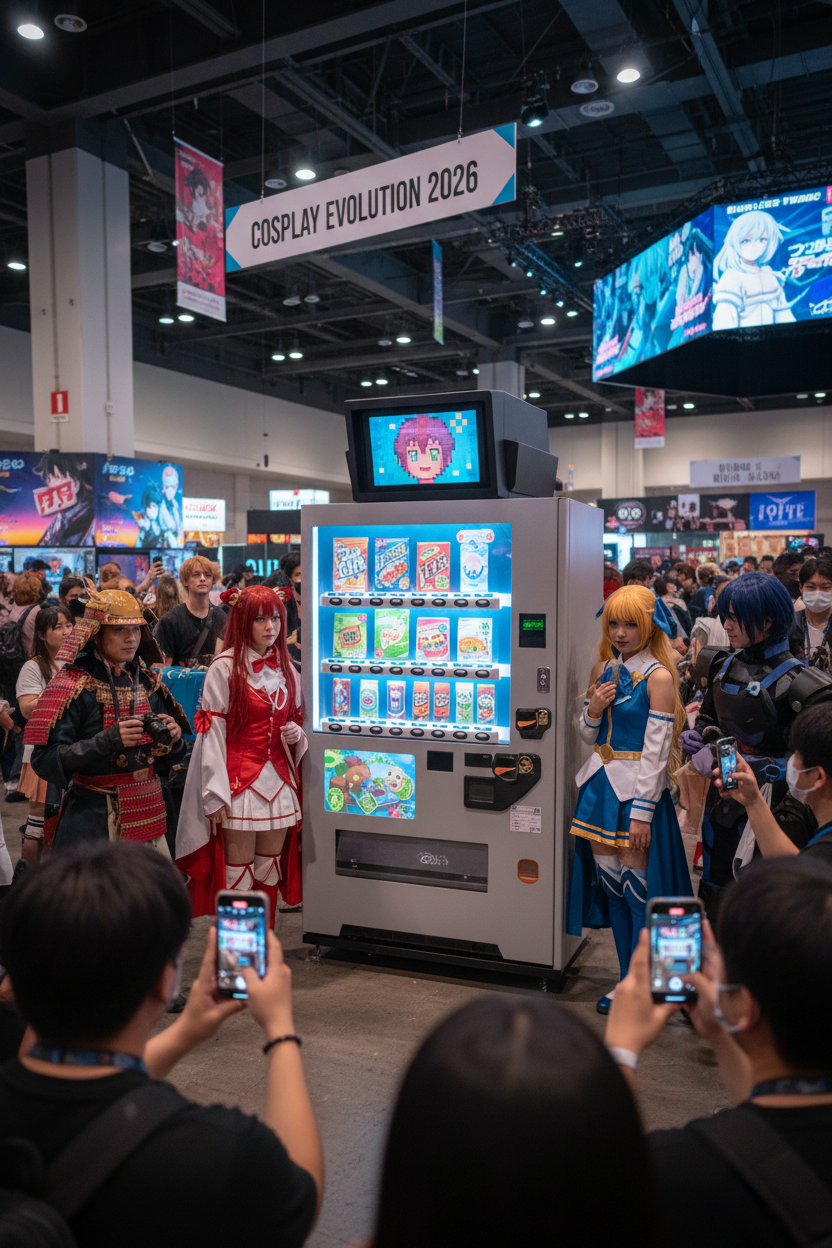
Chapter 1: What Is Object Cosplay?
Traditional cosplay starts with a relatively simple formula:
Character → Costume → Cosplayer
You choose a character, recreate their appearance, put on the costume, and attempt to embody that character.
But in 2026, that formula is becoming much more flexible.
A growing number of cosplay concepts begin somewhere completely different:
Object → Idea → Costume
Or:
Meme → Visual Joke → Cosplay
Or even:
Location → Convention → Cosplay
This is where object cosplay becomes interesting.
Object cosplay is the practice of turning a non-character object, concept, place, or everyday visual reference into a cosplay-style creation.
It could be:
- A household object
- A piece of architecture
- A food item
- A logo
- A meme
- A website
- A recognizable location
- A fictional object
- A piece of internet culture
- An everyday experience
The defining characteristic is simple:
The thing being represented does not have to be a traditional character.
That distinction matters because cosplay has historically been strongly connected to fictional characters.
You cosplay Naruto.
You cosplay an anime heroine.
You cosplay a video game character.
You cosplay a superhero.
But what happens when the thing you want to recreate is not a person?
That is where non-character cosplay begins.
The 2026 Shift: From Character Accuracy to Concept Recognition
One of the biggest changes happening in cosplay is the decreasing importance of literal character accuracy in certain types of content.
Traditional cosplay asks:
“Does this look like the character?”
Object cosplay asks:
“Do people understand what this represents?”
Those are very different creative challenges.
A character cosplay might require:
- Accurate clothing
- Correct wig
- Character-specific accessories
- Detailed props
- Makeup
- Costume construction
An unconventional cosplay might only need:
- The right color
- The right shape
- A recognizable reference
- A clever visual joke
- Good execution
This is why some of the most memorable modern cosplay concepts can look extremely simple at first glance.
The viewer recognizes the idea, rather than the costume.
Chapter 2: How to Create Non-Character Cosplay
The easiest way to understand object cosplay is to stop thinking about “costumes” and start thinking about visual translation.
Your job is to translate something that normally cannot be worn into something that can.
Here is a simple five-step framework.
Step 1: Choose Something Instantly Recognizable
The best unique cosplay ideas usually begin with something that already exists in popular culture.
Look around you.
You might find inspiration in:
- Buildings
- Signs
- Food
- Technology
- Toys
- Household products
- Internet memes
- Transportation
- Video games
- Websites
- Apps
- Convention venues
The more recognizable the reference, the easier the cosplay becomes.
For example, imagine someone says:
“I want to cosplay a vending machine.”
You immediately understand the concept.
Now the creative challenge becomes:
How do you make a person visually resemble a vending machine?
That could involve:
- A rectangular silhouette
- Bright product-like graphics
- Buttons
- A transparent-looking panel
- A coin slot
- A recognizable color scheme
You do not need to reproduce every mechanical detail.
You only need enough visual information for the audience to understand the reference.
Step 2: Identify the Three Most Important Features
Before creating the costume, identify the object's strongest visual signals.
Ask:
What is its shape?
Is it:
- Round?
- Rectangular?
- Tall?
- Flat?
- Oversized?
- Irregular?
What is its color?
Does it have:
- One dominant color?
- Strong contrast?
- A recognizable color combination?
What detail makes it unmistakable?
For example:
A traffic cone is not simply orange fabric.
Its identity comes from:
- Cone shape
- Orange color
- White reflective stripe
Remove all three and the idea becomes difficult to recognize.
This is why good everyday objects cosplay is often surprisingly minimal.
You are reducing an object to its strongest visual characteristics.
Step 3: Convert the Shape Into Clothing
Now ask:
What can reproduce the object's silhouette?
You can use:
- Cardboard
- Foam
- Fabric
- Jackets
- Skirts
- Dresses
- Hoodies
- Hats
- Bags
- Props
- Recycled packaging
The objective is not necessarily to construct the object literally.
Instead, create a wearable interpretation.
For example:
A traffic cone
Use:
- Orange clothing
- A cone-shaped hat
- White reflective bands
A vending machine
Use:
- A rectangular front panel
- Bright printed graphics
- Button details
- Product images
A computer error message
Use:
- A rectangular sign
- A recognizable error window
- Simple typography
- A deliberately exaggerated “system failure” pose
The more familiar the reference, the less explanation you need.
Step 4: Add the Joke
This is where meme cosplay becomes particularly powerful.
Object cosplay does not always need to be serious.
Sometimes the entire purpose is:
“Everyone knows what this is, and that is why this is funny.”
Internet culture has made this easier than ever.
A meme can become a cosplay because people already understand its visual language.
You can translate:
- Viral screenshots
- Reaction images
- Internet jokes
- Social-media trends
- Famous posts
- Gaming memes
- Convention jokes
into physical costumes.
This gives meme cosplay an important advantage over traditional character cosplay:
The audience may understand the joke immediately.
You do not need to explain the character's backstory.
The reference itself is the punchline.
Step 5: Test the Recognition
Before going to a convention, show your cosplay to someone who does not know what you are making.
Do not explain it.
Ask:
“What do you think this is?”
If they immediately identify it, your design is working.
If they guess something completely different, go back to the visual signals.
This is the five-second recognition test.
It is particularly useful for unconventional cosplay, because the audience does not have the character's established appearance to rely on.
Chapter 3: From Objects to Locations — The New Language of Cosplay
This may be the most interesting development.
If you can cosplay an object, why not cosplay a place?
That is where location cosplay comes in.
And Anime Expo 2026 provided a particularly useful cultural example.
The Los Angeles Convention Center was itself part of the cosplay environment surrounding Anime Expo. The 2026 event took place from July 2–5, with the convention center functioning as the primary venue.
The idea of turning a recognizable venue into the subject of cosplay sounds absurd at first.
But that absurdity is exactly what makes it work.
Think about the progression:
Character
↓
Object
↓
Meme
↓
Location
↓
Experience
At each stage, cosplay moves further away from traditional character recreation.
What Is Location Cosplay?
Location cosplay is essentially a wearable or performative interpretation of a recognizable place.
Possible concepts include:
- A convention center
- A subway station
- An airport
- A famous restaurant
- A shopping mall
- A classroom
- A hotel
- A fictional location
- A recognizable street
- A landmark
Imagine someone arriving at a convention dressed as the convention center itself.
The joke works because everyone around them understands the reference.
The venue becomes a “character.”
That is a major conceptual shift.
Why Location Cosplay Works
Locations have personalities.
Think about the difference between:
- An airport
- A nightclub
- A school
- A hospital
- A convention center
Each has recognizable:
- Colors
- Signs
- Architecture
- Objects
- Behaviors
- Atmosphere
- Social associations
A creative cosplayer can translate those elements into a wearable concept.
For example, a convention-center cosplay could incorporate:
- Event signage
- Badge imagery
- Floor-map graphics
- Escalator references
- Hall numbers
- Convention branding
- Crowd jokes
- Security references
Suddenly, architecture becomes character design.
Why Object Cosplay Is Growing in 2026
There are several reasons this trend makes sense right now.
1. Social Media Rewards Instant Recognition
TikTok, Instagram Reels, YouTube Shorts, and other short-form platforms favor content that communicates its idea quickly.
A highly complicated costume may require explanation.
A giant recognizable object may not.
That makes alternative cosplay ideas particularly suitable for short-form video.
The audience sees the costume and immediately understands the joke.
That creates a powerful first-second hook.
2. Cosplay Is Becoming More Meme-Driven
Modern fandom is heavily influenced by memes.
A character can become a meme.
A scene can become a meme.
A prop can become a meme.
Eventually, the meme itself can become cosplay material.
This creates a new cycle:
Fandom → Meme → Costume → New Meme
The cosplay does not merely reproduce fandom culture.
It can create another piece of fandom culture.
3. Accessibility Is Improving
Traditional cosplay can be expensive.
You may need:
- Specialized fabric
- Wigs
- Armor
- Props
- Shoes
- Makeup
- Sewing equipment
Object cosplay can sometimes be much cheaper.
A cardboard box, thrifted clothing, paint, tape, and printed graphics can be enough for a concept.
That makes unconventional cosplay attractive to beginners.
It also creates opportunities for creators who prefer improvisation over detailed costume fabrication.
4. Personal Creativity Matters More
A screen-accurate costume has a clear target.
There is a correct reference image.
Object cosplay has much more freedom.
Two people could cosplay the same object and create completely different interpretations.
That makes the format more personal.
It shifts cosplay from:
“Can you reproduce it?”
toward:
“What is your interpretation?”
Advanced Techniques: Make the Concept More Than a Costume
Once you understand object cosplay, you can go beyond clothing.
The strongest concepts often combine costume, performance, and environment.
Technique 1: Use Behavior
Do not only look like the object.
Act like it.
If you are cosplaying a vending machine, stay unusually still until someone “uses” you.
If you are cosplaying a security gate, imitate the movement.
If you are cosplaying a loading screen, freeze dramatically.
The costume becomes interactive.
Technique 2: Use Sound
Sound can instantly reinforce a concept.
For example:
- Notification sounds
- Elevator sounds
- Loading sounds
- Game sound effects
- Machine noises
- Convention announcements
Sound turns a visual joke into an experience.
This is particularly effective for video content.
Technique 3: Build a Group
Some objects are more recognizable when presented together.
Imagine:
- A traffic-light group
- A group of vending machines
- A group of browser tabs
- Different social-media icons
- Different airport signs
Group cosplay makes the concept easier to understand and creates stronger photography opportunities.
Technique 4: Turn the Environment Into Part of the Costume
This is where location cosplay becomes especially powerful.
If your concept is a subway station, photograph yourself near a subway.
If your concept is an airport, use airport architecture.
If your concept is a convention center, use the actual venue.
The environment becomes the second half of the joke.
That can make a simple costume dramatically more convincing.
Chapter 4: Tools and Resources for Object Cosplay
You do not need a professional fabrication studio.
Start with inexpensive materials.
Basic Materials
- Cardboard
- Craft foam
- Fabric
- Acrylic paint
- Fabric markers
- Velcro
- Elastic
- Double-sided tape
- Safety pins
- Hot glue
- Printed graphics
- Recycled packaging
Useful Clothing
Keep basic pieces in neutral colors:
- Black hoodie
- White shirt
- Black pants
- Plain skirt
- Oversized jacket
- Sneakers
- Boots
These can become foundations for dozens of unique cosplay ideas.
Digital Design Tools
Simple graphic-design software can help you create:
- Signs
- Labels
- Logos
- Fake interfaces
- Product graphics
- Meme references
- Convention-style badges
You can print these designs and attach them to cardboard, foam, fabric, or other lightweight materials.
Photography Tools
A smartphone is usually enough.
For better results, consider:
- A portable tripod
- Small LED light
- Bluetooth remote
- Wide-angle lens
- Portable power bank
But equipment should support the idea, not replace it.
A brilliant concept photographed on a phone can be more memorable than a complicated costume photographed with expensive equipment.
How to Generate Your Own Object Cosplay Ideas
If you want to create your own alternative cosplay ideas, use this formula:
Step 1: Look Around
Choose one ordinary thing.
Step 2: Identify Its Visual Identity
Find its:
- Shape
- Color
- Texture
- Signature detail
Step 3: Find the Human Equivalent
Ask:
“What clothing could represent this?”
Step 4: Add One Exaggerated Feature
Make the concept obvious.
Step 5: Add a Joke
Give it a meme, personality, or convention reference.
Step 6: Photograph It in Context
The environment can complete the idea.
This framework can produce almost unlimited concepts.
FAQ
What is object cosplay?
Object cosplay is a form of cosplay where someone recreates an object, concept, place, meme, or other non-character subject rather than portraying a traditional fictional character.
Is object cosplay considered real cosplay?
There is no universal rule that defines what counts as “real” cosplay.
Different communities may have different opinions.
However, cosplay has always included creative interpretation, parody, crossovers, original designs, and unconventional concepts. Object cosplay extends that creative tradition beyond traditional characters.
What is non-character cosplay?
Non-character cosplay refers to cosplay inspired by something that is not a traditional fictional character.
It can include objects, locations, memes, logos, fictional items, concepts, or other recognizable references.
What is meme cosplay?
Meme cosplay turns an internet meme, viral image, joke, or recognizable online reference into a physical costume or performance.
The concept depends heavily on audience recognition.
What is location cosplay?
Location cosplay is a creative interpretation of a recognizable physical or fictional location.
Instead of dressing as someone who exists there, the cosplayer represents the place itself.
Is object cosplay cheaper than traditional cosplay?
It can be.
Many object cosplay concepts can be created using thrifted clothing, cardboard, craft foam, recycled materials, paint, and household objects.
However, cost depends entirely on the complexity of the concept.
What are some good everyday objects cosplay ideas?
Begin with objects that have strong visual identities, such as:
- Traffic cones
- Vending machines
- Road signs
- Smartphones
- Game controllers
- Household appliances
- Fast-food packaging
- Luggage
- Computer windows
- Internet icons
The key is recognizability.
How do I make my unconventional cosplay recognizable?
Focus on the three strongest visual signals:
Shape + Color + Signature Detail.
If those three elements are immediately visible, your audience has a much better chance of understanding the reference.
Conclusion: Cosplay Is Becoming a Language, Not Just a Costume
The most important thing about the rise of object cosplay is not the objects themselves.
It is what they represent.
Cosplay is increasingly becoming a form of visual communication.
In the past, the message might have been:
“I am this character.”
Today, the message can be:
“I am this meme.”
Or:
“I am this object.”
Or:
“I am this building.”
Or even:
“I am this shared experience.”
That is why the progression from Character → Meme → Object → Place → Experience is so important.
It shows how cosplay can move beyond character accuracy and become a form of humor, commentary, creativity, and community participation.
Anime Expo 2026 is a useful backdrop for this shift. The convention itself occupied the Los Angeles Convention Center and surrounding event spaces, while its official programming included cosplay gatherings and other activities built around fan participation.
Meanwhile, the enormous online engagement surrounding Anime Expo 2026 cosplay shows just how quickly unusual cosplay concepts can become part of the wider fandom conversation. One Reddit cosplay thread from the event surpassed 2,200 upvotes.
So if you are searching for your next unique cosplay idea, do not limit yourself to character lists.
Look around.
Look at your phone.
Look at the building you are standing in.
Look at the memes your fandom keeps repeating.
Look at the ordinary objects nobody normally thinks about.
Because in 2026, almost anything recognizable can potentially become cosplay.
The question is no longer simply:
“Which character should I cosplay?”
It can also be:
“What does my fandom recognize that I can turn into a costume?”
And that may be where the next generation of cosplay trends begins.


Laisser un commentaire
Ce site est protégé par hCaptcha, et la Politique de confidentialité et les Conditions de service de hCaptcha s’appliquent.