Introduction
Cosplay has always involved interpretation.
Some creators try to reproduce a character as accurately as possible. Others modify the costume, change the materials, redesign the silhouette, or adapt the character to their own style.
Genderbend cosplay takes that creative reinterpretation one step further: the creator deliberately reimagines a character with a different gender presentation while retaining recognizable elements of the original character.
And in 2026, that format remains highly visible across social platforms.
The discussion is not merely theoretical. A TikTok hashtag tracker currently reports more than 210 million views for #genderbendcosplay, while recent Reddit discussions show cosplayers actively asking whether genderbending is unusual, how it differs from crossplay, and how much freedom creators should have when adapting a character.
One reported industry figure puts the sharing rate for genderbend content at 1.9× that of conventional cosplay content. Because this is a reported benchmark rather than a universal cross-platform dataset, it should not be interpreted as meaning every genderbend post automatically performs 1.9× better.
But it raises a more interesting question:
Why does changing one fundamental aspect of a familiar character create so much additional discussion?
The answer goes beyond novelty.
Quick Verdict: Genderbend Cosplay vs. Standard Cosplay
| Dimension | Standard Costume | Genderbend Cosplay |
|---|---|---|
| Character recognition | Very high | High |
| Creative freedom | Moderate | Very high |
| Visual novelty | Moderate | High |
| Comment potential | Moderate | High |
| Share potential | Variable | Potentially high |
| Design challenge | Character accuracy | Character + reinterpretation |
| Social discussion | Usually lower | Often higher |
| Best for | Faithful recreation | Creative interpretation |
The verdict
Choose standard cosplay when your priority is screen accuracy and immediate character recognition.
Choose genderbend cosplay when you want to reinterpret the character, experiment with fashion and create something audiences have a reason to discuss.
The important distinction is that genderbend cosplay isn't inherently “better.”
Its potential advantage comes from giving the audience another question to answer.
H2: 1. Why Does Genderbend Cosplay Get More Attention?
The first reason is simple:
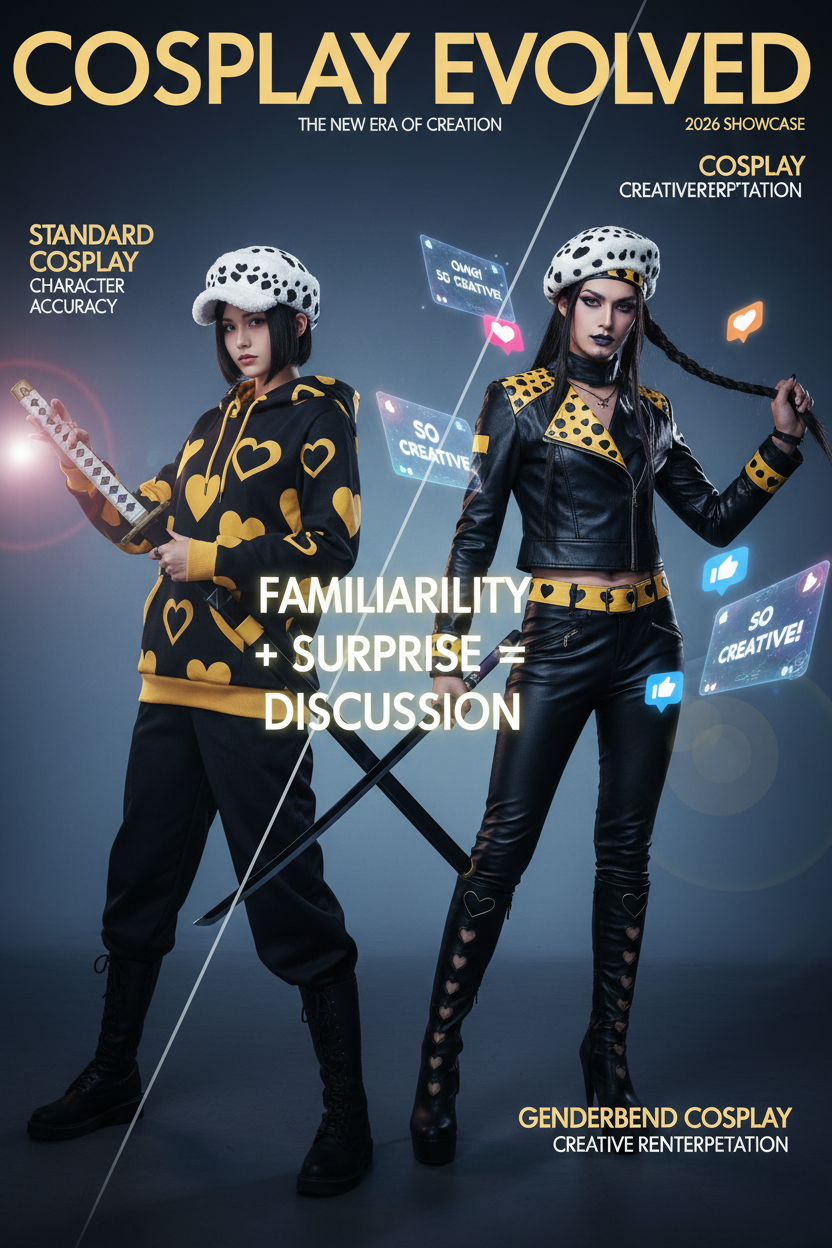
Familiar character + unexpected design
A conventional cosplay asks the audience:
“How accurately did this person recreate the character?”
A genderbend version introduces another question:
“How did they redesign this character?”
That second question creates additional visual information.
Imagine a character everyone recognizes.
Now change:
- Silhouette
- Clothing structure
- Hairstyle
- Makeup
- Accessories
- Proportions
- Styling
- Fashion references
The character remains recognizable, but the interpretation is new.
That creates a useful social-media formula:
Familiarity + surprise = discussion
H2: 2. Genderbend Cosplay Is More Than a Costume Change
One of the biggest mistakes is treating genderbend character cosplay as simply changing a skirt into pants or pants into a skirt.
The strongest interpretations usually preserve the character's visual identity.
Think about the character as a collection of signals.
Character identity can come from:
- Signature colors
- Hairstyle
- Weapon
- Jewelry
- Symbols
- Facial markings
- Costume motifs
- Silhouette
- Personality
- Pose
A successful genderbend keeps enough of these signals for the audience to recognize the source.
Then the creator can reinterpret everything else.
This is why the best examples feel like:
“I know exactly who this is—but I've never seen this version before.”
H2: 3. The Social-Media Advantage: It Creates a Reason to Share
A conventional cosplay photograph can be beautiful.
But beauty alone doesn't necessarily create a reason to share.
A genderbend version can generate a stronger reaction:
“I've never seen this character like this.”
That reaction is valuable because sharing is often driven by novelty plus identity.
Someone might share a post because:
- They recognize the character.
- They like the redesign.
- They want their friends to see it.
- They disagree with the interpretation.
- They want to compare it with the original.
- They want to try the same concept.
This creates multiple possible engagement paths.
That's one reason the reported 1.9× sharing figure is interesting.
The important insight isn't the exact multiplier.
It's that reinterpretation gives the audience something additional to react to.
H2: 4. Genderbend Cosplay vs. Crossplay: What's the Difference?
This distinction is important because the terms are often used interchangeably online.
They aren't necessarily the same thing.
Crossplay
Crossplay generally means cosplaying a character whose canonical gender differs from the cosplayer's presentation.
The character itself remains essentially the same.
For example:
A woman cosplays a male character while attempting to reproduce the male character's original design.
Genderbend Cosplay
A genderbend cosplay changes the character's design itself.
For example:
A creator turns a male character into a female reinterpretation and redesigns the clothing accordingly.
In simplified form:
Crossplay:
Different performer → same character
Genderbend:
Same character concept → redesigned gender presentation
The distinction is also reflected in recent community discussions. Cosplayers on Reddit specifically debate whether cosplaying a character of another gender is crossplay, while a deliberately redesigned version constitutes genderbend.
Neither approach is inherently more legitimate.
They're simply different creative choices.
H2: 5. Why Audiences Respond to the “Redesign” Element
The real appeal of genderbend cosplay popularity may be less about gender itself and more about creative reinterpretation.
Consider what happens when you genderbend a character.
You suddenly have design questions that a conventional costume may not require.
What happens to the silhouette?
Does the original shape remain?
Or does it become more fashion-oriented?
What happens to the costume?
Do you reproduce the original clothing?
Or reinterpret its key motifs?
What happens to the hairstyle?
Do you preserve the iconic shape?
Or adapt it to a different styling language?
What happens to the accessories?
Which items are essential for recognition?
Which can be redesigned?
These questions turn cosplay into a design exercise.
H2: 6. Why “Creative Interpretation” Can Beat Perfect Accuracy
There is an ongoing tension within cosplay between:
Character Accuracy
and
Creative Interpretation
A highly accurate cosplay answers:
“How closely can I reproduce this character?”
A genderbend version often asks:
“How would this character exist if their design language were different?”
Neither question is superior.
They simply produce different forms of creativity.
This matters because social platforms often reward content that can be understood quickly but still contains something unexpected.
A recognizable character gives the audience an immediate reference point.
The genderbend gives them the surprise.
H2: 7. The Representation Conversation Adds Another Layer
This is where the topic needs more nuance.
Some creators use genderbend cosplay purely as a design experiment.
Others connect their interpretations with broader conversations about gender expression, representation or inclusivity.
These shouldn't automatically be treated as the same thing.
A creator can genderbend a character because:
- They prefer the redesigned fashion.
- The original character doesn't fit their personal style.
- They enjoy alternative character interpretations.
- They want a creative challenge.
- They want to explore gender presentation.
- They simply think the design looks cool.
The social meaning depends on the individual creator.
That is why content about inclusive cosplay should avoid assuming that every genderbend cosplay represents a particular identity or political position.
Instead, the broader observation is:
Cosplay gives fans a relatively flexible space to experiment with fictional identity and character design.
Academic writing on cosplay has similarly examined genderbend as a space where creators can both challenge and reproduce traditional gender conventions.
H2: 8. What Makes a Genderbend Cosplay Shareable?
If we're analyzing this from a content perspective, several elements consistently make a reinterpretation easier to understand and discuss.
1. Strong Character Recognition
People need to know what changed.
If nobody recognizes the original character, the genderbend concept becomes less obvious.
2. A Clear Design Twist
The redesign should communicate itself visually.
For example:
Original → redesigned
works especially well in transformation videos.
3. Strong Before-and-After Presentation
A creator can show:
Canon design
↓
Genderbend interpretation
This gives viewers an immediate comparison.
4. A Recognizable Signature Element
Keep one or two unmistakable elements.
It might be:
- Hair
- Weapon
- Color
- Symbol
- Accessory
- Makeup
This maintains the character connection.
5. A Personal Design Choice
The most interesting genderbend versions don't look like generic gender-swapped costumes.
They look like someone actually designed them.
That's where creative cosplay becomes important.
H2: 9. Genderbend Cosplay Can Also Make Good Transformation Content
The format works particularly well for short-form video.
A simple structure could be:
Scene 1
Show the original character.
Scene 2
Show the creator in everyday clothing.
Scene 3
Transformation begins.
Scene 4
Reveal the genderbend interpretation.
Scene 5
Show close-ups of:
- Wig
- Makeup
- Costume
- Accessories
- Prop
Scene 6
Final character pose.
The audience gets both:
the character recognition
and
the transformation payoff.
That's a strong combination for genderbend cosplay social media content.
H2: 10. How to Design a Genderbend Cosplay Without Losing the Character
Start with a character identity map.
| Element | Keep / Change | Why |
|---|---|---|
| Signature color | Keep | Immediate recognition |
| Hair silhouette | Usually keep | Strong visual cue |
| Main accessory | Keep | Character identity |
| Costume structure | Adapt | Creates reinterpretation |
| Makeup | Adapt | Supports new presentation |
| Footwear | Adapt | Fits new styling |
| Props | Keep/adapt | Reinforces character |
The goal isn't:
Change everything.
The goal is:
Change enough to make the interpretation interesting while keeping enough to make the character recognizable.
H2: 11. Why Genderbend Content Can Generate More Comments
Comments often come from comparison.
A viewer may say:
“This looks better than the original.”
Another might say:
“I prefer the canon design.”
Someone else might ask:
“What character is this based on?”
Another person may say:
“I want to try this version.”
That is important.
A post doesn't need everyone to agree to generate engagement.
It needs to give people something specific to discuss.
Genderbend naturally introduces that discussion because the audience has a reference version.
H2: 12. But More Engagement Doesn't Mean Every Genderbend Post Will Go Viral
This is an important caveat.
The reported 1.9× sharing figure shouldn't become:
“Genderbend cosplay always performs better.”
Social performance depends on many variables:
- Character popularity
- Creator audience
- Platform
- Video quality
- Timing
- Editing
- Caption
- Music
- Thumbnail
- Trend relevance
- Execution
A poorly executed genderbend can receive less attention than an excellent conventional cosplay.
The more useful conclusion is:
Genderbend gives creators an additional creative hook.
That hook can increase the likelihood of discussion when the execution is strong.
H2: 13. When Should You Choose Genderbend Cosplay?
Choose standard cosplay when:
- Accuracy is your priority.
- You're entering an accuracy-focused competition.
- You love the original design.
- You want immediate character recognition.
Choose genderbend cosplay when:
- You want more creative freedom.
- You enjoy fashion reinterpretation.
- You want to redesign the silhouette.
- You want transformation content.
- You want to experiment with character presentation.
Choose a hybrid approach when:
You want to preserve most of the canon costume while introducing subtle changes.
This can be particularly effective for first-time creators.
H2: 14. How to Make Your First Genderbend Cosplay
You don't need to redesign an entire costume from scratch.
Start with one character you already love.
Then identify three elements:
Keep
One unmistakable character feature.
Adapt
One major clothing element.
Reinvent
One element that gives the costume your own identity.
For example:
Keep: signature wig
Adapt: jacket
Reinvent: skirt/pants/accessory combination
This creates a manageable first project.
If you're looking for practical construction ideas, a gender-neutral cosplay approach can also provide useful inspiration for separating character identity from conventional gendered clothing choices.
H2: 15. Where the Trend Could Go Next
The interesting question isn't whether genderbend cosplay will replace conventional cosplay.
It won't.
Instead, cosplay appears to be expanding into more forms of interpretation:
Canon cosplay
↓
Crossplay
↓
Genderbend
↓
Fashion reinterpretation
↓
Original character adaptation
↓
Character-inspired design
The boundaries between cosplay, fashion and fan creativity continue to become more flexible.
Recent community discussions reflect that flexibility. A July 2026 Reddit discussion from a newer cosplayer asked whether doing mostly genderbent characters was unusual; the overwhelming response was essentially that there is no requirement to restrict yourself to canon gender or one “correct” way to cosplay.
A separate August 2026 genderbent Alice post received thousands of upvotes and comments, with commenters specifically praising the unusual interpretation and suggesting a series of other genderbent characters.
Those examples don't prove a universal growth rate.
But they do demonstrate something valuable:
The format continues to give communities something to talk about.
FAQ
Is genderbend cosplay the same as crossplay?
No. Crossplay generally refers to cosplaying a character of a different gender from the cosplayer, while genderbend cosplay deliberately reimagines the character itself with a different gender presentation. Community terminology can vary, however.
Why is genderbend cosplay popular?
Its appeal comes from combining a familiar character with a new interpretation. That creates visual novelty while preserving enough recognizable elements for fans to understand the reference.
Does genderbending make a cosplay less accurate?
Compared with a canon recreation, yes—the design is intentionally different. But accuracy and creativity are different goals. A genderbend cosplay can be highly successful on its own terms.
What makes a good genderbend cosplay?
Strong character recognition, thoughtful redesign and a clear creative concept. Keeping signature colors, accessories, hairstyles or props can help viewers immediately understand the source character.
Is genderbend cosplay inclusive?
It can be. Some creators use genderbend as a way to explore identity or representation, while others simply enjoy redesigning fictional characters. It is better to let creators define the personal meaning of their own work.
What is gender-neutral cosplay?
Gender-neutral cosplay generally focuses on adapting a character or costume without relying heavily on traditionally gendered clothing or presentation. It can overlap with genderbend, crossplay and other forms of character reinterpretation, but the concepts aren't identical.
Should beginners try genderbend cosplay?
Absolutely. A first attempt doesn't need to completely redesign the character. Keeping the wig, colors or signature accessories while changing one or two major costume elements can be a manageable starting point.
Conclusion: The Real Advantage Is Creative Freedom
The most interesting thing about the genderbend cosplay trend isn't simply that it can receive more shares.
It's that genderbending gives fans another way to answer a fundamental cosplay question:
“What would this character look like through my creative lens?”
A conventional cosplay celebrates the character as they are.
A genderbend cosplay celebrates the character and the interpretation.
That distinction explains why these posts can create stronger conversations. The audience isn't only evaluating whether the costume is accurate. They're comparing the original character with a new creative possibility.
And that is ultimately why genderbend cosplay popularity shouldn't be reduced to an algorithm trick.
The reported sharing advantage is interesting, but the deeper trend is cultural:
Cosplay is increasingly becoming less about reproducing one fixed version of a character and more about exploring how many ways that character can exist.
For creators interested in trying the format, the best approach isn't to chase the 1.9× sharing figure.
Start with a character you genuinely like.
Keep the elements that make them recognizable.
Change the elements that inspire you.
And make the reinterpretation feel like your version of the character, rather than simply a gender-swapped template.

Laisser un commentaire
Ce site est protégé par hCaptcha, et la Politique de confidentialité et les Conditions de service de hCaptcha s’appliquent.