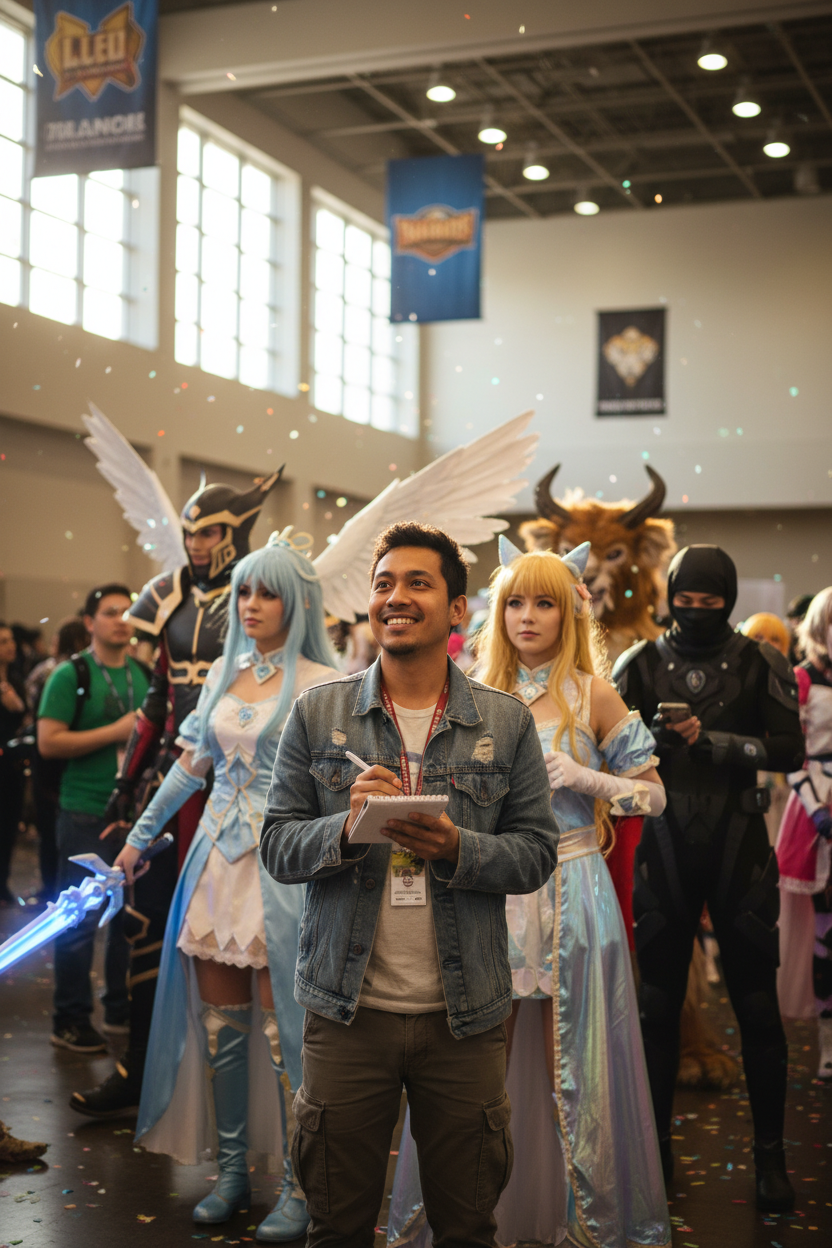
For a long time, cosplay culture seemed to have three obvious participants: cosplayers who create the looks, photographers who document them, and convention organizers who provide the stage.
But there may be another group quietly becoming part of the picture:
These are people who do not cosplay themselves. They may not carry a camera. They may not enter competitions or attend workshops. They simply enjoy seeing characters brought to life and want to experience the atmosphere surrounding cosplay.
A recent discussion around World Cosplay Summit 2026 in Nagoya makes this increasingly visible. One Reddit user asked how to enjoy the event because they were “not going to be cosplaying or photographing” and simply wanted to look at cosplayers. Other attendees explained where they could walk around, what could be viewed without entering ticketed programs, and which days offered the strongest cosplay atmosphere.
That question may sound simple, but culturally it is interesting.
It suggests that participation in cosplay culture does not necessarily require wearing a costume.
You can participate by watching, appreciating, learning, photographing, discussing, sharing, or simply being present.
World Cosplay Summit itself describes its purpose as bringing together fans of anime, manga, and games through cosplay and cross-cultural exchange. Its 2026 event brought participants from 41 countries and regions to Nagoya, showing how large the surrounding audience can become.
So if you are interested in cosplay for non-cosplayers, where should you start?
Here are five ways to become part of the culture without putting on a costume.
1. Walk the Convention Floor and Experience Cosplay in Real Life
The easiest way to become a cosplay spectator is also the most obvious:
Go where cosplayers are.
You do not need to cosplay to appreciate cosplay.
Large conventions often transform ordinary exhibition spaces into temporary communities filled with costumes, props, character performances, meetups, and spontaneous interactions.
For a spectator, this can be more interesting than simply looking at finished cosplay photos online.
You can see:
- How costumes move in real life
- How large props actually are
- How cosplayers interact with fans
- How groups coordinate their costumes
- How different people interpret the same character
- How costumes look from different angles
- How much craftsmanship goes into apparently simple outfits
This is one reason watching cosplay at conventions can feel different from consuming cosplay on social media.
Online, you usually see the final image.
At a convention, you see the entire process surrounding it.
A cosplayer might spend months making armor, styling a wig, testing makeup, and building props. Then, for a few hours, that creation becomes part of a public environment where other fans can experience it.
That interaction is itself part of cosplay culture.
Where should spectators go?
Large cosplay events often have designated photography areas, public gathering areas, parades, stages, and outdoor spaces where cosplay naturally becomes visible.
World Cosplay Summit 2026, for example, spread activities across Nagoya's Sakae and Osu areas, with Oasis 21 serving as the main venue. The official program included a red-carpet cosplay photo session, stage events, the Osu Cosplay Parade, and other public activities.
You do not necessarily have to understand every event category before attending.
Start by finding where cosplayers naturally gather.
Then observe.
2. Watch Cosplay Performances and Competitions
If you are not interested in walking around and looking at costumes, try watching cosplay as a performance art.
Cosplay competitions can be especially interesting because they reveal another side of the community.
A competition is not simply:
“Who has the most accurate costume?”
Competitors may incorporate:
- Acting
- Dance
- Stage combat
- Props
- Lighting
- Music
- Comedy
- Character interpretation
- Storytelling
The costume becomes part of a larger performance.
This makes competitions accessible even to spectators who know very little about costume construction.
You do not need to understand sewing techniques to appreciate a strong performance.
You simply need to understand the character or story being represented.
World Cosplay Summit is a particularly strong example because its World Cosplay Championship brings representatives from multiple countries and regions together around cosplay performance and craftsmanship. The 2026 championship also offered free online streaming, meaning spectators did not even have to travel to Japan to watch it.
This is an important point for the future of cosplay fandom.
Spectators can participate from different levels:
In-person audience → online viewer → social-media viewer → casual fan
The physical convention is only one part of the ecosystem.
3. Become a Casual Cosplay Photographer
You do not have to become a professional photographer to document cosplay.
A smartphone is enough to begin.
For many spectators, photography provides a natural bridge between simply watching cosplay and becoming more actively involved in the cosplay community.
You can photograph:
- Full costumes
- Group cosplays
- Props
- Makeup
- Convention environments
- Character interactions
- Behind-the-scenes moments
- Creative interpretations
However, there is one important rule:
Ask before taking a close-up portrait.
Cosplay photography works best as a collaboration rather than an extraction.
A simple:
“Can I take a photo?”
can make the interaction much more comfortable.
This is particularly important when photographing people who have spent hours creating elaborate costumes.
You don't need expensive equipment
Start with whatever camera you already have.
For beginners, focus on:
Composition
Leave enough space around the costume so the character's silhouette remains visible.
Lighting
Avoid placing the subject directly under harsh overhead lighting whenever possible.
Background
A clean background helps the costume stand out.
Angles
Take a few different perspectives instead of repeating the same shot.
Interaction
If the cosplayer agrees, ask whether they have a preferred pose.
This last point can make a major difference.
Experienced cosplayers often know which poses best communicate their character.
Photography therefore becomes more than documentation.
It becomes another form of participation.
4. Join the Conversation Without Wearing a Costume
You do not need to cosplay to have an opinion about cosplay.
This is perhaps the most overlooked form of spectator participation.
You can discuss:
- Favorite characters
- Costume craftsmanship
- Makeup techniques
- Convention experiences
- Creative prop designs
- Character interpretations
- Cosplay trends
- Convention etiquette
- New fandom communities
Social media has made this particularly easy.
A cosplay photo can lead to a discussion.
A convention video can inspire someone to attend their first event.
A particularly creative costume can introduce a viewer to an unfamiliar anime, manga, game, or character.
This creates a larger cosplay fandom ecosystem.
The person who never cosplays may still:
- Discover a character through cosplay.
- Search for the original series.
- Join a fandom.
- Follow cosplayers.
- Visit a convention.
- Eventually try cosplay themselves.
In other words, the spectator does not necessarily remain a spectator.
They can become part of the wider fandom journey.
5. Attend a Convention Specifically as a Spectator
Perhaps the biggest change is psychological.
You do not have to attend a convention with the assumption that you need to “do” something.
You can simply go to experience it.
For someone new to conventions, this can actually be less intimidating.
You can:
- Walk around
- Watch cosplay
- Browse merchandise
- Attend panels
- Watch performances
- Explore artist areas
- Meet other fans
- Take photos
- Eat at the venue
- Sit and people-watch
- Leave whenever you want
The recent World Cosplay Summit discussion demonstrates exactly this type of participation. One attendee specifically wanted to visit the event without cosplaying or photographing and asked where they could simply admire the costumes. The responses treated that as a legitimate way to experience the event rather than an unusual request.
Another Reddit discussion about attending WCS without making a costume received similar responses: people explained that attendees did not need to create their own costumes unless they were competing.
That distinction is important.
Cosplay participation and cosplay spectatorship are not the same thing.
And they do not have to be.
Quick Comparison: Which Type of Cosplay Spectator Are You?
| Spectator Type | Best For | What You Do | Equipment Needed |
|---|---|---|---|
| Convention Walker | First-time visitors | Explore and observe cosplay | None |
| Performance Viewer | Fans of anime/game culture | Watch competitions and stage shows | None |
| Casual Photographer | Visual creators | Photograph consenting cosplayers | Smartphone or camera |
| Online Participant | Remote fans | Watch, comment, share and discuss | Phone/computer |
| Fandom Explorer | New fans | Discover characters and communities | None |
The important thing is that there is no “correct” way to be a spectator.
Your level of participation can change depending on your interests.
How to Choose the Best Way to Enjoy Cosplay as a Non-Cosplayer
If You Are Completely New to Conventions
Start with walking around.
You do not need a complicated schedule.
Spend a few hours observing the environment and learning how the event works.
This is probably the easiest introduction to cosplay for non-cosplayers.
If You Love Performing Arts
Prioritize:
- Cosplay competitions
- Masquerades
- Stage shows
- Character performances
- Dance performances
These events allow you to appreciate cosplay as entertainment rather than simply costume design.
If You Love Photography
Bring your phone or camera and learn basic convention photography etiquette.
Look for designated photography areas.
Most importantly, communicate with the people you photograph.
The best cosplay photos are often collaborative.
If You Are Introverted
You do not have to interact with everyone.
Try:
- Watching performances
- Walking around quieter areas
- Exploring merchandise
- Taking environmental photos
- Following event livestreams
- Watching cosplay content online
There is no requirement to become socially active immediately.
If You Want to Meet the Community
Start with shared interests.
Ask someone about:
- Their character
- Their costume
- Their prop
- The series they are representing
- Which convention they recommend
Cosplay gives strangers an immediate conversation topic.
That can make convention socializing easier than entering a conversation with no common subject.
A Simple First-Time Spectator Plan
If you have never attended a cosplay convention before, you can keep your first visit extremely simple.
Before the event
Check:
- Event schedule
- Venue map
- Photography rules
- Ticket requirements
- Stage schedule
- Transportation
- Weather
- Convention policies
Do not build an impossible itinerary.
Choose two or three things you genuinely want to see.
When you arrive
Spend the first 30 minutes simply walking around.
Observe where people gather.
Find the main cosplay areas.
Locate restrooms, food, exits, and information desks.
Then decide what you want to do next.
During the event
Take breaks.
Large conventions can become overwhelming because of:
- Crowds
- Noise
- Heat
- Long walking distances
- Bright lights
- Constant stimulation
You do not need to stay active every minute.
Sometimes sitting somewhere and watching the convention environment is part of the experience.
Before leaving
Think about what you enjoyed most.
Was it:
- Costumes?
- Photography?
- Performances?
- Fandom conversations?
- Merchandise?
- Meeting creators?
That answer can help you decide what type of convention experience you want next time.
Common Mistakes Cosplay Spectators Should Avoid
Treating Cosplayers Like Public Displays
Cosplayers are people, not convention decorations.
Do not assume that wearing a costume means someone has agreed to be photographed, touched, interrupted, or followed.
Ask before taking close-up photos.
Respect a “no.”
And never touch costumes or props without permission.
Blocking Photography Areas
If you are watching photographers and cosplayers work, avoid standing directly behind the photographer or walking into an active shooting area.
Designated photography spaces exist for a reason.
Give creators room to work.
Assuming Every Cosplayer Wants Attention
Some people cosplay because they enjoy:
- Crafting
- Character design
- Performing
- Fashion
- Friendship
- Personal creativity
Not everyone wants to become the center of attention.
Respect different comfort levels.
Thinking You Need to Buy Everything
You do not need a full convention wardrobe.
You do not need an expensive camera.
You do not need a VIP ticket.
You do not need to attend every panel.
You do not even need to cosplay.
Your first convention can simply be an exploration.
Why Cosplay Spectators Matter to Fandom Culture
This may be the most interesting question.
If cosplay culture only consisted of people wearing costumes, its audience would be relatively limited.
But once spectators become recognized participants, the culture becomes much larger.
Consider the ecosystem:
Cosplayer → Photographer → Spectator → Content Viewer → Fandom Member → Future Cosplayer
Someone can enter the ecosystem at almost any point.
A spectator may discover a character.
A photographer may become interested in costume construction.
A fan watching a competition may eventually decide to enter one.
A convention visitor may start with no costume and return the following year wearing one.
That means spectators are not necessarily passive.
They can be future participants.
The WCS 2026 discussions are useful because the question was not “How do I enter the cosplay competition?”
It was much simpler:
“How can I go there just to look at cosplay?”
That question itself reveals something about modern cosplay culture.
People increasingly recognize cosplay as something worth experiencing even when they are not personally creating it.
From Cosplayer to Spectator: A Wider Definition of Participation
The traditional model of cosplay culture looked something like this:
Creator → Photographer → Audience
But modern fandom is becoming more interconnected.
A person might be:
- A cosplayer one weekend
- A photographer the next
- A spectator at another event
- A content creator online
- A fandom commenter every day
These identities can overlap.
That is why cosplay community may be better understood as a network rather than a group with strict membership requirements.
You do not have to prove that you are a “real fan.”
You do not need a handmade costume.
You do not need to know every convention rule.
You can simply be interested.
And sometimes, simply showing up is enough to begin participating.
Final Thoughts
The rise of cosplay spectators may not look like a major cultural shift at first.
After all, people have always watched cosplayers.
But the difference is that fandom is increasingly recognizing spectatorship as a legitimate form of participation.
The recent discussions surrounding World Cosplay Summit 2026 provide a useful example. People were asking where to go, when to go, what they could see, whether they needed a costume, and how to experience the event simply as fans.
And the answer is surprisingly simple:
You do not need to cosplay to belong at a cosplay event.
You can watch.
You can learn.
You can photograph—with permission.
You can cheer.
You can discuss.
You can discover new characters.
You can meet people who love the same stories.
And maybe, one day, you will decide to put on a costume yourself.
Until then, being the person standing on the other side of the convention floor and saying, “That cosplay is amazing,” is already a way of participating in cosplay culture.

Laisser un commentaire
Ce site est protégé par hCaptcha, et la Politique de confidentialité et les Conditions de service de hCaptcha s’appliquent.