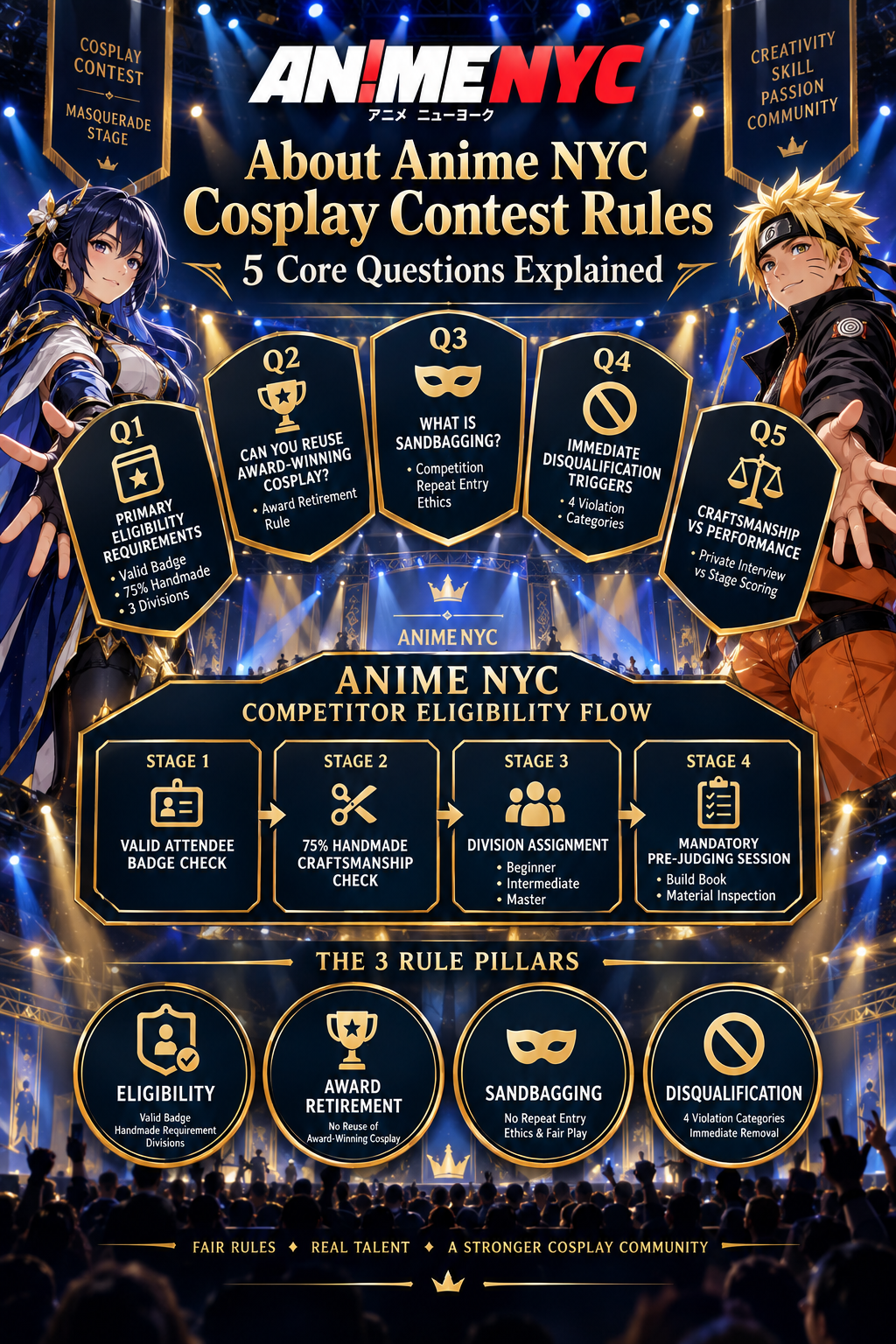
Navigating competitive cosplay requires more than exceptional sewing and prop fabrication; it demands a thorough understanding of event rulebooks. As one of the largest anime conventions in North America, Anime NYC enforces strict guidelines governing costume construction, division placement, and past award eligibility.
Whether you are entering a major masquerade for the first time or aiming for a Master-level trophy, understanding these five core questions ensures your entry remains fully eligible and compliant.
Question 1: What Are the Primary Eligibility Requirements Under Anime NYC Cosplay Contest Rules?
Direct Answer: To compete in the Anime NYC cosplay competition, participants must hold a valid convention badge, meet the minimum 75% handmade construction threshold for craftsmanship divisions, and register under a skill category determined by the highest-awarded member of their group.
                [ ANIME NYC COMPETITOR ELIGIBILITY FLOW ]

  +------------------------------------------------------------------+
  | Valid Attendee Badge Check  --> 75%+ Handmade Craftsmanship Check |
  | Division Assignment         --> Beginner / Intermediate / Master |
  | Mandatory Pre-Judging Session--> Build Book & Material Inspection |
  +------------------------------------------------------------------+
Division Classification & Handmade Thresholds
For all craftsmanship entries at Anime NYC, store-bought or fully commissioned outfits are strictly prohibited from competing. Creators must prove that at least 75% of the garment, armor, or prop work was fabricated by hand. Competitors are grouped into standard skill divisions to maintain fair play:
-
Beginner: Creators who have won 0 to 1 major awards at previous competitions.
-
Intermediate: Creators who have earned 2 to 4 major awards across previous conventions.
-
Master / Advanced: Veteran makers with 5 or more major division titles or those who derive over 75% of their income from custom costume commissions.
Verifying your Anime NYC cosplay contest eligibility early prevents last-minute division reassignment by convention judges during pre-judging sessions.
Question 2: Can You Reuse an Award-Winning Cosplay in Major Competitions?
Direct Answer: No, under official Anime NYC cosplay contest rules, a costume that has previously won a major award (e.g., Best in Show, Best Division) at Anime NYC or an equivalent major convention cannot re-enter competition unless it undergoes significant overhaul.
The "Award Retirement" Rule Explained
The policy against re-entering winning costumes—often referred to in the community as the "Award Retirement Rule"—exists to promote creative growth and prevent single high-tier builds from dominating prize pools across multiple events.
                 [ AWARD REUSE ELIGIBILITY MATRIX ]

   ( Major Award Won Elsewhere )  --> RETIRED from Anime NYC Craftsmanship
               |
   ( Minor / Judges' Choice )    --> ELIGIBLE for Competition Entry
               |
   ( Over 50% Heavy Rework )     --> ELIGIBLE with Proof of Modification
If you are asking can you reuse an award winning cosplay, consider these critical nuances:
-
Major Awards (Retirement Trigger): Titles such as Best in Show, Best Master, Best Journeyman, or First Place Overall permanently retire a specific build from future craftsmanship entry at comparable major conventions.
-
Minor Awards (Entry Permitted): Accolades like Judge's Choice, Honorable Mention, Best Hair/Wig, or Director’s Award generally do not trigger automatic costume retirement, allowing the build to compete again.
-
The 50% Overhaul Exception: If an award-winning costume is substantially rebuilt—with more than 50% of the armor pieces, tailoring, or mechanics remade from scratch—judges may grant an exemption upon reviewing build book documentation.
Question 3: How Do Cosplay Competition Repeat Entry Rules Define "Sandbagging"?
Direct Answer: Cosplay competition repeat entry rules define "sandbagging" as the unethical practice of an experienced builder entering a lower skill division or competing with a previously decorated build to secure easy wins over less experienced entrants.
Ethical Competition Standards & Skill Escalation
Sandbagging undermines the competitive integrity of convention masquerades. To counteract this, event organizers enforce strict division placement parameters based on lifetime achievements:
-
Lifetime Award Tracking: Winning a major award automatically elevates the builder's division standing. Once a maker qualifies as a Master, they may no longer enter Beginner or Intermediate categories.
-
Group Division Leveling: In group entries, the entire group must compete at the skill division of its highest-ranked member. A team consisting of two Beginners and one Master must compete in the Master division.
-
Professional Status Identification: Anyone who crafts costumes professionally or earns the majority of their income through prop-making is automatically placed in the Master division regardless of past contest entries.
Question 4: What Triggers Immediate Disqualification Under Anime NYC Rules?
Direct Answer: Under official cosplay contest disqualification rules, immediate disqualification occurs for using dangerous prop weapons, open flames, unapproved pyrotechnics, offensive or hateful imagery, or failing to attend mandatory pre-judging and dress rehearsals.
Non-Negotiable Safety & Conduct Violations
| Violation Category | Disqualification Trigger | Event Penalty |
| Prop Weapons & Safety | Live steel blades, functional firearms, projectile launchers, open flames | Immediate removal & security escort |
| Content & Materials | Hate speech symbols, offensive caricatures, blackface makeup | Permanent contest ban & badge revocation |
| Craftsmanship Fraud | Submitting store-bought or commissioned outfits as 75%+ self-made | Stage disqualification & award forfeit |
| Attendance Failures | Skipping assigned pre-judging slots or mandatory stage dress rehearsals | Automated score cancellation |
Adhering strictly to basic cosplay contest rules ensures your team stays safe and compliant throughout the competition weekend.
Question 5: How Does Cosplay Competition Judging Evaluate Craftsmanship vs. Performance?
Direct Answer: Cosplay competition judging evaluates craftsmanship entries on material execution, seam cleanliness, structural stability, and build book documentation during private interviews, while performance entries are scored on stage presence, audio-visual timing, and choreography.
               [ CRAFTSMANSHIP VS. PERFORMANCE EVALUATION ]

  ( Craftsmanship Division )  --> Private Panel Interview (3-5 mins)
                              --> Physical Build Book & Material Swatches
                              --> Cleanliness, Seams & Structural Execution

  ( Performance Division )    --> Live Stage Skit / Walk-On (30-90 secs)
                              --> Pre-Recorded Audio / Narrative Structure
                              --> Stage Presence, Acting & Crowd Impact
Pre-Judging vs. Stage Scoring Breakdown
Understanding how judges score your work allows you to allocate build time efficiently:
-
Craftsmanship Scoring: Judges inspect the inside of garments, seam finishes, lining, prop rigging, and wiring. Entrants must bring a physical or digital build book containing work-in-progress photos, material swatches, and reference images.
-
Performance Scoring: Judges assess stage choreography, character acting, audio syncing, and storytelling flow within designated time limits (typically 30 seconds for walk-ons, up to 90 seconds for individual skits).
-
Base Garment Materials: When starting a complex build, using high-grade base fabrics from specialized collections like cosplay competition costumes provides clean foundational construction for advanced modification.
Summary & Related Internal Resources
Understanding the rulebook is as crucial to competitive cosplay success as mastering advanced fabrication techniques. By respecting award retirement policies, entering the correct skill division, and preparing thorough build documentation, you can compete confidently on major convention stages

Laisser un commentaire
Ce site est protégé par hCaptcha, et la Politique de confidentialité et les Conditions de service de hCaptcha s’appliquent.