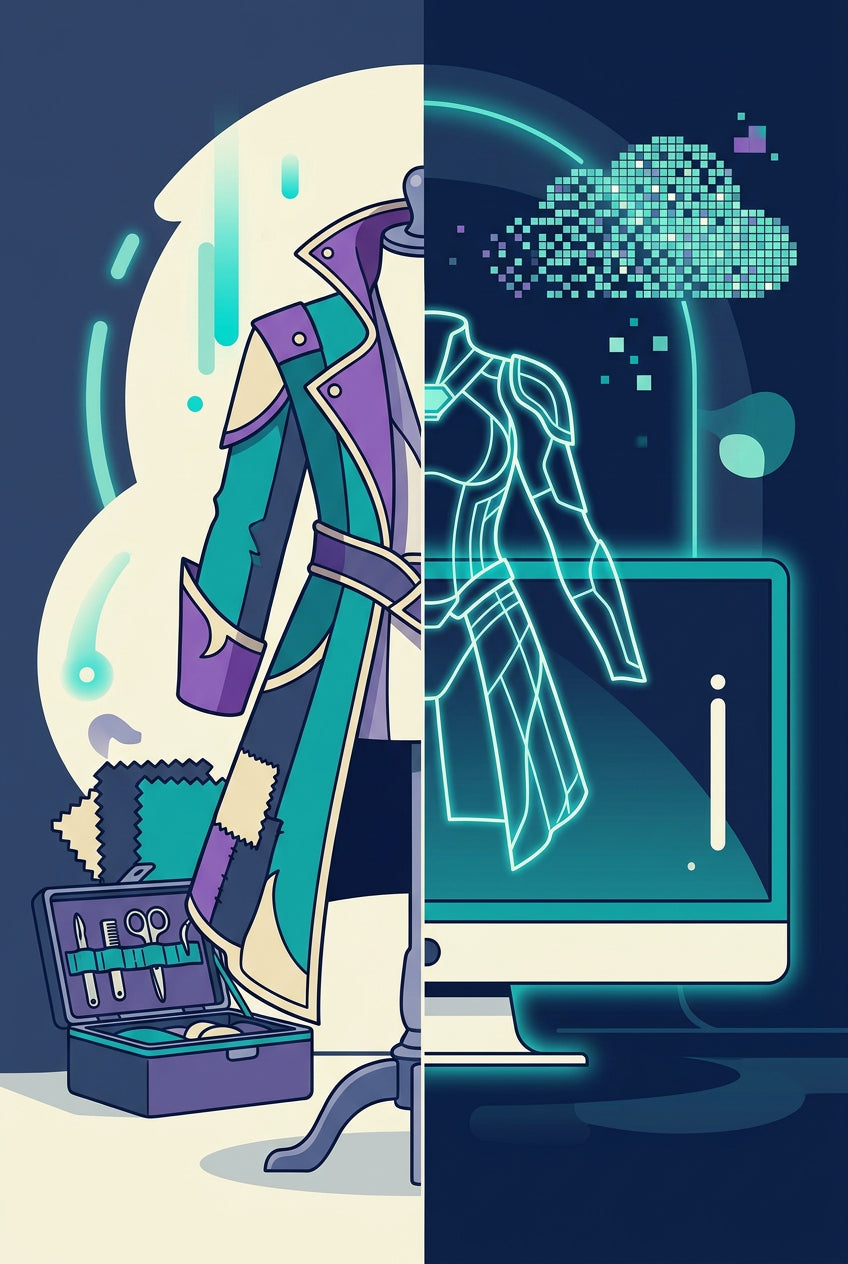
 The rapid rise of generative artificial intelligence (AI) image models has sparked intense subcultural debates across creative industries. Within costuming, community discussions surrounding the AI cosplay controversy highlight growing tensions between physical, human-made craftsmanship and algorithmic image generation.
While traditional costuming relies on sewing, armor sculpting, wig styling, and physical performance, AI accounts across platforms like X (formerly Twitter) and TikTok generate hyper-realistic, synthetic "cosplayers" with prompt engineering. These accounts often amass tens of thousands of followers within days without ever fabricating a physical garment or putting on makeup.
Academic literature in digital fandom studies and cultural sociology emphasizes that subcultures derive internal prestige from "subcultural capital"—the tangible effort, skill acquisition, and physical presence invested into a craft (Thornton, Club Cultures, Wesleyan University Press; Lamerichs, Productive Fandom, Amsterdam University Press). When generative tools bypass physical craftsmanship, subcultural boundaries are drawn to preserve authenticity.
Here are research-backed, neutral answers to the top three questions driving the debate across conventions and digital communities.
Question 1: Is AI-generated cosplay considered "real" cosplay by the community?
Direct Answer: The overwhelming consensus among costumers, prop builders, and convention organizers is no. "Cosplay" (a portmanteau of costume and play) inherently requires a physical human wearing a tangible outfit. Synthetically generated images without physical garments are classified as AI art or digital rendering, not authentic cosplay.
                     +---------------------------------------+
                     | PHYSICAL COSPLAY VS. AI GENERATION    |
                     +---------------------------------------+
                                         |
               +-------------------------+-------------------------+
               v                                                   v
  [ Authentic Human Cosplay ]                            [ AI-Generated "Cosplay" Images ]
  - Physical tailoring, wig styling, & EVA foam sculpting  - Text-prompt algorithmic pixel generation
  - In-person convention walks & stage performance       - 0% physical material or tangible garment presence
  - Human facial expression & embodied photography        - Synthetic "facsimile" images without human effort
               |                                                   |
               +-------------------------+-------------------------+
                                         v
                     +---------------------------------------+
                     | Community Subcultural Capital Line    |
                     +---------------------------------------+
The Subcultural Capital & Authenticity Debate
The debate centers on labor, embodiment, and transparency:
-
Devaluation of Physical Labor: Fabricators spend dozens of hours sewing garments or sculpting EVA foam. The surge of synthetic "AI cosplayers" generating thousands of flawless images per day is perceived as devaluing human craft.
-
Transparency Disclaimers: Many prominent creators have posted public statements declaring their images 100% human-crafted. When creators utilize generative tools for background conceptualization or minor promo edits, community standards dictate that full disclosure tags must be provided.
-
The "Fake Couple" Phenomenon: Marketing campaigns on social media now promote tools suggesting users "save $200 on couples costumes by generating an AI Frankenstein photo." While popular for casual digital avatars, costumers distinguish these digital filters from authentic cosplay authenticity debate entries.
Question 2: How are major fan conventions responding to AI-generated art and vendor booths?
Direct Answer: Major conventions are establishing strict anti-AI rules to protect human creators. Following artist pushback, San Diego Comic-Con (SDCC) updated its Art Show policies to bar AI-generated artwork. Similarly, Dragon Con removed a vendor selling AI-generated prints.
                     +---------------------------------------+
                     | MAJOR CONVENTION POLICY RESPONSES     |
                     +---------------------------------------+
                                         |
               +-------------------------+-------------------------+
               v                                                   v
  [ San Diego Comic-Con (SDCC) ]                         [ Dragon Con ]
  - Updated official Art Show rules                        - Enforces strict anti-AI Artist Alley policies
  - Banned all AI-generated artwork                        - Booted vendors selling AI prints
  - Enforces human-artist protections                      - Escorted non-compliant vendors off floor
               |                                                   |
               +-------------------------+-------------------------+
                                         v
                     +---------------------------------------+
                     | Protection of Human Creative Market   |
                     +---------------------------------------+
Key Convention Policy Milestones:
-
San Diego Comic-Con (SDCC) Policy Shift: In response to artist advocacy, SDCC revised its official Art Show guidelines to explicitly prohibit any works created via generative artificial intelligence models. Organizers updated the rules to protect human illustrators, writers, and designers from exploitation.
-
Dragon Con Vendor Floor Enforcement: At Dragon Con, convention staff and security escorted a vendor out of the Artist Alley hall after attendees and neighboring artists reported that the booth was selling AI-generated art prints under the guise of original handcrafted illustrations.
-
Cosplay Contest Integrity: Masquerades and craftsmanship competitions (such as Motor City Comic Con or World Cosplay Summit) require in-person pre-judging, physical build logs, and material inspection, making synthetic entries impossible in judged categories.
Review full venue policies at our Comic-Con AI art policy hub.
Question 3: Where do cosplayers draw the line between digital retouching and full AI generation?
Direct Answer: The line is drawn at human physical presence. Traditional digital editing—such as color grading, removing background crowds, or adding glowing eye/magic FX to a photo of a real person in a real costume—is widely accepted. Fully generating a synthetic person or replacing an entire costume with AI crosses the boundary into synthetic generation.
                  +------------------------------------------------+
                  |    DIGITAL RETOUCHING SPECTRUM IN COSPLAY      |
                  +------------------------------------------------+
                  |                                                |
                  |  [ ACCEPTED: Standard Photo Editing ]          |
                  |  - Color grading, contrast & lighting tweaks   |
                  |  - Removing background crowd/stray wires      |
                  |  - Adding magic/laser FX over real props       |
                  |                                                |
                  |  [ CONTROVERSIAL: Heavy Hybrid Retouching ]    |
                  |  - AI-smoothing skin to erase natural texture   |
                  |  - Swapping backgrounds completely via AI      |
                  |                                                |
                  |  [ BANNED / REJECTED: Full Synthetic AI ]      |
                  |  - 100% prompt-generated synthetic model       |
                  |  - Digital costume generation over naked base  |
                  |                                                |
                  +------------------------------------------------+
Editing Guidelines & Best Practices:
-
Allowed / Standard Post-Processing: Adjusting exposure, enhancing contrast, and compositing fantasy backdrops (e.g., adding glowing magic circles) behind a physically wearing costumer is celebrated as collaborative photography.
-
Rejected / Non-Authentic Practice: Generating a fictional face and body from text prompts, or using AI to digitally slap a complex armor set over casual street clothes, is rejected by competition panels and community showcases.
-
Focusing on Tangible Craft: Costumers seeking genuine character transformation rely on physical tailoring, screen-accurate wigs, and tangible garments. Explore high-quality, physical anime cosplay costumes for authentic character looks for your next project.
Conclusion & Extended Reading
The AI controversy highlights a collective effort to safeguard human effort, craftsmanship, and community connection. While generative technology continues to evolve, the core spirit of cosplay remains grounded in physical creation and in-person participation. Discover authentic, hand-tailored outfits in our catalog of anime cosplay costumes for authentic character looks!
Clownfish TV on Dragon Con AI Vendor Incident
This video report discusses the viral Dragon Con incident where an artist selling AI-generated prints was escorted out of the convention hall by security and police, providing helpful commentary on vendor policies.

Laisser un commentaire
Ce site est protégé par hCaptcha, et la Politique de confidentialité et les Conditions de service de hCaptcha s’appliquent.