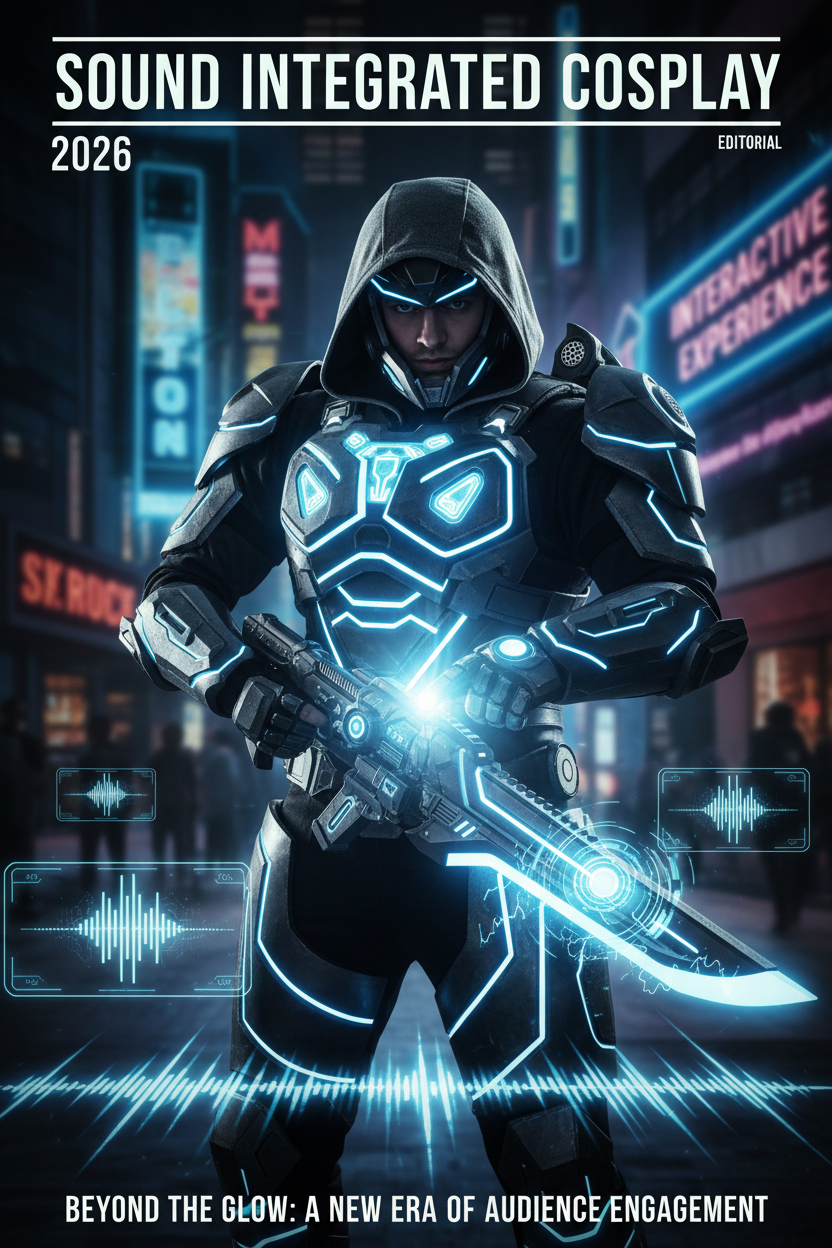
Cosplay technology has moved beyond simply making a costume glow.
In 2026, some of the most attention-grabbing builds combine light, movement and sound to create something closer to an interactive character experience.
That shift is important because a conventional costume is primarily visual. People see it, recognize the character and move on.
A sound integrated cosplay can create another reason to stop.
A prop can activate when you press a button. Armor can produce a mechanical sound when it moves. A weapon can combine an LED effect with a synchronized audio cue. A character transformation can become a short performance rather than a static photo opportunity.
Industry reporting cited in the trend research behind this topic has claimed that cosplay builds incorporating LED and audio elements can substantially outperform purely visual builds, with sound-enabled designs receiving 2.1× the comments of visual-only examples. That figure should be treated as a reported engagement benchmark rather than a universal rule, but the underlying idea is compelling: interactive sensory effects give audiences more ways to participate.
So what kinds of technology actually work?
Here are seven practical directions for building tech cosplay in 2026.
Quick Comparison: 7 Sound-Integrated Cosplay Ideas
| Build Type | Visual Effect | Sound Potential | Difficulty | Best For |
|---|---|---|---|---|
| 1. Sound-Activated Prop | ⭐⭐⭐⭐⭐ | ⭐⭐⭐⭐⭐ | Medium | First tech build |
| 2. LED + Sound Weapon | ⭐⭐⭐⭐⭐ | ⭐⭐⭐⭐⭐ | Medium | Action characters |
| 3. Interactive Armor | ⭐⭐⭐⭐⭐ | ⭐⭐⭐⭐ | Advanced | Experienced makers |
| 4. Character Voice System | ⭐⭐⭐⭐ | ⭐⭐⭐⭐⭐ | Medium | Character performance |
| 5. Reactive Costume Lighting | ⭐⭐⭐⭐⭐ | ⭐⭐⭐⭐ | Advanced | Photo/video creators |
| 6. Transformation Effects | ⭐⭐⭐⭐⭐ | ⭐⭐⭐⭐⭐ | Advanced | Performance cosplay |
| 7. Mini Soundscape Build | ⭐⭐⭐ | ⭐⭐⭐⭐⭐ | Beginner | First-time builders |
The best option depends on what you want your cosplay to accomplish.
If you're new to electronics, start with a sound-activated prop.
If you're already comfortable with LEDs, move toward interactive armor or synchronized transformation effects.
1. Sound-Activated Props — The Best Starting Point
A sound-activated prop is arguably the easiest way to experiment with sound effects cosplay without rebuilding an entire costume.
The basic concept is simple:
Action → Trigger → Sound → Visual Effect
For example:
Press button → weapon lights up → activation sound plays.
Or:
Move prop → LED effect activates → mechanical sound plays.
This creates an immediate feedback loop.
Why It Works
A static prop communicates:
“This is the character's weapon.”
An interactive prop communicates:
“This behaves like the character's weapon.”
That difference is surprisingly powerful.
Pros
- Relatively easy to build
- Doesn't require modifying the entire costume
- Easy to demonstrate on video
- High visual and audio impact
- Can be upgraded later
Cons
- Requires basic wiring
- Batteries need to be accessible
- Audio can become annoying if triggered accidentally
Best For
Beginners experimenting with cosplay electronics.
If this is your first project, don't start by putting electronics everywhere.
Make one prop interactive first.
2. LED + Sound Weapons — The Classic Tech Cosplay Upgrade
The next step is combining LED cosplay with audio.
Imagine a fictional energy weapon.
Instead of simply adding a glowing strip, you create:
Activation → Light → Sound → Movement
This produces a much more convincing effect.
A good LED-and-sound weapon doesn't need dozens of components.
The most important thing is synchronization.
If the sound happens half a second after the light, the illusion becomes weaker.
If they activate simultaneously, the audience's brain interprets them as a single event.
How to Design the Effect
Think about the weapon as three layers:
Layer 1: Physical Prop
The actual shape.
Layer 2: Light
LED strips, individual LEDs or illuminated elements.
Layer 3: Sound
Activation, movement, impact or energy sounds.
This is where LED and sound cosplay becomes more interesting than simply attaching an LED strip.
The electronics are supporting the physical storytelling.
Pros
- Very high visual impact
- Excellent for short-form video
- Relatively self-contained
- Easy to demonstrate
Cons
- More wiring
- Battery placement becomes important
- Sound needs to be loud enough without becoming disruptive
Best For
Action characters, sci-fi characters and fantasy weapons.
3. Interactive Armor — When the Costume Starts Responding
If props are the entry point, interactive armor is where electronic cosplay becomes significantly more advanced.
Imagine armor that:
- Lights up when you move
- Plays mechanical sounds
- Activates different sections independently
- Responds to a button
- Produces different sounds for different actions
Now the costume isn't just decorated with technology.
The technology has become part of the costume's behavior.
What Does Interactive Armor Require?
A basic system can include:
- LED modules
- Battery pack
- Microcontroller
- Small speaker
- Trigger/button
- Wiring
- Mounting system
You don't need to build a complicated computer system.
The key is designing a reliable trigger.
For example:
Button A → Chest lights + activation sound
Button B → Arm lights + mechanical sound
Button C → Full-system effect
This makes the costume feel much more like a fictional piece of equipment.
Pros
- Extremely impressive
- Strong convention presence
- Excellent for demonstrations
- Huge creative potential
Cons
- Higher technical difficulty
- More failure points
- More weight
- More battery management
Best For
Experienced cosplayers who already understand basic cosplay electronics.
4. Character Voice Systems — Give the Cosplay a Personality
Not every cosplay sound effects project needs to sound mechanical.
You can use audio to make the character itself feel interactive.
A small speaker system can play:
- Character quotes
- Catchphrases
- Transformation dialogue
- Battle lines
- Vocal effects
- Environmental sounds
For example, imagine approaching someone at a convention and activating a character-specific voice line when they interact with your prop.
Suddenly the cosplay becomes a social experience.
Why This Is Different
A normal cosplay says:
“Look at my costume.”
An interactive cosplay says:
“Interact with my character.”
That distinction is particularly useful for short-form content.
Someone can record the interaction and share it.
The audience isn't only watching a costume.
They're watching an experience.
Pros
- Doesn't require complicated lighting
- Great for character acting
- Excellent for videos
- Can create memorable interactions
Cons
- Audio needs to be understandable
- Public spaces can be noisy
- Repeated sounds can become irritating
Best For
Characters with recognizable dialogue or strong personalities.
5. Reactive Costume Lighting — Make the Costume Respond to Movement
Another direction for tech cosplay is reactive lighting.
Instead of pressing a button, the costume responds to what you're doing.
For example:
Arm movement → LEDs activate
Walking → lighting sequence begins
Pose → specific color pattern
Prop activation → costume lights synchronize
This can create a much more natural performance.
Why Motion Matters
Humans naturally notice movement.
A glowing costume that remains static can quickly become background decoration.
A costume that changes when the wearer moves becomes much more attention-grabbing.
This is especially useful for:
- TikTok
- Instagram Reels
- Convention videos
- Stage performances
- Night photography
It also creates a natural relationship between costume design and choreography.
Pros
- Very strong video potential
- Makes movement more meaningful
- Creates unique effects
- Can synchronize with music
Cons
- Motion sensors increase complexity
- Calibration may be required
- False triggers can happen
Best For
Creators who want their cosplay to function as both a costume and a performance system.
6. Transformation Effects — The Most Dramatic Option
If you want the biggest “wow” moment, transformation effects are worth exploring.
The concept is:
Normal state → Trigger → Transformation → Sound + Light
This could mean:
- A prop unfolds
- LEDs activate
- A mask illuminates
- Armor sections light sequentially
- A cape reveals hidden lighting
- A weapon changes configuration
The transformation doesn't necessarily have to involve complex mechanics.
Even a simple lighting sequence can create the impression of transformation.
Example Sequence
Imagine a futuristic character.
Step 1
Button pressed.
Step 2
Low electronic sound begins.
Step 3
Chest light activates.
Step 4
Arm lights activate.
Step 5
Weapon illuminates.
Step 6
Final sound effect plays.
The entire sequence might only last three seconds.
But those three seconds can become the most memorable part of the cosplay.
Pros
- Extremely high impact
- Excellent for videos
- Great for convention performances
- Combines multiple technologies
Cons
- Advanced construction
- More expensive
- More potential failure points
- Requires careful testing
Best For
Experienced makers, stage performers and creators producing cinematic cosplay content.
7. Mini Soundscape Builds — The Easiest Way to Start
You don't need to build an entire electronic costume to experiment with cosplay sound effects.
A small soundscape can be surprisingly effective.
For example, a character might have:
- Footstep sounds
- Equipment startup
- Ambient effects
- Radio chatter
- Weapon sounds
- Character voice clips
The system can remain hidden inside a pocket, prop or accessory.
This is one of the best entry points for someone who thinks:
“I like the idea of tech cosplay, but I'm not an electronics person.”
Start small.
Build one reliable effect.
Then expand.
How to Choose the Right Sound-Integrated Cosplay
The best sound integrated cosplay isn't necessarily the one with the most electronics.
It's the one where the technology actually supports the character.
Use this framework.
Choose a Sound-Activated Prop If...
You are a beginner.
You want a relatively simple project.
You want something highly visible.
You don't want to modify your entire costume.
Choose an LED + Sound Weapon If...
Your character has a signature weapon.
You want strong visual effects.
You make short-form videos.
You enjoy prop building.
Choose Interactive Armor If...
You already understand basic electronics.
You want a high-end build.
You're comfortable troubleshooting wiring.
You want the technology to become part of the costume itself.
Choose a Character Voice System If...
Your character has memorable dialogue.
You enjoy performance cosplay.
You want more social interaction.
You plan to make convention videos.
Choose Reactive Lighting If...
Movement is important to your character.
You perform.
You create TikTok or Reels content.
You want lighting that responds naturally to your actions.
What Should You Buy for a Tech Cosplay Build?
Before buying components, separate your shopping list into four categories.
| Category | Examples | Purpose |
|---|---|---|
| Lighting | LEDs, strips, modules | Visual effects |
| Audio | Speaker, sound module | Sound effects |
| Control | Buttons, sensors, controller | Triggers |
| Power | Battery pack, wiring | System operation |
This prevents a common beginner mistake:
Buying components before deciding what the costume actually needs.
Start with the effect.
Then work backward.
For example:
“I want my weapon to light up and make a sound when I press a button.”
Now you know you need:
LED + speaker + trigger + controller + power.
That's much easier than buying random tech cosplay accessories and trying to figure out how they fit together afterward.
The Most Important Design Principle: Don't Add Technology Just Because You Can
A costume with 100 LEDs isn't necessarily better than one with 10.
Likewise, adding 20 sound effects can make a cosplay worse if the audience can't understand what's happening.
The best interactive builds use technology selectively.
Think about:
What should the audience notice first?
Light?
Sound?
Movement?
Character performance?
Then make that element strongest.
Common Mistakes When Building Electronic Cosplay
1. Making the Sound Too Loud
A convention is already noisy.
Your system doesn't need to compete with the entire exhibition hall.
Use a volume level that is noticeable at close range without becoming disruptive.
2. Forgetting Battery Access
Never bury the battery somewhere you cannot reach.
Plan for:
- Charging
- Replacement
- Testing
- Emergency shutdown
before assembling the costume permanently.
3. Poor Wire Management
Loose wires can become:
- Uncomfortable
- Fragile
- Dangerous
- Difficult to repair
Use proper routing and secure connections.
4. Testing Only at Home
A sound effect that seems loud in your bedroom may disappear inside a convention hall.
Test your system in environments that resemble the conditions where you'll actually use it.
5. Making Everything Interactive
This is probably the biggest mistake.
Not every component needs a sensor.
Choose a few meaningful interactions and make those reliable.
How to Build a More Professional Sound-Integrated Cosplay
The difference between a gimmick and a professional-looking electronic cosplay is usually integration.
Instead of:
“I added a speaker.”
Think:
“The character's equipment produces this sound.”
Instead of:
“I added LEDs.”
Think:
“This armor appears to power up.”
Instead of:
“I installed a button.”
Think:
“The character activates this system.”
The technology should disappear into the storytelling.
When people stop thinking about the electronics and start believing the fictional object is actually functioning, the build has succeeded.
FAQ
What is sound integrated cosplay?
Sound integrated cosplay combines traditional costume construction with audio technology, allowing costumes, props or accessories to produce sounds in response to buttons, movement, sensors or other triggers.
Is sound-integrated cosplay difficult for beginners?
Not necessarily. A simple sound-activated prop can be an excellent first project. More advanced systems such as reactive armor and transformation effects require greater knowledge of wiring, controllers and power management.
What is the difference between LED cosplay and electronic cosplay?
LED cosplay primarily focuses on lighting effects. Electronic cosplay is broader and can include LEDs, speakers, sensors, controllers, motors and other interactive components.
How can I add sound effects to a cosplay?
Start with a simple trigger system consisting of a sound module, speaker, power source and button or sensor. Test the complete system before permanently integrating it into the costume.
Are sound effects allowed at conventions?
Convention rules vary. Some events restrict excessive noise, amplified audio or disruptive props. Always check the specific convention's prop and behavior policies before using an audio system.
What are the best tech cosplay accessories for beginners?
Start with simple components such as battery-powered LEDs, compact sound modules, small speakers, buttons and preassembled electronic modules. These are easier to integrate than building an entire system from individual components.
Conclusion: The Next Step Beyond LED Cosplay
The evolution from LED cosplay to sound integrated cosplay represents an important change in how creators think about costume design.
The question is no longer simply:
“How can I make this costume look futuristic?”
It is becoming:
“How can I make this costume behave like the character's world?”
Light creates visual impact.
Sound creates presence.
Movement creates interaction.
Combine all three and a costume can become something much more than clothing.
For beginners, the smartest starting point is still a single sound-activated prop.
For intermediate creators, LED and sound cosplay can turn weapons and accessories into interactive character equipment.
For experienced builders, reactive armor, transformation systems and synchronized effects offer an entirely different level of creative possibility.
And that's ultimately where tech cosplay is heading in 2026: not simply adding more electronics, but using technology more intentionally to make characters feel alive.


Laisser un commentaire
Ce site est protégé par hCaptcha, et la Politique de confidentialité et les Conditions de service de hCaptcha s’appliquent.