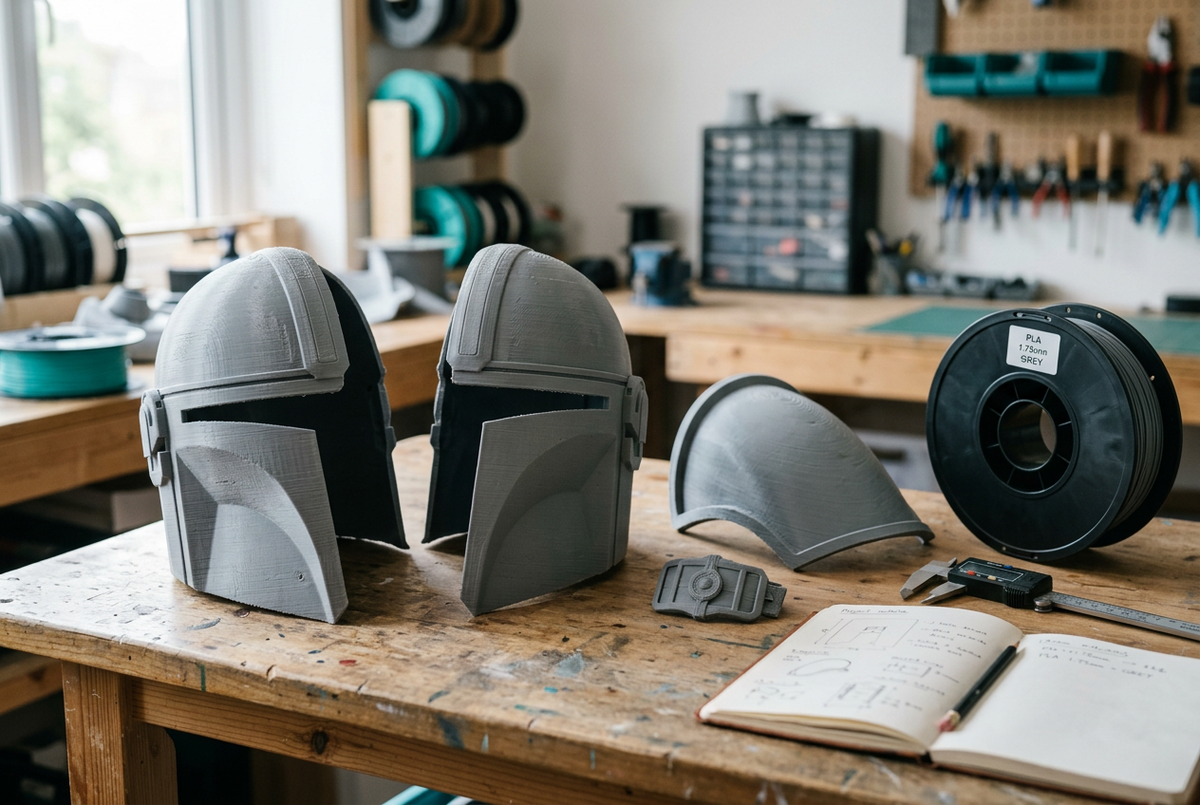
Introduction: Choosing a 3D Printer for Cosplay Projects
A 3D printer can make cosplay armor, helmets, decorative accessories, and custom props easier to produce. But choosing the right machine is not simply a matter of buying the printer with the largest build volume or the highest price.
For cosplay makers, three factors matter most:
-
Build volume: Determines how large a component can be printed and how much model segmentation may be necessary.
-
Material compatibility: Determines whether the printer is suitable for everyday PLA projects or more demanding materials such as ABS and ASA.
-
Post-processing workload: Larger prints may reduce the number of seams, but sanding, filling, fitting, and surface finishing are still part of costume fabrication.
Bambu Lab's 2026 U.S. Black Friday promotion runs from October 27 through December 1, 2026, at 2:00 a.m. ET. The prices below are U.S. promotional prices, before applicable taxes, and refer to the specific configurations identified in the table. Regional pricing and availability may differ.
Quick Comparison: Bambu Lab Black Friday 2026 Deals
| Printer and configuration | Sale price | Reference price | Build volume |
|---|---|---|---|
| H2C AMS Combo | $1,899 | $2,199 | 305 × 320 × 325 mm single nozzle |
| H2D standalone | $1,399 | $1,549 | 325 × 320 × 325 mm single nozzle |
| H2S AMS Combo | $1,249 | $1,399 | 340 × 320 × 340 mm |
| P1S + AMS 2 Pro Combo | $509 | $579 | 256 × 256 × 256 mm |
| P2S standalone | $449 | $549 | 256 × 256 × 256 mm |
| A1 standalone | $259 | $299 | 256 × 256 × 256 mm |
| A1 mini standalone | $199 | $219 | 180 × 180 × 180 mm |
Important: H2D and H2C have different usable build areas depending on nozzle configuration. The table uses their single-nozzle dimensions rather than the larger combined dual-nozzle volume. Combo packages also include additional equipment, so compare the exact package contents before purchasing.
1. Bambu Lab H2D and H2C: Best for Advanced Large-Format Cosplay Projects
Bambu Lab H2D — $1,399
The H2D is a strong option for experienced makers who regularly produce large costume components. Its single-nozzle build area measures 325 × 320 × 325 mm, while its dual-nozzle printing area and combined two-nozzle volume have different dimensions.
Its main advantages include:
-
Large-format printing: More room for helmet shells, chest armor sections, and oversized decorative components than a standard 256 mm printer.
-
Active chamber heating: The heated chamber reaches up to 65°C, helping maintain a more stable environment for materials such as ABS and ASA.
-
Dual-nozzle capability: Supports workflows involving different materials or support structures.
-
High-temperature printing: The hotend reaches up to 350°C.
However, a large build volume does not guarantee that every adult helmet will fit in one piece. Helmet dimensions, orientation, nozzle selection, and support requirements all matter. Check the actual model in Bambu Studio before planning a single-piece print.
Best for: Experienced armor builders who regularly print large components and want greater material flexibility.
Bambu Lab H2C AMS Combo — $1,899
The H2C is aimed at makers who want a more advanced multi-material workflow.
Its Vortek system is designed to simplify nozzle changes for multi-material and multi-color printing. The machine offers a 305 × 320 × 325 mm single-nozzle printing area, with separate dimensions for dual-nozzle operation.
Potential cosplay applications include:
-
Multi-color armor details and decorative panels.
-
Props combining different compatible materials.
-
Complex models that benefit from different support and model materials.
-
Detailed costume components that would otherwise require separate color or material runs.
The H2C is not automatically the better choice for every cosplay maker. If most of your projects use one material and are painted after printing, the H2D or a less expensive printer may provide better value.
Best for: Advanced prop makers who frequently use multi-material or multi-color printing and can benefit from the Vortek workflow.
2. Bambu Lab H2S AMS Combo — Best for Tall, Large-Format Props
Black Friday price: $1,249
The H2S offers a 340 × 320 × 340 mm build volume, giving it substantial room for tall costume components and large props.
Its 340 mm Z-axis clearance can be useful for:
-
Tall shin guards and leg armor.
-
Long decorative components.
-
Large costume panels.
-
Oversized accessories that benefit from vertical orientation.
The H2S also features an enclosed design, a 350°C maximum nozzle temperature, and active chamber heating up to 65°C.
One important distinction: the H2S does not use the H2D's dual-nozzle arrangement. Its value is its large single-nozzle printing space and enclosed printing environment, not a dedicated dual-nozzle support workflow.
Best for: Cosplayers who regularly make tall or oversized components and want a large-format enclosed printer without moving to the H2D or H2C price range.
3. Bambu Lab P2S and P1S: The Mid-Range Enclosed Options
Bambu Lab P2S — $449
The P2S provides a 256 × 256 × 256 mm build volume in an enclosed CoreXY design.
Its main features include:
-
300°C maximum nozzle temperature.
-
110°C maximum heatbed temperature.
-
5-inch touchscreen.
-
1080p high-rate live-view camera.
-
AI-assisted detection of common printing problems.
-
Quick-swap hotend design.
Its adaptive airflow system helps retain heat inside the enclosure, with passive chamber temperatures reaching up to 50°C under suitable conditions.
For cosplay makers, the P2S is a practical middle ground. It can handle segmented helmet shells, chest armor panels, gauntlets, and decorative props without requiring the investment of the H2 series.
A 256 mm build volume still means that many adult helmets will need to be divided into multiple sections. Plan for joining, filling, sanding, and painting after printing.
Best for: Intermediate makers who want an enclosed printer for regular costume production and a balance between price and material flexibility.
Bambu Lab P1S + AMS 2 Pro Combo — $509
The P1S offers the same 256 × 256 × 256 mm build volume in an enclosed CoreXY platform.
The AMS 2 Pro Combo adds automated filament management, multi-color printing capabilities, and filament-drying functionality.
For cosplay applications, this combination can be useful when producing:
-
Repeated decorative components in different colors.
-
Multi-color costume details.
-
Segmented armor pieces.
-
PLA, PETG, ABS, and ASA projects using suitable settings and compatible components.
There is an important material limitation: Bambu Lab lists carbon-fiber and glass-fiber reinforced polymers as not recommended for the P1S. Do not assume that an enclosed printer automatically supports every engineering filament.
Compared with the P2S, the P1S is an older platform with a different interface and monitoring system. Its main attraction here is the discounted AMS 2 Pro package.
Best for: Makers who value an enclosed printer and automated filament management, especially when multi-color printing is part of their workflow.
4. Bambu Lab A1 — Best Budget Choice for PLA Cosplay Props
Black Friday price: $259
The A1 offers a 256 × 256 × 256 mm build volume at a considerably lower price than the enclosed P-series machines.
Its open-frame design is suitable for everyday materials such as PLA, PETG, TPU, and PVA.
Typical cosplay applications include:
-
Segmented helmet shells.
-
Decorative armor panels.
-
Weapon accessories and prop details.
-
Costume emblems and structural components.
The main limitation is its open-frame construction. Bambu Lab does not recommend ABS, ASA, or carbon-fiber and glass-fiber reinforced materials for this model.
For makers who primarily use PLA or PETG and do not need an enclosed printer, the A1 offers a useful balance of build volume and price.
Best for: Beginners and budget-conscious cosplayers who mainly print everyday PLA and PETG parts.
5. Bambu Lab A1 mini — Best for Small Costume Accessories
Black Friday price: $199
The A1 mini has a compact 180 × 180 × 180 mm build volume. It is not designed for full-size helmets or large armor panels, but it can be useful as a dedicated accessory printer.
Consider it for:
-
Belt buckles and clasps.
-
Small emblems and decorative pieces.
-
Jewelry and costume ornaments.
-
Armor rivets and small mechanical details.
-
Miniature props and replacement parts.
Like the A1, it is an open-frame printer intended primarily for materials such as PLA and PETG. Its small build volume is the main reason to choose it, rather than a substitute for a larger workshop machine.
Best for: Cosplayers who sew or assemble costumes and need a compact printer for small custom accessories.
6. Which Bambu Lab Printer Should You Buy for Cosplay?
The right choice depends on how you actually build costumes.
| Your main project | Recommended model | Why |
|---|---|---|
| Large helmet shells and armor sections | H2D | Larger usable single-nozzle area |
| Advanced multi-material props | H2C | Vortek multi-material workflow |
| Tall armor and oversized components | H2S | 340 mm vertical build space |
| Regular segmented armor production | P2S | Enclosed design at a mid-range price |
| Multi-color printing on a budget | P1S + AMS 2 Pro | Enclosed printer with AMS package |
| Everyday PLA armor and props | A1 | Large build volume at a lower price |
| Small costume accessories | A1 mini | Compact and affordable |
Before purchasing, consider the total cost of your project rather than the printer alone:
Total Project Cost = Printer + Filament + Support Material + Adhesives + Surface Finishing Supplies
A larger printer may reduce the number of sections in some projects, but it does not eliminate post-processing. A smaller printer can still produce excellent full-size cosplay pieces when models are carefully segmented and assembled.
7. Don't Forget Filament and Workshop Costs
Bambu Lab's Black Friday promotion also includes filament discounts. For example, Tom's Hardware reported a four-roll PLA Basic Starter Classic Pack at $52.99, compared with its listed $71.96 price.
For cosplay projects, PLA is a practical starting material for prototypes, decorative parts, and many indoor costume components. PETG can be useful when a project needs different flexibility or impact characteristics.
ABS and ASA may be appropriate for selected functional parts, but they require suitable printing conditions and careful handling. Material choice should be based on the part's intended use, temperature exposure, flexibility, and finishing requirements.
Remember that printed pieces usually need additional supplies such as filler, sandpaper, primer, paint, adhesives, and protective equipment. Include these costs in your workshop budget.
Conclusion
Bambu Lab's Black Friday 2026 lineup offers options for different cosplay production needs, from the compact A1 mini to the large-format H2 series.
For most intermediate cosplay makers, the P2S is a practical enclosed option. The A1 is attractive for budget-focused PLA projects, while the H2D and H2S are worth considering for larger components. The H2C makes the most sense when its advanced multi-material workflow will be used regularly.
The most expensive printer is not automatically the best choice. Start with the size of the parts you actually make, the materials you plan to use, and how much assembly work you are willing to do.
FAQ
Can a Bambu Lab printer make a full-size cosplay helmet in one piece?
It depends on the helmet's dimensions, orientation, and the printer's usable build area. The H2D, H2C, and H2S offer more room than standard 256 mm printers, but always check the model in the slicer before printing.
Which Bambu Lab printer is best for cosplay armor?
The P2S is a practical enclosed option for many makers. The H2D and H2S are worth considering for larger components, while the A1 is a budget-friendly choice for PLA-based armor.
Can the Bambu Lab A1 print ABS or ASA?
Bambu Lab lists ABS and ASA as not recommended materials for the open-frame A1. For projects requiring these materials, consider an enclosed model with suitable material support.
Is the H2C worth the extra cost over the H2D?
The H2C is most relevant to makers who will regularly use its Vortek multi-material and multi-color workflow. If you mainly print single-material parts and paint them afterward, the H2D or a less expensive model may be more suitable.
When does the Bambu Lab Black Friday 2026 sale end?
Bambu Lab announced that its U.S. Black Friday promotion runs through December 1, 2026, at 2:00 a.m. ET. Prices, stock, and regional terms can change, so verify the final offer on the official store before ordering.


Laisser un commentaire
Ce site est protégé par hCaptcha, et la Politique de confidentialité et les Conditions de service de hCaptcha s’appliquent.