Editorial Note: We've worked with cosplayers across every tier — from first-convention newcomers to competition-stage veterans who spend hundreds of hours on a single build. We've watched the attention economy reshape this hobby in real time. This article doesn't pretend the problem isn't real. It also doesn't pretend there's a simple fix. What follows is the most honest account we can give of what's actually happening — and what skilled cosplayers are doing about it.
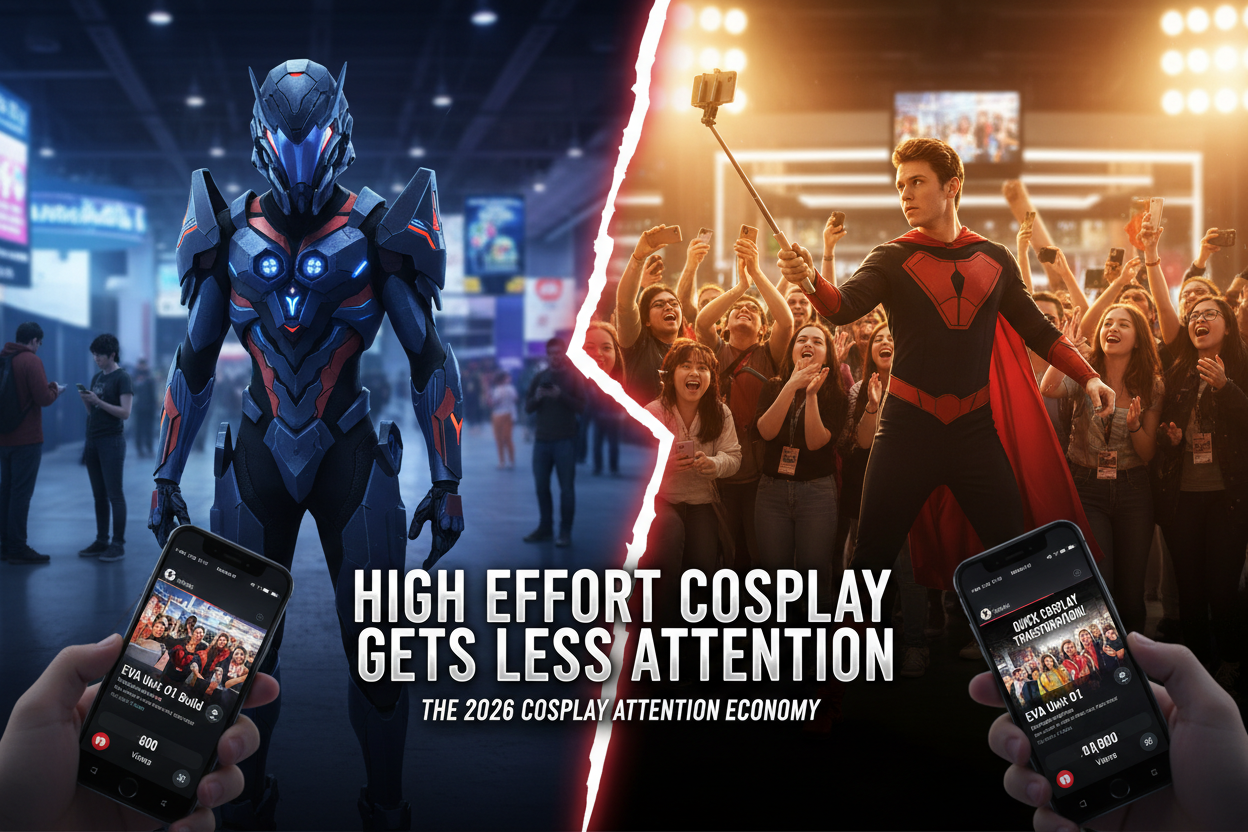
A cosplayer spends four months on a full EVA foam armor build — hand-painted, weathered to look battle-worn, with functioning LED panels and custom-fabricated joints. They post it on TikTok. It gets 800 views.
Three days later, a different cosplayer posts a thirty-second transformation video in a purchased costume, face front and center, filtered and lit for maximum visual impact. It gets 200,000 views.
The reaction in the comments under the craft build: "The algorithm doesn't care about your craftsmanship. It cares about what makes people stop scrolling."
That's not cynicism. That's a direct observation from within the community — one that's being documented, discussed, and increasingly accepted as structural rather than accidental. Talented creators spend weeks creating stunning, intricate costumes that barely get noticed, while simpler, appearance-forward content skyrockets in popularity. Platforms like Instagram and TikTok push appearance ahead of costume detail due to fierce competition for views.
The community's frustration is legitimate. But so is the complexity underneath it. Understanding why this happens — and what high-effort cosplayers are doing to navigate it — requires separating several arguments the community keeps collapsing into one complaint.
⚡ Where Does Craftsmanship Actually Get Rewarded?
The pattern is clear: craftsmanship gets rewarded in every context except the two that dominate cosplay's public visibility — TikTok and Instagram Reels. And those two platforms are where most cosplayers measure their reach.
To clearly understand the actual weight of production quality across different channels, one can draw conclusions by comparing performance across the following platforms and scenarios:
| Platform / Context | What Gets Rewarded | Craftsmanship Visibility |
| TikTok / Instagram Reels | Scroll-stopping thumbnail, face, transformation reveal | ⚠️ Low — detail work invisible at video speed |
| Instagram static posts | Color story, composition, character recognition | ⚠️ Medium — detail visible but algorithm deprioritizes |
| YouTube long-form | Build process, tutorial, before/after reveal | ✅ High — craft community actively rewards this |
| Convention floor | Costume presence, character embodiment, scale | ✅ High — detail visible at close range |
| Competition stage | Construction quality, craftsmanship documentation | ✅ Very High — the only context where effort = formal score |
| Craft community (Reddit, Discord) | Process documentation, material innovation, technique | ✅ High — specialist audience values craft explicitly |
🔥 The Debate: Three Arguments Being Made Simultaneously
1. "The Algorithm Is Structurally Biased Against Craft"
This is the argument with the most evidence behind it, and the community knows it. Social media platforms often reward aesthetic appeal and sexualized cosplay with increased likes, shares, and visibility — feeding a cycle that encourages creators to prioritize appearance over construction. Many cosplayers feel stuck in this loop, facing a difficult choice between staying true to their artistic vision or chasing greater reach.
The mechanism is straightforward: short-form video algorithms optimize for watch time and engagement in the first three seconds. A complex armor build reads as a static image in that window — interesting, but not urgent. A face-forward transformation with dramatic music triggers an emotional response in under two seconds. The algorithm reads one as content worth pushing and one as content worth burying, regardless of which represents more skill. The stress to go viral forces a focus on appearance over craftsmanship, which is a rational response to the incentive structure these platforms have created.
2. "The Cosplay Community and the Mainstream Audience Judge Differently"
This is the nuance that gets lost in the complaint. The cosplay community itself — the subset that attends conventions, participates in competitions, and builds within craft traditions — does recognize and reward craftsmanship. Internal community members highlight creators committed to the technical skill behind bringing a fictional character's design into the real world. As fellow makers, they understand and respect the meticulous hours of sewing, crafting, and makeup it takes to cosplay well.
The external audience — mainstream social media users who encounter cosplay content without fandom context — judges entirely differently. Pop culture coverage of conventions has long devoted significant gallery space to "sexiest cosplays" rather than the most technically accomplished. Cosplayers often feel reduced to their physical attributes, with their craftsmanship and creativity overshadowed by their appearance, undermining the appreciation of the effort and passion that goes into creating a build. Two separate audiences are applying two separate value systems in the same space, and the short-form video algorithm aligns almost entirely with the external audience's response patterns.
3. "High Effort Is Getting Rewarded — Just Not Where You're Looking"
This is the counter-argument that veteran cosplayers and craft community members make, and it has merit. Cosplay sits at a fascinating crossroads between craftsmanship, performance, and digital-age celebrity. The best cosplayers are not simply wearing costumes — they are engineering experiences, with work spanning disciplines: sewing, 3D modeling, prosthetics, electronics, and performance.
Cosplayers known for precision and game-character accuracy tend to get strong reactions at gaming events, where accuracy and craftsmanship are everything. Competitions at conventions like Awesome Con, MegaCon, and Fantasy Basel specifically award categories like "master armorer" and "best construction" — contexts where hours of effort translate directly into recognition. The problem isn't that craftsmanship is unrewarded. It's that the most visible platforms reward something different — and many cosplayers have oriented their entire sense of success around those feeds specifically.
📊 What the Craftsmanship Data Shows
Many top creators spend hundreds of hours on a single outfit, combining materials like EVA foam, thermoplastics, and custom fabrics. Advances in accessible technology — desktop 3D printers, laser cutters, and affordable electronics kits — have democratized the process, enabling creators to experiment with complex builds that would have been prohibitively expensive a decade ago.
The craftsmanship floor has risen significantly: detailed cosplayers who require accuracy and durability have embraced the $200–300 price category as the sweet spot between affordability and quality, while competition-level builders invest thousands in professional commissions or custom materials.
Yet this rising craft ceiling exists alongside a social media attention economy that rewards different attributes. The tension is structural: the skill level in the cosplay community has never been higher, and the mainstream visibility of that skill has arguably never been lower relative to appearance-forward content. The community's own top performers have found ways through this tension by understanding which metrics to optimize for in which context. Stella Chuu, for example, blends high-level craftsmanship with media-savvy presentation: the craft earns respect within the community; the presentation earns reach on platforms. These are complementary strategies, not competing ones.
🎌 Costume Reviews: High-Effort Builds That Justify Every Hour
Every costume here is chosen specifically because the construction complexity rewards your time investment — in competition contexts, in craft community recognition, and in the quality of convention-floor interaction it generates. These are the builds where effort does pay off.
1. Raiden Shogun — Genshin Impact | Full Ornate Build
Product Overview
Raiden Shogun is the convention competition circuit's most-entered Genshin Impact character for craftsmanship judging — and the gap between a basic version and a truly high-effort handmade or premium-tier build is visible in exactly the contexts where craftsmanship gets formally evaluated.
The full ornate build — hand-embroidered brocade, structured obi with internal boning, custom resin accessories with hand-painted detail, and precision-cut shoulder pauldrons — is the kind of costume that competition judges examine at close range. The detail work that disappears in a TikTok thumbnail is fully visible at two feet of distance on a competition stage. This is where the four-month build pays off. At the same time, a premium purchased version of Raiden Shogun occupies an important middle tier: construction quality that exceeds most convention-floor builds, at a fraction of the handmade investment.
Ensure your details stand out under close examination—shop Raiden Shogun cosplay high quality base options designed to support advanced fabrication and custom upgrades.
Pros & Cons
-
Pros: Competition judges evaluate exactly the elements where the high-effort build excels: brocade embroidery, structural obi construction, and resin accessory finish. The royal purple/gold palette generates strong convention-floor recognition.
-
Cons: The TikTok/Instagram algorithm will not differentiate between a budget version and a premium handmade version in short-form video — the social media return does not scale with construction effort.
Wear Experience
The full handmade build requires an assistant for dressing — allow 30–45 minutes. Internal boning in the obi improves all-day structural integrity but adds warmth. Premium purchased versions offer a similar silhouette with faster dressing. For competition entries, document your construction process photographically — judges may ask for evidence of technique.
Key Specs
-
Handmade Priorities: Brocade embroidery, internal obi structure, resin accessory finish, pauldron paint quality.
-
Purchased Tier Signal: Velvet or brocade construction with visible embroidery detail indicates quality tier; flat printed fabric indicates budget tier.
-
Competition Documentation: Photograph each construction stage — judges evaluate process, not just product.
-
Photography Tip: Detail shots of embroidery and accessory finish are the content format where construction quality actually reads on social media.
2. Kafka — Honkai: Star Rail | Precision Leather Architecture
Product Overview
Kafka from Honkai: Star Rail is a premium craft community build challenge because her design's construction demands — precision leather paneling, asymmetric hem execution, and a highly structured coat silhouette — are exactly the kind of technical problems that skilled tailors find compelling and that social media audiences cannot evaluate from a thumbnail.
Cosplayers focused on game-character accuracy tokens get strong reactions at gaming events, where accuracy and craftsmanship are everything. Kafka is precisely this kind of character: the difference between a mediocre build and an excellent one is visible to any player who looks closely. Her construction rewards investment in two ways: at gaming events and panels, a technically excellent Kafka build generates specialist recognition; on general social media, the coat silhouette and face-forward presentation do the work. This is why many creators combine a quality purchased coat base with handmade accessory upgrades.
Achieve clean, sharp garment architecture that holds its shape—shop Kafka cosplay costume high quality leather sets engineered for professional styling.
Pros & Cons
-
Pros: Asymmetric hem and leather panel precision are exactly the details that craft judges and specialist audiences evaluate. Kafka's character design has an incredibly favorable impression among players, ensuring strong interaction at game-specific events.
-
Cons: Advanced leather construction requires pattern grading experience — errors in the coat silhouette are immediately visible given how specific the character's proportions are.
Key Specs
-
Handmade Priorities: Leather panel precision, asymmetric hem execution, coat shoulder structure, earring accuracy.
-
Hybrid Strategy: Quality purchased coat + handmade earrings and custom wig styling = strong convention result with reduced construction time.
-
Competition Entry: Significant alteration of a purchased base (relined, re-hemmed, custom accessory additions) can qualify under many events' percentage thresholds.
-
Process Content: The Kafka build is highly searchable as tutorial content — document it for YouTube or Patreon.
3. Jingliu — Honkai: Star Rail | The Armor Build That Earns Its Hours
Product Overview
Jingliu from Honkai: Star Rail represents the apex of what the "high effort" complaint is really about: a character whose design demands EVA foam armor construction, complex wig styling with an ice-blue gradient, and precision accessory work. Her convention-floor presence is unmistakably different in quality between a rushed execution and a dedicated build.
Jingliu's complex design has kept the build population naturally lower. High-effort builds face less saturated competition, which means the investment in quality is more visible relative to other characters. The ice-blue color story, flowing silver hair, and angular armor elements require skills from multiple craft disciplines simultaneously.
Skip the budget fabrics and step into competition-ready tailoring—shop Jingliu cosplay costume Honkai Star Rail packages optimized for advanced armoring.
Pros & Cons
-
Pros: Armor construction complexity naturally filters the costume pool — most Jingliu builds are high-effort, so yours exists in a better comparison context. Competition categories that evaluate armor construction specifically reward this build's strongest elements.
-
Cons: One of the most time-intensive builds; a realistic estimate is 200–400 hours for a competition-quality execution.
Key Specs
-
Primary Construction: EVA foam armor paneling, thermoplastic details, painted and weathered finish.
-
Wig: Ice-blue gradient, long — the wig is the single element most visible at convention distance; invest proportionally.
-
Armor Weathering: Battle-worn finish is character-accurate and demonstrates construction depth to judges and photographers.
-
Timeline: Allow minimum 3 months for a competition-quality build; 6 months for a portfolio piece.
4. Jiyan — Wuthering Waves | The Emerging Craft Frontier
Product Overview
Wuthering Waves has rapidly grown into a major cosplay driver, with visually complex characters creating constant new opportunities. Jiyan is the game's craft community's most ambitious build target: a military-fantasy aesthetic with layered armor, flowing fabric integration, and weapon prop complexity that rewards genuine construction investment.
What makes Jiyan particularly relevant to this debate is that he's a newer character in a rapidly growing game, meaning the craft community around his cosplay is still forming its reference standards. Being an early, high-quality Jiyan build means setting the visual benchmark — not competing against an over-saturated field.
Establish the visual benchmark for a rapidly growing fandom—shop Jiyan Wuthering Waves cosplay costume kits to secure your pattern foundations early.
Pros & Cons
-
Pros: Early in the character's cosplay lifecycle — a high-quality build now sets the visual standard others compare against. Weapon prop complexity is a specific craft challenge that competitions actively reward.
-
Cons: Lower immediate recognition compared to legacy characters — some casual convention attendees won't yet know the game.
Key Specs
-
Primary Construction: Layered armor paneling, flowing fabric integration, elaborate prop fabrication.
-
Aesthetic: Military-fantasy; rewards construction depth from both armor and tailoring disciplines simultaneously.
-
Timeline: Build early for the upcoming convention season while the recognition window for high-quality builds is wide open.
-
Content Strategy: Search volume is growing; early high-quality build documentation captures compounding search traffic.
🛍️ How to Get the Recognition Your Effort Deserves
Define Your Recognition Metric First
The frustration at the center of this debate comes from a mismatch between effort invested and the specific recognition metric being measured. Before building or buying, clarify which recognition you're actually pursuing:
-
Social Media Reach (Views/Followers): Effort level correlates very weakly with this metric. Character selection, presentation format, thumbnail design, and posting timing correlate strongly. A high-effort build in the wrong content format performs worse than a low-effort build in the right one.
-
Competition Recognition (Awards/Scores): Effort level correlates very strongly with this metric — and almost nothing else does. This is the only context where construction investment directly and formally determines the outcome.
-
Community Recognition (Peer Respect): Effort level correlates strongly with this metric in craft-specific communities (YouTube, Patreon, Discord build servers, Reddit craft forums), but weakly in general social media feeds.
-
Convention-Floor Interaction Quality: Effort level correlates moderately — the most visually distinctive and technically accomplished builds generate the deepest interactions. However, character recognition and costume presence matter just as much as construction depth.
Balance your creative hours strategically—browse our full cosplay costume collection to find high-end base sets that streamline your fabrication timeline.
The Platform Documentation Strategy
If you've invested significantly in a build, the content format determines whether that investment generates social returns. Match your format to your platform:
-
TikTok / Instagram Reels (Transformation Reveals): Start in civilian clothes, dramatic music transition, final costume reveal with face prominent. The construction complexity is secondary to the visual pacing — film this separately from your craft documentation.
-
Instagram Static Posts (Detail Photography): Close-up embroidery, texture shots, and accessory craftsmanship. Caption the construction context explicitly — most viewers need to be told how a detail was fabricated.
-
YouTube Long-Form (Build Documentation): Material sourcing, pattern-making, construction timelines, and completed reveals. This format rewards complex builds — the audience values the technical journey, not just the result.
-
Reddit / Discord Craft Communities (Process/Technique): WIP (work in progress) documentation, material testing, and technical Q&As. This audience is highly craft-literate and recognizes genuine construction investment.
The Hybrid Strategy: Buy the Base, Build What Shows
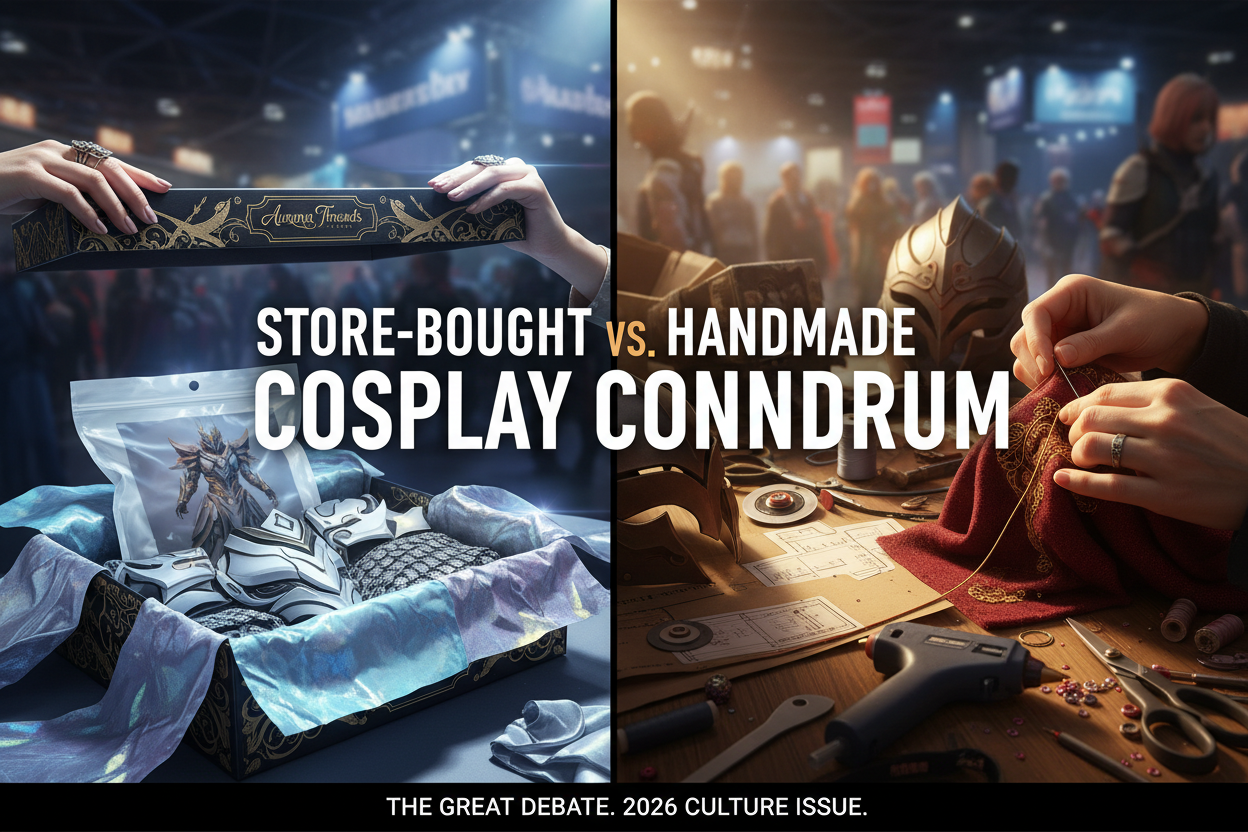
For cosplayers who want both social media reach and craft community respect, the hybrid approach is the most efficient path: purchase a quality base costume, then invest handmade time in the specific elements that are highly visible and recognizable to your target audiences.
For Raiden Shogun, buy the robe and hand-make the prop weapon with custom resin work. For Kafka, buy the coat and hand-make the signature earrings. For Jingliu, build the armor plates from scratch and source the wig from a quality vendor. This maximizes the craft investment return by concentrating handmade hours where they count, while drastically reducing total build times.
❓ FAQ
Q: Is it true that appearance matters more than craftsmanship on social media?
On short-form video platforms, yes — the feed algorithm optimizes for engagement in the first three seconds, which naturally favors appearance-forward content over construction-detail content in most formats. Social media can create unrealistic expectations, causing creators to compare social reach with craft quality as if they were the same metric. They are not.
Q: Where does high-effort cosplay actually get recognized?
Convention competitions remain the clearest context where effort formally determines outcomes. Gaming events where accuracy is expected (rather than casual environments) also reward technical builds. Long-form content platforms (YouTube, Patreon) and craft-specific communities (Reddit forums, Discord servers) are the digital contexts where construction investment generates corresponding recognition.
Q: Should I stop investing in complex builds if social media doesn't reward them?
Only if social media reach is your primary goal. Many cosplayers who invest heavily in construction are explicitly not optimizing for TikTok performance — they're building for competition, portfolio development, peer respect, and the personal satisfaction of solving difficult construction problems. Success should not be measured by general platform metrics alone.
Q: How do competition judges actually evaluate craftsmanship?
Competitions evaluate construction quality through a combination of close examination and process documentation. Judges look at seam finishing, material quality, pattern accuracy, prop fabrication technique, and overall construction integrity — none of which are visible in social media thumbnails. Process photography is often required or strongly recommended.
Q: Can a purchased costume ever win a craftsmanship competition?
Not in standard craftsmanship categories, which require significant handmade content (typically 75% or more). However, significantly altered purchased costumes — relined, re-hemmed, fitted, with handmade accessories and modified details — can qualify in many events' modified-work categories depending on local rules.
🚀 The Ultimate Reframe: Document Differently for Different Audiences
If you want the craft community to recognize you, build for the spaces that value technique. If you want both broad reach and technical respect, learn to document your work differently for different audiences.
The hours you invest in EVA foam, intricate tailoring, and resin casting are always worth it. Just make sure you are measuring that effort in a place that actually has the tools to see it.
Complete your next master-tier project on a world-class foundation. Cosplayreal to lock in your next premium character base and focus your energy entirely on the custom craftsmanship that matters.
Built something incredible that deserved far more attention than it got? Tell us about your build process, the materials you used, and the context in the comments below — we would genuinely love to hear your story!

Laisser un commentaire
Ce site est protégé par hCaptcha, et la Politique de confidentialité et les Conditions de service de hCaptcha s’appliquent.