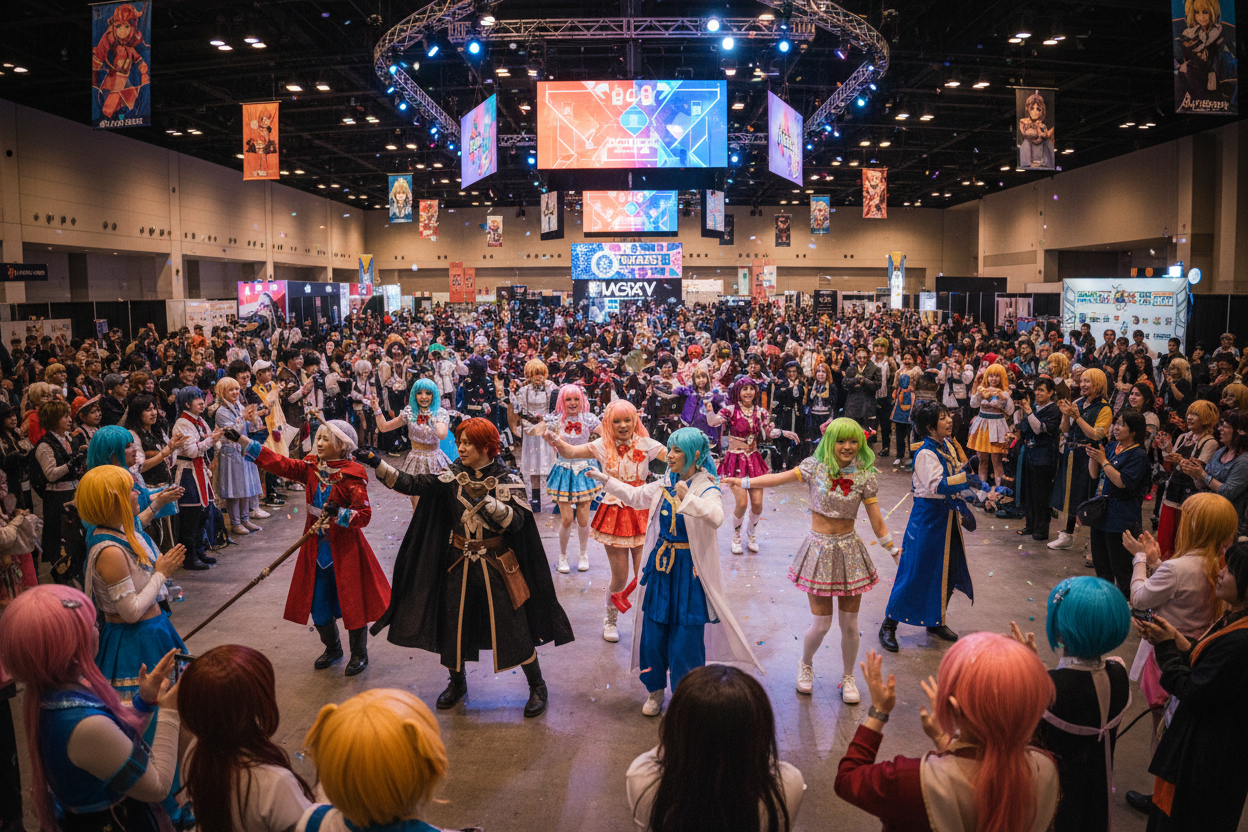
If you've been to a mid-size or major anime convention recently and stumbled into a crowd of people in full cosplay — Genshin Impact characters standing next to Haikyuu players standing next to Oshi no Ko idols — suddenly breaking into perfectly synchronized K-pop choreography the moment a song snippet plays, you've run into Random Play Dance, and you've also run into one of the more genuinely interesting identity debates happening in fan spaces right now.
Reddit threads accuse these sessions of turning core convention thoroughfares into an impromptu concert venue, disrupting photography and foot traffic for attendees who came for something else entirely. Younger, more genre-blended fans argue this reaction misreads what anime conventions actually are today — spaces where ACG (anime, comics, and games) fandom and K-pop fandom substantially overlap in the same people, not two separate audiences competing for territory.
This guide walks through where the format actually came from, how to navigate the tension practically whichever side you're on, and why one specific 2025-2026 crossover phenomenon is making the whole "us vs. them" framing increasingly hard to sustain.
Chapter 1: What Random Play Dance Actually Is, and Why It's Showing Up at Anime Cons
Random Play Dance (often abbreviated RPD) is a fan-organized format with roots in Korean K-pop fan culture: short clips of different K-pop songs play in random order, and any attendee who knows a given song's choreography runs into a designated area to perform it before the clip cuts to the next track. It's a genuinely global phenomenon at this point — documented RPD sessions have popped up everywhere from Times Square to Comic Con London, organized by dedicated K-pop dance crews and casual fan groups alike, well before it became a recurring fixture at anime-specific conventions.
Its arrival at anime cons specifically isn't really an "invasion" from an outside fandom so much as a reflection of who's actually attending these events. The Gen Z fanbase driving a huge share of current anime convention attendance substantially overlaps with K-pop fandom — plenty of attendees are cosplaying an anime or game character while listening to K-pop on their way to the con, and treating these as two hermetically sealed fan identities increasingly doesn't match how a large share of the actual audience experiences their own fandom.
Convention organizers have responded to this reality in two different ways depending on the event:
-
Sanctioned Programming: Some have formally scheduled RPD as an official programming block with a designated room or time slot, treating it the same way they'd treat any other panel or activity.
-
Spontaneous Hallway Takeovers: Others have left it to happen organically, which is exactly the scenario producing the "main hallway got taken over" complaints driving the Reddit backlash — an unscheduled, spontaneous RPD session in a core walkway genuinely does compete for the same physical space photographers and casual attendees are trying to use for something else.
That distinction — sanctioned, scheduled RPD versus spontaneous hallway takeovers — is the single most useful thing to understand before wading into this debate, because a huge amount of the actual friction traces back to logistics and space planning rather than a genuine, irreconcilable culture clash.
Chapter 2: A Practical Framework for Sharing Convention Space
Whichever side of this debate you find yourself on, there's a real, workable path to coexistence, and it looks different depending on which group you're part of.
For Photographers, Traditional Cosers, & Hallway Traffic
-
Check official schedules in advance: An increasing number of events now list RPD sessions as a formal programming block with a specific time and location — knowing that window lets you plan your own photo sessions around it rather than around it happening unpredictably.
-
Provide constructive event feedback: If a convention hasn't formally scheduled RPD and it's genuinely disrupting core traffic flow, the more effective path is raising it directly with convention staff or through official feedback channels after the event, requesting a designated space for future years, rather than confronting dancers directly on the floor — con organizers are generally receptive to this kind of space-planning feedback, since it's ultimately a logistics problem they're equipped to solve.
For RPD Organizers & Dancers
-
Coordinate ahead of time: Check with convention staff in advance about space, sound levels, and timing rather than defaulting to whatever open hallway looks biggest — many conventions are genuinely happy to accommodate a scheduled session in an appropriate space (a large panel room, an outdoor area, a designated activity zone) precisely because it prevents the friction that comes from an unscheduled session blocking a primary walkway.
-
Be mindful of venue boundaries: Being mindful of sound volume near panel rooms or quieter con areas, and keeping sessions within an agreed time window rather than running indefinitely, goes a long way toward this being received as "a fun, additive part of the con" rather than "an unwelcome takeover."
The throughline in both directions is the same: most of the actual conflict in this debate is a space-and-scheduling problem wearing the costume of a bigger identity argument, and it resolves far more smoothly through coordination with convention staff than through an adversarial standoff between two attendee groups who, in a lot of cases, actually overlap more than either side assumes.
Chapter 3: Advanced Perspective — Why KPop Demon Hunters Is Dissolving the Line Entirely
If there's a single piece of media making the "ACG purist vs. K-pop fan" framing genuinely harder to sustain, it's KPop Demon Hunters — the animated film that exploded into one of the most-cosplayed properties of the past year specifically because it isn't really "K-pop content at an anime con" or "anime content at a K-pop event." It's both, natively, by design: an anime-influenced visual style built entirely around a fictional K-pop girl group who are secretly demon hunters, complete with full original choreography and songs written specifically for the film.
This makes KPop Demon Hunters cosplay a genuinely unique case study for this debate. A Rumi, Zoey, or Mira cosplayer performing the film's own choreography during a Random Play Dance session isn't crossing from one fandom into another's territory — they're doing the single most source-accurate thing possible for the character, since the songs and dances were written as an integral part of the source material itself, not adapted in from an unrelated fandom.
The same logic increasingly applies to Genshin Impact cosplay groups who choreograph fan-made dance routines to K-pop tracks for their characters — while this is a genuine cross-fandom reinterpretation rather than a source-accurate performance the way KPop Demon Hunters is, it reflects the same underlying reality: for a huge share of current anime and game fandom, K-pop isn't an outside influence being imposed on their space, it's already part of their own fan identity and creative practice.
Convention programming has started to reflect this shift structurally rather than just anecdotally — a growing number of events now bill themselves explicitly as combined "Anime/K-pop" conventions from the outset, rather than treating the two as separate audiences sharing a venue awkwardly. That's a meaningful signal about where this is heading: the "purist vs. crossover" framing may describe a real generational and preference divide among individual attendees, but at the level of convention programming and IP itself, the boundary between these two fan cultures is actively dissolving rather than holding steady.
Chapter 4: Tools and Resources for Both Communities
-
For Movement-Heavy Cosplay Construction: For anyone building a costume meant to survive a full dance routine (KPop Demon Hunters or Genshin Impact characters alike), construction priorities shift meaningfully compared to a photo-only costume:
-
Look for stretch-panel fabric inserts at high-movement joints (shoulders, underarms, knees) rather than rigid, non-give material throughout.
-
Secure wig clips and a well-fitted wig cap rated for active movement rather than a loosely-secured style built only for standing poses.
-
Wear breathable base layers underneath any heavier costume pieces, since a full choreography run generates real heat and sweat that a photo-only build doesn't need to account for.
-
-
For Photographers and Traditional Attendees: Many major conventions now publish detailed digital schedules or apps specifically listing programming blocks, including RPD sessions where they're officially scheduled — checking this before your con day, and building your photo-session timing around it, solves most of the friction described in Chapter 2 without requiring any direct confrontation at all.
-
For RPD Session Organizers: Reaching out to convention programming staff well in advance of the event (rather than the week of) significantly improves your odds of getting a properly allocated space and time slot, and it's worth asking specifically about sound equipment policies, since many venues have restrictions on amplified audio outside designated areas.
Frequently Asked Questions
Q: Is Random Play Dance always unofficial, or do conventions actually schedule it?
A: Both happen, and it varies significantly by event — a growing number of conventions now formally schedule RPD as official programming, while others still see it happen organically and unscheduled, which is where most of the hallway-blocking friction originates.
Q: Will my elaborate KPop Demon Hunters or Genshin Impact costume actually survive a full dance routine?
A: It can, with the right construction choices — stretch-panel inserts at joints, secure wig attachment methods rated for movement, and breathable base layers are the main adjustments needed compared to a build made purely for standing photos.
Q: How do I find out when and where RPD is happening at a specific convention?
A: Check the convention's official schedule or app first — increasingly, this is where sanctioned sessions are listed. For less formal, fan-organized sessions, convention-specific Discord servers or social media groups (see our earlier guide on Facebook-organized con meetups for a similar coordination approach) are usually where organizers post timing and location ahead of the event.
Q: Is this really a "culture clash," or is the overlap between ACG and K-pop fandom just being reflected back at us?
A: The evidence leans heavily toward the latter — a substantial share of current anime convention attendees are already K-pop fans as well, and properties like KPop Demon Hunters that blend both aesthetics natively suggest the "two separate fandoms" framing describes a real but shrinking preference divide, not a clean, ongoing territorial line.
Summary and Related Resources
The Random Play Dance debate captures something bigger than a scheduling disagreement — it's really a conversation about how much anime and K-pop fandom have already merged for a huge share of current convention attendees, and properties like KPop Demon Hunters are making the "separate spaces for separate fandoms" framing harder to sustain by the year.
In the meantime, most of the actual day-to-day friction comes down to space planning that conventions and attendees can genuinely solve together. If you're building a costume meant to move — whether for a KPop Demon Hunters dance session or a Genshin Impact photo shoot — check out our guides on stretch-friendly costume construction, secure wig styling for active wear, and choosing durable fabrics that hold up through a full day of convention movement.

Laisser un commentaire
Ce site est protégé par hCaptcha, et la Politique de confidentialité et les Conditions de service de hCaptcha s’appliquent.