Table of Contents
Instagram has a trust problem, and its own leadership has said so publicly. In a widely discussed year-end note, Instagram head Adam Mosseri acknowledged that AI-generated imagery has broken the old assumption that a polished photo represents something that actually happened, and advised creators to start proving their work is real rather than just showing the finished result.
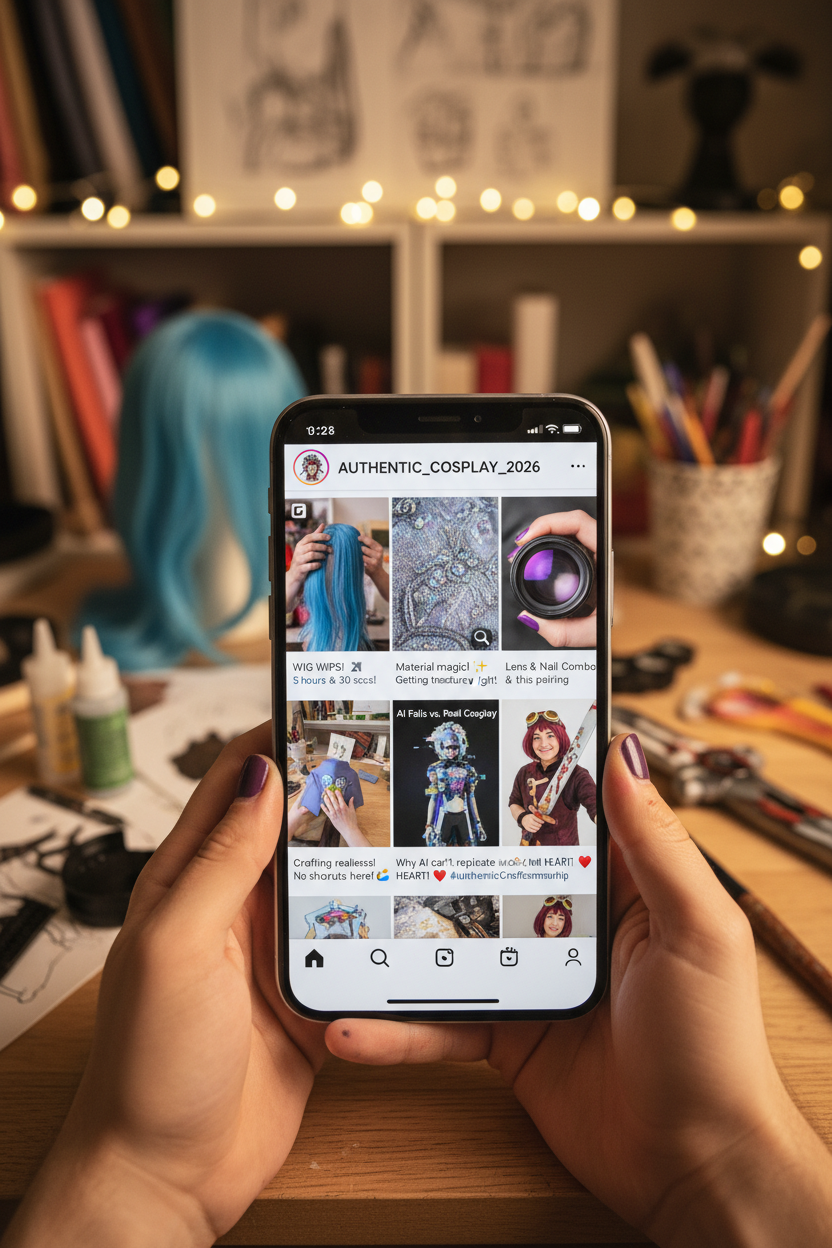
For cosplayers, this shift has reshaped what actually performs on the platform. A single, heavily edited final photo — no matter how good the costume is — now struggles to break through a feed saturated with AI-generated art, "AI cosplay" mashups, and synthetic influencer content. What's winning instead is process: wig styling time-lapses, macro close-ups of lens and nail pairings, and raw texture shots that no AI prompt can convincingly fake yet. This guide walks through exactly how to build that kind of content, from the basic concept through advanced execution.
Chapter 1: What "Process Over Product" Actually Means
Process Over Product is a content approach where the making of a cosplay look becomes the main content, not just a teaser for the final photo. Instead of posting one polished portrait, you post the wig being cut, curled, and styled at high speed; the moment lenses and nail polish are placed side by side to check if the colors actually match; or a slow macro pass over stitching, weathering, and fabric texture before the full look is ever revealed. The final photo might still exist, but it's no longer the centerpiece — it's the payoff at the end of a process the viewer already watched.
This isn't just an aesthetic preference; it's a direct response to a trust problem. As AI image tools have gotten good enough to generate a fully "finished" cosplay photo from a text prompt, a single polished still image has stopped being reliable proof that a real person built a real costume. Multiple 2026 creator-economy analyses point to the same conclusion: as synthetic content floods feeds, audiences increasingly trust how something was made over how good the end result looks, because process footage — hands actually working, materials actually being handled, real-time mistakes and fixes — is far harder to convincingly fabricate than a single generated image.
For cosplayers specifically, this plays directly to a genuine advantage: the actual labor of wig styling, contact lens fitting, and fabric construction is something AI-generated content still can't replicate convincingly, which makes it valuable proof of authenticity rather than just "extra" content.
It's worth being clear about what this trend is not. It's not a rejection of skill or a demand for messy, low-effort content — the styling and detail work still needs to be genuinely good. What's changed is the proof format. A crisp final photo used to be enough proof on its own. Now, the process footage carries the credibility, and the final result is the reward for watching it unfold.
Chapter 2: The Core Framework for Process-First Content
Building a consistent Process Over Product content strategy comes down to four repeatable formats, each suited to a different part of a cosplay build.
-
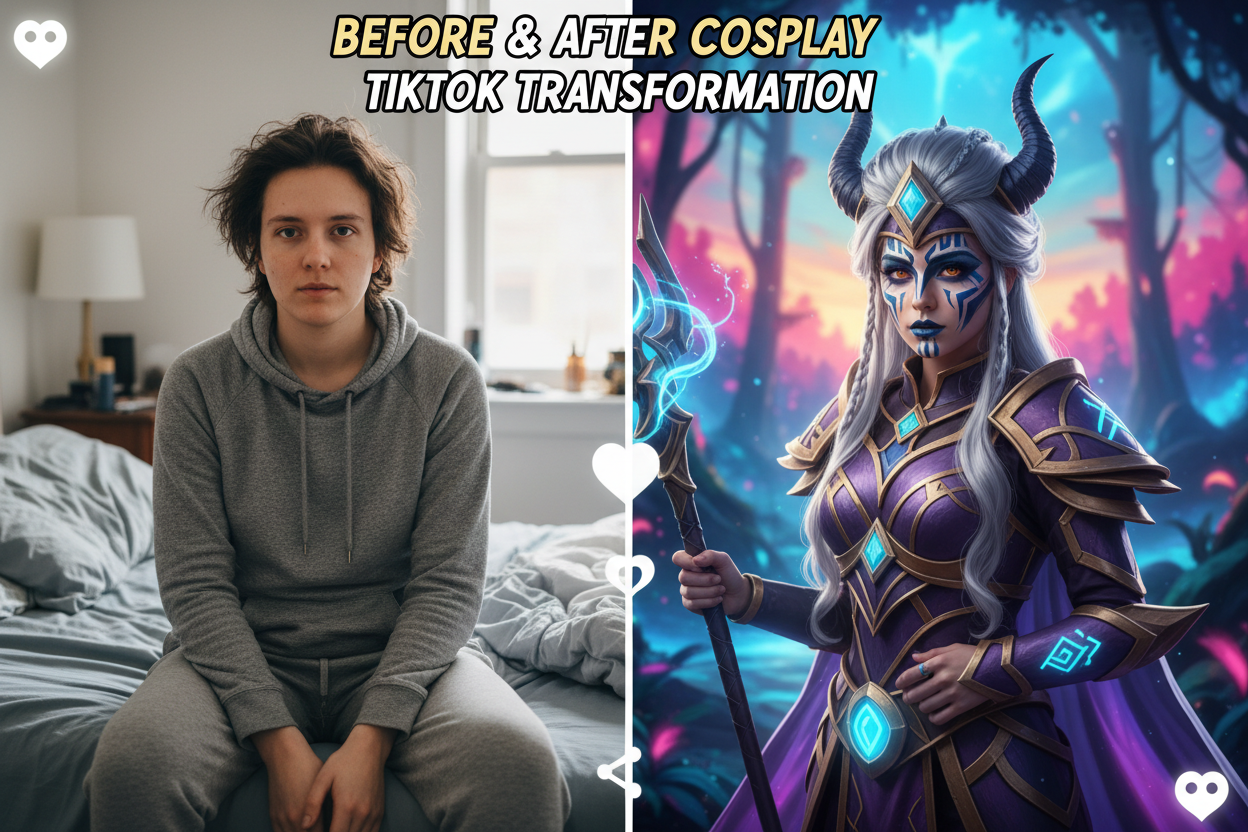
Wig styling time-lapses are the anchor format. Set up a phone or camera on a tripod, record the full styling session at real speed (this can run anywhere from 20 minutes to several hours depending on the wig), then speed the footage up in editing to a 15–30 second time-lapse. The appeal here is watching raw, tangled hair transform into a precise, character-accurate style — the more dramatic the "before," the stronger the payoff, similar in structure to the transition-video format popular on other platforms, but built around real, unscripted craft rather than a cut on a beat.
-
Lenses & nails macro pairing is a shorter, simpler format that performs well because it's fast to make and easy to watch on repeat. Shoot a tight macro close-up placing a colored contact lens directly against a freshly painted nail in the same or complementary shade, checking whether the tones actually match under real lighting. This format works particularly well for the color-palette-driven cosplay looks that are popular right now, since it doubles as proof that the whole look was color-planned deliberately, not thrown together.

-
Texture and material macro shots focus the camera on fabric weave, stitching, weathering effects, or armor paint layers from just a few inches away. This is one of the strongest "proof of craft" formats available, since it shows construction quality that a distant full-body photo simply can't communicate — and it's exactly the kind of granular, physical detail that current AI image generation still struggles to render convincingly.
-
Raw, unedited behind-the-scenes clips — messy work tables, mid-build costume fittings, honest shots of what didn't work on the first try — round out the strategy. These don't need to be polished; in fact, some visible imperfection now functions as a trust signal rather than a flaw, since content that looks too seamless increasingly reads as suspicious rather than impressive.
A simple weekly framework: post one wig or fabric time-lapse as your anchor Reel, two to three quick macro pairing clips as supporting content, and let your final full-look photo function as a payoff post rather than a standalone piece — ideally referencing or linking back to the process content that led up to it.
Chapter 3: Advanced Techniques and Case Examples
Once the basic formats are working, a few refinements make a measurable difference in reach and retention.
-
Layer process and product instead of separating them. Rather than posting a time-lapse Reel and a separate final photo days apart, structure a single Reel so the last two or three seconds cut to the finished look — this keeps the "proof" and the "payoff" in one piece of content, which tends to hold completion rate higher than splitting the story across multiple posts.
-
Lean into visible imperfection deliberately. A wig time-lapse that shows a section getting recurled because it didn't sit right the first time, or a macro shot that includes a small stray thread before it's trimmed, reads as more credible than a flawlessly clean process video — precisely because that kind of small, unplanned detail is difficult to convincingly fake or generate.
-
Use captions to reinforce the "made, not generated" narrative without being defensive about it. Rather than explicitly saying "this is not AI" (which can read as anxious or accusatory), let the footage do that work, and use captions to add context that only someone who actually did the work would know — how long the wig took, what went wrong the first attempt, what fabric was used and why. Specificity itself functions as credibility.
-
Prioritize formats that drive shares over likes. Instagram's 2026 distribution model weights direct message shares significantly higher than likes when ranking Reels for wider reach. Process content — especially satisfying time-lapses and "did the colors match" macro pairings — tends to get shared in DMs between friends far more than static final photos do, which is a meaningful reason this format is outperforming traditional posed photography right now, independent of the authenticity angle.
Chapter 4: Tools and Resources You'll Actually Need
You don't need professional film equipment to execute this well, but a few pieces of gear make a real difference:
-
A basic tripod or phone mount for hands-free, stable wig styling and macro footage — shaky handheld process shots are harder to watch and undercut the "satisfying" quality that drives shares.
-
A clip-on macro lens for smartphones, which makes lens-and-nail pairing shots and fabric texture close-ups significantly sharper than a phone's native camera can manage on its own.
-
Wig styling tools built for repeated, camera-friendly use — heat-safe combs, wig clips, and a proper canvas head — since a smoother styling process also makes for smoother, more watchable footage.
-
Consistent, cool-toned lighting (a small ring light or panel works fine) so that macro color-matching content — like lens-and-nail pairings — reads accurately on camera instead of shifting under warm indoor bulbs.
-
A simple video editing app with speed-ramping controls, so you can shoot process footage at real time and compress it into a fast, satisfying time-lapse without needing complex editing software.
None of this requires a big budget — the entire point of the trend is that raw, hands-on process footage outperforms expensive, over-produced content right now.
Frequently Asked Questions
Does this mean I should stop posting final, polished photos entirely? No — final photos still matter, especially for portfolios and conventions. The shift is in how you frame them: a final photo performs better on Instagram in 2026 when it's positioned as the payoff to process content the audience already saw, rather than posted as a standalone piece with no visible build behind it.
How long should a wig styling time-lapse be? Most well-performing examples run 15–45 seconds after speed-ramping, even if the original footage covers an hour or more of real styling time. The goal is a satisfying, fast transformation, not a full tutorial — save longer step-by-step breakdowns for a separate tutorial-style post if you want to offer that too.
Will showing my process ruin the surprise of the final reveal? In practice, it tends to do the opposite — process footage builds anticipation rather than spoiling it, since viewers are watching to see whether the finished result matches the effort they just watched. The "reveal" still lands; it just lands with more credibility behind it.
What if my process footage isn't glamorous — messy workspace, imperfect first attempts, etc.? That's generally a strength right now, not a weakness. Visible mess and real mistakes are difficult to convincingly fake, which is exactly why they function as trust signals in a feed increasingly filled with synthetic content.
Summary and Related Resources
Process Over Product isn't a passing aesthetic trend — it's a direct response to a real credibility problem that Instagram's own leadership has acknowledged, and it plays to something cosplayers have always had in genuine abundance: real, hands-on craft that's hard to fake. Building a consistent habit around wig time-lapses, macro detail shots, and honest behind-the-scenes footage will do more for your reach right now than another single polished final photo.
If you're ready to build out your process-content toolkit, check out our guides on choosing the right macro-friendly colored contact lenses, building a wig styling station at home, and pairing fabric textures for photo-ready detail shots.

Laisser un commentaire
Ce site est protégé par hCaptcha, et la Politique de confidentialité et les Conditions de service de hCaptcha s’appliquent.