Introduction
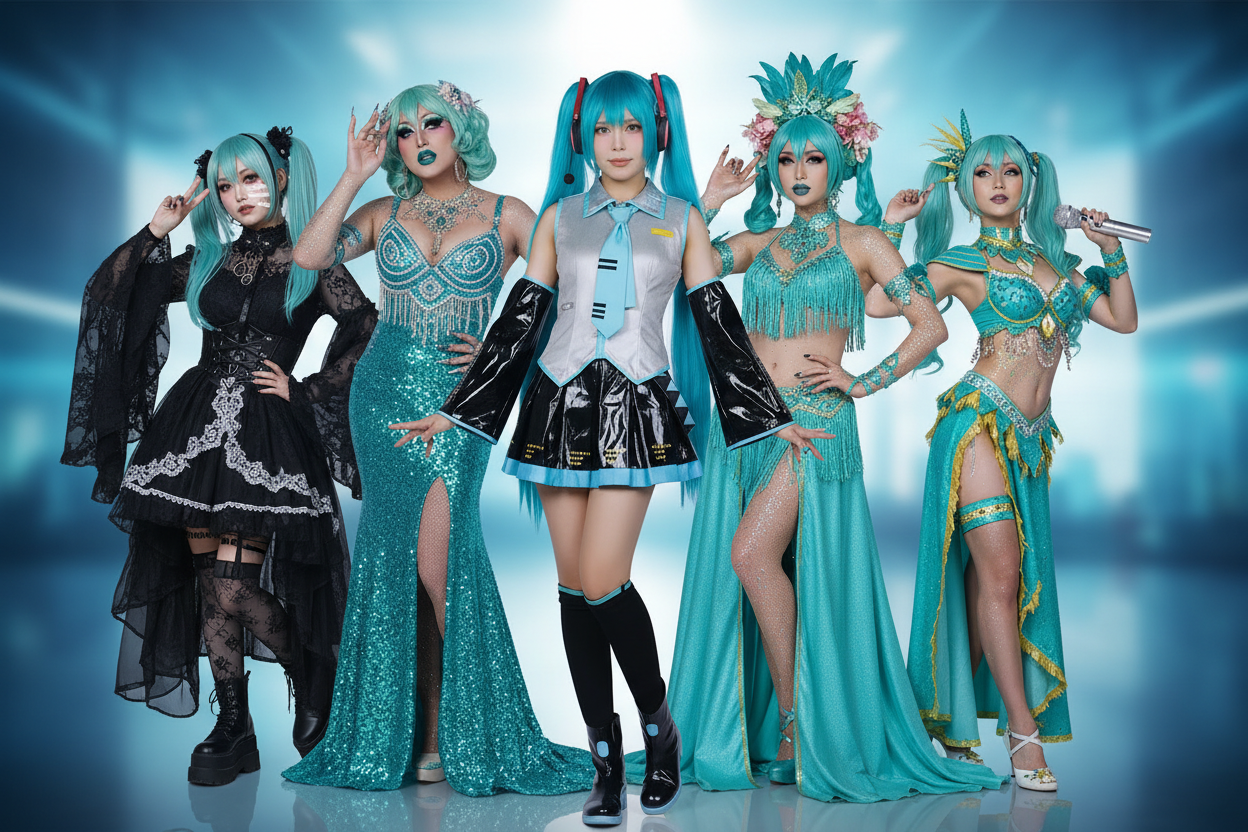
Most cosplay-worthy characters eventually run out of road — the show ends, the actor ages out of the role, or the franchise simply stops producing new content. Hatsune Miku cosplay doesn't follow that pattern, and a scroll through TikTok and Facebook cosplay communities in 2026 makes it obvious why. Miku shows up as a Brazilian drag performer at a Florida convention, a jiraikei-street-fashion hybrid in a makeup tutorial, and a Coachella headliner — often within the same month, on the same platforms, without any of those interpretations contradicting the others. In this guide, we'll break down exactly why virtual characters like Miku sidestep the expiration date that eventually catches up with almost every other cosplay-worthy character, and what that means for building your own Hatsune Miku cosplay costume .
No Fixed Age, No Ending: Why Miku Never "Ages Out" of Relevance
Nearly every long-running cosplay subject eventually hits a structural limit. A manga or anime character exists inside a story that eventually concludes. A character played by a real actor is tied to that actor's own visibility, aging, and career choices. Even long-running franchises like superhero comics periodically reboot specifically because their characters need to be refreshed for new audiences. Miku has none of these constraints. Crypton Future Media's official backstory fixes her at 16 permanently, and because she was never built around a finished narrative in the first place, there's no story for her to "complete" that would naturally wind down community interest the way a series finale often does.
That single design choice — an ageless character with no canon ending — removes the two biggest reasons cosplay-worthy characters typically fade from relevance. There's no point at which Miku cosplay becomes "outdated" the way cosplaying last year's most popular anime protagonist eventually does once the story wraps up and fan attention moves on.
"She Belongs to Everyone": How Community Ownership Makes Every Miku Costume Valid
The deeper reason Miku's cosplay culture keeps regenerating shows up directly in how fans describe her online. A widely-circulated TikTok explainer on Miku's fandom puts it plainly: her identity is shaped by the community itself, not by a fixed creative team — one creator can present her as cheerful and playful, another can use her to represent loneliness or grief, and neither interpretation is more "correct" than the other. That's the sentiment behind fans repeatedly describing her as belonging to everyone, more of a shared creative symbol than a conventional fictional character with an owner.
That community-driven ownership shows up concretely in how differently Miku actually gets cosplayed across current social platforms. Within recent TikTok cosplay content alone, Miku appears as a jiraikei-street-fashion hybrid look blending Japanese subcultural fashion with her signature teal twin-tails, as a plus-size cosplayer's confident take on the character, and as a full drag performance at Miku Only NYC 2026, an event explicitly built around the overlap between drag culture and Vocaloid fandom. None of these compete with each other for legitimacy the way a "wrong" costume interpretation might for a strictly canon-driven character — they coexist, because there was never a single gatekept version to deviate from in the first place.
From Coachella to Anime Conventions: Why Miku Keeps Crossing Into New Scenes
Perhaps the clearest proof of Miku's lifecycle-resistant design is how many completely different cultural scenes she's shown up in without needing to be "reintroduced" to any of them. She performed at Coachella as a hologram act alongside mainstream headliners, a genuine crossover into a music festival audience that has nothing to do with anime fandom by default. At NEC Con 2026, a Brazilian cosplayer's stage performance of Miku sparked an active, good-natured social media debate over which regional interpretation of the character is strongest — a conversation that simply couldn't happen with a character tied to one canon appearance or one voice actor's performance. And ongoing "Miku lookalike contests" circulating on TikTok treat her design as a competitive cosplay category in its own right, similar to how conventions run contests for enduringly popular characters that never go out of style.
Each of these scenes — a music festival, a Brazilian convention stage, a New York drag night, a lookalike contest — represents an entry point that doesn't require fans to have followed any particular canon "moment" to participate. That portability is structurally unavailable to characters tied to a specific show, actor, or storyline, and it's a major reason Miku cosplay content keeps showing up in front of audiences who aren't traditional anime convention-goers at all.
Virtual Characters vs. Traditional Cosplay Subjects: What Actually Makes the Difference
| Factor | Traditional Story-Bound Character | Hatsune Miku (Virtual Character) |
| Canon narrative | Tied to a story that eventually concludes | No fixed narrative to complete or "move past" |
| Aging/relevance window | Character or actor visibility fades with the property's cultural moment | Permanently fixed at 16; no aging-out mechanism |
| Design ownership | Controlled by a single studio or creative team | Shared across official releases and a vast, equally legitimate fan-created ecosystem |
| Cultural adaptability | Reinterpretation risks being seen as "inaccurate" | Reinterpretation (drag, jiraikei, regional stage performances) is an accepted, celebrated part of the culture |
| Cross-genre reach | Typically confined to its originating fandom space | Verified crossover into music festivals (Coachella), drag scenes (Miku Only NYC), and international conventions |
| Cosplay "expiration risk" | Real — interest fades once the story or actor's relevance declines | Minimal — no single ending or aging process to fade from |
Building Your Own Miku Costume: Choosing Your Interpretation
Because Miku cosplay covers this much creative range, your first decision isn't fabric or fit — it's which interpretation you're building toward, and current social platforms offer more legitimate starting points than most characters ever get.
-
Classic twin-tail Miku remains the most universally recognized entry point, and it's still the safest choice if you want instant recognition regardless of which corner of the fandom your audience comes from.
-
Subculture fusion looks (like jiraikei-inspired Miku) are actively trending in current TikTok tutorial content and offer a way to make the costume personally distinctive while keeping the recognizable teal twin-tails and color story intact.
-
Drag and performance-style Miku builds, as seen at events like Miku Only NYC, tend to lean into bolder makeup, exaggerated proportions, and stage-ready durability — worth considering if you're building specifically for a performance or dance-focused convention segment rather than a standard photo-op costume.
Whichever direction you choose, wig quality and styling remain the highest-leverage investment across every version — the twin-tails read as "Miku" faster than any other single design element, regardless of which broader interpretation you're building toward. This is why we refuse to use digital renders and instead provide high-grade Miku wigs backed by real showroom photography, ensuring the fiber density and structural support can actually handle the weight of her signature twin-tails without exposing the wefts or losing shape on the convention floor.
Frequently Asked Questions
Why doesn't Miku cosplay go out of style the way other character trends do?
Because she has no fixed age and no concluding storyline, there's no natural point at which her design becomes "outdated" the way a finished anime or show's popularity eventually cools once the story wraps up.
Is there an "official" way to cosplay Miku, or are fan reinterpretations equally valid?
Both are considered legitimate. Crypton's official designs exist alongside a vast fan-created ecosystem, and community sentiment consistently treats Miku as belonging to the fandom collectively rather than to one gatekept version.
Why has Miku shown up in scenes like Coachella and drag events that don't normally overlap with anime cosplay?
Because she isn't tied to a specific show, actor, or narrative, she can be adapted into completely different cultural contexts — music festivals, drag performances, regional convention stages — without needing to be "reintroduced" to those audiences first.
Do different Miku cosplay interpretations compete with each other for accuracy?
Not typically. Because there's no single canon appearance to be judged against, interpretations like jiraikei-fusion looks, drag performances, and classic twin-tail builds tend to coexist rather than being ranked against one another as more or less "correct."
What's the most important detail to get right regardless of which Miku interpretation I choose?
Wig quality and twin-tail styling remain the most instantly recognizable element across every version of the character, making it the highest-priority detail no matter which broader interpretation you're building toward.
Conclusion
Choosing a high-quality Hatsune Miku cosplay costume means engaging with something genuinely rare in cosplay culture: a character with no aging process, no concluding storyline, and no single gatekept design to measure yourself against. From Coachella's stage to a drag night in New York to a convention floor in Brazil, Miku keeps proving that a virtual character built around community ownership rather than a fixed narrative simply doesn't expire the way traditional cosplay subjects eventually do. If you're ready to build your own Miku costume — classic, subculture-fused, or entirely your own interpretation — check our Miku wig styling and costume collection below before you order.

Laisser un commentaire
Ce site est protégé par hCaptcha, et la Politique de confidentialité et les Conditions de service de hCaptcha s’appliquent.