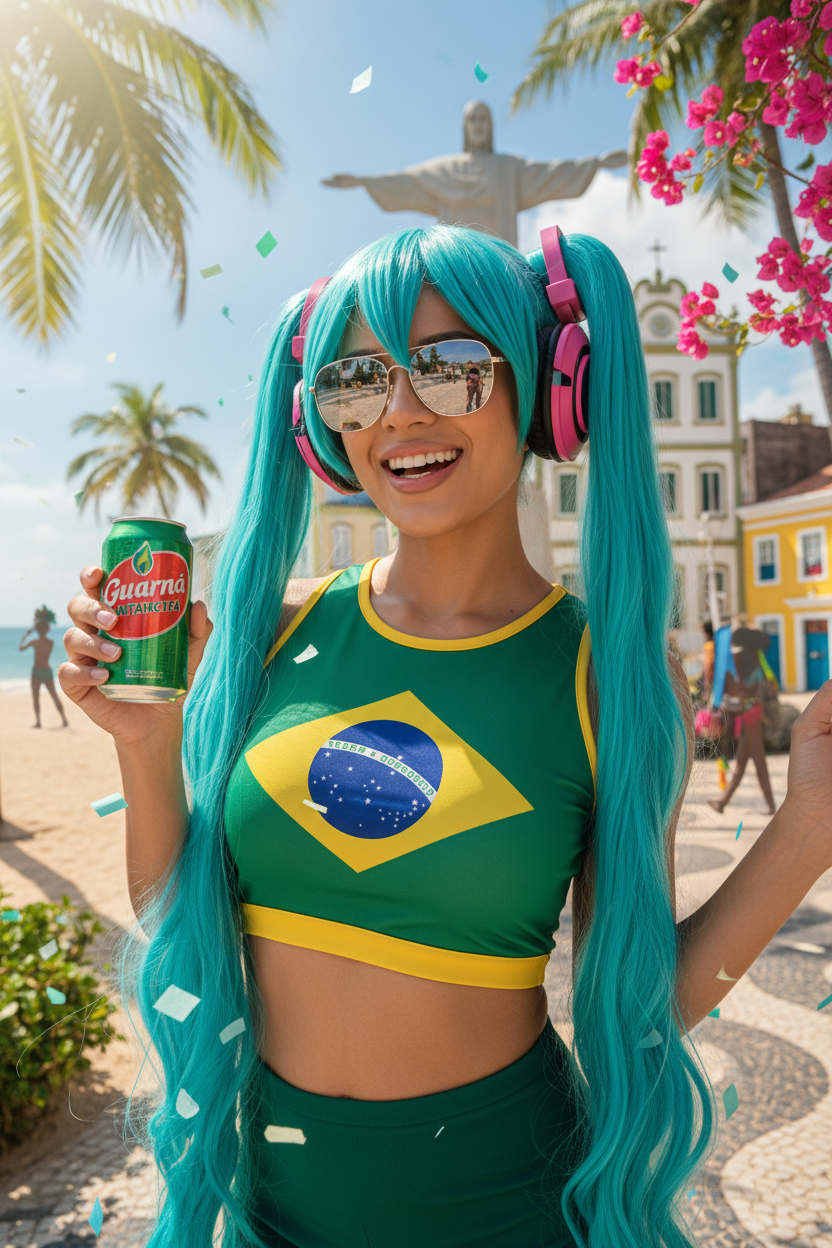
TL;DR: "Every Country's Miku" is a global fan art trend that reimagines Hatsune Miku through different national aesthetics — tanned Brazilian Miku in a flag crop top, and dozens of other regional variants that followed — and it's rooted in something structural, not just internet whimsy: Miku's official license explicitly permits and encourages fans to reinterpret her design, unlike most anime characters who exist inside a fixed, protected narrative.
While a smaller, vocal group frames these reimaginings as diluting the "real" Miku, the trend has been embraced overwhelmingly by the broader fandom — including a fresh viral wave in mid-2026 tied to the FIFA World Cup, where fans jokingly treated each match result as a "custody battle" over which country got to claim her next.
Why This Trend Works Differently for Miku Than for Almost Any Other Character
To understand why "Every Country's Miku" hasn't generated the kind of sustained, serious backlash that redesign controversies around other franchises sometimes have, it helps to understand what Hatsune Miku actually is.
Unlike a character from a story-driven anime or game with a fixed canon, backstory, and single "correct" design maintained by a media company protecting a narrative, Miku is fundamentally a vocal synthesizer — a piece of software whose voice anyone can license and use to create original songs. Her visual design was created by Crypton Future Media specifically to represent that software, and crucially, the company's Piapro Character License has long explicitly permitted fans to create and share their own derivative artwork and reinterpretations of her design for non-commercial use. In other words, "anyone can be Miku" isn't just a fan slogan — it's close to the actual, intended premise behind the character from a licensing standpoint, which puts "Every Country's Miku" on fundamentally different footing than a redesign debate involving a character with an authored backstory and a company actively defending one canonical depiction.
The trend's specific origin traces back to June 2024, when artist @ErinArtista posted a sketch imagining Miku as Brazilian — tan skin, sunglasses, a Brazilian flag crop top, and a can of Guaraná Antarctica soda in hand. The design went properly viral two months later, in August 2024, when another artist's take on the concept exploded on X, pulling in tens of thousands of shares within weeks. From there, the "why stop at Brazil" energy took over almost immediately, with artists producing Miku variants for dozens of countries within about a week, each drawing on national dress, food, and cultural iconography specific to that place. The trend even picked up its own mini-narrative arc: when Brazil's government temporarily banned X in August 2024, fan artists drew mourning tributes to "the death of Brazilian Miku," followed by celebratory "resurrection" art when the ban lifted that October — turning a corporate regulatory dispute into a genuinely emotional, community-wide fan art moment.
The trend didn't stay confined to 2024, either. During the 2026 FIFA World Cup, fans revived the concept in a new form dubbed the "Hatsune Miku World Cup Custody Battle" — treating each knockout-round match as a battle for temporary "custody" of Miku, with the winning country's colors and cultural symbols getting applied to a fresh round of fan art. A viral TikTok framing Japan's Round of 16 match against Brazil as "the Hatsune Miku custody match" pulled millions of views, and the joke continued through subsequent rounds as custody passed from Brazil to Norway and beyond, each transition prompting its own wave of art. This staying power — resurfacing organically two years after its original viral moment, in a completely different context — is a meaningful signal that this is a genuinely embraced piece of ongoing fan culture, not a one-off controversy that faded quickly.
Key Elements and How Cosplayers Are Applying the Trend
For cosplayers interested in building a regional Miku look rather than just enjoying the fan art, a few consistent patterns are worth understanding. Successful "Every Country's Miku" designs — and the cosplay builds inspired by them — tend to preserve a small set of anchor traits that keep the design instantly recognizable as Miku specifically, most importantly her signature long, turquoise twin-tails, regardless of how the rest of the outfit changes. From there, the reinterpretation happens through color palette shifts tied to national flags or cultural motifs, clothing silhouettes drawn from regional traditional or popular dress, and small prop or accessory choices referencing food, symbols, or objects specific to that place — the way Brazilian Miku's design incorporated a Guaraná Antarctica can, for instance, or the way World Cup-era variants incorporated national team jersey colors and football-specific styling.
This gives cosplayers a genuinely flexible framework: keep Miku's core silhouette and hair recognizable, then layer in your own cultural background, a country you're celebrating, or even a specific event (like a World Cup match) as the reinterpretation lens. It's a similar underlying methodology to the subculture-remix approach covered in our goth, coquette, Y2K, and cyberpunk-wasteland cosplay guide — identify your anchor traits, then translate the rest of the design through a specific, coherent lens rather than changing everything at once.
Common Misunderstandings and Things Worth Knowing
-
"This is just political correctness changing a classic design." This framing shows up in some corners of the discourse, but it doesn't hold up well against how Miku's design has actually been treated by her own rights holder for over a decade — derivative fan reinterpretation isn't a recent imposition on a previously "untouchable" character, it's close to the explicit premise Crypton Future Media built the character's licensing around from early on. That's a meaningfully different situation than a studio-owned, narrative-driven character whose design the company actively protects as a single canonical depiction.
-
"Country-variant Miku isn't really cosplay, it's just OC art with her name on it." This critique has more merit as a genuine aesthetic opinion than the "political correctness" framing does, and it's worth taking seriously as a real position some cosplayers hold — if a build changes so much that Miku's core recognizable traits (the twin-tails, her general silhouette) disappear entirely, it's fair to debate whether it reads as Miku cosplay or an unrelated original design. The practical fix, as with most character-recognition debates covered elsewhere on this site, is keeping at least one or two strong anchor traits intact so the connection to Miku remains legible even through a heavy reinterpretation.
-
"Any regional variant is automatically respectful just because it's fan-made." It's worth applying a bit more care here than the meme format itself always encourages. The most well-received regional Miku designs tend to reflect real, specific cultural details — actual foods, real textile patterns, genuine regional aesthetics — rather than a handful of surface-level stereotypes stapled onto her outfit. If you're building a regional Miku cosplay inspired by a culture you're not personally from, doing a bit of the same research that the better fan artists clearly did tends to produce a more thoughtful, better-received result than defaulting to the most obvious clichés.
Summary and Further Reading
"Every Country's Miku" has stayed a beloved, recurring piece of fan culture rather than fading into controversy largely because it's built on the actual philosophy Miku was designed around — an open, shared character anyone can reinterpret through their own voice or, in this case, their own culture — and its return during the 2026 World Cup shows it has real staying power beyond a single viral moment.
If you're building your own regional-inspired Hatsune Miku Cosplay Costume, check out our guides on styling Miku's signature twin-tail wig, choosing fabrics that hold up well for a vibrant, color-blocked Cosplay Costume, and our subculture-remix framework for translating a character's design through a new cultural or aesthetic lens while keeping her recognizable.

Laisser un commentaire
Ce site est protégé par hCaptcha, et la Politique de confidentialité et les Conditions de service de hCaptcha s’appliquent.