💡 Systemic Briefing:
In 2026, the global cosplay landscape is witnessing a profound structural shift regarding how character gender-bending is perceived, executed, and judged. What was once considered a niche novelty or an internet subgenre ("Rule 63") has officially matured into a mainstream form of creative expression. Across Reddit cosplay subreddits, Tumblr fandom communities, and highly anticipated convention panels, a fierce debate has ignited. The core of the argument is no longer about whether cosplayers should swap a character’s gender, but rather how this normalization reshapes our fundamental understanding of character lore, costume geometry, and artistic fidelity to the original source.
1. Core Character IP Analyses: The Debate in Three Dimensions
To understand why this conversation dominates 2026 convention panels, we must analyze how specific, hyper-recognizable properties are being completely re-engineered by creators.
🎭 Gojo Satoru cosplay costume (Jujutsu Kaisen)
-
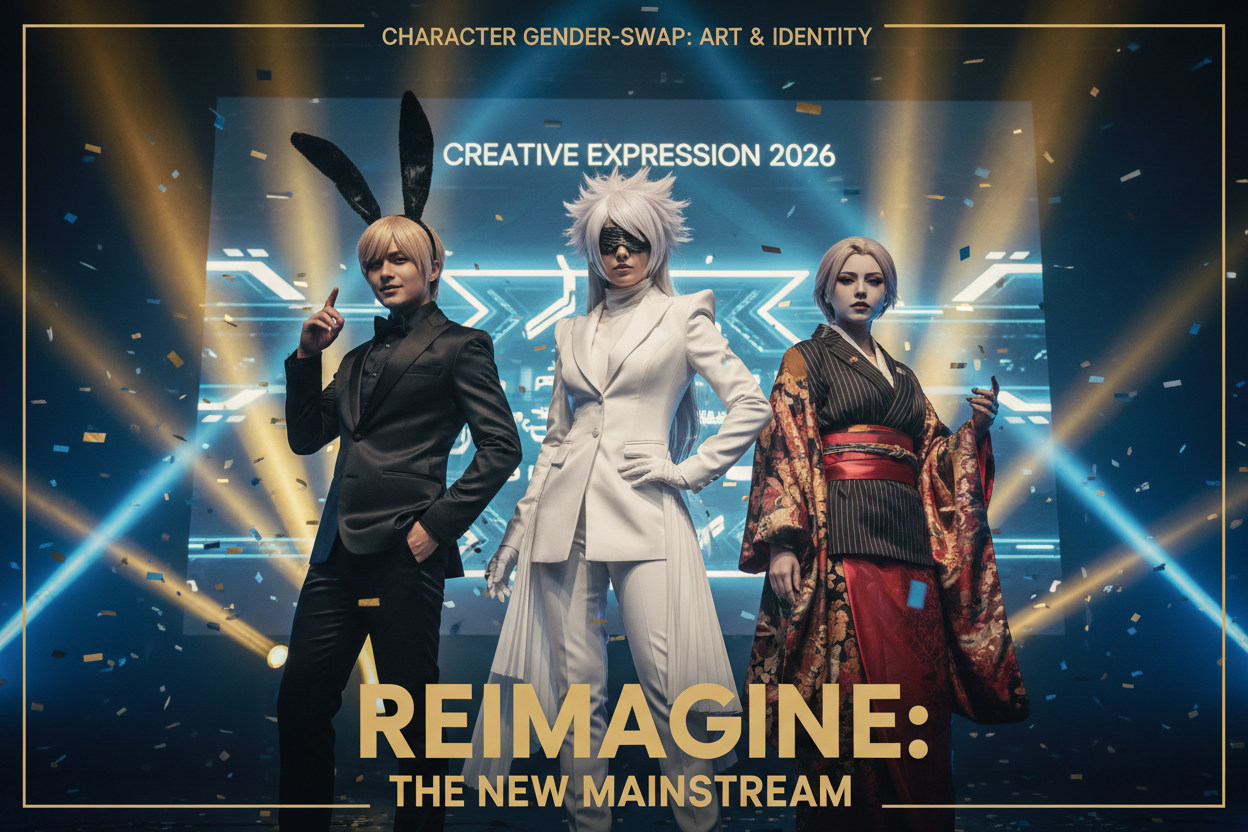
The Design Transformation: The traditional Gojo Satoru cosplay costume features a minimalist, high-necked dark blue Jujutsu High uniform designed for a lean, towering masculine frame. In 2026, "Fem!Gojo" creators are deconstructing this uniform into sharp, avant-garde high-fashion pantsuits or structured asymmetrical blazers. The look preserves the critical character anchors—the pure white wig, the signature dark blindfold, and the precise "Unlimited Void" hand gesture—but replaces the blocky shonen silhouette with tailored, high-fashion lines.
-
The Fandom Debate: On Reddit r/jujutsukaisen, purists argue that Gojo’s overwhelming presence in the anime is inherently linked to a massive, physically dominating male power trope, claiming that shifting the garment's cut softens his threatening aura. Conversely, progressive panel speakers argue that a beautifully tailored female suit heightens his detached, god-like arrogance, proving that true character authority lies in psychological depth rather than physical build.
🎭 Mai Sakurajima cosplay costume (Rascal Does Not Dream)
-
The Design Transformation: The foundational Mai Sakurajima cosplay costume is culturally fixed to her iconic black satin bunny girl suit, a design historically tailored for a hyper-feminine silhouette and the traditional male gaze. The 2026 normalization movement has seen male and non-binary cosplayers completely reclaim this concept. Instead of treating it as a parody, they re-engineer the costume into sleek, deep-black red-carpet tuxedos, matching the satin lapels to the texture of the bunny ears while wearing her signature purple hairclip with absolute artistic gravity.
-
The Fandom Debate: This adaptation represents the ultimate shift in mainstream fan culture. Tumblr fandom discussions highlight that decoupling Mai’s personality—her emotional maturity, sharp wit, and quiet independence—from an objectified female garment allows her character to be understood on a purely intellectual level. It transitions genderbend work from a lazy "Rule 63" internet joke into a serious statement about narrative connection.
🎭 Kibutsuji Muzan cosplay costume (Demon Slayer)
-
The Design Transformation: While the Kibutsuji Muzan cosplay costume has an official female iteration within the canon lore, 2026 creators are pushing the boundaries of his classic Taisho-era black kimono and Western fedora suits. Cosplayers are cross-pollinating these looks—blending the sharp, menacing lines of his male mob-boss suit with the sweeping, dramatic drapes of his traditional female traditional wear, heavily utilizing customized jacquards and blood-red silk accents.
-
The Fandom Debate: Demon Slayer fandom circles frequently debate the line between creative redesign and unauthorized historical deviation. Because the IP relies on rigid, historically grounded Japanese attire, altering the silhouette is heavily policed by purists. However, convention judges increasingly view these hybridized, gender-fluid Muzan designs as peak craftsmanship, celebrating the creator's ability to retain historical textile patterns while building an entirely original garment structure.
⚖️ 2. The Clash Over Aura vs. Innovation: De-Gendering Supreme Power
The broader community argument centers heavily on whether a performer's physical presentation alters the intrinsic understanding of a character's story. Traditionalists worry that when a character built entirely around masculine or feminine tropes is swapped, the narrative weight of their actions is diluted.
However, the prevailing consensus at 2026 convention panels suggests that gender-swap normalization actually exposes the universal appeal of these characters. When a performer successfully projects the absolute malice of a gender-swapped Sukuna or the quiet grace of a male Shinobu Kocho without relying on their original anatomical framework, it demonstrates that subcultural archetypes are bound by soul and performance, not by biology.
📐 3. Sartorial Engineering: The Battle of Silhouettes
The debate moves from philosophy to pure physics when analyzing garment construction:
True normalization has raised the technical standards for alternative interpretations. Creators can no longer simply buy an off-the-rack outfit and wear it unaltered; they must engage in complex pattern drafting to shift a garment's balance points, shoulder slope, and waistlines to fit a completely different anatomy while ensuring the character remains instantly recognizable from fifty feet away on a crowded convention floor.
📊 4. The Supply Chain Registry: Textile and Craftsmanship Engineering Standards
The shift toward treating gender-swaps as serious artistic endeavors has fundamentally changed the consumer habits of the cosplay community. High-end cosplayers are moving away from cheap, un-altered mass production and are demanding premium fabrics that can handle structural re-tailoring:
| Target Character Node | The Gender-Swap Reinterpretation | Traditional Costume Barrier | 2026 Supply Chain Standard | E-Commerce Strategy Shift |
|
Gojo Satoru / Sukuna (Jujutsu Kaisen) |
From utilitarian male uniforms to high-fashion suits/dresses with supreme presence. | Cheap polyester fabrics look wrinkly and completely lose their intimidating, authoritative drape. | Heavy-weight TR (Tetron Rayon) suit blends, customized matte linings, and structural shoulder padding. | Shift toward premium, ready-to-wear tailored apparel that easily transitions from daily wear to convention floor. |
|
Muzan / The Hashira (Demon Slayer) |
Deconstructing Taisho-era garments into alternative gendered shapes. | Flat, screen-printed polyester patterns destroy the premium historical feel up close. | Authentic woven jacquard fabrics, raised metallic thread embroidery, and specialized dye sublimated linen. | Provide unstitched fabric kits or highly adjustable panels to allow custom re-tailoring for alternative silhouettes. |
|
Mai Sakurajima (Bunny Girl Senpai) |
From a feminine bodysuit to masculine or non-binary red-carpet fashion. | Faux-leather bodywear is highly restrictive and often viewed as cheap or parody-adjacent. | Deep matte black velvet, tailored satin lapels, and custom-sculpted resin hair accessories. | Market alternative fashion collections that focus on character-inspired haute couture over literal costume copies. |
❓ 5. Frequently Asked Questions (FAQ)
-
Q: Does altering a character’s biological gender in a cosplay mean the creator is rejecting the original canon?
-
A: Absolutely not. In modern fan culture, gender-swapping is treated as a physical extension of transformative fan fiction. It requires an incredibly deep understanding of the character’s psychological core to change their outward presentation while keeping their identity immediately recognizable to the public. It is an act of deep passion and analysis, not rejection.
-
-
Q: How are major global cosplay contests managing the judging criteria for gender-swapped entries in 2026?
-
A: Judging matrices have evolved rapidly. While traditional categories still prioritize 1:1 screen accuracy, modern competitions have introduced robust "Design Innovation" and "Alternative Interpretation" rubrics. Judges score these entries on how logically the cosplayer re-engineered the costume’s architecture to fit a different silhouette, ensuring that high-level tailoring and brilliant conceptual redesigns are rewarded equally.
-
-
Q: What does the normalization of gender-bending tell us about the future direction of the global cosplay community?
-
A: It proves that cosplay is shifting from a hobby based entirely on literal replication to a sophisticated art form centered on personal identity and artistic reinterpretation. It opens up the entire universe of character design to every single fan, regardless of their gender identity, allowing the community to prioritize craftsmanship and character passion above all else.
-
🎯 Conclusion: The Ultimate Creative Freedom
The intense debate surrounding character gender-swapping in 2026 is a clear indicator of a healthy, rapidly evolving art form. Far from diluting the original source material, gender-swap normalization breathes dynamic new life into iconic designs. It challenges manufacturers to produce better textiles, pushes cosplayers to master advanced tailoring, and encourages fans to look beyond surface-level traits to engage with a character's true personality. In the modern era of fandom, fabrics are shaped by hands and needles, but the soul of a character remains completely boundless.

Laisser un commentaire
Ce site est protégé par hCaptcha, et la Politique de confidentialité et les Conditions de service de hCaptcha s’appliquent.