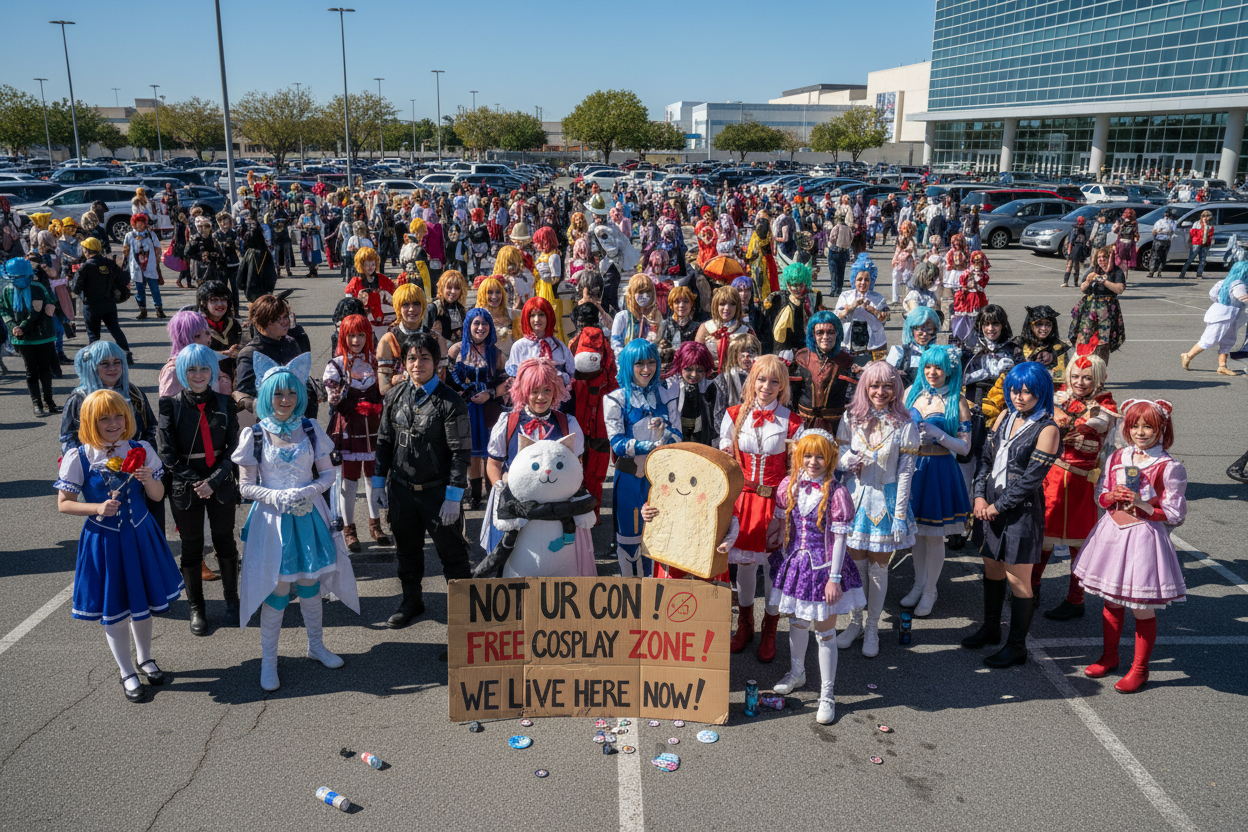
TL;DR: During FanimeCon 2026, a group of cosplayers set up an unofficial gathering in a nearby parking lot — complete with a deliberately absurd "Fresh Foot Juice" stunt — that had nothing to do with the actual convention and quickly went viral on Reddit and social media anyway. It's a small, silly moment on the surface, but it's also a visible symptom of something bigger: cosplay culture is no longer contained inside convention center walls. The real social event now stretches from the show floor into parking lots, hotel lobbies, sidewalks, and afterparties — spaces no organizer books, badges, or controls.
Why This Is Happening: The Convention Doesn't End at the Convention Center
For most of cosplay's modern history, "the convention" meant a specific, bounded thing: a building, a schedule, a badge that let you in and, implicitly, defined where the event actually was. What happened at FanimeCon 2026 is a clear signal that boundary has been quietly dissolving for a while, and it's worth understanding the actual mechanics behind why.
1. Convention centers were never built for how cosplay actually gets consumed now. Photography, not panel attendance, is the dominant activity for a huge share of convention-goers today, and photography doesn't require an official venue — it requires good light, interesting backdrops, and enough space to pose without being trampled. A parking lot with decent lighting and open space can outperform a crowded convention hallway for exactly the kind of content cosplayers are actually trying to produce. Once you realize the "official" venue isn't even the best location for the thing most attendees are there to do, stepping outside it stops being a workaround and starts being an upgrade.
2. Unofficial spaces have none of the friction official ones do. Convention centers come with badge checks, capacity limits, no-photography zones, contest rules, and staff enforcing them. A parking lot, a hotel lobby, or a stretch of sidewalk has none of that. For a generation of cosplayers who grew up documenting everything for social platforms first and attending events second, the appeal of a space with zero rules about what you can wear, do, or film is obvious — it's the same reason unofficial meetups have always existed at the margins of organized fandom events, just now amplified by how easy it is to coordinate and broadcast in real time.
3. Social media turns "unofficial" into a feature, not a bug. A stunt like "Fresh Foot Juice" being explicitly non-official is part of what made it spread — it reads as spontaneous, absurd, and free from any brand or organizer's oversight, which is exactly the kind of content that performs well against the more polished, sanctioned photo sets coming out of the actual convention floor. Official con content competes with every other official con's content. Unofficial, slightly unhinged parking-lot content competes with nothing — it's its own category, and novelty travels fast online.
4. Housing and overflow crowds already pushed the community outward. Major cons regularly sell out nearby hotels and push attendees into satellite lodging blocks away from the main venue, which has quietly been building hotel lobby cosplay culture for years — impromptu meetups, photo sessions, and hangouts in spaces that were never part of any official programming. The parking lot phenomenon isn't really a new behavior; it's an extension of a pattern that's existed in lobbies and side streets for a while, just now visible enough (and viral enough) to get its own name and its own news cycle.
5. It reflects a broader shift in what people actually want from a con. For a meaningful slice of today's cosplay community, the appeal was never really about panels or exclusive merchandise — it's about being around other people who understand the reference, in costume, with a camera nearby. Once that's the actual draw, the specific building stops mattering nearly as much as the people and the moment. A convention center provides infrastructure. It was never, on its own, the point.
Put together, this isn't a one-off prank that happened to catch on — it's what happens when a fandom's actual social behavior has outgrown the physical container built for it a decade or two ago, and the container hasn't caught up.
Key Elements & Where This Shows Up
This shift isn't limited to a single dramatic parking lot stunt — it's showing up in a recognizable pattern of spaces and behaviors across multiple major conventions, not just Fanime.
Parking lots as informal photo studios. Open pavement, natural light, and enough room to pose without navigating a packed hallway make convention parking lots a genuinely practical alternative to the show floor for photography — which is why they keep becoming impromptu gathering points regardless of whether an event officially sanctions it.
Hotel lobbies as after-hours convention floors. Once official programming ends for the day but the con badge crowd is still very much awake and in costume, hotel lobbies near the venue become de facto extensions of the event — informal meetups, group photos, and socializing that organizers have no visibility into and no control over.
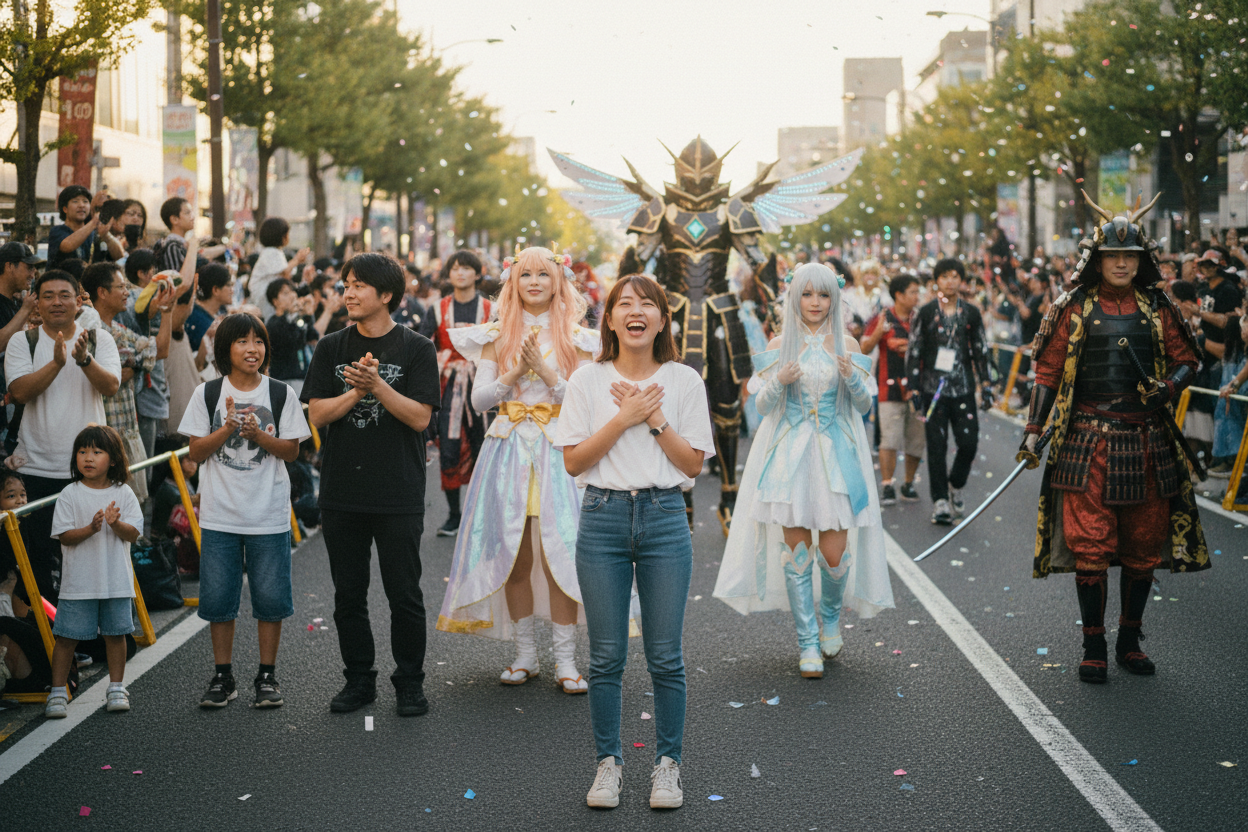
Sidewalks and adjacent public space as transitional social zones. The walk between a convention center and nearby hotels or parking has increasingly become its own social space rather than just a commute — cosplayers stopping for photos, running into other attendees, and effectively extending the con's footprint block by block outward from the official venue.
Deliberately absurd, meme-driven stunts as community glue. The "Fresh Foot Juice" stunt is a good example of a broader pattern: unofficial spaces tend to produce weirder, more inside-joke-driven content than official programming does, precisely because there's no brand, sponsor, or organizer reputation to protect. That freedom is part of what makes this content spread — it feels authentically fan-made in a way heavily produced official con content sometimes doesn't.
Coordination happening entirely outside official channels. These gatherings aren't listed in any program guide — they're organized through Discord servers, group chats, and social media posts in the days and hours before or during an event, which makes them fundamentally different from "unofficial" meetups of a decade ago that mostly happened by chance rather than active coordination.
Common Misconceptions & Things Worth Watching
This isn't the same as an organized rival convention. It's tempting to frame this trend as cosplayers "competing" with official conventions, but that overstates what's actually happening. These are loosely coordinated, often spontaneous gatherings, not organized alternative events with their own infrastructure, ticketing, or programming — the appeal is specifically that they're unstructured, not that they're trying to replace the con itself.
It's not necessarily antagonistic toward organizers. Coverage of moments like this can sometimes frame it as attendees rebelling against convention rules or organizers, but for most participants this reads less like protest and more like simple behavioral drift — people gravitating toward whatever space actually serves what they showed up to do. Most of these cosplayers likely still bought badges and attended the official event; the parking lot gathering is additive, not a replacement.
Unofficial doesn't mean unsafe by default, but it does mean unmanaged. Official convention spaces have security, first aid, harassment policies, and staff oversight that unofficial gatherings simply don't have. This doesn't mean parking lot or lobby meetups are inherently dangerous, but it does mean none of the safety infrastructure attendees might take for granted inside the venue extends to these spaces — worth keeping in mind if this trend continues to grow in scale.
Not every viral "unofficial con" moment reflects a deep cultural shift — some are genuinely just one weird stunt. It's easy to over-read a single viral clip as proof of a sweeping trend. The more reliable signal isn't any one event going viral — it's the recurring pattern across multiple cons over multiple years of overflow socializing happening in lobbies, lots, and sidewalks. The Fanime moment is a good illustration of the pattern, not necessarily its origin point.
Organizers are likely to respond eventually, one way or another. As these unofficial spaces get more visible and more actively coordinated, it's reasonable to expect convention organizers to start acknowledging or even formally accommodating some version of this behavior — official photo zones outside the main hall, extended lobby programming, or explicit guidance about nearby public spaces — rather than simply treating it as something happening entirely outside their purview.
Summary and Further Reading
The "parking lot con" phenomenon at FanimeCon 2026 is a small, viral moment on its surface, but it points at something structural: cosplay's actual social center of gravity has been drifting outward from the official convention floor for a while, driven by photography-first attendee behavior, the total absence of friction in unofficial spaces, and social media's appetite for unpolished, un-branded content. It's less a rebellion against conventions than a sign that fans have quietly redefined what "the convention" actually includes — and that definition now runs well past the doors organizers control.
Related reading you might find useful next:
- A guide to convention-day comfort for cosplayers who plan to be on their feet well beyond scheduled programming, including outdoor and off-venue meetups
- A look at how convention housing and overflow crowds have shaped fan behavior around major events for years, beyond this one viral moment
- A practical guide to travel and packing for cosplayers attending multi-day events with unpredictable, unofficial extensions to the schedule


Laisser un commentaire
Ce site est protégé par hCaptcha, et la Politique de confidentialité et les Conditions de service de hCaptcha s’appliquent.