Introduction
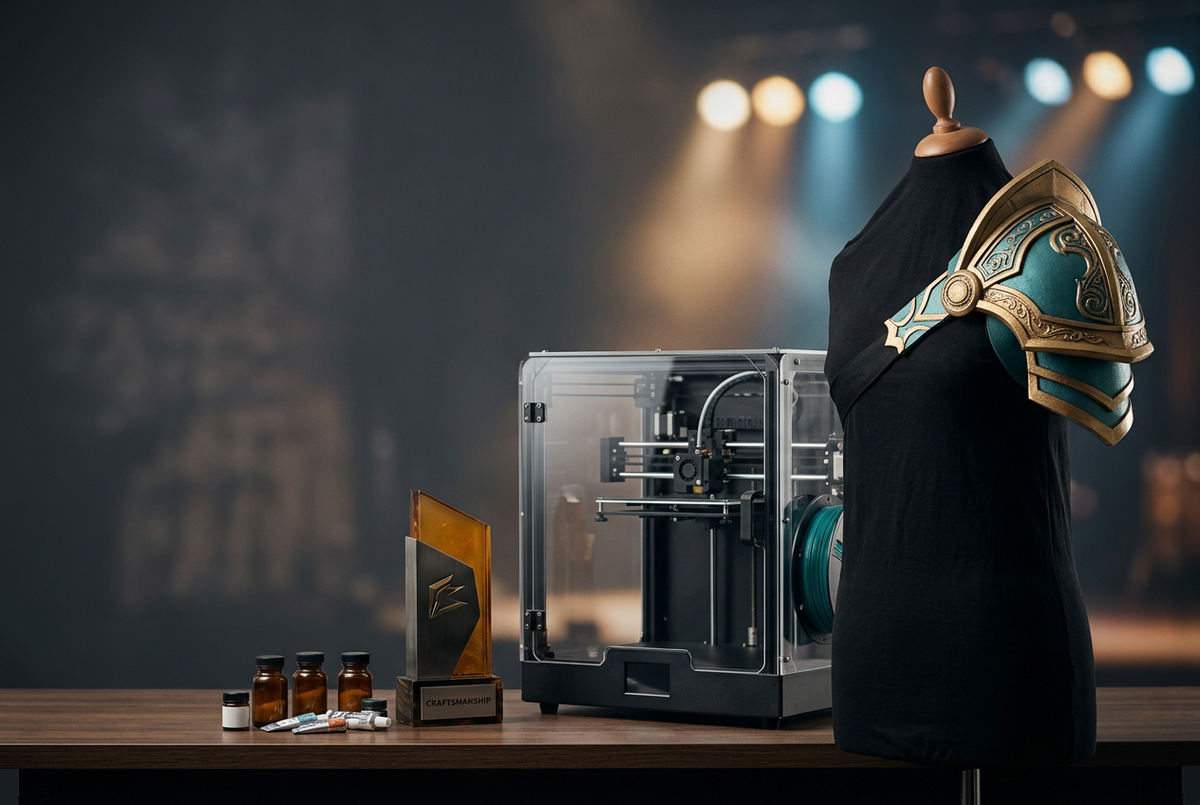
Cosplay competitions have traditionally been associated with costume craftsmanship, character interpretation, stage performance, and fan creativity. In 2026, several convention partnerships offer an interesting development: brands connected to the actual process of making costumes and props are becoming more visible within competition programs.
Three examples illustrate this connection.
-
Snapmaker became the presenting sponsor of the Cosplay National Championship at L.A. Comic Con, with three competition divisions and $25,000 in cash prizes.
-
Krazy Glue appeared as the presenting brand for Cosplay Central at New York Comic Con, including its regional Crown Championships program.
-
TCC with 3D Prints sponsored, sculpted, and printed the championship belt and trophies for Comic Con Revolution's Cosplay Revolution Costume Contest.
These partnerships are worth examining because they connect cosplay competitions with the materials, equipment, and fabrication services that makers use.
However, three examples do not establish an industry-wide sponsorship trend or prove that every convention is moving toward technology and materials brands. There is no comprehensive public industry dataset measuring the number of tool-brand-sponsored cosplay contests.
This guide examines the three documented examples, explains what each partnership contributes, and explores what cosplayers should consider when choosing 3D printing equipment and prop-making materials.
Selection Criteria
The examples below were selected using four criteria:
-
Official event confirmation: The sponsorship or partnership should appear on an event's official website or in a clearly attributable announcement.
-
A direct connection to cosplay making: The brand should be connected to tools, materials, repairs, fabrication, or competition presentation.
-
A distinct sponsorship format: Each example should illustrate a different way a brand can participate.
-
Practical relevance: The partnership should offer something useful for understanding the relationship between cosplay craftsmanship and commercial brands.
Quick Comparison: Three Cosplay Contest Sponsorship Examples
| Brand or partner | Event | Sponsorship format | What is publicly confirmed |
|---|---|---|---|
| Snapmaker | L.A. Comic Con 2026 | Presenting sponsor | National championship, three divisions, $25,000 in cash prizes, 3D printing demonstrations and cosplay repair activities |
| Krazy Glue | New York Comic Con 2026 | Presenting brand for Cosplay Central | Regional Crown Championships, craftsmanship judging and cosplay-related activities |
| TCC with 3D Prints | Comic Con Revolution Ontario 2026 | Trophy and championship belt production partner | Sponsored, sculpted, and printed competition awards |
<text color="secondary" size="xs">Sponsorship fees and commercial contract values were not publicly disclosed in the sources reviewed. No sponsorship price comparison is available.</text>
1. Snapmaker — Bringing 3D Printing Into a National Cosplay Championship
<AsyncImage query="Snapmaker U1 multicolor 3D printer at cosplay convention booth" aspectRatio="16:9" width="100%"/>
Event: L.A. Comic Con 2026
Sponsorship format: Presenting sponsor of the Cosplay National Championship
Snapmaker is the clearest example of a 3D printer manufacturer connecting its equipment directly with a major cosplay competition.
The official L.A. Comic Con championship page identifies the event as the Cosplay National Championship presented by Snapmaker. The competition featured three divisions and $25,000 in total cash prizes, with one participant receiving the Best in Show title.
The partnership went beyond putting a company name on a competition.
According to Snapmaker's October 27, 2026 announcement, its L.A. Comic Con program included:
-
3D printing demonstrations.
-
A maker panel focused on cosplay and fabrication.
-
Scheduled free cosplay repair sessions.
-
Selected winning designs from the Snapmaker Cosplay & Costume Model Design Contest.
-
A booth-based opportunity for visitors to explore the company's equipment and maker projects.
The company's activities connected its products with several stages of the cosplay process: designing, printing, assembling, repairing, and presenting a finished costume.
Why This Sponsorship Is Relevant
A 3D printer manufacturer has a natural connection with cosplayers who make helmets, armor, masks, decorative accessories, and complex props.
Traditional materials such as EVA foam remain useful for many costume projects. However, 3D printing provides another way to produce repeatable shapes, detailed surface elements, and components that may be difficult to create by hand.
The important point is that printing is only one stage of the process.
A finished 3D printed cosplay prop may still require:
-
Support removal.
-
Sanding and surface preparation.
-
Assembly of separate components.
-
Filling and priming.
-
Painting and finishing.
-
Straps, padding, or other wearable attachments.
-
If you are learning the full production process, you can refer to our comprehensive guide: "Post-Processing 3D-Printed Cosplay Props."
Snapmaker's convention activities are interesting because they connect the printer itself with the wider process of making and maintaining cosplay.
Pros and Cons of This Sponsorship Model
Advantages
-
Demonstrates equipment in a real creative environment.
-
Connects a manufacturer with people who may use its products.
-
Creates opportunities for hands-on demonstrations and practical learning.
-
Gives the competition a visible connection to costume fabrication.
Limitations
-
A printer demonstration does not establish that every cosplayer needs a 3D printer.
-
Sponsorship does not prove that a particular printer is the best option for cosplay.
-
The event's prize pool should not be confused with the value of the sponsorship contract.
Best suited to: Cosplayers interested in 3D printed armor, helmets, detailed props, maker workshops, and digital fabrication.
2. Krazy Glue — Connecting Adhesive Products With Cosplay Craftsmanship
<AsyncImage query="Krazy Glue cyanoacrylate adhesive product tubes craft workbench" aspectRatio="16:9" width="100%"/>
Event: New York Comic Con 2026
Sponsorship format: Presenting brand for Cosplay Central and the Crown Championships
The Krazy Glue example demonstrates a different type of partnership.
Unlike a 3D printer manufacturer, an adhesive brand is connected to a much broader range of costume-making tasks. Cosplayers may use adhesives when assembling small costume components, repairing decorative details, attaching certain materials, or completing prop construction.
The official New York Comic Con Cosplay Central page identifies the program as Cosplay Central presented by Krazy Glue.
The NYCC Crown Championships also carried the Krazy Glue presenting-brand association. The regional competition formed part of the wider Cosplay Central Crown Championships pathway, with the New York winner progressing toward the U.S. national final at C2E2 2027.
The competition emphasized self-made costumes, reference images, work-in-progress photographs, and detailed descriptions of the build.
This is important because it places the sponsorship within a program that recognizes the work behind a finished costume, rather than treating cosplay only as a stage performance.
Why an Adhesive Brand Fits Cosplay Competitions
Costume construction often involves combining materials with different properties.
For example:
-
EVA foam may be used for armor shapes.
-
Printed plastic parts may be used for detailed accessories.
-
Fabric may be combined with foam or decorative components.
-
Small ornaments may need to be attached to a larger structure.
There is no universal adhesive that works equally well for every combination.
For 3D printed cosplay props, the correct adhesive depends on the plastic, joint design, surface preparation, and the forces the assembled part will experience.
A manufacturer's adhesive selection guide, such as Henkel's LOCTITE 3D Printing Bonding Guide, emphasizes that substrate material, stress type, part dimensions, and bond-line design all matter when choosing an adhesive.
This is a more useful approach than simply asking which glue is strongest.
Regarding methods for bonding different materials, please refer to our Guide to Choosing Glues and Adhesives for Cosplay.
Choosing Adhesives for 3D Printed Cosplay Props
| Adhesive category | Potential application | Important consideration |
|---|---|---|
| Cyanoacrylate (super glue) | Small, close-fitting rigid plastic joints | Can be brittle in some joint designs; avoid skin and eye contact |
| Two-part epoxy | Larger rigid assemblies and selected structural joints | Requires correct mixing and curing time |
| Flexible adhesive | Selected flexible or mixed-material connections | Confirm compatibility with the specific plastic and surface |
| Foam contact adhesive | EVA foam construction | Not automatically suitable for bonding every 3D printed plastic |
For example, cyanoacrylate and epoxy are commonly listed as options for joining PLA and PETG printed parts in technical joining guidance. That does not mean every formulation will work equally well for every print.
Before applying an adhesive to a finished costume, test it on a small sample made from the same materials.
Follow the manufacturer's instructions for ventilation, protective equipment, curing, and handling. Do not use industrial adhesives directly on skin.
Pros and Cons of This Sponsorship Model
Advantages
-
Connects an everyday making material with cosplay craftsmanship.
-
Makes the assembly and repair process more visible.
-
Creates a natural opportunity for material demonstrations.
-
Applies to a wider range of costume-making methods than 3D printing alone.
Limitations
-
One adhesive cannot solve every material-joining problem.
-
Sponsorship does not establish that a brand's product is suitable for every cosplay project.
-
Cosplayers should choose adhesives based on material compatibility and safety rather than brand recognition alone.
Best suited to: Cosplayers who assemble multi-material costumes, repair props, build foam armor, or combine printed components with other materials.
3. TCC with 3D Prints — Making Competition Awards Part of the Craft Story
<AsyncImage query="Comic Con Revolution Cosplay Revolution costume contest championship belt trophies TCC 3D Prints" aspectRatio="16:9" width="100%"/>
Event: Comic Con Revolution Ontario 2026
Sponsorship format: Competition award production partnership
The third example is different from the first two.
Comic Con Revolution's official Cosplay Revolution Costume Contest page identifies the competition as sponsored by TCC with 3D Prints.
The same page states that the championship belt and Jetpack Jules trophies were sponsored, sculpted, and printed by TCC with 3D Prints.
This makes the partnership particularly interesting from a fabrication perspective.
Instead of supplying the main competition prize money or presenting an entire competition program, the partner contributes to the physical objects that recognize the winners.
Why This Example Matters
Competition trophies are part of the event experience.
A custom-made championship belt or sculpted award can represent the identity of a contest more clearly than a generic mass-produced trophy.
3D printing can be useful in this context because it allows a designer to create complex shapes and customized decorative details.
A digital model can be adjusted before production, and the finished object can be printed, assembled, and finished according to the event's design requirements.
This also creates a connection between the skills used to produce cosplay props and the skills involved in producing competition awards.
Both may involve:
-
Digital modeling.
-
Component planning.
-
Material selection.
-
Surface finishing.
-
Painting.
-
Assembly.
The important distinction is that the official event page confirms the award-production partnership. It does not disclose the printing technology, material, production cost, or exact fabrication process used for each award.
Those details should not be assumed.
Pros and Cons of This Sponsorship Model
Advantages
-
Gives a fabrication partner a visible role in the competition.
-
Creates custom awards associated with the event.
-
Demonstrates how digital production can support creative event objects.
-
Highlights the craft behind the competition's presentation.
Limitations
-
Trophy production is not the same as sponsoring the entire competition.
-
The event page does not publish production costs or material specifications.
-
A custom printed award does not demonstrate that every competition prop is made using 3D printing.
Best suited to: Digital fabrication studios, custom prop makers, 3D printing services, and organizations that produce event awards or custom objects.
How to Choose the Right 3D Printer for Cosplay Props and Armor
The sponsorship examples show why 3D printing is becoming more visible in cosplay events. But if you are considering buying a 3D printer for cosplay props and armor, the right machine depends on the type of work you plan to produce.
Do not choose a printer simply because it has a large advertised print speed or supports many colors.
Start with the actual objects you want to make.
If you are still comparing different models, you might want to take a look at our guide: "Recommended Entry-Level 3D Printers for Cosplay."
1. Consider Build Volume Before Print Speed
Large costume components such as helmets and armor panels may not fit on a small printer's build plate.
A larger build volume can reduce the number of sections you need to print and assemble.
However, a large printer also requires more workspace and may increase material use and operating costs.
For beginners, it can be more practical to print smaller components first and learn how to split larger models into manageable sections.
2. Choose a Printing Technology That Matches the Project
For many large cosplay props, FDM printing is a practical starting point.
| Printing technology | Typical strengths | Potential cosplay applications |
|---|---|---|
| FDM | Uses filament and can produce relatively large components | Armor panels, helmets, props, costume accessories |
| Resin (SLA/MSLA) | Can produce fine surface details | Small ornaments, miniature accessories, detailed decorative parts |
| SLS | Can produce complex parts without conventional support structures | Specialized functional or intricate components |
These technologies are not interchangeable.
FDM is often easier to approach for larger costume parts, while resin printing can be useful for small details. Resin handling and post-processing require additional care, and the equipment and workflow may not suit every beginner.
3. Understand Filament Selection
The filament you choose affects printability, durability, flexibility, and finishing.
| Material | Potential advantages | Considerations |
|---|---|---|
| PLA | Accessible, commonly used, and suitable for many decorative prints | Can soften in high temperatures |
| PETG | Often offers greater toughness and temperature resistance than standard PLA | Can be more challenging to sand and finish |
| TPU | Flexible material for selected soft or flexible components | Requires compatible printer settings and handling |
For indoor decorative armor and props, PLA can be a practical starting material.
For components that may experience more handling or warmer conditions, compare PETG and other suitable materials using the manufacturer's technical data.
No filament makes a costume prop impact-proof or suitable for use as protective equipment.
4. Include the Cost of Finishing Equipment
The printer is only one part of the total investment.
A realistic budget should also consider:
-
Filament or resin.
-
Spare nozzles and maintenance parts.
-
Sandpaper and finishing tools.
-
Primer and paint.
-
Adhesives.
-
Protective equipment.
-
Storage and ventilation requirements.
-
Modeling and slicing software.
For resin printing, include the appropriate washing and post-curing equipment and follow the material manufacturer's handling requirements.
Formlabs' post-processing documentation explains that printed parts may require washing, curing, support removal, polishing, or other finishing steps before they reach their intended final state.
5. Decide Whether You Need to Own a Printer
Not every cosplayer needs to buy a 3D printer.
There are three practical routes:
Option A: Buy your own printer
This may suit people who regularly create props, want control over the printing process, and are willing to learn maintenance and modeling.
Option B: Use a 3D printing service
This can be a sensible option if you only need a few parts or want to test a design before investing in equipment.
Option C: Collaborate with a local maker
A local makerspace or experienced prop maker may offer access to equipment and practical guidance.
The best choice depends on how often you print, the complexity of your projects, and the amount of time you want to spend learning the process.
If you prefer to test the results using an external service first, you may want to refer to "Things to Consider When Using 3D Printing Services for Cosplay Props."
What These Sponsorships May Mean for the Future of Cosplay Competitions
The three examples reveal different ways brands can become involved in cosplay events.
| Partnership model | Brand's contribution | Potential value to the event |
|---|---|---|
| Equipment sponsorship | Printers, demonstrations, maker activities | Connects the competition with digital fabrication |
| Material sponsorship | Adhesives and related products | Connects the competition with construction and repair |
| Production partnership | Custom trophies, belts, and printed objects | Adds customized physical elements to the competition |
There is a reasonable commercial explanation for these partnerships.
A printer manufacturer can demonstrate equipment to an audience interested in making physical objects. An adhesive company can connect its products with assembly and repair tasks. A fabrication studio can show its capabilities through custom event awards.
Academic research provides context for this relationship.
Huichuan Hu's 2024 study, Staged Creativity and Co-creation of Meanings: The Commodification of Spaces for Cosplay in Japanese Cosplay Culture, examines how commercial organizations and cosplayers interact in the creation of cosplay spaces. Based on fieldwork and interviews, the research explains how companies can shape parts of the cosplay experience while cosplayers also contribute their own creative agency and cultural meanings.
The study does not investigate Snapmaker, Krazy Glue, or the three competitions discussed here. Its value is conceptual: it helps explain why commercial participation and fan creativity can exist together, while also raising questions about how brands use community participation in marketing.
Research by Seregina and Weijo (2017) also examines how cosplayers produce and sustain communal creative experiences. Their work highlights the importance of making, shared participation, and the social practices surrounding cosplay.
Together, these studies suggest that cosplay is not simply a finished costume displayed on a stage. It is also a creative process involving materials, skills, communities, and commercial relationships.
Is This Already an Industry-Wide Trend?
Not yet proven.
The three examples provide evidence that equipment, adhesive, and fabrication partners have visible roles in particular competitions. They do not establish how many cosplay contests have adopted similar sponsorship models, whether sponsorship spending is increasing, or whether these arrangements are more common in 2026 than in previous years.
A more accurate conclusion is that tool and material brands are finding visible ways to participate in selected cosplay competitions.
Future research would need a larger sample of conventions, sponsor announcements, and year-by-year comparisons to establish whether this is a sustained industry trend.
Conclusion: Cosplay Craftsmanship Is Creating New Opportunities for Brand Partnerships
Snapmaker, Krazy Glue, and TCC with 3D Prints illustrate three different ways brands can participate in cosplay competitions.
Snapmaker connects 3D printing equipment with a national championship and hands-on maker activities. Krazy Glue is associated with a cosplay program and regional competition pathway. TCC with 3D Prints contributes to the physical presentation of a contest through custom awards.
These examples do not prove that every cosplay competition is becoming commercially sponsored by tool manufacturers. They do, however, show how equipment, adhesives, and digital fabrication can become part of the public conversation around cosplay craftsmanship.
For cosplayers, the practical lesson is straightforward: choose tools and materials according to the project, not the sponsorship logo. A good 3D printer should match the size and complexity of your props. A suitable adhesive should match the materials being joined. And a finished costume still depends on design, assembly, surface preparation, and careful craftsmanship.
If you are preparing for a cosplay competition, you may also want to refer to our previously compiled "Complete Guide to Cosplay Competition Preparation."
As more conventions explore partnerships with maker-focused brands, it will be worth watching how these collaborations develop—and whether they bring more accessible workshops, repair support, and fabrication opportunities to the cosplay community.

Dejar un comentario
Este sitio está protegido por hCaptcha y se aplican la Política de privacidad de hCaptcha y los Términos del servicio.