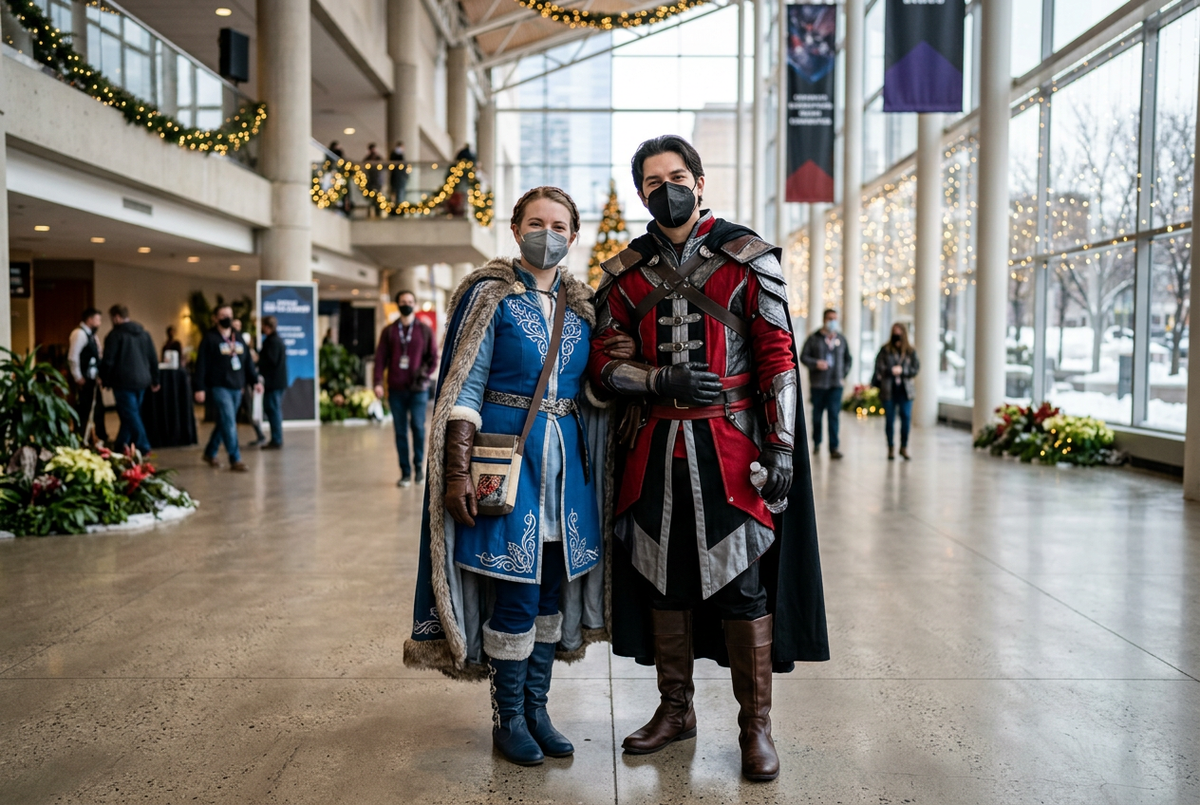
Introduction: Prepare for Convention Season Without Bringing an Illness Home
December is an exciting month for cosplay enthusiasts, with major events such as Anime Frontier taking place December 4–6, 2026, and Holiday Matsuri scheduled for December 18–20. But several days of crowded indoor activities, travel, shared facilities, and social gatherings can also create opportunities for respiratory illnesses to spread.
The term con crud is commonly used by convention communities to describe feeling sick after attending an event. It is not a medical diagnosis or the name of one specific virus. Symptoms may be associated with different respiratory infections, including common colds, influenza, and COVID-19. Gastrointestinal illnesses can also occur in group settings, although they have different transmission routes.
The goal is not to eliminate every possible risk. It is to prepare intelligently, reduce avoidable exposure, and give yourself enough time to recover after a demanding convention weekend.
What you should prepare before attending:
-
A well-fitting mask or respirator appropriate for extended wear.
-
Hand sanitizer containing at least 60% alcohol.
-
Tissues and a small personal hygiene kit.
-
A plan for cleaning shared cosplay props and accessories.
-
Appropriate seasonal vaccinations, based on your healthcare provider's advice.
-
A flexible travel and work schedule that allows you to rest after the event.
This guide uses CDC public health recommendations, convention-specific policies, and peer-reviewed research to explain how to prepare before, during, and after a winter cosplay convention.
Step 1: Prepare Your Health and Convention Essentials Before You Travel
The most effective convention health plan starts before you arrive. Once you are surrounded by thousands of attendees, your opportunities to change your environment or avoid crowded situations become more limited.
Check Your Vaccination Status Before the Convention
Seasonal vaccination is one of the CDC's core strategies for reducing the risk of serious respiratory illness.
For the 2026–2027 influenza season, CDC guidance states that influenza vaccination should continue to be offered during the season while influenza viruses are circulating and an appropriate vaccine is available. For most people who need one dose, September or October is the preferred timing, although vaccination after October can still be appropriate.
Vaccination does not guarantee that you will not become infected. Its purpose is to reduce the risk of influenza illness and its complications.
If you are attending several winter conventions, consider discussing seasonal influenza and COVID-19 vaccination with a qualified healthcare professional before traveling. Recommendations can depend on age, health conditions, previous vaccination, and individual circumstances.
Check the Convention's Official Health Policy
Never assume that every anime convention has the same mask or health requirements.
For example, Arisia 2026, held January 16–19, 2026, required attendees to wear masks without exhalation valves in convention spaces. Its policy specified a minimum medical mask and strongly encouraged N95, KN95, KF94, or FFP2 protection.
The policy also asked people who became sick during the week before the convention to stay home, with registration rollover available for affected attendees.
This is a useful example of how an organizer can establish a specific community health policy. However, Arisia's rules should not be applied to other events.
For December 2026, Anime Frontier's official policy page provides its event rules and conduct information, while Holiday Matsuri's policy page includes general health and safety recommendations such as handwashing, hydration, and considering masks in crowded areas.
Check the latest versions of these pages before departure because organizers can update their requirements.
Pre-convention checklist:
-
Read the event's current health and safety policy.
-
Check whether masks are required, recommended, or optional.
-
Find out whether the organizer offers registration transfers or refunds if you become sick.
-
Review the event's first-aid arrangements.
-
Check the latest travel and local public health information.
-
Avoid attending if you are sick or have symptoms that make you potentially contagious.
Pack a Small Convention Health Kit
A compact health kit is easier to carry than a large collection of supplies, especially when wearing a complicated cosplay.
| Item | Purpose |
|---|---|
| Well-fitting mask or respirator | Additional protection in crowded indoor spaces |
| Hand sanitizer (at least 60% alcohol) | Hand hygiene when soap and water are unavailable |
| Tissues | Cough and sneeze hygiene |
| Personal water bottle | Convenient access to drinking water |
| Personal medication | Access to medications you normally use, as appropriate |
| Small cleaning cloth | Removing visible dirt from compatible props and accessories |
| Spare mask | Replacing a mask that becomes wet, damaged, or dirty |
Keep essential items in an accessible pocket or convention bag rather than storing everything inside a large cosplay case.
Step 2: Reduce Exposure During the Convention
A convention combines several environments: crowded exhibit halls, panel rooms, queues, hotel elevators, restaurants, photo areas, and social gatherings.
Your risk is not identical in every location. A crowded indoor room with limited airflow presents a different situation from an outdoor cosplay photoshoot.
The CDC identifies cleaner air, hygiene, and appropriate mask use as important strategies for reducing respiratory illness risks.
Wear a Well-Fitting Mask in Crowded Indoor Spaces
Masking is an additional prevention strategy that can be particularly useful in crowded indoor settings or when respiratory viruses are circulating widely in the community.
The CDC recommends choosing the most protective mask you can comfortably wear for extended periods and ensuring that it fits well over both the nose and mouth.
For cosplay enthusiasts, this creates an important distinction between a costume mask and a protective mask.
A decorative face covering may complete a character's appearance, but it should not automatically be treated as respiratory protection.
Practical cosplay mask considerations:
-
Choose a well-fitting protective mask or respirator.
-
Ensure it covers your nose and mouth.
-
Avoid modifying its filtering material to accommodate costume decorations.
-
Do not assume that a decorative mask, mesh face covering, or loose costume accessory offers equivalent protection.
-
If your costume includes a helmet or face covering, make sure the complete setup remains comfortable and does not interfere with safe breathing or vision.
A useful solution is to coordinate the protective mask with the costume's color palette or visual design, rather than sacrificing fit for appearance.
For example, a dark respirator may be easier to integrate into certain sci-fi or armored character designs. A neutral-colored mask can also work with many everyday cosplay looks.
The key is to prioritize fit and protective performance.
Pay Attention to Indoor Air and Crowd Density
Respiratory viruses can spread through the air, particularly in crowded indoor environments with insufficient airflow.
The CDC's cleaner-air guidance recommends increasing fresh-air ventilation, using effective air filtration where appropriate, and moving activities outdoors when possible.
For attendees, this translates into several practical decisions:
-
Avoid spending unnecessary time in extremely crowded areas.
-
Take breaks in less crowded or outdoor spaces when available.
-
Consider stepping outside between long panel sessions.
-
Avoid prolonged close conversations in congested indoor areas.
-
Choose less crowded dining locations when possible.
Attendees generally cannot control a convention center's HVAC system. However, they can make choices about how long they spend in crowded spaces and when to take breaks.
A CDC investigation published in 2022 provides a particularly relevant example. It examined a large indoor convention in New York City attended by approximately 53,000 people in November 2021.
The venue had HEPA filtration, and attendees were required to wear masks indoors and provide evidence of at least one COVID-19 vaccine dose. Among 4,560 attendees with available test results, 119 tested positive. The investigation did not identify evidence of widespread transmission during the event.
The researchers emphasized that multiple prevention measures, including vaccination, consistent masking, improved ventilation, and testing, can help limit transmission at large indoor events.
This was an investigation of one particular event during a specific phase of the pandemic. It is not a guarantee that every convention with similar measures will have the same outcome.
Practice Hand Hygiene Between Activities
Convention attendees frequently touch shared surfaces and equipment:
-
Registration counters.
-
Escalator and elevator buttons.
-
Restaurant tables.
-
Photography equipment.
-
Shared gaming equipment.
-
Convention props and display items.
The CDC recommends washing hands regularly, covering coughs and sneezes, and cleaning frequently touched surfaces.
Wash your hands with soap and water when available, especially before eating and after using the restroom.
If soap and water are unavailable, use hand sanitizer containing at least 60% alcohol.
Avoid touching your eyes, nose, and mouth with unwashed hands. This is particularly relevant after handling shared objects or equipment.
Clean Shared Cosplay Props Without Damaging Them
Cosplay props deserve attention because they are frequently handled, passed between people, and used during photographs.
However, it is important to understand the difference between surface hygiene and respiratory protection.
Research on respiratory virus transmission shows that airborne transmission is important for many respiratory viruses. Surface cleaning can help reduce contact-related exposure, but it should not replace ventilation, masking, or staying home when sick.
For cosplay props, use a material-compatible cleaning method.
| Prop material | Practical cleaning approach |
|---|---|
| Sealed plastic | Wipe with a compatible household cleaner |
| Acrylic accessories | Use a soft cloth and an appropriate non-abrasive cleaner |
| EVA foam | Use a lightly damp cloth when compatible with the surface finish |
| Fabric accessories | Follow the manufacturer's washing or care instructions |
| Painted props | Test a small hidden area before applying any cleaner |
Do not soak electronic props, foam accessories, or delicate painted surfaces unless their manufacturer specifically permits it.
For shared props, clean frequently handled areas between users when appropriate. Avoid sharing personal makeup, lip products, drinking containers, or items that come into direct contact with the face.
A well-maintained cosplay prop is not only more presentable but also easier to share responsibly.
Step 3: Plan Your Post-Con Recovery Day
A convention weekend can involve several consecutive days of walking, standing, traveling, photographing, and socializing.
It is easy to underestimate the physical demands of an event, particularly when you are wearing a heavy costume or carrying props.
A recovery day is a practical scheduling decision, not a medical requirement or a guarantee that you will avoid illness.
Leave a Buffer Between the Convention and Your Next Workday
If possible, avoid scheduling your most demanding work or travel commitments immediately after returning home.
For example, if a convention ends on Sunday, returning to work on Tuesday may give you more flexibility than immediately scheduling an important Monday morning meeting.
A recovery buffer can help you:
-
Get adequate sleep after several busy days.
-
Rehydrate and return to your usual eating routine.
-
Clean and store your costume.
-
Organize photographs and convention purchases.
-
Monitor how you feel before returning to a demanding schedule.
This is especially useful when attending multiple events in December.
However, rest should not be confused with a medical quarantine period. The appropriate response depends on whether you develop symptoms, have a known exposure, or receive a positive test result.
Monitor Symptoms After Returning Home
Pay attention to how you feel during the days following a convention.
Possible respiratory illness symptoms include:
-
Cough.
-
Sore throat.
-
Runny or congested nose.
-
Fever or chills.
-
Fatigue.
-
Headache.
-
Muscle or body aches.
Some infections can be transmitted before symptoms appear. The CDC's January 2026 influenza guidance notes that adults with influenza may shed the virus beginning approximately one day before symptoms develop and for around five to seven days after illness begins.
This is one reason it is important not to assume that feeling well during the convention means there is no possibility of infection.
If you develop symptoms, consider testing when appropriate and follow current public health advice. COVID-19 and influenza can have overlapping symptoms, so symptoms alone cannot reliably identify the cause.
What Should You Do If You Become Sick After an Anime Convention?
The CDC's August 2025 respiratory virus guidance recommends staying home and away from others when experiencing respiratory symptoms that are not better explained by another cause.
You can generally return to normal activities when both of the following conditions have been met for at least 24 hours:
-
Your symptoms are improving overall.
-
You have not had a fever and are not using fever-reducing medication.
After returning to normal activities, the CDC recommends taking additional precautions for the next five days. These can include wearing a well-fitting mask, improving indoor air quality, practicing good hygiene, maintaining distance, and considering testing when around other people.
If symptoms return or you develop a fever again, stay home and away from others.
Seek prompt medical advice if you are at higher risk of severe illness, since some respiratory infections have treatments that work best when started early.
Important: Seek emergency medical care immediately if you experience warning signs such as difficulty breathing or chest pain. Do not rely on a convention recovery checklist to manage serious symptoms.
A Simple Post-Con Schedule
| Time | Suggested action |
|---|---|
| First day home | Rest, hydrate, unpack essential belongings, and monitor symptoms |
| Following days | Return to normal activities only when appropriate and continue precautions if recovering |
| If symptoms appear | Stay home, assess symptoms, consider appropriate testing, and seek medical advice when needed |
| If symptoms become severe | Seek urgent or emergency medical care as appropriate |
Troubleshooting: Common Winter Convention Health Mistakes
Mistake 1: Assuming a Costume Mask Provides Enough Protection
A decorative mask may have openings, loose edges, or materials that are not designed to filter inhaled air.
Better approach: Use a well-fitting protective mask or respirator. Treat decorative face coverings as costume components, not substitutes for respiratory protection.
Mistake 2: Thinking Hand Sanitizer Alone Prevents Every Infection
Hand sanitizer is useful for hand hygiene, but it does not replace ventilation, masking, vaccination, or staying home when sick.
Better approach: Use multiple prevention measures rather than relying on one product.
Mistake 3: Focusing Only on Cleaning Props
Cleaning a shared prop is sensible, but it does not remove respiratory particles from crowded indoor air.
Better approach: Prioritize clean air, appropriate masking, and hand hygiene. Clean shared props as an additional measure.
Mistake 4: Attending a Convention While Feeling Sick
Some attendees may be tempted to attend because they have already paid for travel, tickets, or accommodation.
However, attending while infectious can expose other participants, including people who may be at higher risk of severe illness.
Better approach: Read the event's cancellation and registration-transfer policies before traveling. If you become sick, follow public health guidance and contact the organizer about available options.
Mistake 5: Scheduling Important Work Immediately After a Convention
Long convention days and travel can leave attendees exhausted.
Better approach: When practical, leave a recovery buffer before major deadlines, important meetings, or another long-distance trip.
Mistake 6: Assuming Every Convention Has the Same Health Rules
Arisia's 2026 mask requirements were more specific than the general health guidance published by some other conventions.
Better approach: Check each event's official health policy before departure, even if you attended the same event in a previous year.
Conclusion: Enjoy Winter Cosplay Season While Looking After Yourself and Others
Winter conventions are an important part of cosplay culture, bringing together fans, artists, photographers, and creators from different communities.
But a successful convention experience should not end with an avoidable illness spreading through your household, workplace, or social circle.
The most practical approach is to prepare before traveling, reduce exposure during crowded indoor activities, maintain basic hygiene, and leave enough time to recover after the event.
The research and public health guidance support a layered approach: vaccination where appropriate, cleaner air, well-fitting masks, hand hygiene, and staying home when sick.
There is no single product or trick that can guarantee you will avoid con crud. A protective mask cannot replace clean air, prop cleaning cannot replace respiratory precautions, and a recovery day cannot prevent an infection that has already occurred.
What you can do is make informed decisions, respect each convention's health policy, and avoid attending when you may expose others to illness.
A great cosplay weekend should leave you with photographs, new friendships, and creative inspiration—not an unnecessary health problem.

Dejar un comentario
Este sitio está protegido por hCaptcha y se aplican la Política de privacidad de hCaptcha y los Términos del servicio.