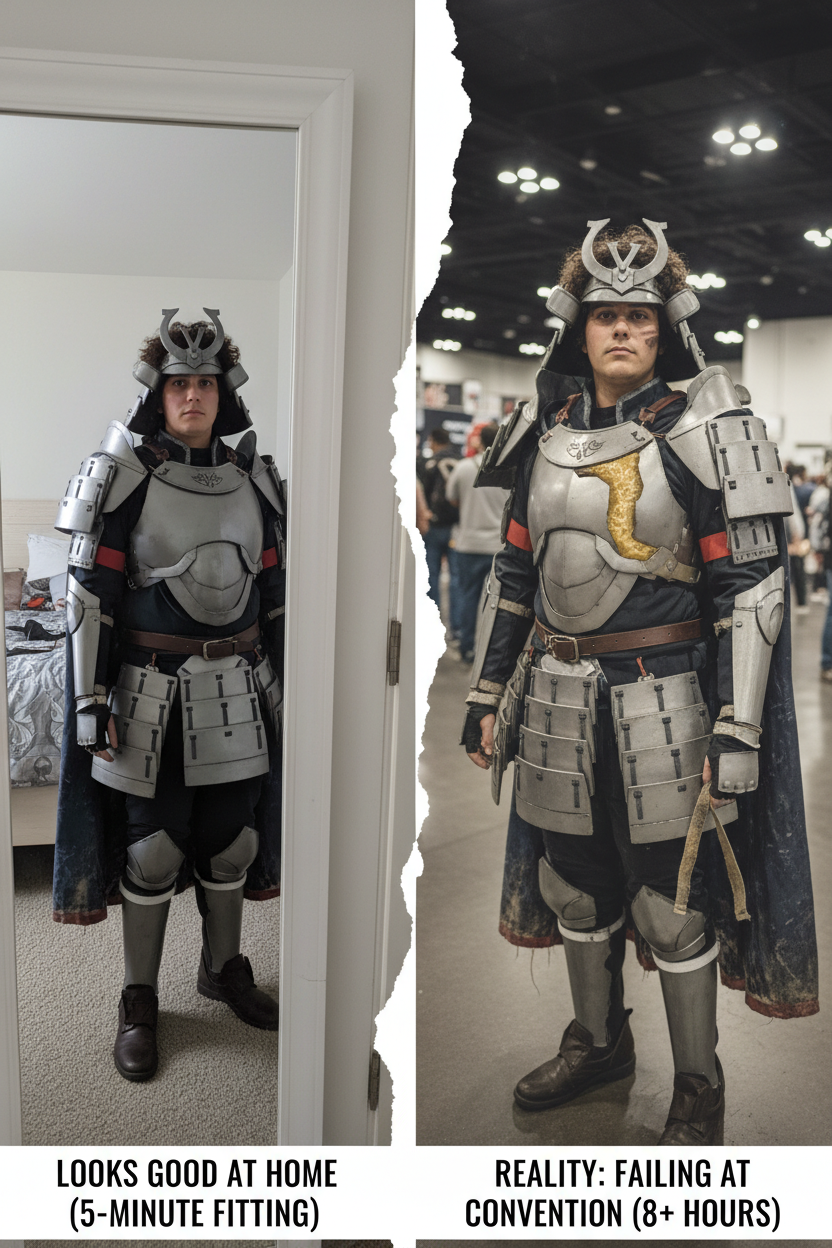
TL;DR: A costume that looks perfect in front of a mirror at home can fall apart within hours at an actual convention — glue softens from body heat, straps loosen, Velcro gives out, and pieces that never touched each other in a quick fitting start colliding once you're actually moving, sitting, and walking for hours. Con-proof cosplay isn't about better materials alone — it's about actually test-wearing the full costume the way you'll really use it: walking, sitting, using the bathroom, and moving around for an extended stretch, not just checking your reflection for five minutes.
Why This Keeps Happening: The Gap Between "Looks Good" and "Works in Real Life"
Cosplayers consistently describe the same frustrating pattern in community discussions: a costume tried on at home feels completely fine, but the same outfit starts failing within the first few hours of an actual event — adhesive points loosening as body temperature rises, hook-and-loop closures giving way under repeated movement, straps that felt secure standing still slipping once the wearer actually walks and bends. Some cosplayers have described this failure cascading badly enough mid-event that they've reconsidered whether to compete in a costume contest at all, simply because the piece stopped holding together the way it did during a brief home fitting.
The underlying reason is straightforward once you name it: a home mirror check and a convention day are testing completely different things. A mirror check tests appearance for a few motionless minutes. A convention day tests durability, mobility, and comfort across many hours of continuous, varied physical activity — and those are fundamentally different stress conditions that a costume can pass one of while failing the other entirely.
Body heat changes how adhesives behave. Glue, tape, and adhesive-based construction methods are usually applied and checked at room temperature, in a controlled environment, for a short period. Once you're actually wearing the piece for hours — especially anywhere warm, or under layered costume pieces that trap heat against skin — adhesives can soften, shift, or fail entirely in ways they never would during a brief test at home.
Static posing hides mobility problems that walking reveals immediately. A costume that looks flawless standing straight for a photo can restrict your stride, dig into your skin when you bend your knees, or pull awkwardly across the shoulders the moment you actually walk any real distance. These are exactly the kinds of problems a five-minute mirror check will never surface, because standing still simply doesn't stress the costume the same way walking does.
Sitting down is an entirely different physical test than standing. Conventions involve a huge amount of sitting — panels, meals, resting between photo sessions — and a costume that fits perfectly standing can become genuinely uncomfortable or even damaged when you sit, especially anything with rigid armor pieces, a fitted waistline, or props that weren't designed with a seated position in mind.
Bathroom access is a genuinely underrated design failure point. This is one of the most practical, least glamorous problems in cosplay, and it's exactly the kind of thing that only becomes obvious once you actually need to use a restroom in full costume — elaborate layering, structural pieces, or anything requiring assistance to remove and reassemble can turn a two-minute bathroom break into a genuine ordeal if it wasn't planned for in advance.
A single day's worth of wear reveals cumulative fatigue problems a quick try-on can't. Shoes that feel fine for ten minutes can become genuinely painful after six hours of walking. A wig that sits comfortably at first can start creating real scalp discomfort by the afternoon. None of these problems show up in a brief fitting — they only emerge with sustained, real-world wear time.
This is exactly the logic behind the community advice to actually wear your cosplay before the event itself, rather than relying on a quick mirror check: walk in it, sit down in it, use a restroom in it, and stay in it for a meaningful stretch of time, ideally while wearing the actual shoes you plan to wear on the day. Cosplay looks good is a completely different claim from cosplay works in real life, and the only way to know which one you actually have is to test it under real conditions before you're relying on it for a full con day.
Key Elements: The Seven Tests Every Costume Should Pass
Building a genuine cosplay mobility test routine means running your costume through the specific physical conditions it will actually face at an event, not just checking how it looks. Here's what each test is actually checking for.
The Walking Test
Put on the full costume, including shoes, and walk continuously for at least 15–20 minutes — not just across a room, but enough distance to reveal chafing points, straps that slip with repeated motion, and any part of the silhouette that restricts your natural stride. Pay attention to anywhere fabric or armor rubs with each step; a minor irritation at minute five can become a genuine problem by hour four of an actual event.
The Sitting Test
Sit down fully — in a chair, ideally the kind of chair you'll actually be using at panels or meals — and stay seated for several minutes. Check whether any rigid pieces dig in, whether a fitted waistline becomes uncomfortable, and whether props or accessories get in the way or shift out of position. If your costume includes a cape, tail, or any trailing element, sitting is also where you'll discover whether it gets trapped or crushed awkwardly.
The Bathroom Test
This is the test most beginners skip and most experienced cosplayers insist on. Actually use a restroom in your full costume before the event, start to finish, and time how long it realistically takes. If it's genuinely difficult or requires help, that's critical information to know in advance — you can plan around it (extra time built into your schedule, a friend on standby to help) rather than discovering the problem for the first time in an unfamiliar convention center restroom.
The Shoe Test
Wear your actual convention shoes for a real walking test, not a substitute pair. Costume shoes are often chosen for appearance over comfort, and a pair that feels fine for a quick photo can become genuinely painful across a full day of standing and walking. If your shoes aren't broken in, this test also reveals that — better to find out at home than three hours into a con day.
The Adhesive Test
If your costume relies on glue, tape, or spirit gum for any element — wig security, prosthetics, costume pieces held in place with adhesive rather than mechanical fasteners — test that adhesive under conditions closer to actual wear: worn for an extended period, ideally while physically active, and in a warm environment if possible. An adhesive that holds perfectly for a static ten-minute test can behave completely differently after two hours of movement and body heat.
The Mobility Test
Beyond simple walking, actually move through the range of motion your costume needs to support: raising your arms for photos, turning your head if you're wearing a mask or hood, bending to pick something up, turning around. This catches restriction problems in shoulders, necklines, and armor joints that a simple walk won't necessarily reveal.
The Full-Day Cosplay Test
For any costume you're genuinely worried about, or anything you're planning to wear at a major event, the most reliable test is simply wearing it for as close to a full day as you reasonably can before the actual convention — ideally combining all of the above tests into one extended session. This is the single best predictor of how the costume will actually perform, because it's the only test condition that matches real convention wear time rather than a short sample of it.
Common Mistakes & Things to Watch Out For
Testing the costume only in isolation, piece by piece, rather than as a full assembled outfit. A jacket might move fine on its own and a prop might handle fine in your hand separately, but problems often only appear when multiple pieces interact — a prop that catches on a cape, an accessory that shifts differently once the full weight of the costume is distributed. Test the complete, fully assembled look, not individual components tested separately.
Skipping the shoe test because "shoes are shoes." Costume footwear is frequently different from what you wear day to day — platform soles, unfamiliar heel heights, or boots that look right but were never actually broken in. Treat shoes as part of the costume test, not an afterthought.
Assuming a successful five-minute try-on means the costume is convention-ready. This is the core misconception this entire guide addresses — a brief home fitting and a full day of convention wear are testing fundamentally different things, and passing one tells you very little about whether you'll pass the other.
Not testing in conditions similar to the actual event. If your convention will be warm, humid, or involve a lot of outdoor walking, testing your costume in a cool, still living room won't reveal how adhesives, fabric, and your own comfort will hold up under those specific conditions. Match your test conditions to your actual event conditions as closely as is practical.
Waiting until the week of the convention to test-wear for the first time. If a full-day test reveals a real problem — a strap that needs restructuring, an adhesive that clearly won't hold, shoes that are genuinely too uncomfortable — you need enough time left to actually fix it. Test-wearing at least a few weeks before your event, not the night before, gives you room to address whatever the test reveals.
Summary and Further Reading
The gap between a costume that looks great and a costume that actually works comes down almost entirely to testing conditions — a quick mirror check simply can't reveal what hours of walking, sitting, bathroom breaks, and body heat will do to adhesives, straps, and fit. Running your costume through a real walking test, sitting test, bathroom test, shoe test, and ideally a full-day test before your event is the most reliable way to catch problems while you still have time to fix them, rather than discovering them for the first time in the middle of a convention.
Related reading you might find useful next:
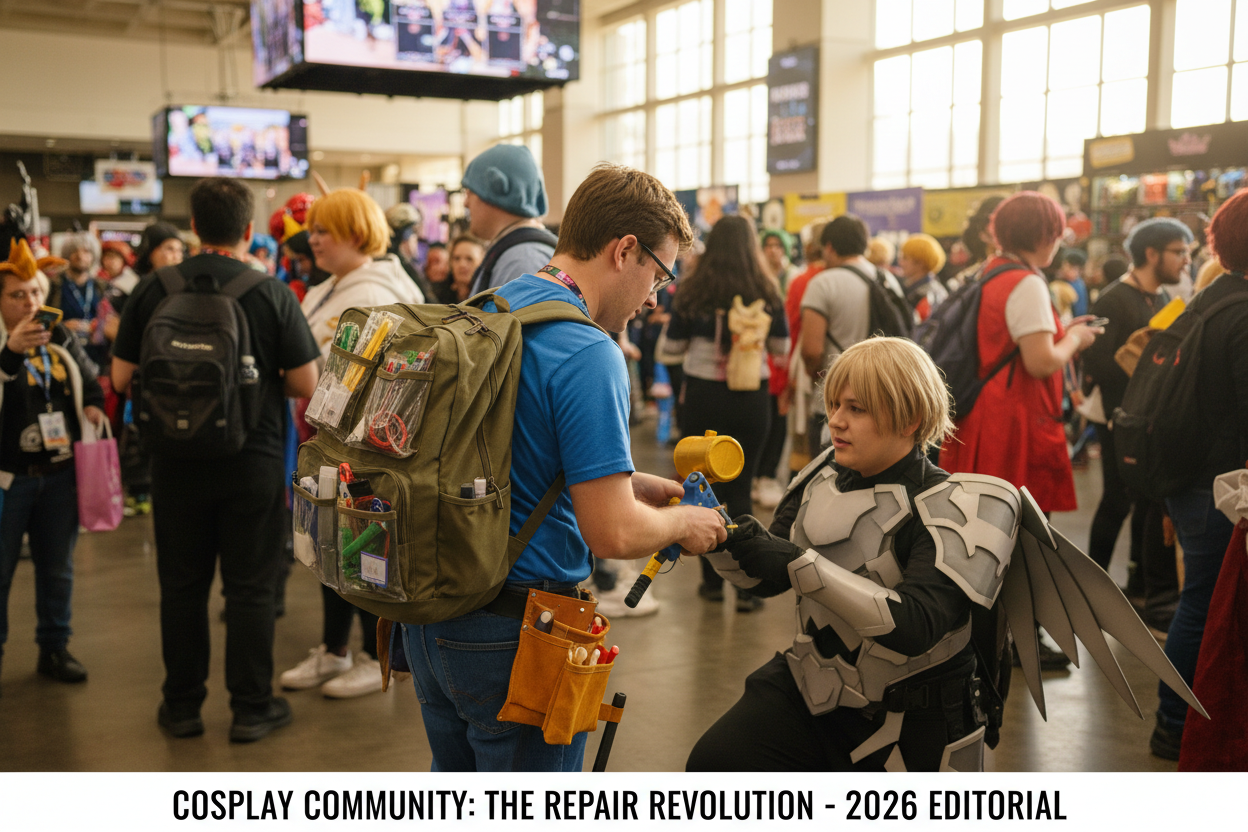
- A guide to building a convention repair kit, for the failures that slip through even after thorough test-wearing
- A comparison of fashion tape and wig tape for preventing the specific adhesive and slippage failures this guide covers
- A full convention-day survival guide covering what else to plan for beyond the costume itself


Dejar un comentario
Este sitio está protegido por hCaptcha y se aplican la Política de privacidad de hCaptcha y los Términos del servicio.