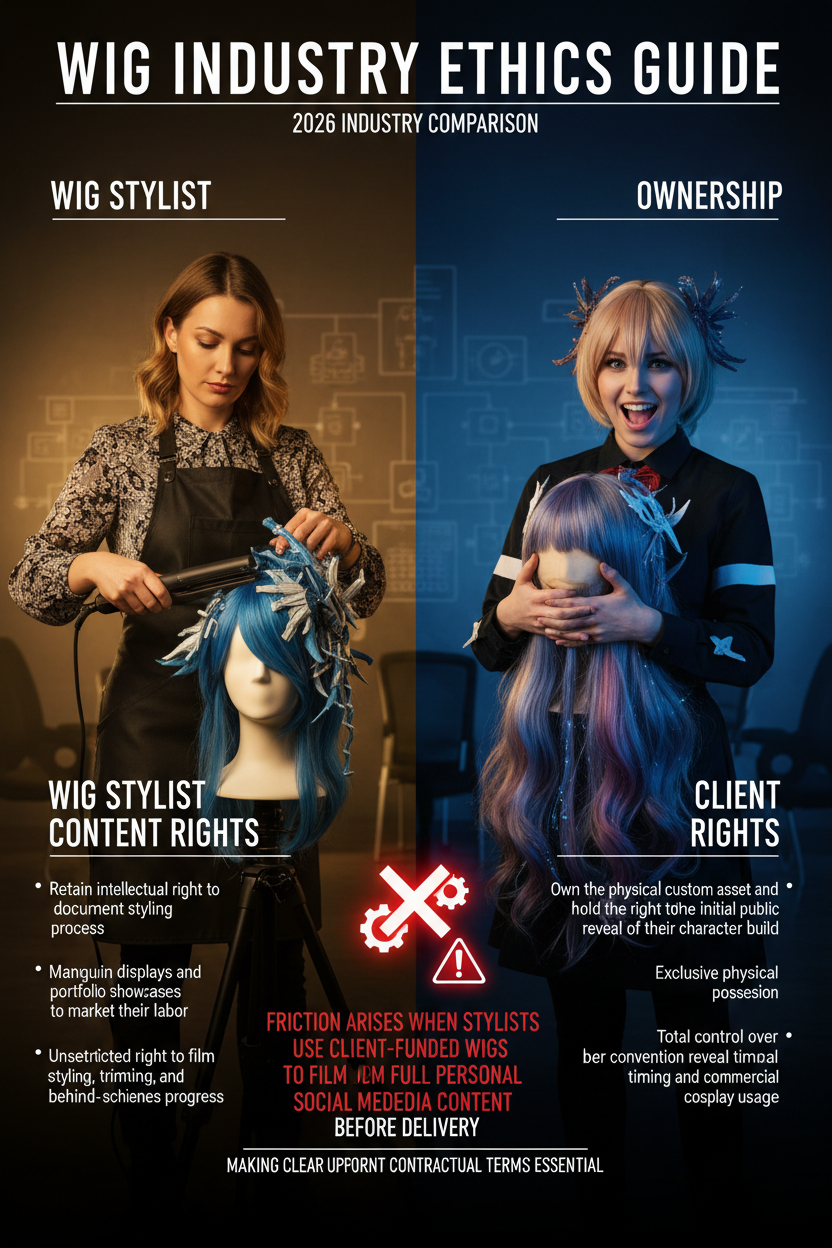
Verdict: Wig stylists retain the intellectual right to document their styling process, mannequin displays, and portfolio showcases to market their labor. Clients own the physical custom asset and hold the right to dictate the initial public reveal of their character build. Friction arises in the wig commission industry when stylists use client-funded wigs to film full personal social media content before delivery, making clear upfront contractual terms essential for both parties.
Core Rights & Expectations Comparison Table
| Rights Category | Wig Stylist Content Priority | Client Ownership Priority |
| Process Documentation (WIP) | Unrestricted right to film styling, trimming, and behind-the-scenes progress | Right to request a "spoiler blackout" until an official convention debut date |
| On-Head Fitting Checks | Permitted strictly on mannequin heads or briefly on-person for physical fit verification | Strict restriction against stylists modeling the wig in full-makeup personal entertainment videos |
| Social Media Attribution | Guaranteed mandatory creator tagging across all client cosplay posts | Full ownership of modeling photography, character performance, and final costume presentation |
| Portfolio & Marketing | Right to list styled photos in order catalogs for future cosplay wig commission services | Exclusive physical possession and total control over commercial cosplay usage |
Dimension 1 Comparison: Content Creation Boundaries & Fitting Checks
The boundary between quality control and unauthorized content creation is the primary catalyst for any cosplay commission credit dispute.
-
Stylist Workflow Needs: Custom styling requires testing hairline placement, bang drop, and heavy gravity-defying spikes on a human head or foam mannequin to ensure stability during transit and wear.
-
Client Boundaries: Tension builds when a stylist moves beyond a technical fitting check and wears the client's paid, custom piece in full-makeup TikToks, lip-syncs, or personal vlogs prior to shipping. This practice can feel like an unauthorized personal driver using a custom car before handover.
Dimension 2 Comparison: Promotional Credit & Tagging Expectations
Navigating wig maker vs client rights requires balancing artistic promotion with client narrative control over their character debut.
-
Stylist Portfolio Visibility: Hair stylists rely on video transformations to prove their craftsmanship and attract new business. Restricting a maker from sharing work behind-the-scenes limits their ability to maintain a viable creative business in the wig commission industry.
-
Client Reveal Control: Cosplayers invest heavily in full costume debuts for specific conventions or photo shoots. Early, unannounced posts by a stylist can diminish the impact of a cosplayer's planned reveal, highlighting the need for clear agreement on who owns cosplay wig commission content exposure timelines.
Dimension 3 Comparison: Commercial vs. Non-Commercial Usage Rights
Establishing clear cosplay creator rights depends on separating intellectual service labor from the physical commodity.
                   [ COMMISSION RIGHTS DISTRIBUTION ]
                                   │
     ┌─────────────────────────────┼─────────────────────────────┐
     ▼                             ▼                             ▼
1. Stylist Retains            2. Shared Space              3. Client Retains
- Styling technique IP        - Co-tagged debut posts      - Physical possession
- Process tutorial videos     - Portfolio cross-links      - Final performance rights
- Catalog display photos                                   - Convention reveal timing
-
Intellectual Property of Styling: The labor, crimping techniques, and structural foam work belong creatively to the artist who built them.
-
Physical Asset Rights: Once payment settles, the physical wig belongs entirely to the client. Stylists cannot hold physical assets hostage for content creation, nor can clients claim the stylist's original technique as their own unassisted handiwork.
When Should You Choose a Stylist-Prioritized Content Agreement?
Choose a stylist-prioritized model when commissioning heavily discounted sample wigs, entering promotional sponsorship deals, or participating in tutorial builds.
In this framework, the client receives a lower labor rate or priority slot in exchange for allowing the stylist full freedom to film transformation videos, stream the styling process, and publish detailed tutorials on their personal channels before shipping the wig.
When Should You Choose a Client-Exclusivity Agreement?
Choose a client-exclusivity framework when preparing competitive cosplay builds, secret convention debuts, or high-budget commercial shoots.
Under full exclusivity, the client pays standard or premium market rates for cosplay wig commissions and specifies non-disclosure terms. The stylist agrees to withhold all photos, mannequin videos, and process posts until the client completes their official event reveal, ensuring the commissioner retains total control over their project's public debut.
Establishing clear, written terms prior to sending a deposit protects both stylists and creators from misunderstandings over wig commission content rights. Setting clear boundaries upfront ensures that artistic labor is properly credited while client investments remain respected.
To explore similar debates surrounding creator labor, attribution, and digital assets in the maker community, read our analysis on The Intellectual Property and Craft Debate in 3D-Printed Cosplay Props.

Dejar un comentario
Este sitio está protegido por hCaptcha y se aplican la Política de privacidad de hCaptcha y los Términos del servicio.