Introduction
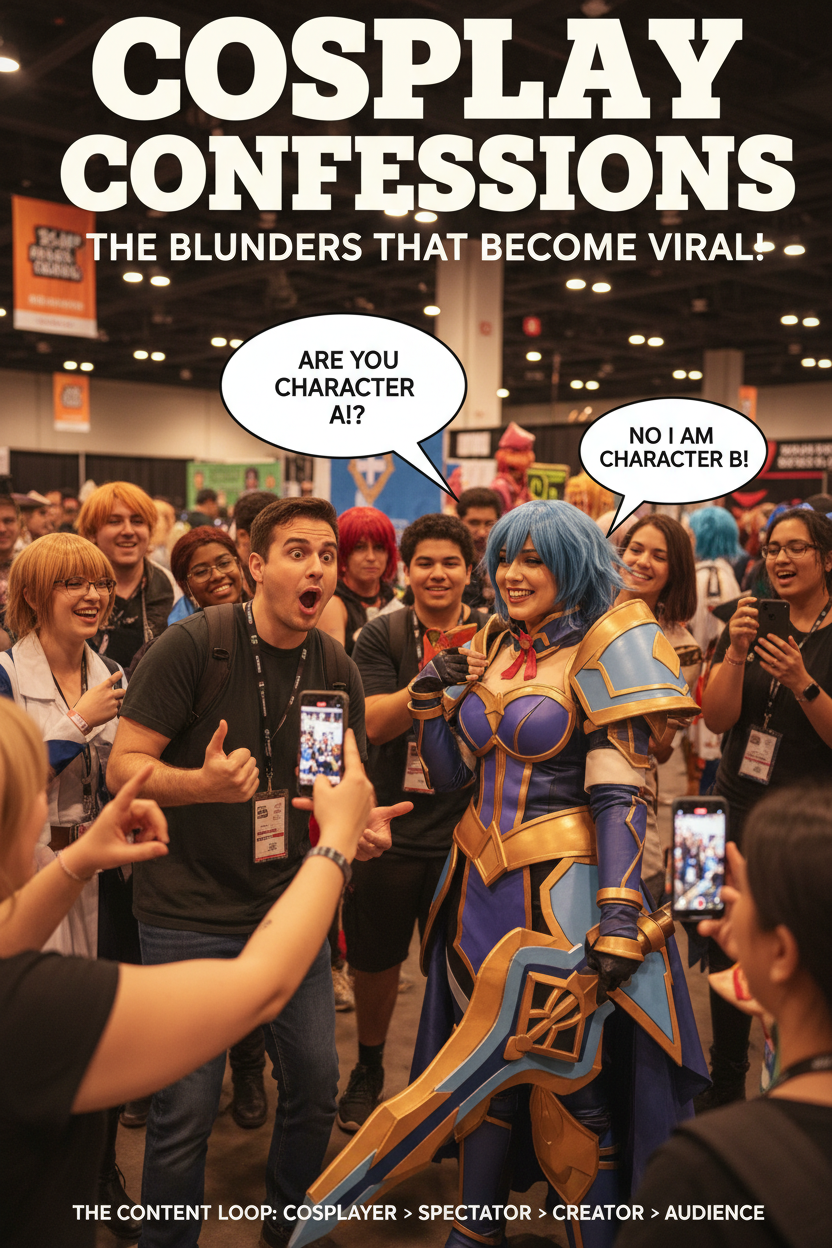
Not every memorable cosplay convention interaction starts with a perfectly recognizable costume.
Sometimes, the funniest moment happens when someone confidently walks up to a cosplayer and says:
“Are you… this character?”
And gets it completely wrong.
That simple interaction has increasingly become content in its own right.
A real-world example is the TikTok format “Mistaken Cosplays at Lvl Up Expo: Hilarious Moments!”, which captures creators incorrectly identifying cosplayers at a convention and turning those moments into short-form entertainment.
The interesting part isn't simply that people make mistakes.
It is that the mistake itself becomes the story.
This creates a new type of convention content positioned somewhere between cosplay photography, street interviews, fandom humor and spectator culture.
Instead of:
Coser → creates costume → audience watches
the format becomes:
Coser → spectator guesses → mistake → reaction → video → audience participates
For cosplay content creators, this creates an inexpensive and highly repeatable content format.
Table of Contents
- What Is Mistaken Cosplay?
- Why Cosplay Character Mix-Ups Work So Well
- How to Create Mistaken Cosplay Convention Content
- Advanced Strategies for Better Convention Videos
- Common Mistakes and Ethical Considerations
- Tools and Resources for Convention Creators
- FAQ
- Conclusion
Chapter 1: What Is Mistaken Cosplay?
What Does “Mistaken Cosplay” Mean?
Mistaken cosplay refers to convention content where a cosplayer is incorrectly identified as another character, usually producing a humorous or unexpected interaction.
The format can take several forms.
Format 1: Direct Character Mix-Up
A creator approaches a cosplayer:
“Are you Character A?”
The cosplayer is actually Character B.
The reaction becomes the content.
Format 2: Audience Guessing
The creator shows a cosplayer to viewers and asks:
“Who do you think this is?”
The audience guesses.
The reveal comes afterward.
Format 3: Deliberate Misidentification
The creator intentionally gives a funny wrong answer to create an interaction.
This can work, but it needs more care because the joke should be collaborative rather than making the cosplayer feel embarrassed.
Format 4: Costume Confusion
Two characters share:
- Similar colors
- Similar wigs
- Similar clothing
- Similar props
- Similar visual aesthetics
The resulting confusion becomes the story.
Why Is Mistaken Cosplay Becoming Convention Content?
The format works because it combines several things social media algorithms tend to reward:
Recognition → uncertainty → interaction → reaction → payoff
A normal convention photograph may communicate:
“Here is a great cosplay.”
A mistaken-cosplay video creates a question:
“Wait… who is this?”
That question gives viewers a reason to continue watching.
The audience wants to discover whether the creator was correct.
That makes cosplay convention videos naturally suited to short-form platforms.
Why Cosplay Character Mix-Ups Are Funny
The Recognition Gap
A cosplay character mix-up usually happens because the viewer recognizes some elements of a costume but doesn't have enough information to identify the exact character.
For example:
White wig + blue outfit
could immediately remind someone of several characters.
Likewise:
Black coat + red accents
might trigger several possible associations.
This creates what we can call the recognition gap:
The viewer recognizes the visual category but not the specific character.
That gap is exactly where the humor comes from.
Chapter 2: The Core Strategy Behind Mistaken Cosplay Content
Step 1: Find High-Recognition Convention Areas
The first step isn't finding a specific cosplayer.
It's finding the right environment.
Good locations include:
- Main convention floors
- Cosplay gathering areas
- Photography areas
- Convention entrances
- Popular photo backdrops
- Character meetups
- High-traffic fan areas
These locations naturally contain people who are already prepared to interact with other fans.
Step 2: Look for Visually Ambiguous Cosplay
Ironically, the best mistaken cosplay subject isn't always the most obscure character.
You want costumes that create an immediate visual association.
Look for:
- Similar character designs
- Shared color palettes
- Popular archetypes
- Cross-IP visual similarities
- Generic fantasy outfits
- School uniforms
- Similar wigs
- Recognizable props
For example, two characters may both use:
Long white hair + black clothing + red accessory.
A casual spectator may immediately assume the wrong character.
That's a natural setup for the format.
Step 3: Make the Question Simple
The best convention interaction questions are short.
Instead of asking:
“Can you explain your costume, character background and why you chose this specific version?”
try:
“Who are you cosplaying?”
Or:
“Can I guess your character?”
Or:
“Everyone in our comments keeps getting this character wrong. Who are you?”
Simple questions make the interaction feel spontaneous.
Step 4: Capture the Reveal
The most important part of the video is often not the mistake.
It's the correction.
For example:
Creator:
“Are you Character A?”
Cosplayer:
“No, I'm Character B.”
Creator:
“Oh my God.”
That final reaction creates the payoff.
Without the reveal, the audience doesn't get closure.
Step 5: Let the Cosplayer Have the Last Word
This is particularly important for cosplay convention interactions.
The cosplayer should be part of the joke.
After the reveal, ask something like:
“What gave it away?”
or:
“How many people have mistaken you for that character today?”
Now the mistake becomes a conversation.
You're no longer laughing at the cosplayer.
You're creating a moment with them.
Chapter 3: Advanced Mistaken Cosplay Content Strategies
1. Turn One Interaction Into a Series
The biggest opportunity isn't one funny video.
It's creating a repeatable format.
For example:
Series Name
“How Many Cosplayers Can I Get Wrong?”
Episode 1:
Convention A
Episode 2:
Convention B
Episode 3:
Anime convention
Episode 4:
Gaming convention
The format becomes recognizable.
This is valuable for cosplay content creators because you don't need to invent a completely new concept for every convention.
2. Use the Audience as the Judge
Instead of revealing the answer immediately, let viewers participate.
For example:
“I thought this was Character A. Was I right?”
Then reveal the answer.
Or:
“Which character did you think this was?”
This transforms passive viewers into participants.
It also creates natural comments:
“How did you not know that was Character B?”
“I thought the same thing!”
“The wig should have given it away.”
Those comments are part of the entertainment.
3. Add a Scoreboard
A simple scoring system can turn the format into a game.
For example:
Correct guesses: 4
Wrong guesses: 7
Current accuracy: 36%
Now viewers have a reason to watch multiple episodes.
You can even create recurring challenges:
“Can I reach 50% accuracy before the convention ends?”
That transforms cosplay convention content into an ongoing narrative.
4. Include the Cosplayer's Perspective
A more sophisticated version asks:
“What character do people mistake you for most often?”
This is particularly interesting because it changes the content from a joke into an observation about costume design.
You can then discuss:
- Character silhouette
- Color palette
- Wig
- Props
- Costume shape
- Makeup
This connects directly to the question:
What makes a cosplay recognizable?
Why Some Cosplays Get Mistaken More Than Others
Silhouette
Silhouette is one of the strongest recognition factors.
A character with:
- Giant hat
- Oversized weapon
- Huge wings
- Distinctive hairstyle
may be recognizable immediately.
But characters with similar silhouettes can be easily confused.
Color
Color is another major factor.
A casual viewer may identify a character primarily through:
Hair color + costume color.
If two characters share those colors, confusion becomes more likely.
Props
A signature prop can dramatically increase recognition.
Without it:
“Who is that?”
With it:
“Oh, that's definitely Character X.”
This is why character-accurate cosplay accessories can be important not only for costume quality but also for character recognition.
Chapter 4: Mistaken Cosplay vs. Guess-the-Cosplay
These formats look similar, but they are fundamentally different.
| Format | Who Creates the Game? | Main Mechanism |
|---|---|---|
| Guess-the-Cosplay | Cosplayer/Creator | Audience guesses |
| Mistaken Cosplay | Spectator/Creator | Creator gets it wrong |
| Character Interview | Creator | Cosplayer explains |
| Cosplay Ranking | Creator | Audience judges |
| Cosplay Photography | Photographer | Visual appreciation |
This distinction matters for content strategy.
Guess-the-Cosplay is designed as a game.
Mistaken cosplay is built around an authentic social interaction.
That makes mistaken-cosplay content feel more spontaneous.
How to Film Mistaken Cosplay Videos
Camera Setup
You don't necessarily need professional equipment.
A smartphone can be enough.
The most important things are:
- Stable framing
- Clear audio
- Good lighting
- Close enough distance
- Quick reaction shots
For cosplay convention photography, a camera with better low-light performance can help, but the content format itself is more important than expensive equipment.
Keep the Interaction Short
A good short-form interaction may only require:
2 seconds: Approach
3 seconds: Guess
3 seconds: Correction
2 seconds: Reaction
That's enough.
Don't force a 60-second conversation out of a moment that naturally lasts 10 seconds.
How to Make the Video More Engaging
Use captions.
For example:
“I thought this was Character X…”
Then:
“I WAS SO WRONG 😭”
Then reveal the character.
The viewer understands the story even if they're watching without sound.
This is especially important because many social users initially encounter videos in environments where audio is muted.
What Makes a Good Mistaken Cosplay Video?
A strong video usually has five ingredients:
1. Immediate Setup
The viewer understands the challenge instantly.
2. Recognizable Costume
The audience can attempt the guess themselves.
3. Genuine Interaction
The cosplayer responds naturally.
4. Clear Reveal
The actual character is identified.
5. Reaction
There is a satisfying emotional payoff.
If all five are present, you have a strong piece of cosplay convention content.
Common Mistakes and Troubleshooting
Mistake 1: Making the Cosplayer Feel Embarrassed
This is the biggest risk.
A character mix-up should feel playful.
Avoid:
- Mocking someone's costume
- Insulting their accuracy
- Repeatedly insisting they're “wrong”
- Making the cosplayer uncomfortable
The joke should be:
“I made a funny mistake.”
Not:
“Your cosplay looks so bad that I couldn't recognize it.”
Mistake 2: Pretending Every Mistake Is Spontaneous
If a creator repeatedly produces perfectly timed misunderstandings, viewers may eventually question whether the interactions are staged.
Authenticity matters.
If something is planned, don't manufacture a fake “caught in the moment” story.
Mistake 3: Ignoring Convention Rules
Some conventions have specific policies around:
- Recording
- Interviews
- Photography
- Commercial content
- Restricted areas
Check the event's rules before filming.
Mistake 4: Forgetting Audio
Convention halls can be extremely loud.
A visually perfect video with unintelligible dialogue isn't very useful.
For creators regularly producing cosplay convention videos, a compact microphone can make a much bigger difference than upgrading the camera.
Useful Tools for Cosplay Convention Content Creators
Smartphone
Best for:
- Fast interactions
- Vertical videos
- Spontaneous content
Compact Microphone
Useful for:
- Convention interviews
- Character guesses
- Crowd-heavy environments
Portable Power Bank
Conventions are long.
Your phone battery is part of your production equipment.
Small Camera or Gimbal
Useful when you want:
- Smoother footage
- Better image quality
- More professional presentation
Portable Cosplay Photography Kit
For creators who want to combine interviews with photography, a compact setup can include:
- Camera
- Small lens
- Extra battery
- Memory card
- Portable light
- Microphone
The objective isn't to carry a studio.
It's to have enough equipment to capture the moment without slowing yourself down.
FAQ
What is mistaken cosplay?
Mistaken cosplay is convention content centered around incorrectly identifying a cosplayer's character. The resulting correction and reaction become the entertainment.
Why are mistaken cosplay videos popular?
They combine cosplay recognition, surprise, humor and real human interaction. Viewers can also participate by trying to identify the character before the reveal.
How do you make a mistaken cosplay video?
Approach a willing cosplayer, ask permission to interact or film when appropriate, make a genuine character guess, capture the correction and keep the interaction respectful and concise.
Is mistaken cosplay the same as guess-the-cosplay?
No. Guess-the-cosplay is usually designed as a deliberate audience game. Mistaken cosplay focuses more on an unexpected or humorous interaction between a spectator and cosplayer.
What if I genuinely don't recognize the character?
That's actually part of the format. Don't pretend to know something you don't. A genuine “I have no idea who this is—can you tell me?” can create a better interaction than a forced wrong guess.
What equipment do I need for cosplay convention videos?
A smartphone is enough to start. For more consistent results, prioritize a compact microphone, portable power bank and stable camera setup before investing heavily in additional equipment.
How can cosplayers avoid being mistaken for another character?
Focus on highly recognizable elements such as signature props, hairstyle, color palette, silhouette and character-specific accessories. The goal isn't to add more details everywhere, but to strengthen the details that viewers recognize first.
Conclusion: Mistaken Cosplay Is More Than a Joke
The rise of mistaken cosplay content points to a broader change in convention culture.
Cosplay is no longer just something people wear.
It is something people:
- Photograph
- Discuss
- Guess
- Rank
- Interview
- Remix
- Turn into short-form entertainment
The person standing behind the camera is becoming part of that ecosystem too.
That's what makes mistaken-cosplay content particularly interesting.
A cosplayer creates the character.
A spectator tries to identify the character.
The creator records the interaction.
The audience then gets another chance to participate by deciding:
“Would I have gotten it right?”
That creates a complete content loop:
Cosplayer → Spectator → Creator → Audience → Community
And that is why cosplay convention interactions like character mix-ups can evolve beyond isolated funny moments into a recognizable convention content genre.
For creators, the opportunity is relatively simple: don't just document the costumes.
Document what happens between people because of the costumes.
That is where some of the most naturally engaging cosplay convention content can emerge.

Dejar un comentario
Este sitio está protegido por hCaptcha y se aplican la Política de privacidad de hCaptcha y los Términos del servicio.