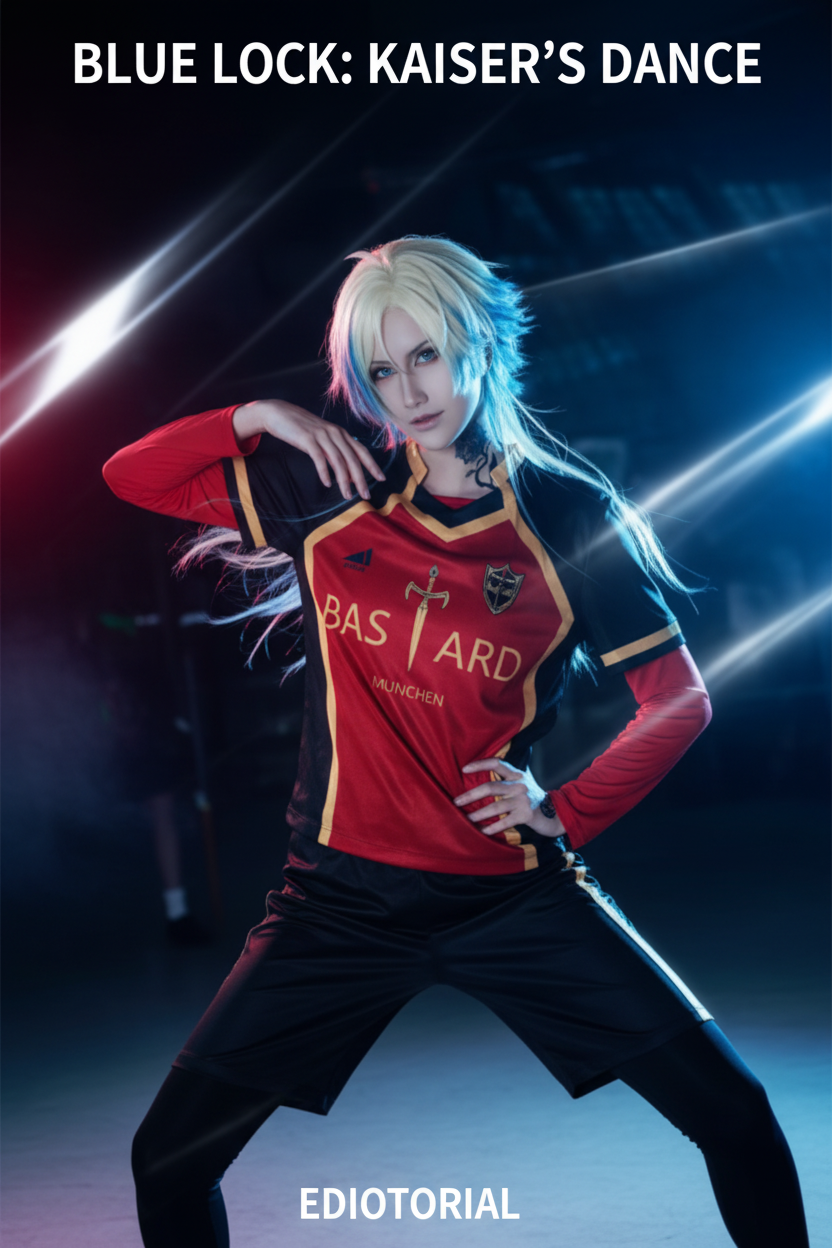
Kaiser cosplay has been showing up consistently in #cosplaydance content lately, and it's not hard to see why — Blue Lock's breakout rival character has the kind of sharp, confident presence that reads perfectly in short-form video, and unlike a lot of the elaborate fantasy or magical builds currently trending, his uniform-based design is genuinely built for movement. This guide walks through building a Kaiser Blue Lock cosplay specifically with dance-level content in mind — not just a static photo, but a build that can actually survive choreography.
What you'll need before you start:
- A reference set covering Kaiser's uniform details, hair, and any signature accessories
- Athletic-style base fabric with genuine stretch (more on why this matters in Step 1)
- Basic embroidery or heat-transfer supplies for team emblem detailing
- A wig matching Kaiser's specific color and cut
- Time set aside specifically to test-dance the finished costume before filming, not just try it on
Step 1: Source an Athletic Uniform Base Built for Movement, Not Just Looks
Blue Lock cosplay starts from a fundamentally different construction logic than most anime character builds. Kaiser's design is a soccer uniform, not an elaborate fantasy costume — which means the priority isn't complex tailoring or structural pieces, it's genuine athletic performance fabric that moves the way real sportswear does.
This is worth taking seriously rather than treating as a minor detail. A sports anime cosplay build made from standard, low-stretch cosplay fabric will look reasonably accurate in a static photo but will fight against you the moment you actually start moving — exactly the problem that shows up in choreography-heavy content if the base garment wasn't chosen with that in mind. Genuine athletic-weight fabric with real four-way stretch is what lets you move through a full dance routine's range of motion without the costume restricting you or looking stiff on camera.
Rather than sourcing generic athletic wear and hoping the fit and color work out, browsing a dedicated sports anime cosplay uniforms collection built specifically around this kind of character gets you a base garment that's already cut correctly for the silhouette these designs call for, saving you from having to heavily modify a non-cosplay athletic piece.
Team emblem and detail work is the other piece of this step. Heat-transfer vinyl or basic embroidery both work well for reproducing Kaiser's team markings and uniform detailing — heat transfer is faster and more beginner-friendly, while embroidery holds up marginally better under repeated movement and washing if you're planning to wear this costume more than once.
Step 2: Add Character-Specific Details — Hair, Accessories, and Presence
With the uniform base sorted, this step is where Kaiser's specific character identity gets layered on top of the athletic foundation.
Hair is doing significant recognition work here, the same way it does for most character builds — get his specific color and cut right, and make sure your wig is secured well enough to survive real movement, not just posed photography. This matters more for a Kaiser cosplay guide-level build than people expect, since a wig that shifts or loses shape during a dance routine undercuts the whole performance in a way it wouldn't for a static photo shoot.
Beyond hair, Kaiser's presence and expression carry as much weight as any physical costume detail — his character reads through posture and confidence as much as through the uniform itself. This isn't something you buy, but it's worth practicing deliberately: a confident stance and expression sells the character in dance content far more than perfect uniform accuracy alone would.
Small accessories — any signature jewelry, wristbands, or other detail pieces specific to his design — are worth adding last, once the bigger uniform and hair elements are locked in. These are lower-cost, lower-effort additions that sharpen the overall accuracy without requiring construction time.
Step 3: Reinforce and Test the Build for Dance-Level Movement
This is the step that separates a Blue Lock costume built purely for photos from one that's genuinely ready for the kind of #cosplaydance content currently circulating this character. Sports anime uniforms have a real practical advantage here — their athletic-inspired construction already lends itself to movement better than a lot of elaborate fantasy costumes — but that advantage only holds if you actually build and test with movement in mind rather than assuming a uniform automatically survives choreography just because it looks sporty.
Identify the specific movements your planned routine involves — arm extension, kicking or leg movement given the soccer theme, any spins or floor work — and check your costume's stress points at each of those movements before filming. This is the same core testing principle covered in our full guide to building dance-ready cosplay costumes: walk through the actual choreography in the complete costume, at real intensity, before you're relying on it for a final take. If anything pulls, restricts, or threatens to give way during that test, reinforce it now rather than discovering the problem on camera.
Because Kaiser's design is uniform-based rather than layered with structural pieces, the specific risk points differ somewhat from more elaborate costume types — watch particularly for underarm and shoulder seams during arm-heavy choreography, and waistband or leg-seam stress if your routine involves any kicking motion given the character's soccer context. Reinforcing these specific points with proper stitching (rather than relying on adhesive alone) before your test-dance saves you from a mid-routine wardrobe failure.
If you're building athletic stretch cosplay fabric pieces yourself rather than buying pre-made, double-stitching or zigzag reinforcement at these exact stress points, combined with a genuinely stretchy base material, gives you a build that holds up to real choreography rather than just standing still for a photo.
Troubleshooting: Common Kaiser Cosplay Pitfalls
"My uniform looks accurate but restricts my movement during choreography." This usually traces back to fabric choice rather than construction — a low-stretch material will limit range of motion regardless of how well it's sewn. Check whether your base fabric has genuine multi-directional stretch; if not, that's the piece worth rebuilding before your next test.
"The wig kept shifting during my dance routine." Movement-heavy content puts more stress on wig security than static photography does. Make sure you're using a properly fitted wig cap and secure attachment method rather than relying on a setup that only needed to hold for a posed photo.
"My team emblem detailing started peeling after one wear." Heat-transfer vinyl applied without enough heat or pressure during application is prone to this, especially once real movement and any sweat get involved. If you're planning to wear the costume repeatedly, embroidery is worth the extra time investment over heat transfer for better durability.
"I'm not sure my costume can handle the specific choreography I have planned." Don't guess — actually run the full routine in the complete costume at real intensity before your filming day, as covered in Step 3. This is the only reliable way to know for certain, and it gives you time to fix any weak points before they become a problem on camera.
"The costume looks good in photos but doesn't have the right energy in dance content." This is often a presence issue rather than a costume issue — go back to Step 2's point about posture and expression. A technically accurate uniform paired with a hesitant or stiff performance won't land the way the confident, sharp energy Kaiser's character calls for.
Next Steps
Once you've built one Kaiser cosplay guide-level costume with dance-readiness in mind, the underlying framework transfers directly to other sports anime characters — the same athletic fabric sourcing, team emblem techniques, and movement-testing process apply whether you're building a soccer uniform, a volleyball kit, or any other sports-based character design. This is a genuinely reusable skill set, not a one-off technique specific to Blue Lock.
If you're planning to actually film choreography in this costume, it's worth reviewing our full guide to building dance-ready cosplay more broadly — the stress-point testing and reinforcement principles covered there apply directly to this build, just with the soccer-specific considerations covered in Step 3 layered on top.

Dejar un comentario
Este sitio está protegido por hCaptcha y se aplican la Política de privacidad de hCaptcha y los Términos del servicio.