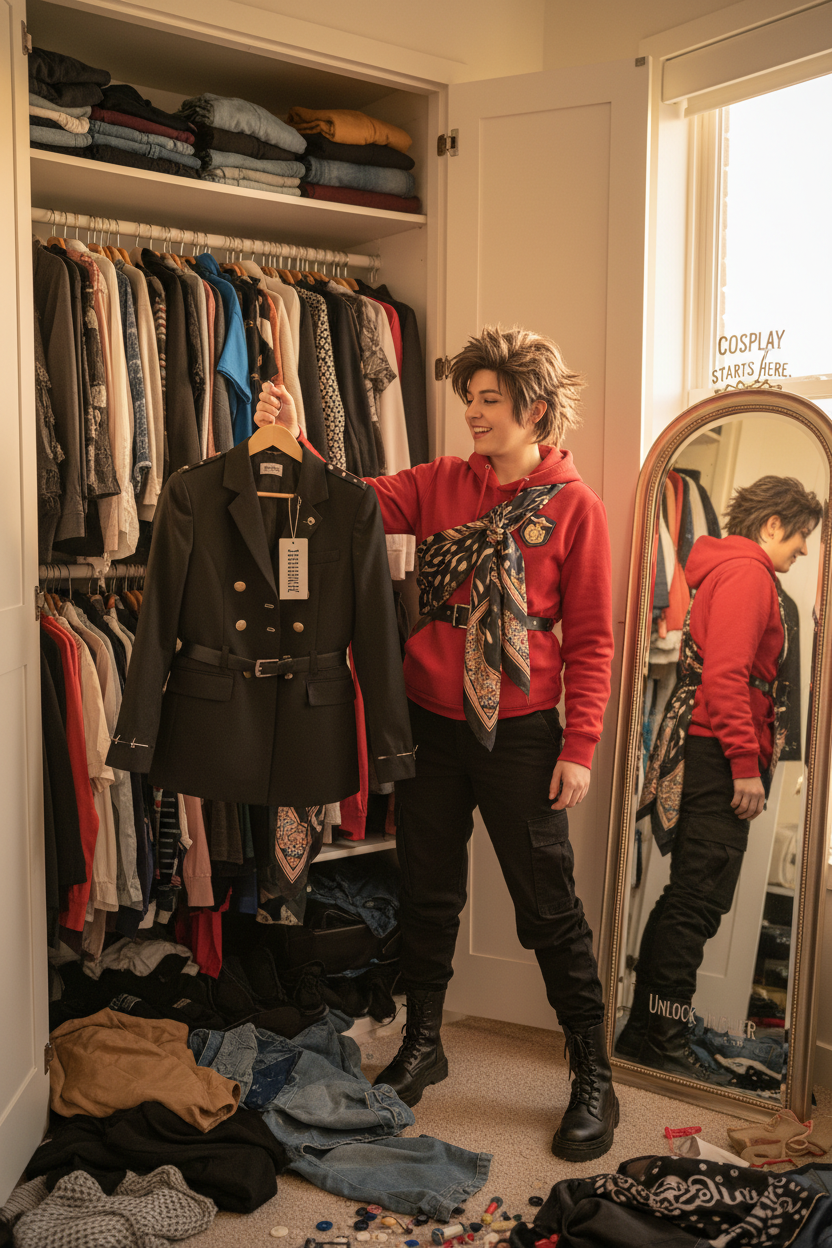
Cosplay does not always have to begin with a sewing machine, a 3D printer, or a shopping cart full of specialty materials. Sometimes, the most convincing character look starts with something already hanging in your closet.
That idea is at the heart of closet cosplay: recreating a character by combining ordinary clothing, accessories, makeup, household objects, and simple DIY modifications. Instead of trying to reproduce every costume detail exactly, closet cosplay focuses on capturing the character's identity through recognizable colors, silhouettes, shapes, textures, and attitude.
The approach has also become increasingly visible in mainstream cosplay culture. At San Diego Comic-Con 2026, creator Snitchery was again highlighted for her playful approach to cosplay. Her work has included transforming ordinary materials into fantastical character-inspired designs. One particularly memorable example was a Shai-Hulud creation made by spray-painting a children's pop-up crawl tunnel. Allure described her approach as “closet cosplay,” emphasizing the use of everyday items rather than relying entirely on elaborate fabrication.
That example illustrates an important change in how cosplay can be understood.
There is a difference between character accuracy and creative interpretation.
A screen-accurate costume asks:
“How closely can I reproduce what the character wears?”
A creative cosplay asks:
“How can I make people recognize this character using what I already have?”
Neither approach is better. They simply solve different creative problems.
If you want to experiment with character inspired cosplay, build a costume quickly for a convention, create content for TikTok or Instagram, or simply try cosplay without spending a lot of money, closet cosplay can be an excellent starting point.
What You Need Before You Start
You do not need a large crafting setup. For a simple closet cosplay, begin with items you already own.
Basic clothing
Look through your wardrobe for:
- T-shirts
- Button-down shirts
- Sweaters
- Hoodies
- Jackets
- Skirts
- Dresses
- Jeans
- Leggings
- Boots
- Sneakers
Do not worry if the items are not exact replicas. Look for similar colors, silhouettes, and textures.
Accessories
Accessories can make a surprisingly large difference.
Check whether you already have:
- Belts
- Sunglasses
- Hats
- Gloves
- Scarves
- Jewelry
- Bags
- Hair clips
- Headbands
- Boots
- Costume jewelry
- Old wigs
Simple DIY supplies
If you want to modify something, keep a small collection of inexpensive supplies nearby:
- Safety scissors
- Fabric tape
- Double-sided tape
- Safety pins
- Craft foam
- Cardboard
- Acrylic paint
- Fabric markers
- Hot glue
- Elastic
- Velcro
- Temporary hair color
- Makeup
The objective is not to build a professional costume workshop.
The objective is to solve visual problems creatively.
Step One: Break the Character Down Into Recognizable Visual Signals
The biggest mistake beginners make with closet cosplay ideas is starting with individual costume pieces.
Instead, start with the character's overall visual identity.
Before opening your closet, choose a character and ask five questions:
- What are the character's dominant colors?
- What is their most recognizable silhouette?
- What accessory immediately identifies them?
- What hairstyle or makeup feature is important?
- What personality does their body language communicate?
This process allows you to separate essential details from optional details.
Imagine you want to recreate a character who normally wears a highly detailed fantasy costume.
You probably cannot reproduce every buckle, embroidered panel, armor component, and decorative element from your closet.
But perhaps the character has:
- A black-and-red color palette
- A long coat
- A distinctive hairstyle
- A pair of gloves
- A dramatic silhouette
- A recognizable weapon or accessory
Those elements may be enough.
This is the foundation of creative cosplay.
Think in visual layers
A useful way to analyze a character is to divide the costume into three layers.
Layer 1: Identity
These are the details that make the character recognizable.
For example:
- Hair color
- Signature accessory
- Dominant color
- Distinctive silhouette
Layer 2: Supporting details
These reinforce the character but are not absolutely necessary.
Examples include:
- Jewelry
- Gloves
- Belts
- Boots
- Makeup
- Small props
Layer 3: Decorative details
These are the elements you can usually simplify.
Examples include:
- Tiny embroidery
- Decorative buttons
- Minor patterns
- Hidden costume details
- Small pieces that are rarely visible from a distance
When creating low budget cosplay, spend most of your effort on Layer 1.
That is where the visual payoff is highest.
Use the “three-second test”
Look at your unfinished cosplay in a mirror.
Then ask:
If someone saw me for three seconds, would they understand the character inspiration?
If the answer is yes, you are probably on the right track.
If the answer is no, adding ten more tiny details may not solve the problem.
Instead, reconsider the silhouette, color palette, hair, or signature accessory.
Step Two: Build the Base Outfit From Your Closet
Once you understand the character's visual identity, start searching through your wardrobe.
Do not search for an exact costume.
Search for substitutes.
A black blazer can become a military jacket.
A long white shirt can become a fantasy tunic.
A red hoodie can become the foundation for a character-inspired streetwear look.
A pleated skirt can work for multiple school-uniform-inspired characters.
An oversized coat can instantly create a dramatic silhouette.
This is where closet cosplay becomes more interesting than simply buying a cheap costume.
You are not asking:
“What costume can I purchase?”
You are asking:
“What can this piece of clothing become?”
Match silhouette before details
If you have to choose between matching the exact color and matching the overall shape, prioritize silhouette.
A character with a long, dramatic coat may still look recognizable if your coat is slightly different in color.
But if you replace a long coat with a tight T-shirt, the visual identity may disappear.
The silhouette communicates character at a distance.
That makes it especially important for:
- Convention photos
- Street photography
- Group cosplay
- TikTok videos
- Instagram Reels
- Event entrances
Combine unexpected clothing
Closet cosplay becomes particularly effective when you stop thinking about clothing according to its original purpose.
A formal blazer does not have to remain formal.
A scarf does not have to remain a scarf.
A bedsheet does not have to remain a bedsheet.
An oversized shirt can become a cape.
A belt can become a harness.
A scarf can become a sash.
A hoodie can become the base layer underneath armor or a fantasy costume.
The goal is to reinterpret the object.
This is one reason everyday items cosplay can feel surprisingly creative.
Step Three: Turn Everyday Objects Into Character Details
This is where the process gets fun.
Once the base outfit is ready, look around your home for objects that could represent the character's signature elements.
This does not mean randomly attaching household objects to yourself.
Instead, think about shape and function.
A cardboard tube can become part of a prop.
Craft foam can become armor.
A plastic container can become a futuristic accessory.
A children's toy can become the foundation of a fantasy prop.
An old umbrella can become part of a dramatic silhouette.
A kitchen object might provide the right shape for a temporary prop.
This philosophy is similar to the approach behind Snitchery's Shai-Hulud creation: the finished visual does not necessarily reveal the mundane object that was used to make it. A children's pop-up crawl tunnel became the basis for a giant sandworm-inspired cosplay after modification and painting.
The important lesson is not to copy that exact project.
It is to ask:
What ordinary object already has the shape I need?
Look for shapes, not objects
Suppose you need a large circular piece.
Do not immediately search for a “cosplay circular prop.”
Search your home for objects that already have that geometry.
You might find:
- A plastic lid
- A serving tray
- Cardboard
- An old lampshade
- A craft hoop
Need something cylindrical?
Look for:
- Tubes
- Bottles
- Containers
- Foam rolls
- Cardboard packaging
Need something lightweight?
Consider:
- Foam
- Cardboard
- Fabric
- Plastic sheets
This dramatically expands your creative options.
Modify instead of manufacture
One of the most useful principles in how to make closet cosplay is:
Modify first. Build from scratch second.
If an existing object is already 60 percent correct, modifying it may take only 20 minutes.
Building the same object from raw materials might take several hours.
You can use:
- Paint to change color
- Fabric to change texture
- Tape to change shape
- Foam to add volume
- Velcro to make pieces removable
- Elastic to improve fit
- Cardboard to create structure
That is often enough to turn an ordinary object into a convincing costume component.
Step Four: Use Hair and Makeup to Close the Character Gap
Clothing gets most of the attention in cosplay, but hair and makeup can dramatically change the final result.
In fact, when your clothing cannot perfectly match the original costume, makeup and hair can compensate for some of that visual difference.
Start with the hairstyle.
Ask:
- Is the hair short or long?
- Is the parting important?
- Is the character associated with a specific color?
- Does the character have bangs?
- Is the hairstyle exaggerated?
You do not necessarily need an expensive professional wig.
Depending on the character, you can experiment with:
- Your natural hair
- Temporary color
- Hair extensions
- Affordable wigs
- Hair clips
- Styling products
- Headbands
- Hats
Snitchery has also discussed using wigs creatively across different cosplay characters, including reusing and restyling wigs rather than treating every character as requiring an entirely new wig.
Makeup should communicate personality
Do not automatically choose dramatic makeup just because you are doing cosplay.
Instead, ask what makes the character's face distinctive.
Maybe the character has:
- Sharp eyeliner
- Strong brows
- Dramatic lips
- Blush
- Face markings
- Unusual eyes
- A specific expression
For a character inspired cosplay, you can exaggerate these elements without attempting to reproduce every tiny facial detail.
The goal is recognition, not photographic duplication.
Expression is part of the costume
This is often overlooked.
If the character is:
- Confident → use an upright posture
- Shy → soften your shoulders
- Aggressive → use sharper poses
- Playful → exaggerate movement
- Elegant → slow down your gestures
A simple outfit can suddenly become much more convincing when the person wearing it understands the character's personality.
Step Five: Add One “Hero Detail”
If you are working with a limited budget or limited time, do not try to perfect everything.
Choose one element that deserves extra attention.
Call it the hero detail.
It could be:
- A signature weapon
- A distinctive hat
- A large bow
- A dramatic wig
- A recognizable necklace
- A unique pair of gloves
- A character-specific prop
- A highly recognizable makeup feature
Why does this work?
Because visual recognition is not distributed equally across every costume component.
Some details carry much more information than others.
A simple black outfit with the correct signature accessory can communicate a character more effectively than an elaborate outfit missing its defining feature.
This is one of the strongest principles for creating low budget cosplay.
Instead of asking:
“How can I make everything perfect?”
Ask:
“Which one thing will make this costume unmistakably mine?”
Step Six: Test the Costume Before You Leave
Your cosplay is not finished when you put everything on.
It is finished when you know that the outfit works from different distances and angles.
Take a few photos:
- Full body
- Waist up
- Side profile
- Sitting
- Walking
- Close-up
Look at the photos rather than relying only on the mirror.
Photos reveal problems that are easy to miss in person.
Maybe the accessory disappears.
Maybe the colors blend together.
Maybe the silhouette looks completely different from the side.
Maybe the wig needs more volume.
Maybe the outfit looks better when the jacket is open rather than closed.
Make small adjustments.
This is especially useful if you plan to post your cosplay online.
A closet cosplay that looks ordinary in a bedroom mirror can look surprisingly strong in a well-composed photo.
Common Troubleshooting and Mistakes to Avoid
“My cosplay doesn't look accurate enough.”
This is probably the most common concern.
But remember: closet cosplay is not necessarily trying to be screen accurate.
If your goal is a perfect replica, you may need specialized materials and construction techniques.
If your goal is character recognition and creative interpretation, accuracy can be flexible.
Focus on:
- Silhouette
- Color
- Hair
- Signature accessory
- Makeup
- Character attitude
These usually matter more than tiny costume details.
“I don't own the right clothes.”
Start with color rather than exact garments.
If the character wears a specific jacket but you do not own one, find another garment with a similar silhouette.
If you cannot match the exact color, choose a nearby color and compensate with accessories.
You can also layer pieces.
A simple shirt underneath a jacket, combined with the right belt, boots, hairstyle, and accessory, can create an entirely different visual impression.
“My DIY prop looks cheap.”
Do not try to make it complicated.
Cheap-looking props often have too many unfinished edges or inconsistent textures.
Three simple improvements can make a major difference:
- Clean the edges.
- Use consistent colors.
- Add one layer of texture or paint.
You do not need ten materials.
A clean, simple prop usually looks better than a complicated prop that was rushed.
“I don't know how to sew.”
You do not need to sew to begin.
Try:
- Fabric tape
- Safety pins
- Velcro
- Elastic
- Temporary clips
- No-sew fabric adhesive
For beginner closet cosplay ideas, reversible modifications are particularly useful because you can experiment without permanently destroying your clothing.
If you eventually become interested in costume construction, sewing can be learned later.
Closet cosplay can be the starting point rather than the final destination.
“My cosplay looks like normal clothes.”
This can happen when the outfit has the right individual pieces but lacks a strong visual connection.
Try exaggerating one or two character features.
Change the hairstyle.
Add a signature accessory.
Introduce a stronger color contrast.
Modify the silhouette.
Use more dramatic makeup.
Or create a recognizable prop.
Remember the three-second test.
If someone cannot identify the character inspiration almost immediately, strengthen the most recognizable visual signals.
The Bigger Idea: Accuracy vs. Interpretation
The most interesting thing about closet cosplay is not that it is cheaper.
It is that it changes the creative question.
Traditional cosplay often asks:
“How accurately can I reproduce this character?”
Closet cosplay asks:
“How creatively can I reinterpret this character?”
That distinction matters.
A screen-accurate costume rewards technical precision.
A creative cosplay can reward:
- Improvisation
- Humor
- Fashion
- Resourcefulness
- Personal style
- Visual storytelling
- Unexpected materials
That is why character inspired cosplay can exist somewhere between costume design and everyday fashion.
You are not necessarily pretending that your outfit is the original costume.
You are creating your own visual language for the character.
And that can make the result more personal.
Final Thoughts: Start With What You Already Have
You do not need to wait for the perfect convention, the perfect budget, or the perfect costume.
Open your closet.
Pick a character you love.
Find three colors associated with them.
Choose one recognizable silhouette.
Identify one signature accessory.
Then look around your home for an ordinary object that could become something else.
That is enough to start.
The growing appeal of closet cosplay is ultimately about accessibility. You can participate in cosplay without having advanced sewing skills, expensive equipment, or a massive crafting budget. Snitchery's approach is a useful contemporary example: her work demonstrates how everyday materials and imperfect, fast-moving construction can still produce memorable character transformations.
More importantly, closet cosplay reminds us that cosplay is not only about reproducing a costume.
It is about interpreting a character.
So the next time you see a complicated costume and think, “I could never make that,” try asking a different question:
“What could I create with the things I already have?”
That question may be where your best cosplay starts.

Dejar un comentario
Este sitio está protegido por hCaptcha y se aplican la Política de privacidad de hCaptcha y los Términos del servicio.