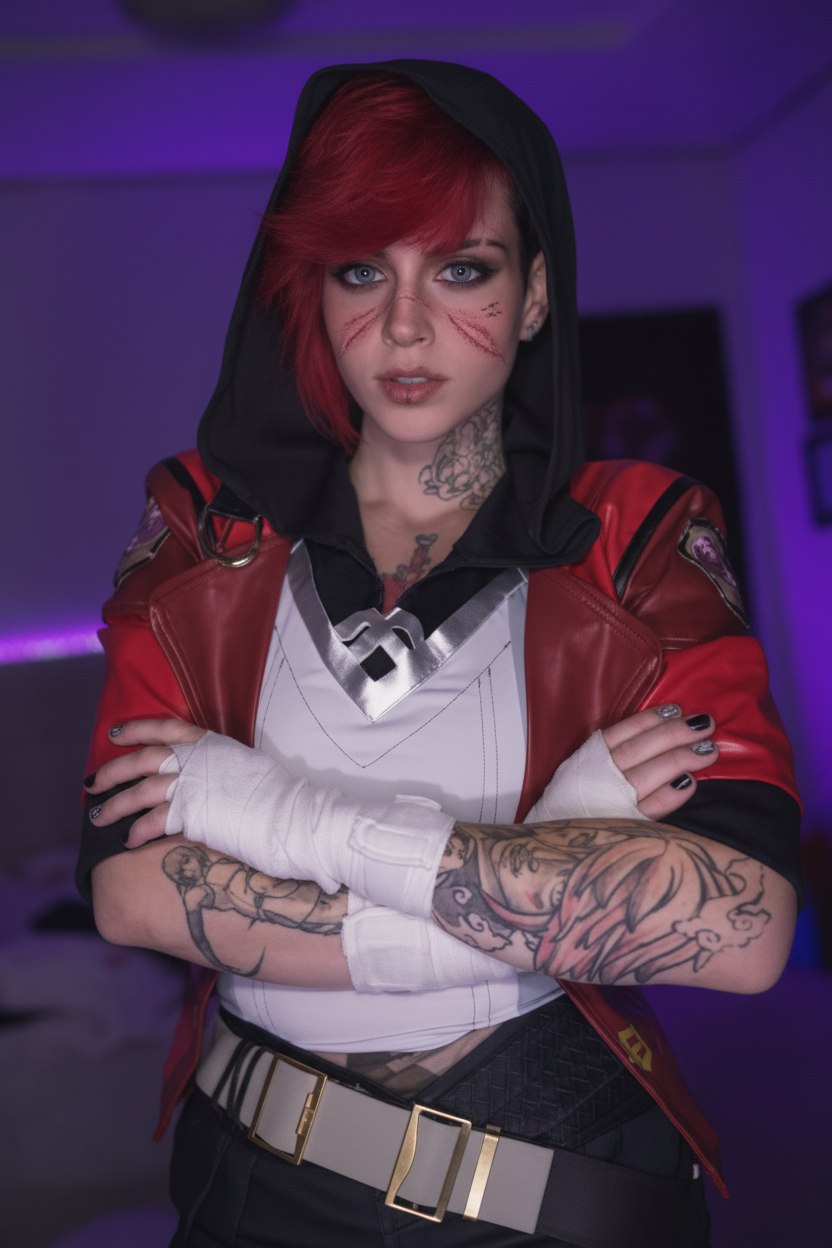
TL;DR: Highly realistic [SFX scar and wound makeup recreating Arcane's Vi and Jinx has drawn real pushback on TikTok and Instagram, with mental-health-focused viewers asking creators to add content warnings before showing graphic-looking cuts and scarring, while SFX artists argue this is legitimate film-style makeup artistry, not something that needs a warning label. Both concerns are grounded in something real: TikTok's actual content policy already treats certain realistic wound imagery as sensitive content requiring warnings or restricted distribution, and there's documented research showing self-harm-adjacent imagery genuinely affects vulnerable viewers on the platform, regardless of the creator's original intent.
A quick note before going further: this piece discusses self-harm-adjacent imagery in a factual, platform-policy context. If this is a subject that affects you personally, it's worth talking to someone you trust or a mental health professional — this article isn't a substitute for that kind of support.
Why This Debate Is Happening, and Why It's Not Just Online Oversensitivity
Arcane's character designs make this an unusually likely flashpoint compared to most cosplay SFX work. Vi's design includes established, canon knuckle scarring and a rougher, battle-worn aesthetic baked directly into her official art, and Jinx's design leans into a more chaotic, scattered pattern of visible damage as part of her characterization. Both lend themselves naturally to elaborate SFX recreation — which is exactly the kind of high-effort, technically impressive makeup work that tends to perform well on TikTok and Instagram Reels.
The problem isn't that cosplayers are doing something unusual by attempting this; it's that the realism some of these builds achieve has, in some cases, crossed into imagery that reads as freshly-inflicted wounds or cuts rather than clearly-established character scarring, and that specific visual category is one platforms already treat with real caution.
It's worth understanding that TikTok's actual, written content policy isn't ambiguous on this point, even though enforcement clearly isn't perfectly consistent in practice:
-
Mental and Behavioral Health Guidelines: The platform states directly that content depicting activities "likely to be imitated" and capable of causing physical harm gets removed outright, while content showing activities that could lead to "moderate physical harm" is restricted from the For You feed, limited to adult viewers, and may carry a warning label.
-
Sensitive and Mature Themes Policy: TikTok doesn't allow content that's "extremely gory, disturbing, or violent, especially when it could cause psychological harm," with warning labels applied specifically to help viewers manage potentially distressing scenes.
This isn't a policy invented in response to the Arcane cosplay debate — it's the same general framework the platform already applies broadly, and it happens to catch hyper-realistic wound and scar imagery whether the creator's intent was cosplay artistry, a viral "challenge," or something else entirely, because the moderation systems are generally responding to what the image depicts rather than why it was made.
There's also real research backing the underlying concern driving calls for content warnings, separate from any individual creator's intent:
-
Algorithmic Exposure & Vulnerable Viewers: A qualitative study of self-harm-adjacent content on TikTok found that imagery referencing visible scarring circulates persistently across the platform, often evading consistent moderation, and genuinely functions as part of a loosely connected but emotionally resonant online community — meaning realistic scar or wound imagery doesn't need to be created with harmful intent to still reach and affect vulnerable viewers who encounter it through the algorithm.
-
Regulatory & Platform Scrutiny: On the regulatory side, Italy's competition authority opened a formal investigation into TikTok after a viral trend called the "French Scar Challenge" — where users pinched their skin to create mock red-line scarring — spread among teenagers, specifically citing concerns that TikTok's moderation systems weren't adequately catching self-injury-adjacent content circulating under its own stated community guidelines. That case is a useful data point here: regulators have already shown they take the spread of realistic-looking self-inflicted marks seriously enough to formally investigate a platform over it, even when the content in question wasn't explicitly framed as promoting self-harm.
Key Elements: Where the Actual Sensitivity Concentrates
It's worth being specific about what does and doesn't tend to draw this kind of scrutiny, because treating all battle-damage SFX work as equally sensitive isn't accurate and doesn't help creators plan responsibly.
-
Established, Textured, "Healed" Scarring: The kind of stylized, tattoo-like knuckle scars Vi has as part of her canon design, or bruising and impact-style damage that reads clearly as combat aftermath rather than a fresh wound — tends to draw far less concern, since it visually reads as character detail rather than an image resembling active self-harm. This category covers the majority of what most Vi and Jinx cosplayers are actually going for, and it rarely runs into the specific content categories TikTok's policy is built to catch.
-
Fresh-Looking, Linear Cut Marks: Particularly when shown in close-up or styled to look raw or actively bleeding, is where the actual sensitivity concentrates, and it's the specific visual category both mental health advocates and platform policy are focused on — not SFX battle damage generally.
Practical Distinction: A cosplayer recreating Vi's established knuckle scars as textured, healed detail work is doing something meaningfully different, both visually and in terms of platform risk, than a cosplayer creating hyper-realistic fresh linear wounds for shock value or dramatic effect, even if both fall under the general umbrella of "battle damage SFX."
Best Practices for Content Creators
For creators who want to include the more visually intense end of this spectrum responsibly, the practices that mental health advocates and experienced SFX creators broadly agree on are straightforward:
-
Add a clear, visible content warning at the very start of a video (not buried in the caption).
-
Avoid using the most graphic single frame as your video's cover thumbnail, since thumbnails are seen far more widely than the video itself.
-
Keep close-up, high-realism shots of fresh-looking wounds to a smaller portion of the overall video rather than the sole focus.
Common Misunderstandings and Things to Watch For
-
"Any battle-damage SFX makeup is sensitive content."
Not accurate — bruising, dirt, established character scarring, and general combat-worn styling make up the bulk of Vi and Jinx SFX work and don't typically resemble the specific imagery platforms and mental health advocates are concerned about. The sensitivity concentrates specifically around realistic, fresh-looking linear cuts, not battle damage as a broad category.
-
"Adding a content warning is just platform overreach into artistic expression."
This framing undersells a real, documented pattern: independent research has found self-harm-adjacent imagery circulating on TikTok genuinely affects vulnerable viewers regardless of the creator's intended context, and film and television productions have used content warnings for comparably graphic makeup effects for years without it being treated as an attack on the craft. A content warning doesn't restrict what you're allowed to create — it gives viewers who might be affected a chance to make an informed choice before watching.
-
"TikTok banning these videos means the platform is specifically targeting cosplay."
The available evidence points the other way — TikTok's relevant policies apply based on what an image depicts, evaluated by the same automated and human moderation systems used across the whole platform, not based on whether the content is tagged as cosplay, SFX art, or anything else. A hyper-realistic fresh-cut effect is likely to be flagged regardless of the creative context around it, which is frustrating for artists working in good faith, but it isn't evidence of the platform singling out cosplay specifically.
-
"Content warnings will kill engagement, so it's not worth adding one."
In practice, a brief, clearly-placed warning at the start of a video is a small addition that doesn't meaningfully change how the rest of the content performs, and it's a far smaller cost than having a video removed outright or an account penalized for triggering the platform's more severe content categories.
Summary and Further Reading
The realistic end of Arcane battle-damage SFX work sits in a genuinely sensitive spot — not because the artistry itself is the problem, but because the most graphic versions of it visually overlap with imagery that platforms, researchers, and regulators have already identified as capable of affecting vulnerable viewers, independent of what the creator intended.
Understanding where that overlap actually concentrates — fresh-looking linear cuts specifically, rather than battle damage broadly — makes it possible to keep doing ambitious, technically impressive SFX work while being genuinely thoughtful about how it reaches an algorithm-driven audience that doesn't share your context.
If you're building a Vi or Jinx look, check out our guides on League of Legends-adjacent costume construction and durable, convention-ready SFX application techniques for effects that read clearly as character detail rather than something more.


Dejar un comentario
Este sitio está protegido por hCaptcha y se aplican la Política de privacidad de hCaptcha y los Términos del servicio.