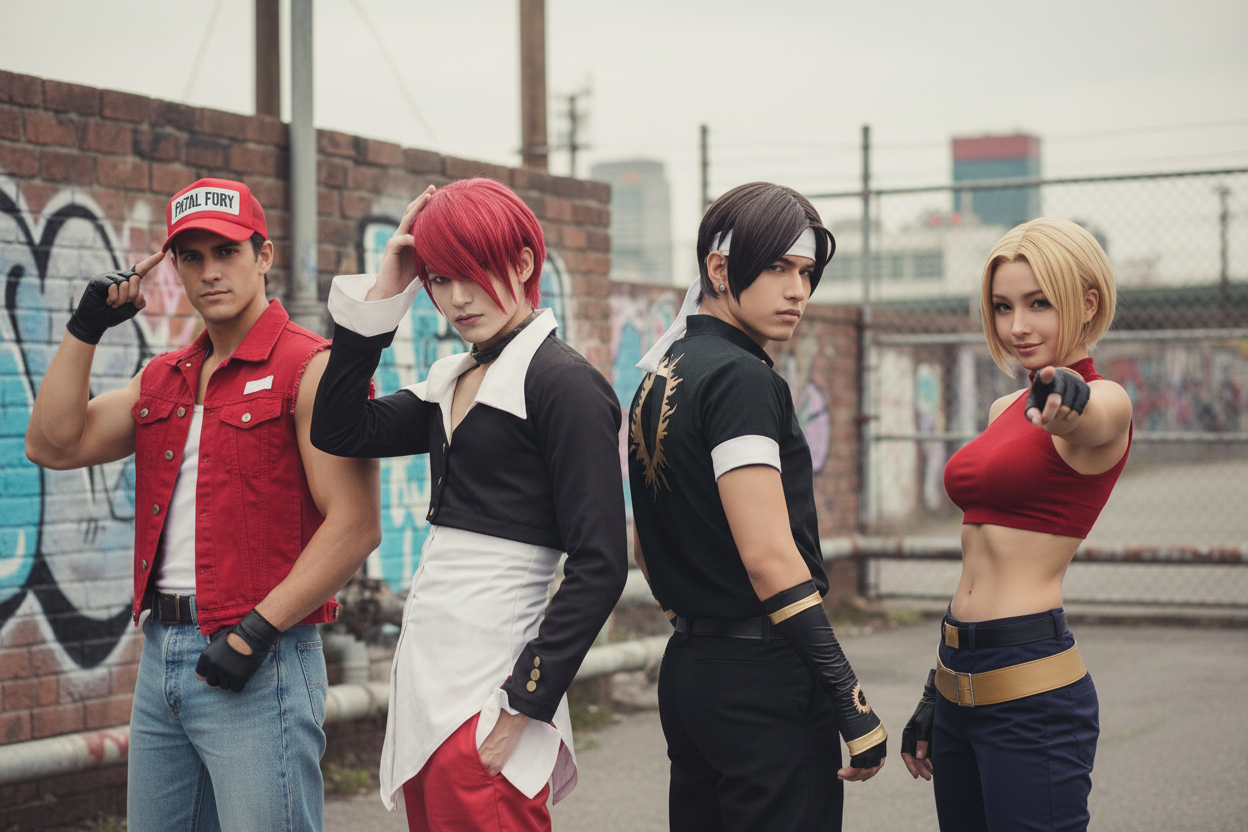
TL;DR: King of Fighters characters weren't designed in a vacuum — SNK's 90s artists were pulling directly from real runway fashion, Japanese street style, and American workwear, which is exactly why KOF-inspired outfits translate so easily into clothes you can actually wear outside a convention. Terry Bogard maps to Americana biker-workwear, Iori Yagami maps to gothic/visual-kei streetwear, Kyo Kusanagi maps to Japanese delinquent biker style, and Blue Mary maps to Y2K biker-girl fashion. Pick the archetype that matches your existing wardrobe leanings, add one or two signature pieces (a leather vest, a choker, a specific jacket cut), and you've got a "casual cosplay" look that reads as intentional streetwear first and character reference second.
Why KOF Style Is Having a Moment Right Now
If you've noticed King of Fighters outfits showing up more often in your feed lately, that's not a coincidence — it's the result of three separate trends converging at once.
-
The source material was already fashion-forward. When SNK designed these characters in the 90s, the art team wasn't just inventing "video game clothes" — they were actively referencing the runway and street fashion of the era: American workwear and biker culture, Harajuku street style, and visual-kei rock fashion. That's a very different design approach than most fighting-game rosters from the same period, and it's exactly why KOF outfits hold up as genuinely wearable fashion decades later instead of reading as obviously "costume." A red leather vest over a white tee wasn't a fantasy invention — it was a real look people were already wearing in the early 90s, just filtered through character design.
-
The IP is back in the cultural conversation. Terry Bogard's crossover as a playable DLC character in Street Fighter 6 introduced his look to an entirely new generation of fighting game fans who may never have played an actual KOF title, and the release of Fatal Fury: City of the Wolves has kept SNK's retro aesthetic circulating heavily in both fighting-game communities and broader anime-adjacent spaces. Every time a legacy character resurfaces in a new game, cosplay and fashion content around them gets a fresh traffic spike — and this crossover moment has been unusually effective at pulling in viewers who follow fighting games but don't necessarily follow "cosplay" as a hobby.
-
TikTok's runway-transition format is a perfect match for this aesthetic. Under hashtags like
#koffashionand#90sanimeaesthetic, two content formats are performing especially well right now: videos that stage KOF characters as if they're walking a 90s runway, and "dressed as [character] for a day out" OOTD-style transition videos. Both formats lean into exactly what makes KOF different from most game-character cosplay — the outfits don't need a con or a photo studio to look intentional. They look like fashion content because, structurally, they are fashion content. -
Gen Z's appetite for "casual cosplay" fits this IP perfectly. A large part of the current Western Gen Z cosplay audience isn't looking to build an elaborate armor set — they want a version of fandom they can actually wear to class, to a show, or on a night out. KOF's wardrobe is almost uniquely suited to this: leather vests, denim jackets, chokers, and biker jackets aren't costume pieces that need to be "shown off" at a con to make sense. They're pieces that work in a normal outfit rotation, which is exactly why purchase intent tends to run higher for this kind of content than for full-armor-build cosplay content — the buyer isn't just planning to wear it once.
Key Elements & Typical Looks by Character
Each of the four most style-forward KOF characters maps to a distinct real-world fashion archetype. Picking the one that's closest to your existing style is a faster path to a convincing look than trying to force a character whose aesthetic doesn't match your wardrobe instincts at all.
Terry Bogard — 90s Americana Workwear
Terry's look is built around unmistakably American biker-and-workwear signifiers: a red leather (or denim) vest with the sleeves cut off, worn over a plain white tee, paired with a baseball cap and washed-in denim. This is one of the most approachable archetypes on this list precisely because every individual piece already exists in most people's closets or is easy to source secondhand — the vest is really the only piece doing the "character-specific" work.
If you want to build this look with minimal guesswork, browsing 90s Anime Leather Jackets is a solid starting point for the outer layer, and a dedicated Terry Bogard Red Cosplay Vest gets you the single most recognizable piece of his silhouette without needing to source and modify a vest yourself. Pair either with plain denim and a cap you likely already own, and the look reads immediately — you don't need every accessory to be screen-accurate for this one to land.
Iori Yagami — Visual Kei & Gothic Streetwear
Iori's aesthetic pulls from 90s Japanese visual-kei and gothic rock fashion: a red-and-black color-blocked leather coat, bondage-style red trousers, a choker, and a crisp white button-up underneath. This is the archetype that resonates most with the current E-boy/E-girl and darkwear streetwear audience, and it's also the look with the highest save-and-repost rate on Pinterest among the four — likely because the color-blocking and silhouette are striking even to viewers who have no idea who the character is.
The coat is doing almost all the visual work here, so it's worth prioritizing over smaller accessories. A well-cut piece from a Gothic Cosplay Coats collection gets the silhouette and color-blocking right without needing custom tailoring, and layering in a choker and other small Anime Punk Accessories afterward is what pushes the look from "cool gothic coat" to "recognizably Iori" for anyone in the know.
Kyo Kusanagi — Japanese Delinquent Biker Style
Kyo's look draws from sukeban/delinquent biker fashion: a short, boxy black leather jacket (often with a graphic or flame motif), a headband, a plain white layer underneath, and dark denim. It sits stylistically close to Terry's archetype but reads noticeably edgier and more compact — a cropped biker jacket instead of an open vest, a headband instead of a cap.
Because this look shares core DNA with Terry's — leather outerwear, white base layer, denim — the same 90s Anime Leather Jackets collection is a natural starting point here too, just styled toward a shorter, boxy cut rather than a sleeveless vest. This overlap is actually useful from a wardrobe-building standpoint: a couple of well-chosen leather pieces can flex between multiple KOF-inspired looks depending on how you style them.
Blue Mary — Y2K Biker-Girl Streetwear
Mary's outfit leans into Y2K biker-girl fashion: a green aviator-style cropped jacket, a red sleeveless top, and high-waisted denim. This is the archetype most directly aligned with the broader Y2K revival that's already been driving streetwear trends independent of any gaming IP, which makes it one of the easiest looks to style into an outfit that reads as current fashion first and character reference second.
Because this look is essentially "Y2K biker fashion styled around a specific color story," it works especially well as a Retro Biker Vests-anchored outfit — swap in the aviator jacket silhouette and lean into the green-and-red color pairing, and the rest of the outfit can be built from denim and basics most shoppers already have on hand.
Common Mistakes & Things to Watch Out For
-
Treating it as a full costume instead of a styled outfit. The entire appeal of this trend is that it reads as wearable fashion, not convention cosplay. If you try to replicate every single accessory detail exactly as drawn, you'll usually end up with something that looks more like a costume than an outfit — which defeats the purpose of "casual cosplay" in the first place. Pick one or two signature pieces per character (the vest, the coat, the choker) and let everything else stay close to normal streetwear.
-
Mixing eras inconsistently. Because these characters were designed with real 90s fashion references, it's easy to accidentally clash decades by pairing, say, Iori's visual-kei coat with obviously 2020s athleisure basics. Keeping your base layers (denim cut, tee style, footwear) loosely period-appropriate makes a much bigger difference to how convincing the outfit reads than any single accessory does.
-
Underestimating how much a single well-made outer layer matters. For all four of these archetypes, the outer layer — vest, coat, or jacket — is carrying most of the visual identity. A cheap, boxy, poorly-fitted jacket will undercut the whole look even if every other detail is accurate, while a well-fitted one can carry a look even with fairly minimal accessorizing elsewhere. If you're only going to invest in one piece per outfit, make it the outer layer.
-
Overloading on accessories instead of committing to silhouette. It's tempting to try to hit every small detail — the specific belt, the specific gloves, the specific footwear — but silhouette and color-blocking read from much farther away (and in much smaller video thumbnails) than any individual accessory does. If you're working with a limited budget, prioritize getting the jacket/coat silhouette and color story right before spending on secondary accessories.
-
Forgetting that these looks are meant to mix and match. Because several of these archetypes share underlying pieces — leather outerwear, denim, plain layering basics — it's worth building a small wardrobe of KOF-adjacent pieces rather than buying a single "outfit" per character. A couple of well-chosen leather pieces and one or two statement accessories can realistically be restyled across two or three different character-inspired looks, which is a much better return on a streetwear budget than treating each character as a one-time purchase.
Summary and Further Reading
KOF's 90s roster works as everyday streetwear because it was designed from real streetwear in the first place — Terry channels American workwear, Iori channels visual-kei gothic fashion, Kyo channels Japanese delinquent biker style, and Mary channels Y2K biker-girl aesthetics. The fastest way into this trend isn't building a full costume; it's picking the archetype closest to your existing style, investing in one strong outer-layer piece, and letting the rest of the outfit stay close to normal streetwear basics you likely already own.
Related reading you might find useful next:

Dejar un comentario
Este sitio está protegido por hCaptcha y se aplican la Política de privacidad de hCaptcha y los Términos del servicio.