Table of Contents
- Chapter 1: The Basics — What Actually Separates a Costume from Cosplay
- Chapter 2: Core Framework — The Costume-to-Convention-Cosplay Spectrum
- Chapter 3: Advanced Strategy — Building a Halloween Look You Can Upgrade Later
- Chapter 4: Tools & Resources for Every Stage of the Spectrum
- FAQ
- Summary & Related Reading
Chapter 1: The Basics — What Actually Separates a Costume from Cosplay
A Reddit post back in May asked a version of a question that comes up every single year: is it even realistic to try building cosplay-quality Halloween cosplay in time for October? The most useful reply in that thread didn't answer the timing question directly — it answered a more fundamental one first, drawing a clear line between two things people often use interchangeably: Halloween costume and cosplay.
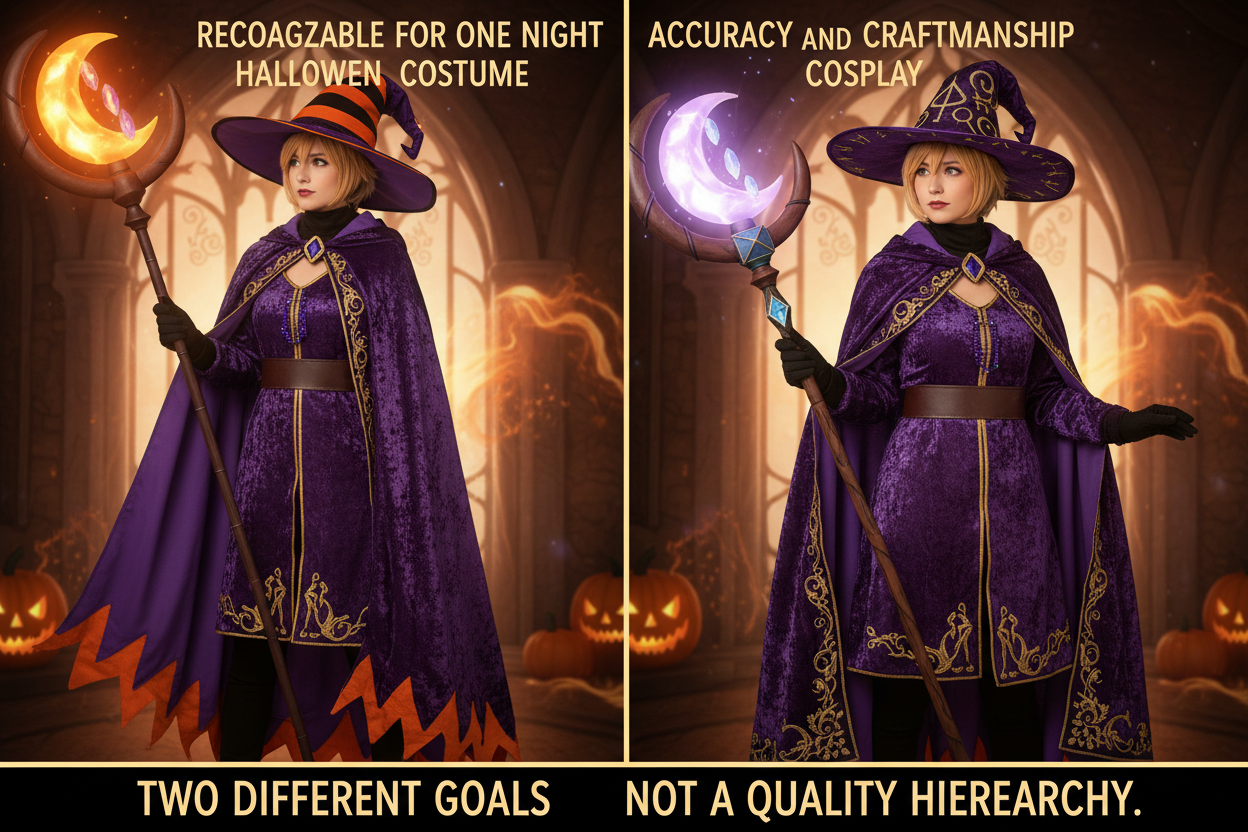
The distinction that thread landed on is genuinely the one the wider community tends to agree on: a Halloween costume needs to be recognizable enough — a good silhouette, the right colors, one or two signature props, enough for someone to go "oh, nice, you're [character]" at a glance. Cosplay, on the other hand, is built around accuracy and detail — matching specific fabric textures, replicating exact prop proportions, getting stitching and construction details right, often to a standard that holds up to close-up photography and side-by-side comparison with reference art.
Neither definition is "better" than the other, and this is worth stating clearly because the framing sometimes gets treated like a hierarchy when it really isn't. Halloween costume or cosplay isn't a quality judgment — it's a description of what you were actually going for. A costume optimized for one night of recognizable fun and a cosplay built for convention-level scrutiny are simply solving different problems, with different amounts of time, budget, and skill invested accordingly.
Where this gets genuinely interesting — and where when does a Halloween costume become cosplay stops being a semantic question and becomes a real, lived experience for a lot of people — is that these two categories aren't actually separated by a hard wall. They sit on a spectrum, and a huge number of builds move along that spectrum over time rather than staying fixed in one category forever.
Chapter 2: Core Framework — The Costume-to-Convention-Cosplay Spectrum
Once you accept that costume and cosplay are points on a spectrum rather than two separate boxes, a useful three-stage framework emerges, and it maps closely to how a lot of builds actually evolve in practice:
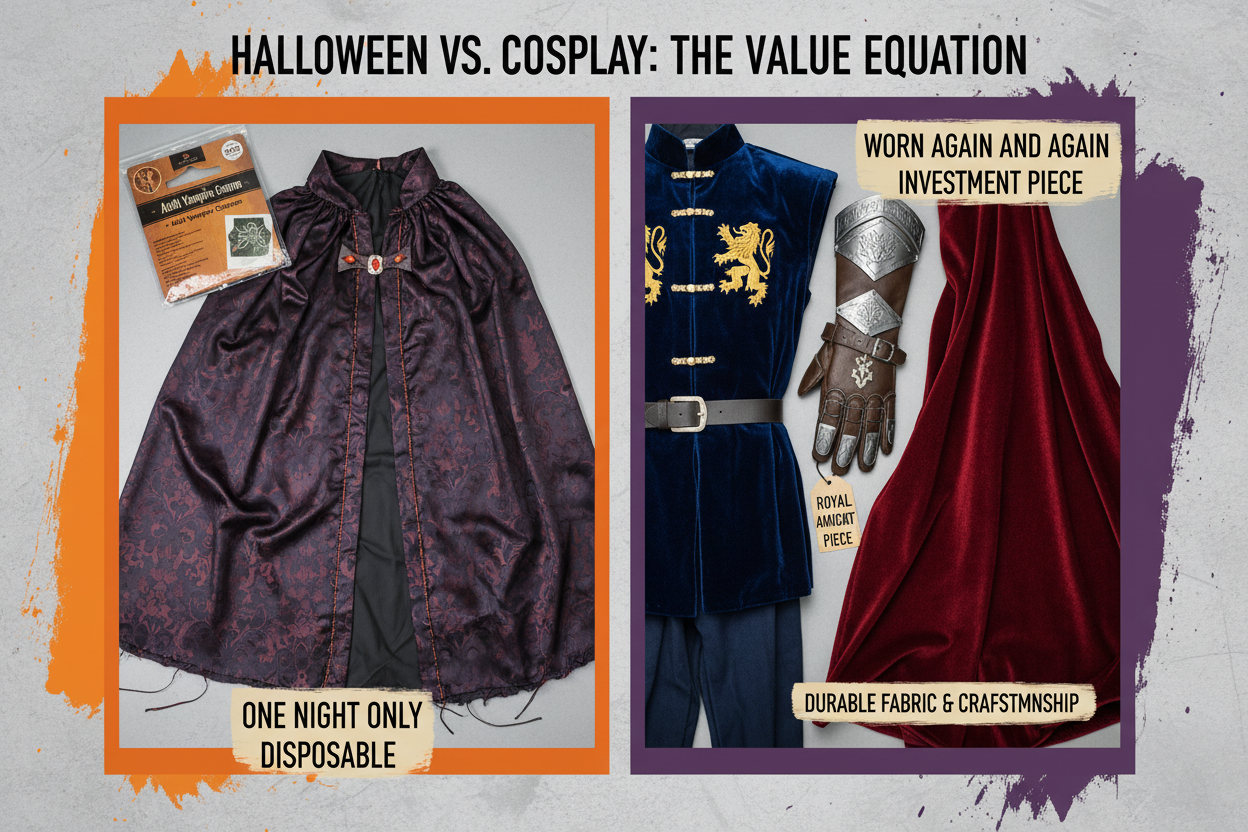
Stage 1: Halloween Costume. Built for recognizability over a single night. Priorities are silhouette, color accuracy, and one or two signature details. Construction time is typically short, and materials are chosen for cost and convenience over durability, since the piece may only need to survive one wearing.
Stage 2: Halloween Cosplay. A step up in intent, even if it's still worn on October 31st. The builder is thinking about photo quality, maybe posting the look online, and putting more care into fit, fabric choice, and accessory accuracy than a pure costume would need. This is the zone a lot of the early Halloween costume planning conversation is actually about — people treating Halloween as a legitimate cosplay occasion in its own right, not just a costume party.
Stage 3: Convention Cosplay. The build is refined further for durability, close-up detail accuracy, and often competition-readiness — reinforced seams, higher-quality materials, props built to survive travel and repeated handling, sometimes formal judging criteria in mind if the goal includes entering a masquerade or craftsmanship contest.
What makes this framework genuinely useful — rather than just an academic breakdown — is recognizing that a single costume can move through all three stages over its lifetime, rather than needing to be built for its "final" purpose from day one. A build made as a quick Halloween costume one October can be refined into a more detailed Halloween cosplay the following year, and refined again into a full convention-ready piece after that, if the person stays interested in the character and keeps improving it incrementally rather than starting over from scratch each time.
This pattern shows up constantly in community discussion, and it's a big part of why treating "costume" and "cosplay" as a strict binary misses what's actually happening for a lot of builders. The line isn't fixed — it moves as the same piece gets more time, budget, and skill invested into it.
Chapter 3: Advanced Strategy — Building a Halloween Look You Can Upgrade Later
This chapter is where the framework from Chapter 2 becomes genuinely actionable, because if a costume can evolve into full convention cosplay over time, it's worth building your very first Halloween version with that possibility in mind — even if you're not sure yet whether you'll take it that far.
The pattern in practice. A version of this plays out constantly in cosplay communities: someone builds a Halloween-tier version of a character — in this case scenarios describing a Silco costume are a good illustrative example — good enough to be recognizable and satisfying for one night, using materials and techniques scoped to a Halloween timeline and budget. Instead of the costume getting boxed up and forgotten afterward, the builder picks it back up months later, replaces a few weaker elements (a prop that didn't quite read right, a wig that needs a better cut, seams that need reinforcing), and takes the refined version to an actual convention the following year — sometimes even entering it into a cosplay contest once it's been through one or two rounds of improvement. This "build once, upgrade twice" pattern is increasingly common precisely because it removes the pressure of getting everything perfect on the first attempt.
Why this approach genuinely works better than starting from scratch each time. Building toward convention quality from your very first attempt at a character is a huge time and money commitment before you even know if you'll enjoy wearing that character, attending in that costume, or sticking with the hobby long-term. Starting at the Halloween-costume tier lets you test the character choice, get a feel for the construction techniques involved, and figure out what actually needs improvement — all before investing convention-tier time and materials into it.
What to prioritize building "upgradable" from day one. Not every choice you make at the Halloween-costume stage needs to be temporary. A few decisions are worth getting right the first time specifically because they're expensive or time-consuming to redo: base garment construction (get the actual pattern and proportions right, even if the fabric itself is a placeholder), wig base color and cut (a decent base wig can often be restyled rather than fully replaced), and any load-bearing structural elements of a prop (the internal armature or support structure is harder to redo than surface detailing). Things that are genuinely fine to build cheap and replace later include surface paint finishes, small accessories, and any element you're not yet sure reads correctly until you've actually worn the full look once and seen how it photographs.
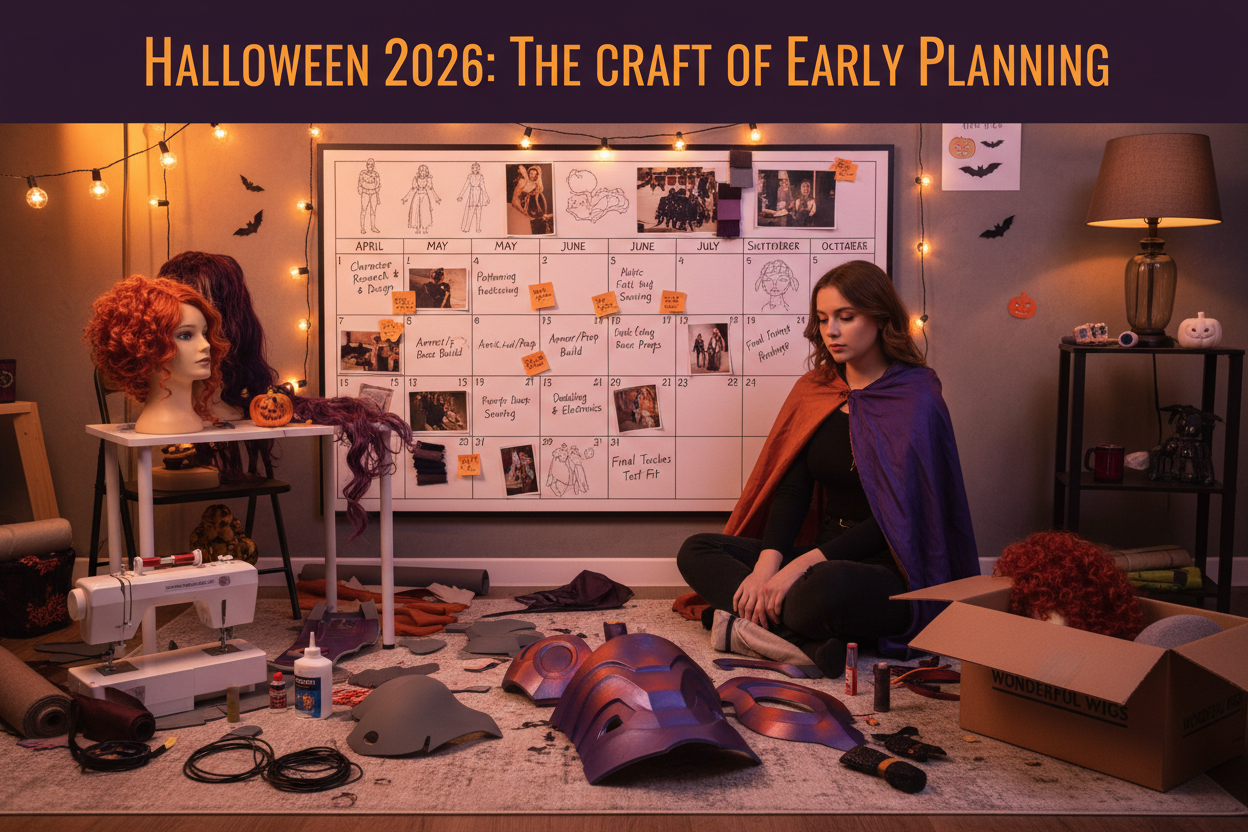
Documenting your build pays off later, even if you don't think you'll need it. If there's any chance you'll want to refine this piece for a future convention, take detailed photos of your first version — construction process, materials used, what worked and what didn't — the same way builders posting "teaser" progress content already do for Halloween cosplay ideas planned months in advance. Future-you, revisiting the project a year later, will have forgotten more of the original construction decisions than you'd expect.
Chapter 4: Tools & Resources for Every Stage of the Spectrum
For Stage 1 (Halloween Costume) builds: prioritize speed and cost-efficiency. Ready-made costume sets and simple accessory pieces let you hit "recognizable" fast without a large time investment — a good starting point if you're not yet sure whether a character is worth a longer-term commitment. A Ready-to-Wear Halloween Cosplay Sets collection is built specifically for this stage.
For Stage 2 (Halloween Cosplay) builds: this is where it's worth investing a bit more in a proper wig and slightly better base materials, since you're now thinking about photo quality and possibly reusing elements of the build later. Browsing Halloween Cosplay Wigs & Props at this stage — rather than grabbing the cheapest available option — sets you up better for the eventual Stage 3 transition, if you decide to make it.
For Stage 3 (Convention Cosplay) refinement: this is where structural durability and detail accuracy matter most — reinforced construction materials, better adhesives and paints, and props built to survive travel and repeated wear rather than a single evening. A DIY Cosplay Materials & Craft Supplies collection covers the kind of higher-durability materials worth upgrading to once you've decided a build is worth taking further.
General planning tools worth using regardless of stage: a simple build log (even just photos with dates) to track what's been done and what still needs work, a rough budget split so early cheap choices don't accidentally become expensive to undo later, and — if convention entry is even a distant possibility — a look at that specific convention's masquerade or craftsmanship contest rules well in advance, since some competitions have category requirements that are much easier to plan for than to retrofit.
FAQ
What is the actual difference between cosplay and a Halloween costume? The core distinction is intent and detail level: a Halloween costume prioritizes being recognizable for one night, while cosplay prioritizes accuracy and craftsmanship, often to a standard that holds up under close inspection or photography. Neither is inherently "better" — they're different goals.
Can cosplay be a Halloween costume? Yes, and increasingly this is exactly how a lot of cosplayers approach the holiday — treating Halloween as a legitimate occasion to debut or wear a genuinely detailed, accurate build, rather than defaulting to a simpler costume just because it's Halloween rather than a convention.
When does a Halloween costume become cosplay? There's no single hard line — it's a gradual shift as more time, detail, and craftsmanship get invested into a build. A useful marker: if you're matching specific reference details, using higher-quality or more accurate materials, and thinking about how the piece photographs up close, you've likely crossed from costume into cosplay territory, regardless of what day you're wearing it.
Should I start planning my Halloween cosplay differently if I might want to take it to a convention later? Yes — prioritize getting base garment construction, wig base quality, and any structural prop elements right the first time, since those are the most expensive and time-consuming things to redo. Surface details, paint finishes, and small accessories are safe to build cheaply and upgrade later.
Is it realistic to build convention-quality cosplay by Halloween if I'm just starting now? It depends entirely on your timeline and the character's complexity, but the more important reframe is that you don't need to hit convention quality by Halloween at all — building a solid Halloween-tier version now and refining it toward convention quality later is a completely legitimate, and often smarter, path than rushing toward full accuracy under a tight deadline.
Summary & Related Reading
Halloween costume and cosplay aren't two separate categories so much as two points on a continuum — recognizability on one end, full accuracy and craftsmanship on the other — and a huge number of real builds move along that spectrum over months or years rather than staying fixed at either end. Understanding this reframes a lot of the anxiety around when should I start my Halloween cosplay: the honest answer is that starting a simpler version now and refining it later is a completely valid strategy, not a compromise, and it's exactly the pattern behind some of the most satisfying long-term builds in the community.
Suggested further reading:
- A full timeline guide to planning Halloween cosplay, covering how far in advance to start based on build complexity
- A beginner's guide to structural prop-building techniques that hold up for repeated convention wear, not just a single night
- A guide to entering your first cosplay contest, including what judges typically look for in craftsmanship categories

Dejar un comentario
Este sitio está protegido por hCaptcha y se aplican la Política de privacidad de hCaptcha y los Términos del servicio.