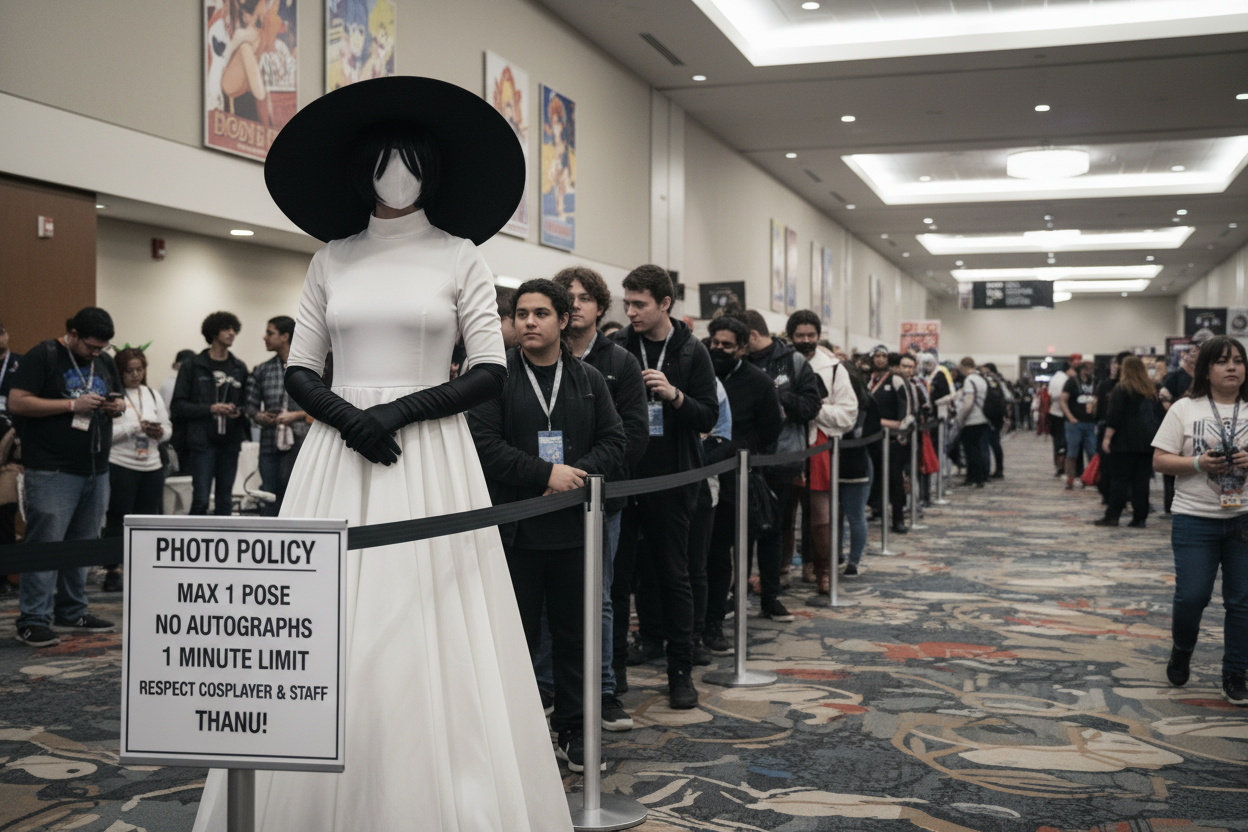
High-detail Resident Evil cosplay — Ada Wong's tailored red dress, or Lady Dimitrescu's towering stilts and elaborate prosthetics — routinely draws long photo lines at conventions, and it's put a real, ongoing debate back in the spotlight:
Should a cosplayer with a big following be allowed to charge for photos in a public convention hall that everyone paid the same admission to enter?
Reddit threads accuse high-follower cosplayers of turning shared community space into a personal storefront; TikTok comment sections defend the same cosplayers, pointing out that a screen-accurate Lady Dimitrescu build can easily run past a thousand dollars in materials alone, and that an unmanaged line of hundreds of people can become a genuine safety and time problem without some kind of structure.
Both of these concerns are legitimate, and this guide isn't here to declare a winner — it's a practical walkthrough for building a convention photo policy that's fair, clearly communicated, and workable, whichever side of this debate you land on.
What you'll need:
-
An honest assessment of your actual situation — your build's cost, your typical crowd size, and how much time you realistically have at a given event
-
A short, clear policy statement you can put in writing before the event, not decide on the fly
-
Signage or a printed card explaining your policy, visible before someone joins a line
-
A friend, assistant, or handler if you expect a large crowd, to manage the line and communicate the policy calmly
-
A convention's specific rules on commercial activity, checked in advance — some events do have explicit policies about this
Step One: Decide Your Actual Policy Based on Your Real Situation
Before you can communicate a policy clearly, you need to actually land on one — and the honest answer depends heavily on factors that are worth being specific with yourself about.
If your build is a from-scratch, high-cost project with expensive materials, custom prosthetics, or stilts requiring real skill and physical strain to wear for hours (the kind of build a Lady Dimitrescu cosplay often is), it's reasonable to weigh that investment when deciding whether a fully free, unlimited-time model is sustainable for you personally. If your following is large enough that an unstructured line could realistically stretch for hours and block a shared hallway, that's also a legitimate practical problem worth solving with some kind of system, separate from any question of compensation.
At the same time, it's worth being honest that a convention hallway is shared public space that every attendee paid the same ticket price to access, and a policy that reads as ambushing regular attendees with a surprise fee — rather than one they could see coming and opt into or skip — is where most of the genuine backlash in this debate actually originates, more so than the existence of any fee at all.
A useful gut-check: Would your policy still feel fair to you if you were the one waiting in line and encountering it for the first time, with no advance warning? If the honest answer is no, that's a signal to adjust the structure rather than the underlying idea.
Many experienced high-visibility cosplayers land on a blended model rather than an all-or-nothing choice: a fast, free "quick selfie" line for casual passersby, alongside a separate, clearly marked line for a longer, posed photo session — sometimes with a small fee, sometimes just with a paid option to skip the wait entirely. This kind of structure tends to preserve the traditional "con culture is for free community photos" spirit for casual fans while still giving you a way to manage genuine crowd-size and time constraints without pretending those constraints don't exist.
Step Two: Communicate Your Policy Clearly and in Advance
Once you've landed on a policy, the single biggest factor in how it's received is whether people know about it before they've already invested time waiting in a line.
Put your policy in your convention-specific social media posts ahead of the event — where you'll be, what to expect, and what any fee or system covers. At the event itself, a simple, visible sign at the start of your line (not halfway through, and not only communicated verbally once someone's already waited twenty minutes) prevents the single most common source of frustration: someone feeling ambushed by a cost they didn't see coming after they'd already committed their time to the line.
If you're using an assistant or handler to manage the line, have them state the policy plainly and early to each new arrival, in a friendly, matter-of-fact tone rather than an apologetic or defensive one — a confidently and clearly stated policy tends to generate far less friction than one that reads as sheepish or reactive, even when the actual terms are identical.
Step Three: Build In a Low-Friction Option for Casual Fans
Whatever your primary policy is, consider what your quickest, lowest-cost or free option looks like for someone who just wants a fast hello and a photo without a full posed session. This matters for two separate reasons:
-
It genuinely preserves some of the traditional, community-first spirit that a lot of the backlash in this debate is really about protecting.
-
It also tends to move your line faster overall, since not every person waiting actually wants (or would pay for) an elaborate posed shot — many are happy with a five-second phone selfie, and separating that option out reduces bottleneck for everyone, including the fans who do want to pay for more.
This is also a good moment to double-check your convention's actual rules, since this varies by event — some conventions have specific policies about commercial activity or paid services conducted on the show floor outside of designated vendor space, and running afoul of those rules (rather than the community debate itself) is a more concrete, avoidable problem worth confirming ahead of time with event organizers or their exhibitor guidelines.
Common Troubleshooting and Avoiding Backlash
-
People feel ambushed by a surprise fee after already waiting.
-
Fix: This is almost always a communication timing problem, not a pricing problem. Move your signage and verbal announcement to the very start of the line, not partway through, and make sure any pre-event social posts mention your policy clearly rather than assuming people will find out once they arrive.
-
-
Your line is blocking convention traffic or a shared walkway.
-
Fix: This is a logistics problem worth solving directly with convention staff rather than informally — many events have specific areas set aside for high-traffic photo ops precisely because this is a recurring issue, and coordinating with organizers in advance (rather than setting up wherever you happen to be standing) usually resolves it far more smoothly than managing an overflow crowd reactively.
-
-
You're getting backlash even though your policy is clearly communicated.
-
Fix: Unfortunately, clear communication reduces backlash but doesn't eliminate it entirely — this is a genuinely contested community debate, and some portion of any reaction will be about the underlying disagreement over public-space monetization rather than anything about your specific execution. It's worth mentally separating feedback about your policy's clarity and fairness (worth adjusting for) from feedback that's really objecting to the concept of charging at all (a values disagreement you're not obligated to resolve for every commenter).
-
-
A convention explicitly prohibits paid photo services on the show floor.
-
Fix: If you discover this after already planning a paid model, don't try to work around it quietly — reach out to convention organizers directly, since many events are open to formal arrangements (a designated photo-op area, a small vendor table) that a spontaneous show-floor line wouldn't be permitted to use.
-
Next Steps
There's no universal right answer to whether convention photos should be free, and thoughtful people land on real, defensible positions on both sides of this — but regardless of where you land, a policy that's decided in advance, clearly signposted, and paired with a low-friction option for casual fans will generate dramatically less friction than the same policy sprung on people mid-line.
If you're building your next Resident Evil look — Ada Wong's tailored suit or Lady Dimitrescu's dramatic silhouette — and want it durable enough to hold up through a long day of photos either way, check out our guides on constructing high-detail costume pieces built for extended convention wear.

Dejar un comentario
Este sitio está protegido por hCaptcha y se aplican la Política de privacidad de hCaptcha y los Términos del servicio.