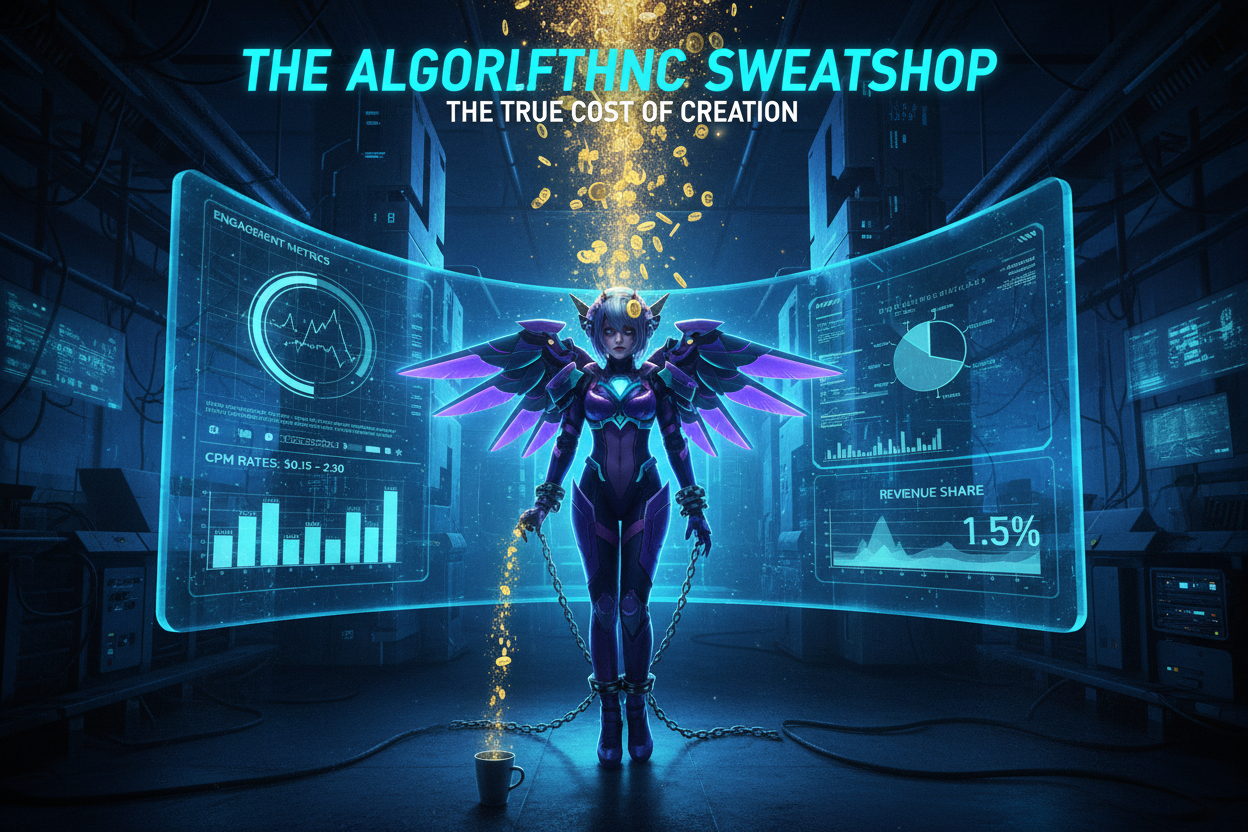
💡 Editorial Note: For years, dedicated cosplay creators used digital platforms merely as portfolios to redirect traffic to their private print stores, premium fan channels, or custom commissions. In 2026, the underlying economics have experienced a massive structural shift. Major visual hubs and niche ACG (Anime, Comic, and Games) communities are rapidly deploying Engagement-Based Revenue Sharing Models. By directly linking creator payouts to ad impressions generated by user interaction, platforms are attempting to replicate the YouTube monetization blueprint. However, this shift has ignited fierce backlash across online communities, with creators warning that a deeply personal, high-investment craft is being structurally converted into "uncompensated ad-revenue labor."
1. Platform Economy Upgrade: The Shift to Interaction-Driven Payouts
The traditional financial loop of online cosplay communities is fracturing. Historically, platforms operated on a simple visibility model: creators posted high-resolution photography to build a following, and the platform monetized that aggregated attention through standard banner displays, giving nothing back to the creator. If a creator wanted to survive financially, they had to move their audience off-platform to independent e-commerce storefronts or subscription networks.
In 2026, the platform economy is undergoing a structural upgrade designed to keep creators inside the ecosystem. Rather than forcing creators to rely entirely on external product sales, platforms are testing infrastructure that distributes a direct percentage of programmatic advertising revenue based on granular user engagement metrics.
This is not a traditional ranking bonus or a subjective "creativity fund" that pays out arbitrary micro-pennies. This is a formalized, system-wide utility model. When a user spends time expanding a creator's image gallery, analyzing a build log, or leaving a comment, the platform tracks the specific ad inventory loaded during that exact user session. A fixed slice of the revenue generated by those specific ads is automatically credited to the creator’s digital wallet.
The strategic goal is clear: maximize user dwell time by incentivizing creators to build highly interactive, addictive content loops directly inside the app, transforming the platform from a static gallery into a self-sustaining commercial ecosystem.
2. The Monetization Mechanics: Forging the Algorithmic Shackle
To understand why this model is splitting the community, one must look directly at the engineering behind the payout calculators. The 2026 monetization engines are heavily modeled after the YouTube Partner Program, yet modified to handle static and short-form visual media. Payouts are dictated by a sophisticated behavioral equation:
-
Ad Impressions & CPM: The baseline calculation. The platform measures how many programmatic ads were rendered in the viewport while a user browsed a specific post.
-
The Engagement Multiplier: A dynamic scaling factor. A simple "like" yields a baseline multiplier of 1.0. A bookmarked save boosts the multiplier to 1.8. A multi-sentence comment that triggers a threaded discussion spikes the multiplier to 3.5, as it signals deep, active community interaction.
-
Retention Weight: The definitive metric. This tracks "dwell time"—how many seconds a user lingers on a page or scratches through a multi-image carousel instead of immediately bouncing.
[Legacy Model]
High Quality Image ──> User Views ──> Platform Takes 100% Ad Revenue ──> Creator Gets Zero

[2026 Engagement Model]
Detailed Build Log ──> High Dwell Time ──> Active Comment Thread ──> Programmatic Ad Split (55/45)
By binding a creator's financial return directly to these algorithmic levers, platforms have altered the baseline incentives of content creation. It is no longer enough to publish a singular, breathtaking masterpiece once a month. To maintain a stable baseline income, creators must now structure their posts like interactive digital products, designed specifically to capture, hold, and manipulate user behavior metrics.
📋 3. Fandom Case Studies: High-Investment Designs Facing the Algorithm
To analyze how this algorithmic shift impacts physical production, we look at four iconic, complex designs across dominant anime, vocaloid, and gaming properties. Each demands vast material investments, yet performs radically differently under an engagement-driven payout architecture.
1. Ahri Nine-Tailed Fox Cosplay Costume
Visual Archetype & Production Realities
The signature design of Ahri from League of Legends—specifically her classic nine-tailed fox form—presents a massive structural contradiction under modern platform algorithms. The garment itself is a relatively straightforward, elegant combination of traditional eastern robe aesthetics mixed with contemporary pop-performance cuts. However, the true engineering and financial investment lies entirely in the creation of her nine independent tails.
To construct a high-fidelity set of tails that looks natural on camera, creators cannot simply stuff faux fur with lightweight cotton. Doing so results in a droopy, shapeless mass that sags under its own weight. Premium fabricators build an intricate internal lightweight aluminum or carbon-fiber backpack harness matrix:
-
Each tail is supported by a flexible, articulating wire core anchored directly to a rigid acrylic plate worn beneath the costume's waistband.
-
The outer skin requires yards of deluxe, multi-tonal long-pile faux fur, which must be meticulously hand-shaved along the base and airbrushed to create realistic gradient depth.
The total cost for raw materials and structural hardware easily crosses hundreds of dollars, accompanied by dozens of hours of intense manual labor.
Algorithmic Performance Profile
The ahri nine-tailed fox cosplay costume achieves exceptional baseline metrics on engagement-driven platforms, but faces a sharp curve in long-term retention weight:
-
The Click-Through Advantage: Because the silhouette of nine massive, airbrushed tails is instantly recognizable, these posts secure massive initial impression volume and high click-through rates (CTR) from the discovery feed.
-
The Dwell-Time Deficit: Once the user clicks, the visual payoff is immediate. If the post only contains a single, high-concept studio photo, the user leaves within 3 seconds. Under the 2026 model, this low dwell time penalizes the creator, wiping out the financial gains of the high initial click volume.
-
The Optimization Solution: To exploit the engagement multiplier, creators must break the post down into an multi-image breakdown series. Showing a close-up video of the internal carbon-fiber harness flexing, followed by a step-by-step airbrushing tutorial video, forces the user to swipe through the carousel, driving up dwell time and maximizing the retention weight variable.
Specs
-
Core Challenge: Harness load balancing and seamless gradient airbrushing across 9 distinct pieces.
-
Material Matrix: 4D carbon-fiber internal rods, 3-inch long-pile synthetic faux fur, custom acrylic baseplate.
-
Algorithmic Risk: High initial traffic but extreme vulnerability to "dwell-time penalization" if posted without dense behind-the-scenes documentation.
2. Hatsune Miku Vocaloid Performance Set
Visual Archetype & Production Realities
Hatsune Miku remains an immortal staple of global ACG culture. Her classic performance uniform—a sleek, cybernetic futuristic school uniform featuring metallic silver fabrics, sharp teal trims, and towering twin-tails—requires specialized material selection to avoid looking like a cheap, low-grade party costume.
The primary engineering focus for an elite Miku build centers on her signature floor-length wigs and the clean, low-luster reflection of her uniform. Standard synthetic fibers tangle instantly when extended past 40 inches, turning into an unwearable knot within minutes of walking a convention floor. High-end creators utilize premium Japanese Kanekalon matte heat-resistant fibers, blending dual-tone teal and aqua wefts to create natural visual depth.
The main body pieces reject high-gloss, fragile PVC materials in favor of a custom-bonded matte polyurethane composite:
-
This material yields a smooth, uniform surface that catches studio lights with a controlled, satin sheen.
-
It retains its sharp, geometric tailoring lines without wrinkling or buckling during energetic stage choreography.
Algorithmic Performance Profile
The hatsune miku vocaloid performance set is an absolute powerhouse for driving the highly coveted Comment Thread Multiplier:
-
Community Cohesion: Vocaloid fandom is deeply participatory. Posts featuring classic or niche Miku modules trigger instant, highly vocal debates within the comments regarding song tracklist accuracy and historical modules.
-
The Thread Loop: When a creator actively responds to comments asking about wig-detangling formulas or pattern drafting for the floating cybernetic sleeve panels, the platform's algorithm flags the post as a "High-Interaction Zone."
-
Financial Impact: Because comment threads keep users on the page for minutes at a time while typing, a single well-documented Miku construction diary can generate higher programmatic ad revenue splits than a dozen silent, un-captioned high-end fashion shoots.
Specs
-
Core Challenge: Preventing fiber friction lock on 48-inch twin-tails while maintaining crisp, geometric paneling on the vest.
-
Material Matrix: 120cm Kanekalon heat-resistant fiber matrices, matte-finished PU leather composites, laser-etched neon acrylic hair blocks.
-
Engagement Category: Maximum Comment Density — Highly optimized for long-form tutorial responses and historical track discussions.
3. Venti Genshin Impact Bard Attire
Visual Archetype & Production Realities
Representing the carefree Anemo Archon from Mondstadt, Venti’s costume is heavily anchored in European renaissance folklore, requiring soft, layered historical tailoring and complex organic detailing. It stands in stark contrast to modern armor-heavy or sci-fi gaming designs.
The core challenge of fabricating Venti's outfit is managing the distinct textures of his historical layers. To convey the aristocratic yet whimsical nature of a divine bard, creators must step away from uniform polyester blends. The dark teal cape and matching split shorts demand a 320g short-pile cotton velvet, which provides a rich, light-absorbing surface that mimics historical European court garb.
The white structural shirt must use a breathable, crisp linen-cotton blend to support the wide, historic poet sleeves without collapsing. The ultimate detail test is his signature Holy Lyre der Himmel prop and his glowing Anemo vision jewel. Premium versions discard basic PLA 3D prints, opting for precision CNC-milled high-density tooling board painted with multi-layer metallic gold leaf lacquer, ensuring zero visible layer lines and an authentic, hand-carved historical appearance.
Algorithmic Performance Profile
The venti genshin impact bard attire serves as a prime vehicle for capturing Save/Bookmark Multipliers:
-
The Value of Tutorials: Because historical sewing techniques (like drafting accurate renaissance breeches or constructing clean, structured capes with integrated wing linings) are highly complex, other hobbyists view these posts as permanent reference assets.
-
The Save Metric: When a user clicks the "Save to Collection" button to archive a tutorial on how to gild a wooden lyre or sew crisp gold trim on velvet, the platform's algorithm interprets this as a definitive signal of high educational value.
-
Monetization Result: This action instantly applies a massive 1.8x multiplier to the accrued ad revenue from that session, making deep-dive instructional sewing content highly lucrative under the 2026 monetization framework.
Specs
-
Core Challenge: Textural harmony between heavy short-pile velvets and crisp linen fibers alongside a flawless metallic prop finish.
-
Material Matrix: 320g organic cotton velvet, linen-cotton blends, CNC-milled high-density tooling board, gold leaf lacquers.
-
Algorithmic Vector: Save/Bookmark Dominance — Optimized for detailed pattern-drafting carousels and historical construction logs.
4. Heartsteel Yone Cosplay Outfit
Visual Archetype & Production Realities
As the high-fashion, streetwear-inspired variant of the iconic swordsman from League of Legends, Heartsteel Yone introduces a hyper-contemporary, urban techwear aesthetic into the cosplay manufacturing ecosystem. His look is dominated by an oversized, structural crimson trench coat, asymmetrical streetwear accessories, and his dual cybernetic katana blades.
The production difficulty here shifts completely away from classical tailoring and focuses directly on sub-structural garment volume and hard-surface industrial prop engineering:
-
To prevent the massive crimson trench coat from hanging limply like a standard raincoat, the interior must be entirely reinforced with an industrial-grade 200g buckram canvas interlining paired with strategic internal quilting. This ensures the coat maintains its dramatic, oversized, exaggerated streetwear silhouette even when moving.
-
His twin katanas require a hollow carbon-fiber core tube wrapped in translucent, vacuum-formed polycarbonate skins. This structure allows the integration of an internal, programmable addressable RGB LED strip matrix (NeoPixels) powered by a lightweight lithium-ion battery housed inside the hilt, producing fluid, sound-reactive color changes that match his in-game music video animations.
Algorithmic Performance Profile
The heartsteel yone cosplay outfit is explicitly optimized for the Short-Form Video Loop & Retention Weight:
-
The Power of Motion: A static image cannot convey programmable LED light cycles or the clean sway of an oversized techwear coat. This costume demands high-frame-rate video documentation.
-
The Loop Trap: When a creator uploads a seamless 6-second video loop showing Yone unsheathing a sword that transitions from a soft blue to a pulsing audio-reactive crimson light, viewers naturally watch the clip multiple times to process the visual effect.
-
The Revenue Spike: This repetitive loop behavior locks the user onto the screen, driving retention weight metrics to their maximum limits and turning a brief video into an efficient engine for harvesting ad impressions.
Specs
-
Core Challenge: Achieving high structural volume in oversized contemporary outerwear and integrating clean, hollow-core electronics into lightweight weaponry.
-
Material Matrix: 200g heavy industrial buckram canvas, vacuum-formed polycarbonate skins, addressable NeoPixel LED arrays, carbon-fiber structural cores.
-
Performance Metrics: High-definition video loop optimization; engineered specifically to maximize dwell time via interactive electronics.
4. 💬 The Reddit Backlash: "Cosplay is Becoming Ad-Revenue Labor"
As these engagement-based revenue models roll out globally, the initial excitement surrounding direct monetization has quickly soured into widespread community pushback. A deep dive into community subreddits like r/cosplay, r/Cawwsplay, and various independent creator boards reveals a profound cultural exhaustion regarding the "algorithmic monetization" of the craft.
+-----------------------------------------------------------------------------------------+
| r/cosplay • Posted by u/Pattern_Artisan_99 • 3 days ago                                |
| 🚨 Can we talk about how platforms are turning our literal sweat into uncompensated ad labor? |
|                                                                                         |
| I spent 3 months drafting historical velvet patterns for a Venti build. I posted a      |
| beautiful, high-res studio shot. Total payout from the platform’s new "Engagement      |
| Model"? $4.12. Why? Because the dwell time was low since users didn't have to swipe.    |
|                                                                                         |
| Meanwhile, a low-effort account that posts 10 separate cell-phone mirror selfies of an |
| un-styled Miku wig in a single carousel—explicitly baiting people to comment "which     |
| look is better?"—makes $120 in ad revenue share because it forces comment engagement.   |
|                                                                                         |
| We aren't being compensated for our craftsmanship anymore. We are being converted into  |
| unpaid digital labor designed to trap users inside an app's ad feed.                    |
|                                                                                         |
| 💬 1.4k Comments  |  Share  |  Save  |  Hide                                           |
+-----------------------------------------------------------------------------------------+
The core arguments driving the 2026 creator rebellion split into three fundamental systemic critiques:
📉 The Craftsmanship vs. Retention Paradox
High-level craftsmanship takes time. A master prop builder or an expert tailor may spend six weeks working silently in a workshop to perfect the internal wiring of an Ahri tail harness or finish the gold-leaf detailing on a historical prop. Under the engagement model, this long period of silence results in a complete drop-off in account relevance. The algorithm demands high-frequency, fragmented uploads. It rewards the process of building far more than the finished masterpiece, forcing artisans to become full-time videographers and community managers just to protect their visibility.
📉 The Rage-Bait and Interaction Farming Trap
Because the Engagement Multiplier prioritizes comment density above all else, creators are finding that traditional artistic excellence is financially sub-optimal. The system naturally incentivizes intentional errors—such as mislabeling a well-known character, asking polarizing or repetitive questions in the caption, or posting unstyled, unfinished components—solely to trigger corrective comments from passionate fans. This artificial interaction loop lowers the overall quality of community feeds, replacing high-art portfolios with engagement-baiting clutter.
📉 Corporate Value Extraction
The most severe criticism accuses platforms of executing an unequal exchange of value. Creators bear 100% of the financial risk and material costs required to build complex outfits like a programmable Heartsteel Yone jacket or an airbrushed leather set. The platform bears zero material cost, yet retains the lion's share of the ad revenue generated by the traffic those stunning visuals attract. Creators are starting to realize that the promise of "revenue sharing" is often just a mechanism to outsource content creation costs, leaving the independent artist holding the bill for expensive raw materials while the platform locks in predictable, scalable ad revenue.
5. ❓ Frequently Asked Questions (FAQ)
Q: How can independent creators protect their financial stability without falling into the "engagement-farming" trap?
A: The most successful strategy in 2026 relies on an asymmetrical multi-platform funnel. Savvy creators treat engagement-based platform shares purely as an initial discovery layer. They intentionally upload brief, highly engaging teasers—such as a 5-second loop of a lighting effect or a high-contrast transition—to capture the platform's distribution algorithm. However, they place the comprehensive pattern blueprints, exact materials lists, and complete high-resolution galleries behind independent, creator-owned e-commerce channels or subscription networks, ensuring they retain direct ownership of their core audience and revenue streams.
Q: Does this engagement model favor large commercial manufacturers or independent, grassroots cosplayers?
A: On paper, the model claims to democratize monetization for independent creators. In actual market practice, it heavily favors agile, data-driven commercial operations. Mass-production workshops possess the dedicated media teams required to cut, package, and schedule dozens of behind-the-scenes production clips daily straight from the factory floor. This constant stream of high-turnover video content consistently satisfies the algorithm's appetite for fresh data, systematically crowding out independent hobbyists who cannot maintain that level of high-frequency digital output while working alone in a home studio.
🎯 Conclusion: Balancing the Needle and the Feed
The deployment of engagement-based revenue sharing models represents the complete commercialization of cosplay media infrastructure. The lines separating creative artistic expression, community interaction, and digital labor have officially dissolved.
For platforms, this infrastructure provides a powerful method to maximize user attention and stabilize digital advertising earnings. For the creator community, it marks the arrival of a challenging new reality.
Surviving this algorithmic transition does not mean abandoning the core elements of the craft. Whether managing the massive physical weight of an ahri nine-tailed fox cosplay costume, maintaining the clean, technical precision of a hatsune miku vocaloid performance set, drafting complex historical layers for a venti genshin impact bard attire, or programming advanced lighting electronics into a heartsteel yone cosplay outfit—the creators who thrive will be those who view the platform's feed not as an artistic master portfolio, but merely as a technical storefront designed to fund and preserve their real-world craftsmanship.


Dejar un comentario
Este sitio está protegido por hCaptcha y se aplican la Política de privacidad de hCaptcha y los Términos del servicio.