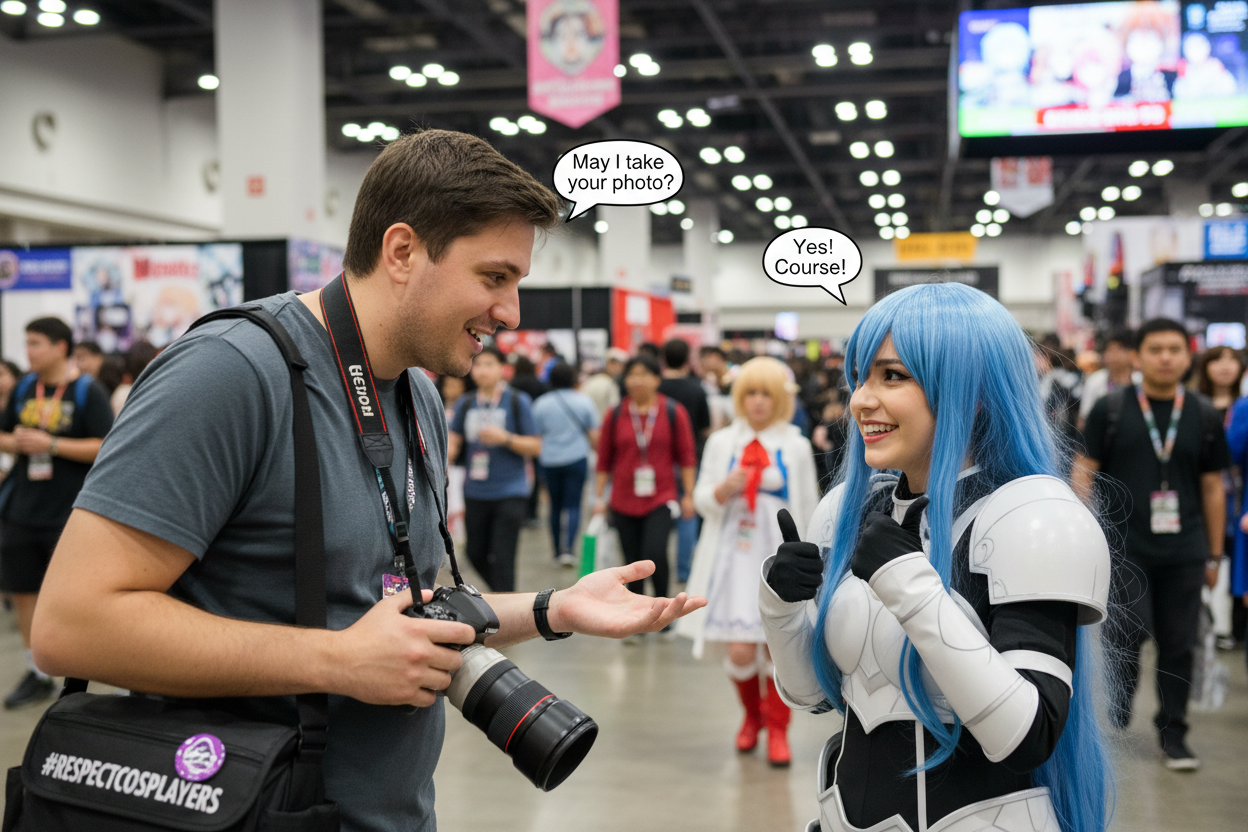
NIKKE's Rapi and Anis have become a recent flashpoint for this issue, but it's worth being upfront about something before going further: this isn't actually a new debate, and it isn't a fair fight between two equally valid opinions.
Targeted, non-consensual photography of a cosplayer's body — low-angle "up-skirt" style shots, zoomed-in crotch or chest shots taken without asking — has been formally recognized as harassment by convention harassment policies for well over a decade. This piece explains why, using the real, documented history behind it.
Cosplayers dressed as characters from high-fanservice properties like NIKKE: Goddess of Victory — whose "battle outfits" are deliberately designed with heavy skin exposure as part of the game's art direction — have been vocal on TikTok and X about a specific, recurring problem: photographers crouching to the ground or angling a camera specifically to capture a low-angle or zoomed shot of a sensitive area, often without asking first.
It's sparked renewed #RespectCosplayers discussion and, according to multiple cosplayer reports, prompted some conventions to revisit their camera and photography enforcement. Here are the three questions people are actually asking when this topic comes up.
Question 1: Is this kind of photography actually against convention rules, or is it just personal etiquette?
Direct answer: At most major conventions, it's an explicit, written policy violation, not just an unspoken etiquette norm — and this rule dates back well over a decade, not just to recent viral incidents.
This is worth stating plainly because a lot of online debate treats this as a matter of personal opinion when it's actually settled, written convention policy in most places.
As far back as 2014, Comiket — one of the largest fan conventions in the world — implemented a specific ban on low-angle "up-skirt" style cosplay photography after the practice became enough of a problem that organizers addressed it directly, alongside guidance reminding attendees to always ask permission before photographing someone. That wasn't a fringe policy; it set a template that a huge number of Western conventions have since followed in their own harassment guidelines.
Modern convention codes of conduct commonly go further than just "ask before photographing" — many, including sample policies used by organizations like the Cosplayer Survivor Support Network and individual convention rulebooks, explicitly prohibit using a camera's zoom function to specifically highlight a cosplayer's body without their consent, separate from the general rule about asking before taking a photo at all. In other words, there's a meaningful, specifically-named distinction in most policies between "may I take a photo of your costume" and "photographing a specific body part in isolation" — and the second one is treated as its own, more serious violation in the actual written rules of most conventions, not an ambiguous gray area.
Question 2: Does wearing a highly revealing costume change what photographers are entitled to do?
Direct answer: No — convention harassment policies do not make an exception for how much skin a costume shows, and the amount of coverage a character's official design has has no bearing on what a real person photographing them is allowed to do.
This is the actual center of the online arguments, and it's worth separating two genuinely different things that get collapsed into one point by the "well, look what she's wearing" argument:
-
The character's official design: NIKKE's characters are, by the game's own art direction and marketing, designed to be sexualized, and that's a legitimate creative and business choice made by the game's developers about a fictional character.
-
A real person's consent to how their actual body is photographed: A real person's consent to how their actual body is photographed while wearing that costume in public doesn't transfer from the character design. A costume being form-fitting or high-coverage-limited doesn't function as advance permission for a stranger to specifically angle a camera at a sensitive area; it's the exact same logic that's been rejected for years in broader conversations about clothing and consent generally, just showing up again in a cosplay-specific context.
Longtime cosplay advocacy writing on this exact topic has made the point directly: a cosplayer choosing to portray a character who's drawn in minimal clothing because they love the character and want to portray them accurately is a completely different thing from consenting to be secretly or specifically photographed in a way they didn't agree to. Most convention policies reflect exactly this distinction — the character's design is not the thing being regulated; the photographer's specific, targeted behavior toward a real person is.
Question 3: What can cosplayers and conventions actually do about this?
There isn't a single fix, but there's a real, growing toolkit that both individual cosplayers and convention organizers have been using, and it's worth knowing about both.
On the Cosplayer Side:
-
Reporting in the moment: Reporting a photographer's behavior to convention staff in the moment rather than only posting about it afterward (since real-time reports are what actually let staff intervene and, in repeat cases, revoke a photographer's badge).
-
Group photo sessions: Traveling with a friend or group specifically during photo sessions with unfamiliar photographers.
-
Firm redirection: Being willing to firmly redirect a photographer who's angling for a shot you didn't agree to — you're allowed to say no to a specific angle or pose without ending the whole photo interaction.
-
Comfort level signals: Some cosplayers have also started using visible signals — buttons, badges, or lanyard tags — indicating their comfort level with photography, which gives photographers a clear, low-friction way to know what's welcome without an awkward conversation every time.
On the Convention Side:
-
Updated camera policies & designated zones: The response to viral incidents like the recent NIKKE photography debate has often included updated or more visibly enforced camera policies, sometimes with designated photo areas that are easier for staff to monitor than open hallway space.
-
Clearer signage & badge revocation: Clearer signage reminding attendees that photography without consent — and specifically targeted or zoomed photography — falls under the convention's harassment policy with real consequences, up to badge revocation.
-
Pairing phrases with actionable policy: It's also worth noting that "Cosplay is Not Consent" signage alone has been criticized by harassment-response organizations as insufficient on its own — the phrase works best paired with a specific, detailed policy (like the zoom and targeted-photography language covered in Question 1) rather than functioning as a stand-alone deterrent.
Summary and Further Reading
The core fact worth taking away here is that this isn't actually a close call under most conventions' own written rules, however loud the "she was asking for it" argument gets in a comment section — targeted, non-consensual photography has been treated as a distinct harassment category since at least Comiket's 2014 policy, and a character's official design has never been the deciding factor in what a real photographer is entitled to do to a real person.
If you're building a highly form-fitting or skin-baring costume — NIKKE-style or otherwise — it's worth planning ahead for how you want to handle photo requests at a convention, not just how the costume itself comes together.
For more on this broader topic, check out our earlier piece on the #CosplayIsNotConsent movement and AI image misuse, and our guide to structural support and secure fit for form-fitting, high-mobility costume builds.

Dejar un comentario
Este sitio está protegido por hCaptcha y se aplican la Política de privacidad de hCaptcha y los Términos del servicio.