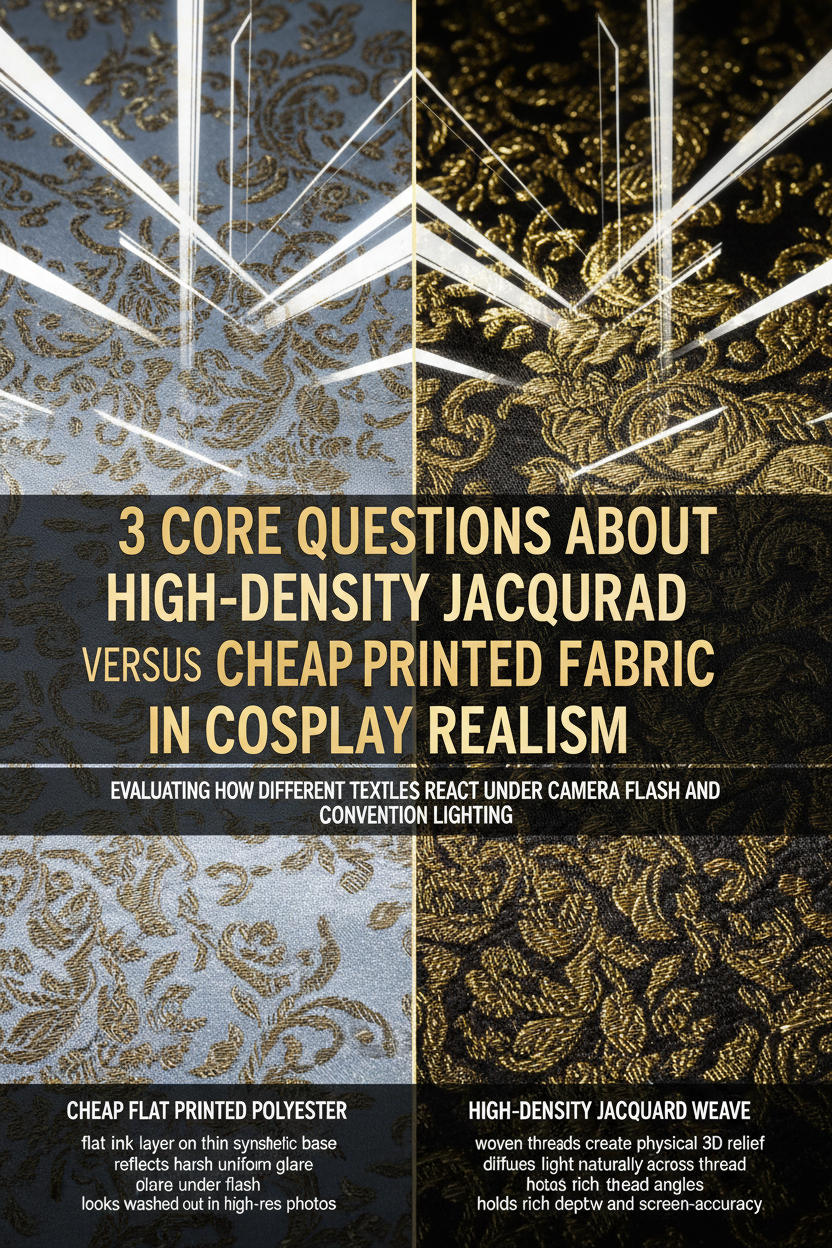
Evaluating how different textiles react under camera flash and convention lighting is crucial for building a screen-accurate character. Choosing the best cosplay costume fabric determines whether an outfit looks like an authentic garment or a flat, cheap costume. Here are the answers to the top three questions cosplayers ask about fabric texture and anime realism.
Table of Contents
-
Question 1: Why does cheap dye-sublimated printed fabric look flat and synthetic in photos?
-
Question 3: Why are high-end jacquard anime costumes worth the extra investment over budget options?
Question 1: Why does cheap dye-sublimated printed fabric look flat and synthetic in photos?
Cheap dye-sublimated printed polyester looks flat in photography because flat ink printing lacks physical surface depth. Under direct camera flash, thin synthetic polyester reflects a harsh uniform glare that erases shadows, making 3D anime patterns appear washed out and plastic-like.
                      [ TEXTURE REALISM ARCHITECTURE ]
                                     │
     ┌───────────────────────────────┴───────────────────────────────┐
     ▼                                                               ▼
Cheap Flat Printed Polyester                         High-Density Jacquard Weave
- Flat ink layer on thin synthetic base               - Woven threads create physical 3D relief
- Reflects harsh uniform glare under flash             - Diffuses light naturally across thread angles
- Looks washed out in high-res photos                 - Holds rich depth, shadow & screen-accuracy
Cheap mass-produced costumes often rely on flat heat-transfer printing over basic polyester to replicate intricate anime patterns. While this method reduces manufacturing costs, it fails in real-world lighting. Because flat printing contains no structural thread variation, the fabric cannot absorb or diffuse light. When hit by DSLR camera flashes or bright convention spotlights, the smooth synthetic surface produces a harsh white reflection known as "costume shine." This bounce-back flattens intricate details, giving gold trims, brocade swirls, and crests a low-quality appearance.
Question 2: How does high-density jacquard compare to flat printed polyester under flash photography?
Comparing jacquard vs polyester cosplay fabrics reveals that high-density jacquard integrates raised patterns directly into the weave. Under flash photography, woven threads diffuse light across varied angles, creating natural micro-shadows that capture realistic depth and rich color tone.
| Fabric Characteristic | Low-Cost Flat Printed Polyester | High-Density Woven Jacquard |
| Pattern Construction | Flat surface ink printing | Intricate thread-woven relief patterns |
| Flash Reflection | High glare, shiny hotspot reflection | Soft, natural light diffusion across weave angles |
| Textile Weight & Drape | Thin (100–120 GSM), prone to static cling | Heavyweight (220–350+ GSM), structured drape |
| Surface Tactility | Smooth, slick synthetic feel | Raised, tactile brocade and embroidery texture |
| Long-Term Durability | Prone to peeling, fading, and seam stress | Fade-resistant thread color with reinforced structure |
While budget polyester uses flat digital prints, high-density jacquard weaves intricate patterns directly into the fabric using metallic, matte, and satin threads. This structural weaving technique allows the garment to handle camera lighting differently. Instead of creating a blinding glare, the raised jacquard threads catch light dynamically, revealing rich texture in hall shots, outdoor portraits, and cinematic photoshoots.
Question 3: Why are high-end jacquard anime costumes worth the extra investment over budget options?
High-end jacquard costumes are worth the investment because their heavyweight construction provides a tailored drape, realistic surface depth, and long-lasting durability. Unlike cheap costumes that wrinkle easily, structured jacquard garments maintain screen-accurate silhouettes throughout long convention days.
Investing in high end anime outfits transforms how a costume feels and performs. Budget costumes bought from mass-market sellers often sag, static-cling to skin, and tear along weak seams after a single wash. In contrast, premium garments crafted from high-density jacquard incorporate heavy thread counts (250+ GSM), reinforced inner linings, and embroidered accents. This heavy tailoring ensures that capes, kimonos, and military coats hang with natural weight, giving cosplayers a screen-accurate silhouette that stands out on stage and in high-resolution photography.
Explore our curated selection of high-end anime cosplay costumes crafted with woven jacquard fabrics, reinforced tailoring, and screen-accurate textures built to last.
Summary & Related Internal Reading
Texture defines the line between a basic costume and a screen-accurate outfit. By choosing high-density jacquard over cheap printed polyester, you gain natural light diffusion, rich tactile depth, and a structured silhouette that stands out in photography.
Related Guides & Craftsmanship Articles:
-
5 Common Cosplay Beginner Mistakes to Avoid: Key advice on fabric selection, breaking in boots, and prop prep.
-
How to Handle a Cosplay Malfunction Gracefully: Quick emergency fixes for torn seams, loose trim, and broken fasteners.
-
Cosplay Photography & Costume Essentials: Garment steamers, fabric tape, anti-static sprays, and repair kits.

Hinterlasse einen Kommentar
Diese Website ist durch hCaptcha geschützt und es gelten die allgemeinen Geschäftsbedingungen und Datenschutzbestimmungen von hCaptcha.