
Introduction / TL;DR
What counts as a contest-ready cosplay costume? It depends on the competition, but three requirements appear repeatedly: the entrant must meet the event's rules for making or modifying the costume, the costume must satisfy any restrictions on previous competition use, and the finished design must be safe and practical to wear.
The rules are not universal. L.A. Comic Con, the Cosplay Central Crown Championships, and Youmacon each use different standards, so a costume that qualifies for one event may not qualify for another.
What Do Cosplay Contest Rules Actually Evaluate?
A cosplay costume can look impressive in photographs and still fail to meet a competition's entry requirements. Contest organizers are not simply asking whether someone can reproduce a character's appearance. They may also want to know who constructed the costume, which components were purchased, how much outside assistance was involved, whether the costume has competed before, and whether the entrant can move safely in it.
These requirements reflect an important distinction between wearing a cosplay costume and entering a craftsmanship competition.
Academic research helps explain why this distinction matters. In Making the Fantastic Real: Exploring Transmedial Aspects of Cosplay Costumes, Therèsa Winge examines how cosplay makers translate fictional designs into physical garments and objects. One of the central challenges is balancing visual accuracy with the practical demands of a real costume worn on a real body.
Similarly, Seregina and Weijo's research, Play at Any Cost: How Cosplayers Produce and Sustain Their Ludic Communal Consumption Experiences, explores cosplay as a time- and resource-intensive creative practice. Their work highlights the emotional, material, temporal, and skill-related investment involved in making and participating in cosplay.
Neither study establishes a universal competition rule. Instead, they provide useful context for understanding why contest organizers may evaluate more than the final appearance of a costume.
Handmade Does Not Always Mean Every Component Must Be Made From Scratch
One of the most common questions among first-time competitors is: Can you buy a costume for a cosplay contest?
There is no universal yes-or-no answer.
Some competitions prohibit store-bought costumes. Others permit commercially purchased basics while requiring the entrant to construct the significant visible elements. A third group may accept purchased components but judge only the work the entrant personally contributed.
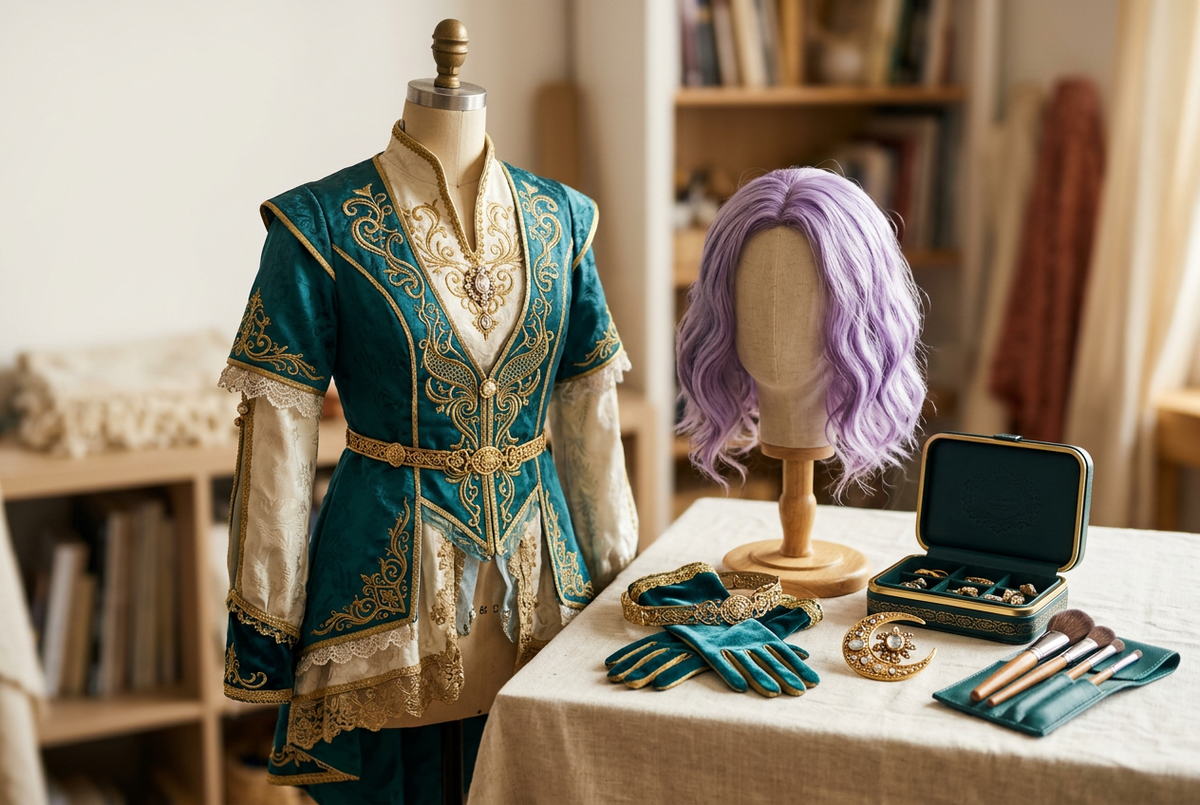
For example, a purchased wig does not necessarily disqualify an entrant. However, the rules may require the contestant to style that wig themselves. The same distinction can apply to shoes, accessories, 3D-printed components, and commercial sewing patterns.
For guidance on determining which elements can be purchased versus those that must be crafted by hand, please refer to our compiled document: "Guidelines on the Boundaries for 'Purchasable Components' in Cosplay Competitions."
The important question is not simply whether an item was purchased. It is whether the purchase and any subsequent work comply with the specific competition's definition of eligible craftsmanship.
Three Real Examples: L.A. Comic Con, Crown Championships, and Youmacon
The following examples demonstrate how different cosplay contest rules can be. They should be treated as event-specific requirements, not as a universal standard for all cosplay competitions.
1. L.A. Comic Con: Store-Bought Costumes Are Not Permitted
The L.A. Comic Con Cosplay National Championship provides a clear example of a competition that places substantial emphasis on personal construction.
Its official 2026 rules state that store-bought costumes are not permitted. Costumes must be made or modified by the entrant. The rules also distinguish between a fully constructed costume and a modified pre-existing item.
Several requirements are particularly important:
-
The entrant must wear their own creation. All entries must be worn by the makers of the costumes. The maker and wearer must be present and registered.
-
Modifications must be substantial. If an existing piece is modified, the rules require at least 50% modification.
-
Outside assistance is limited. Assistance from other people can account for no more than 30% of the construction work, subject to the judges' assessment.
-
Minor purchased items are permitted. The rules recognize that some pre-made or pre-purchased items may be used, with examples and the overall amount of work considered by the judges.
-
Construction evidence may be requested. Judges can ask entrants to verify original construction or demonstrate that an acceptable amount of modification has taken place.
This does not mean every stitch, shoe, or small accessory must be handmade. The rules explicitly recognize limited exceptions, but the main costume must demonstrate the entrant's own construction work.
The competition also encourages entrants to prepare a build book containing reference images and construction information. Although the build book is not mandatory, it can help explain how the costume was developed.
Another important point concerns previous entries. The 2026 rules state that costumes entered in the previous L.A. Comic Con Cosplay National Championships cannot be entered again in the current championship. The organizer also reserves the right to disqualify entries suspected of violating this restriction.
Practical takeaway: If you are preparing for the L.A. Comic Con Cosplay National Championship, keep records of your construction process, identify any purchased components, document modifications, and make sure you personally wear the costume.
2. Cosplay Central Crown Championships: Handmade Construction and Competition History Matter
The Cosplay Central Crown Championships use a different approach. Their 2026 Florida Supercon regional qualifier rules provide detailed requirements for both costume construction and previous competition participation.
First, the rules require entrants to have made their costumes themselves.
All significant visible elements that can safely be made without assistance must be constructed entirely by the entrant. However, certain purchased components are acceptable, including:
-
Wigs
-
Shoes
-
Accessories such as spectacles
-
Simple and largely insignificant base layers, such as leotards or pantyhose
There is an important distinction between purchasing an item and customizing it. For example, buying a wig is permitted, but styling that wig must be the entrant's own work. Similarly, modifying purchased shoes must be completed by the entrant.
The rules also establish a restriction on previous competition use. A costume used for the Championships Qualifier or Final must not have been used in a previous international cosplay or costume contest final. A costume that has previously participated in a ReedPop Championship Qualifier is also ineligible unless it has undergone significant modifications.
This makes competition history an important part of preparation. A costume that is otherwise beautifully constructed may still be ineligible because of where it has previously competed.
How is the costume judged?
The 2026 Florida Supercon qualifier uses two main judging categories:
| Judging category | Weight |
|---|---|
| Accuracy or Design and Ambition | 30% |
| Construction | 70% |
Construction is therefore the dominant component of the score.
Judges consider the quality of construction, the variety and difficulty of techniques, the entrant's mastery of those techniques, appropriate material selection, and whether the costume can withstand being worn and moved in.
The rules also address 3D printing. Automated manufacturing is accepted, but significant pieces produced this way are judged according to the work the entrant personally contributes. A purchased, finished 3D print with no additional work by the entrant is treated as a purchased item and is not eligible for craftsmanship scoring.
If you are using 3D printing to create props, it is recommended that you familiarize yourself with the "scoring criteria and important considerations for 3D-printed components in cosplay competitions" beforehand.
This is a useful distinction for makers who use digital tools: using a 3D printer does not automatically make a component ineligible, but the entrant should be able to explain and document their own contribution.
Practical takeaway: Before entering a Crown Championships qualifier, check the costume's previous competition history, prepare construction and progress photographs, disclose purchased components, and be ready to explain your techniques.
3. Youmacon: Hall Craftsmanship Contest Rules and Wearability
Youmacon provides a different example because its Hall Craftsmanship Contest is not structured like a conventional stage performance.
According to Youmacon's official 2026 cosplay information, the Hall Craftsmanship Contest allows participants to have their costumes judged without the pressure of appearing before an audience. Participants can enter one costume per day, and the Hall Contest is focused on craftsmanship rather than a stage presentation.
One of its practical requirements is especially straightforward:
The costume must be able to pass through a standard three-foot-wide doorway.
This requirement matters for large armor pieces, wings, oversized accessories, and other elaborate costume structures. A design may look spectacular in a photograph, but if its wearer cannot move through the convention environment safely, it may not be suitable for this contest.
Youmacon also sets different handmade requirements for different competition formats:
-
Integrated Cosplay Contest: Costumes must be at least 80% handmade or heavily modified by the contestant.
-
Hall Craftsmanship Contest: Costumes must be at least 50% handmade or heavily modified by the contestant.
-
Youth participants aged 12 and under: Exempt from this percentage requirement.
The same official page lists a $500 Best in Show prize for the Integrated Cosplay Contest. This is a group prize, not an individual payment, and includes free admission to Youmacon 2027 and a trophy.
It is important not to confuse this award with the Hall Craftsmanship Contest. The Hall Contest has its own craftsmanship awards, while the $500 Best in Show award belongs to the Integrated Cosplay Contest.
Practical takeaway: If you are preparing for Youmacon, check which contest you are entering. The handmade percentage depends on the competition format, and the doorway requirement should influence your costume's dimensions from the beginning.
Key Elements of a Contest-Ready Cosplay Costume
Although the three competitions use different rules, their requirements point toward several practical preparation areas.
1. Document Your Construction Process
Do not wait until the competition registration deadline to organize your work.
Keep photographs of:
-
Initial reference images and design sketches
-
Fabric selection and pattern preparation
-
Armor shaping and prop construction
-
Sewing, painting, and finishing stages
-
Modifications to purchased components
-
Final assembly and fitting
A progress record helps demonstrate which parts you made and which parts involved outside assistance or purchased materials.
It also makes it easier to answer judges' questions about construction methods.
If you would like a systematic guide on how to document your crafting process, you can refer to the "Guide to Documenting Cosplay Creation and Preparing a Build Book."
2. Understand What Counts as Handmade
The phrase handmade cosplay contest requirements can be misleading because different organizers define eligible work differently.
For example, one competition may permit purchased shoes and wigs, while another may apply a percentage-based handmade requirement to the entire costume.
Before purchasing materials or starting construction, check:
-
Whether commercial costumes are prohibited
-
Whether purchased base garments are allowed
-
Whether purchased 3D prints can be included
-
Whether commissioned or collaborative work is permitted
-
Whether assistance must be disclosed
-
Whether the rules apply to the entire costume or individual components
Do not assume that a component accepted at one convention will receive the same treatment at another.
3. Design for Movement, Not Just Appearance
A contest-ready costume must function outside a static photograph.
Consider whether you can:
-
Walk through standard doorways
-
Turn without damaging wings or armor
-
Sit down when necessary
-
Use stairs or ramps
-
Move safely through crowded convention spaces
-
Enter and exit the competition stage
Large accessories and rigid armor pieces deserve particular attention. Check whether the costume can be transported, assembled, worn, and removed without creating unnecessary safety risks.
Research on cosplay costume design also highlights this balance between visual accuracy and physical wearability. A costume is not simply an image recreated in fabric and materials; it becomes part of the wearer's physical experience.
Regarding the design of large-scale props and armor with a focus on wearability, we cover this in Key Points for Designing Mobility into Large-Scale Cosplay Props and Armor.
4. Check Competition History Before Reusing a Costume
A costume's previous awards and competition appearances can affect eligibility.
Before submitting an application, identify:
-
Whether the costume has entered an international final
-
Whether it has competed in a previous qualifier
-
Whether it has won a major award
-
Whether substantial modifications are required
-
Whether the event has restrictions on returning costumes
Keep before-and-after photographs if you have made significant changes. They can help explain the difference between an earlier version and the costume you intend to enter.
5. Prepare to Explain Your Craftsmanship
A good costume does not always communicate its construction process by itself.
During judging, explain the decisions behind your work. For example:
-
Why did you select a particular material?
-
How did you create a specific armor shape?
-
What techniques did you use to reproduce a difficult surface?
-
How did you make the costume more comfortable or durable?
-
Which parts were purchased, and what work did you personally complete?
Be specific and honest. Judges may be interested in the construction process as much as the finished appearance.
For additional preparation, explore cosplay prop-building and crafting guides for practical ideas on materials, construction techniques, and project planning.
For additional preparation, explore our cosplay prop-building and crafting guides
Common Misconceptions About Cosplay Contest Rules
Misconception 1: Every Cosplay Contest Requires a 100% Handmade Costume
Not necessarily.
Some competitions require a minimum handmade percentage, while others permit selected purchased components. Even competitions that prohibit store-bought costumes may allow shoes, wigs, or minor accessories.
Always read the event's actual rules.
Misconception 2: A Purchased 3D-Printed Prop Automatically Disqualifies You
Not always.
The Crown Championships' 2026 rules permit automated manufacturing, including 3D printing, but distinguish between a purchased finished object and work personally completed by the entrant.
The source of the digital model, printing process, finishing work, and construction contribution can all matter.
Misconception 3: A Costume That Won Once Can Always Be Entered Again
Competition history can affect eligibility.
The Crown Championships restrict costumes previously used in international finals, while L.A. Comic Con has its own returning-costume restriction. Youmacon also has rules concerning costumes that have won major awards at other events.
These are different policies, not interchangeable standards.
Misconception 4: A Costume Only Needs to Look Good on Stage
Appearance is only one consideration.
The Crown Championships evaluate construction heavily, while Youmacon's Hall Craftsmanship Contest emphasizes craftsmanship without requiring an audience-facing stage performance.
Mobility, structural integrity, and safe movement can also affect eligibility.
Conclusion: Check the Rules Before You Build
A contest-ready cosplay costume is not defined by one universal standard. L.A. Comic Con emphasizes personal construction and limits purchased or modified components. The Crown Championships place substantial weight on construction and restrict certain previous competition appearances. Youmacon uses different handmade percentages for its Hall and Integrated competitions, alongside practical movement requirements.
For cosplayers planning to compete, the best approach is to read the current official rules before purchasing materials or beginning construction. Document the process, disclose outside assistance, understand the restrictions on previously used costumes, and test the finished design for real-world movement.
A costume should not only look impressive when judges see it. It should also meet the rules, demonstrate the maker's work, and remain practical and safe to wear.

Hinterlasse einen Kommentar
Diese Website ist durch hCaptcha geschützt und es gelten die allgemeinen Geschäftsbedingungen und Datenschutzbestimmungen von hCaptcha.